

Beyond Steel Boxes: The Physics of Powder Cure
Powder coating curing requires precise thermal management. Thermoset powders typically require substrate temperatures between 350°F and 400°F (177°C–204°C) for 10–20 minutes of dwell time to achieve complete cross-linking. Undercuring results in poor adhesion, reduced chemical resistance, and premature failure; over-curing leads to color shift, gloss reduction, and brittleness. Leading powder coating oven manufacturers design systems to maintain temperature uniformity within ±5°F across all zones and part geometries—a specification that demands advanced airflow modeling and insulation engineering.
Heat Transfer Mechanisms: Convection vs. Infrared
Two primary heating technologies dominate industrial ovens:
Gas-Fired Convection Ovens: The industry standard for high-throughput lines. Recirculated heated air is forced through plenums and nozzles, ensuring even heat transfer to parts of varying mass. Modern convection ovens use modulating burners with 30:1 turndown ratios to maintain setpoints without thermal overshoot. For heavy-gauge substrates, convection provides superior penetration compared to radiant methods.
Infrared (IR) and Combination Ovens: IR ovens use medium-wave or short-wave emitters to heat surfaces directly, achieving gelation in seconds. They are ideal for thin substrates or for boosting convection lines to accelerate ramp-up. However, complex geometries can suffer from shadowing effects. Hybrid designs—IR booster sections followed by convection hold zones—offer the best of both technologies, reducing overall oven length by 20–30% while maintaining cure uniformity.
Expert powder coating oven manufacturers conduct computational fluid dynamics (CFD) analysis to optimize nozzle placement, air velocity, and return air paths before fabrication, eliminating cold spots that cause inconsistent film properties.
Construction Quality: Insulation, Materials, and Thermal Breaks
Oven construction directly impacts energy consumption and maintenance intervals. Industrial ovens fabricated with 4–6 inches of mineral wool or ceramic fiber insulation achieve external skin temperatures below ambient +15°F, minimizing heat loss and protecting personnel. Key construction details to evaluate include:
Panel interlocking: Cam-lock or tongue-and-groove systems prevent thermal bypass and maintain structural integrity under thermal expansion.
Thermal breaks: Isolated conveyor openings and door seals reduce infiltration of ambient air, which can cause temperature stratification and increase fuel consumption by up to 15%.
Material gauge: 14- to 16-gauge aluminized steel or stainless steel liners resist oxidation at high temperatures; galvanized exteriors with powder coating prevent corrosion in plant environments.
HANNA integrates these construction principles with proprietary panel designs that achieve insulation R-values exceeding R-25, contributing to overall line energy savings of 20–35% compared to legacy installations.
Burner Systems and Combustion Efficiency
Burner selection dictates operating costs and emissions compliance. The most advanced ovens use direct-fired, modulating burners with electronic proportional control. Key metrics to compare among powder coating oven manufacturers include:
Turndown ratio: A 30:1 turndown allows the burner to operate efficiently at both high-fire (during startup or heavy part loads) and low-fire (during idle or light loads), reducing short-cycling and NOx emissions.
Heat exchanger integrity: Indirect-fired ovens separate combustion gases from recirculated air, essential for applications requiring zero contamination. Direct-fired systems are more efficient (95%+ thermal efficiency) but require careful air-to-fuel ratio control to avoid byproducts.
Fresh air makeup: Integrated dampers maintain positive oven pressure while diluting volatile organic compounds (VOCs) that evolve during cure, ensuring compliance with NFPA 86 and local air permits.
Real-time oxygen trim systems, now standard in high-performance units, continuously adjust the air-fuel mixture to maintain peak combustion efficiency despite variations in natural gas composition or ambient conditions.
Energy Recovery and Sustainability Engineering
With natural gas prices and carbon reduction targets pressuring industrial finishers, energy recovery has become a defining feature of modern ovens. Technologies that reduce consumption include:
Exhaust heat recuperation: Plate-type heat exchangers capture waste heat from oven exhaust stacks (typically 300°F–400°F) and preheat incoming fresh air or combustion air, recovering 30–40% of otherwise lost energy.
Zone isolation curtains: Flexible barriers at oven entrances and exits reduce infiltration of cool plant air, maintaining internal temperatures with lower burner input.
Variable frequency drives (VFDs): On recirculation fans, VFDs adjust airflow based on real-time load, cutting fan motor energy use by 20–50% during partial load conditions.
Integrators like HANNA incorporate these technologies into complete line designs, ensuring that the oven’s energy performance aligns with pretreatment, booth, and conveyor operations for maximum overall efficiency.
Controls, Data Logging, and Process Traceability
Modern industrial ovens are no longer standalone units but integrated nodes in Industry 4.0 finishing lines. Sophisticated programmable logic controllers (PLCs) with SCADA interfaces provide:
Thermal profiling: Real-time monitoring via thermocouples placed on parts or on carriers, with historical data storage for batch traceability—a requirement for automotive (IATF 16949) and aerospace specifications.
Predictive maintenance: Algorithms that analyze burner flame signals, fan vibration, and filter pressure drops to alert operators before component failures cause unplanned downtime.
Recipe management: Stored oven profiles for different part types (e.g., heavy castings vs. sheet metal) ensure that temperature ramp rates and dwell times are automatically selected based on production scheduling.
HANNA’s HANNA-ICON™ platform unifies oven controls with pretreatment, application, and conveyor systems, providing a single interface for OEE tracking and full process traceability.
Application-Specific Oven Configurations
Reputable powder coating oven manufacturers understand that oven design must align with part geometry, throughput, and quality standards. Common configurations include:
Batch Ovens: For job shops and low-volume high-mix operations. Walk-in or truck-in designs with horizontal airflow patterns. Modern batch ovens feature programmable temperature profiles and data logging to certify cure schedules for each batch.
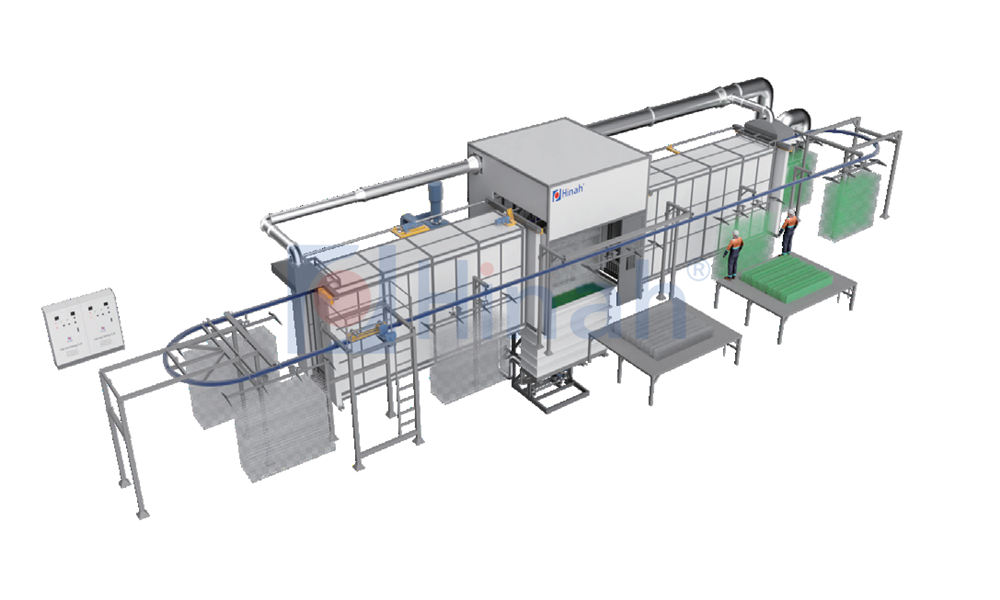
Continuous Monorail Ovens: The workhorse of high-volume lines. Parts travel through a tunnel oven on an overhead conveyor. Zoned temperature control allows separate ramp, soak, and cool-down sections. Lengths range from 40 to over 200 feet depending on throughput and cure time.
Slot or Box Ovens: Used for large, heavy parts that cannot be conveyed continuously. Automated shuttle systems move parts in and out of integrated cure chambers, often paired with robotic loading.
Each configuration demands specific burner sizing, airflow patterns, and insulation strategies to achieve uniform cure across varying load densities.
Common Operational Pain Points and Engineering Solutions
Industrial finishers frequently encounter curing challenges that undermine quality and productivity. Expert oven manufacturers address these with targeted engineering:
Thermal Stratification (Hot/Cold Zones): Caused by inadequate airflow or poor recirculation design. Solution: CFD-optimized nozzle patterns and adjustable baffles that allow rebalancing airflow without mechanical modification. HANNA’s oven designs incorporate field-adjustable air distribution systems that can be tuned during commissioning and after line modifications.
Excessive Ramp-Up Time: Slows throughput and increases energy use. Solution: Infrared boosters at the oven entrance provide rapid heat input to bring parts to cure temperature quickly, followed by convection hold zones to maintain uniformity. This hybrid approach can reduce required oven length by up to 30%.
Contamination from Outgassing: Porosity in castings or heavy weldments releases trapped air during heating, causing surface defects. Solution: Pre-heat zones that allow outgassing before the powder is applied, or stepped ramp profiles that slow heating at critical temperature ranges (200°F–300°F) where outgassing peaks.
Selecting Powder Coating Oven Manufacturers: A Due Diligence Framework
When evaluating powder coating oven manufacturers, industrial buyers should assess capabilities beyond catalog specifications. Critical criteria include:
Thermal modeling expertise: Does the manufacturer perform CFD analysis for each project, or rely on generalized designs? Custom CFD reduces the risk of cold spots and ensures uniform cure even with complex part geometries.
Integration experience: Ovens do not operate in isolation. Manufacturers that also design conveyors, pretreatment, and application systems—like HANNA—deliver harmonized lines with shorter commissioning times and fewer interface issues.
Aftermarket support: Availability of spare parts, remote diagnostics, and field service engineering directly impacts mean time to repair (MTTR). Leading manufacturers offer 24/7 support and maintain critical inventory (burners, motors, thermocouples) for rapid replacement.
Compliance documentation: Full documentation for NFPA 86, OSHA, and local emissions permitting is non-negotiable. Ask for sample manuals and testing reports from previous installations.
HANNA: Integrating Oven Excellence Into Complete Finishing Lines
With over two decades of engineering automated finishing systems, HANNA has developed a reputation for delivering powder coating ovens that set benchmarks for thermal uniformity and energy efficiency. Their approach combines proprietary insulation systems, modulating burner controls with oxygen trim, and fully integrated PLC supervision. In a recent installation for a Midwest agricultural equipment manufacturer, HANNA’s hybrid IR-convection oven reduced natural gas consumption by 28% while achieving ±3°F temperature uniformity across 12-foot-long tractor frames—surpassing the client’s first-pass yield target by 4%. By designing ovens that are integral to the complete line—from pretreatment to final cooling—HANNA ensures that cure parameters are optimized in context, not as an isolated component.
Frequently Asked Questions (FAQ)
Q1: What temperature uniformity should I expect from a high-quality powder coating oven?
A1: Reputable powder coating oven manufacturers guarantee temperature uniformity of ±5°F across all zones when measured under loaded conditions. For critical applications (automotive, aerospace), custom designs can achieve ±3°F uniformity through advanced airflow management and zone segmentation. Uniformity specifications should be verified via nine-point thermal profiling during factory acceptance testing (FAT) and site acceptance testing (SAT).
Q2: How do I determine the required oven length for my production volume?
A2: Oven length is calculated using: Line Speed (ft/min) × Required Cure Time (min) = Oven Length (ft). For example, a line running at 8 ft/min with a 15-minute cure requirement needs 120 feet of heated tunnel. Additional length for entrance/exit vestibules and cool-down sections must be added. Experienced manufacturers provide thermal modeling to optimize length while accounting for part mass and conveyor loading density.
Q3: What are the advantages of indirect-fired ovens versus direct-fired systems?
A3: Direct-fired ovens achieve higher thermal efficiency (95%+) by using combustion gases directly in the recirculated airstream. They are suitable for most powder coating applications where combustion byproducts (CO₂, water vapor) do not affect finish quality. Indirect-fired ovens use a heat exchanger to isolate combustion gases; they are required for applications where zero contamination is critical, such as coating sensitive electronic components or when using certain specialty powders that are moisture-sensitive. The trade-off is slightly lower thermal efficiency (85–90%) and higher initial cost.
Q4: How can I reduce energy consumption in my existing powder coating oven?
A4: Three retrofit measures deliver rapid payback: (1) Installing VFDs on recirculation fans to match airflow to actual load, (2) Adding entrance/exit curtains or vestibules to reduce air infiltration, and (3) Upgrading to modulating burners with oxygen trim to maintain peak combustion efficiency. Energy audits by integrators like HANNA can identify specific opportunities; typical retrofit projects achieve 15–25% gas savings with 12–18 month paybacks.
Q5: What certifications should I require from powder coating oven manufacturers?
A5: At minimum, manufacturers must provide NFPA 86-compliant systems (Standard for Ovens and Furnaces) with full documentation. For automotive or aerospace applications, look for ISO 9001:2015 certification and experience with IATF 16949 or AS9100 quality systems. Additionally, request proof of UL or CSA listing for electrical panels and burner controls. Manufacturers like HANNA provide comprehensive compliance packages that streamline local permitting and insurance inspections.
Selecting among powder coating oven manufacturers requires evaluating not only the hardware but also the engineering depth, integration capabilities, and aftermarket support that determine long-term performance. By partnering with experienced firms like HANNA, industrial finishers secure ovens designed for precision cure, energy efficiency, and seamless integration into complete automated lines—ensuring that the final cross-linking step delivers the durability and appearance that customers demand.