Thermal processing stands as the defining phase in thermosetting powder application. When thermosetting polymers undergo heat exposure, they transition from a dry powder state into a continuous, cross-linked polymer film. Achieving optimal cross-linking density requires precise substrate temperature management within a narrow process window. Partnering with experienced Powder coating oven manufacturers ensures that heating equipment delivers uniform thermal energy across complex geometric parts, preventing film integrity failures and aesthetic variations.
Industrial curing systems must maintain balanced thermal transfer mechanisms regardless of part orientation, mass variations, or conveyor line speed changes. Inadequate thermal profile control causes under-curing, which compromises impact resistance and corrosion protection, or over-curing, which leads to color shifting and brittleness. Evaluating high-performance thermal processing equipment requires a rigorous analysis of airflow design, heat generation systems, structural insulation, and digital control integration.
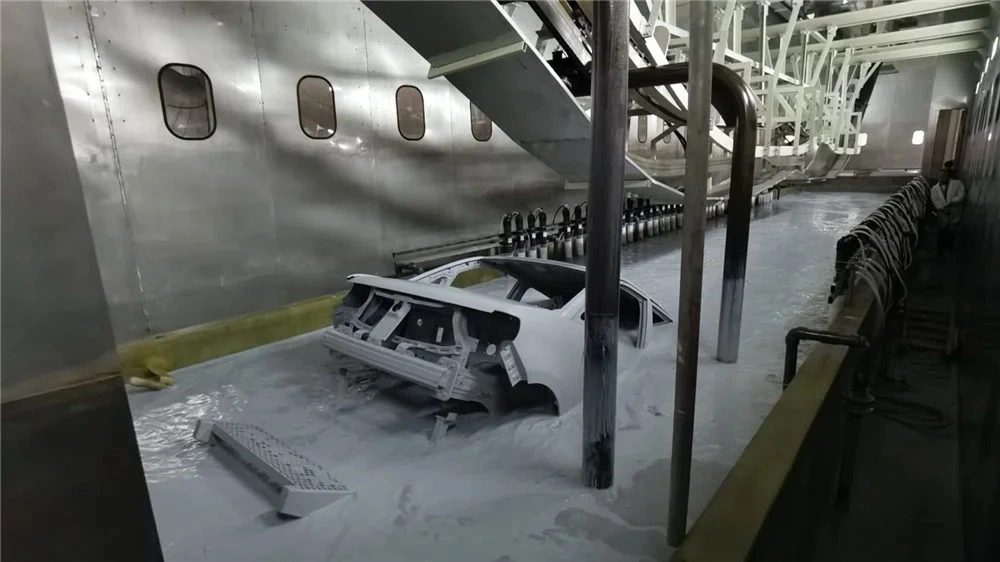
Industrial powder curing relies on three primary modes of heat transfer: convection, radiation (infrared), and hybrid combinations. Convection systems utilize heated air moved through targeted ducting to raise the temperature of the target substrate. Radiation systems employ catalytic or electric infrared elements to directly transfer electromagnetic energy to the coating surface without heating the surrounding mass of air first.
Convective heat transfer is governed by Newton's law of cooling, where the heat transfer rate depends directly on the surface area, temperature differential, and the convective heat transfer coefficient. The heat transfer coefficient is influenced heavily by air velocity across the substrate surface. Precise airflow dynamics prevent thermal boundary layers from insulating the metal surface, which accelerates heat transfer during the initial ramp-up phase.
Infrared heat transfer, governed by the Stefan-Boltzmann law, provides rapid radiant heat transfer directly proportional to the fourth power of absolute temperature. Infrared systems are suitable for flat, low-mass substrates or pre-heating zones. However, line-of-sight limitations make pure infrared systems challenging for complex three-dimensional structures with recessed pockets or shadowed areas. Modern production environments frequently adopt hybrid setups where infrared zones bring the part to gel temperature quickly, followed by convection zones that maintain steady peak metal temperature (PMT) throughout the required soak time.
Temperature variation across the spatial volume of a curing chamber must be minimized to ensure uniform cross-linking. High-grade systems aim for a maximum temperature deviation of less than ±3°C (±5°F) throughout the working envelope. Achieving this uniformity demands sophisticated fluid dynamic engineering within recirculating duct structures.
Air velocity balance must be calibrated accurately. High air speeds enhance convective heat transfer coefficients, but excessive velocity risks blowing uncured powder off parts prior to initial gelation. Advanced continuous systems incorporate quiet, low-velocity air knife zones at the entry and exit vestibules to seal heat within the main chamber without disturbing the un-gelled powder layer on incoming components.
Evaluating commercial offerings from industrial Powder coating oven manufacturers requires close inspection of mechanical construction standards. Long-term operational reliability depends directly on how thermal expansion, wall insulation, and structural framing are handled by equipment designers.
High-efficiency oven enclosures utilize tongue-and-groove or modular panel designs filled with high-density rockwool insulation. Standard panel thicknesses range from 100 mm to 200 mm depending on maximum operating temperatures. A structural feature in advanced equipment is the incorporation of true thermal breaks between the inner hot shell and the outer protective skin. Metal-to-metal contact across structural framing acts as a thermal bridge, causing localized heat loss, higher outer surface temperatures, and energy inefficiencies.
Inner wall panels must account for linear thermal expansion. Steel expands predictably when elevated from room ambient to operating temperatures above 200°C. Rigidly welded inner chambers without expansion joints can buckle, rupture seam welds, or deform structural tracks over repeated thermal cycles. Sliding panel joints and expansion tracks allow internal structures to grow and contract without structural fatigue.
Heat generation hardware dictates thermal responsiveness and fuel economy. Direct-fired natural gas burners offer rapid response times and high thermal conversion, introducing combustion products directly into the recirculating airstream. However, sensitive application scenarios—such as clear coats, specific white formulations, or gas-sensitive powder chemistries—require indirect-fired heat exchangers to prevent combustion byproducts (like nitrous oxides or sulfur compounds) from yellowing or contaminating the surface.
Indirect heat exchangers must be constructed from high-grade stainless steel (such as 304 or 316 grade for standard applications, or 310 grade for high-temperature duties) to withstand cyclic oxidative stress. Tube geometry, passage count, and internal turbulators are designed to maximize thermal extraction while maintaining minimal static head pressure on the burner blower systems.
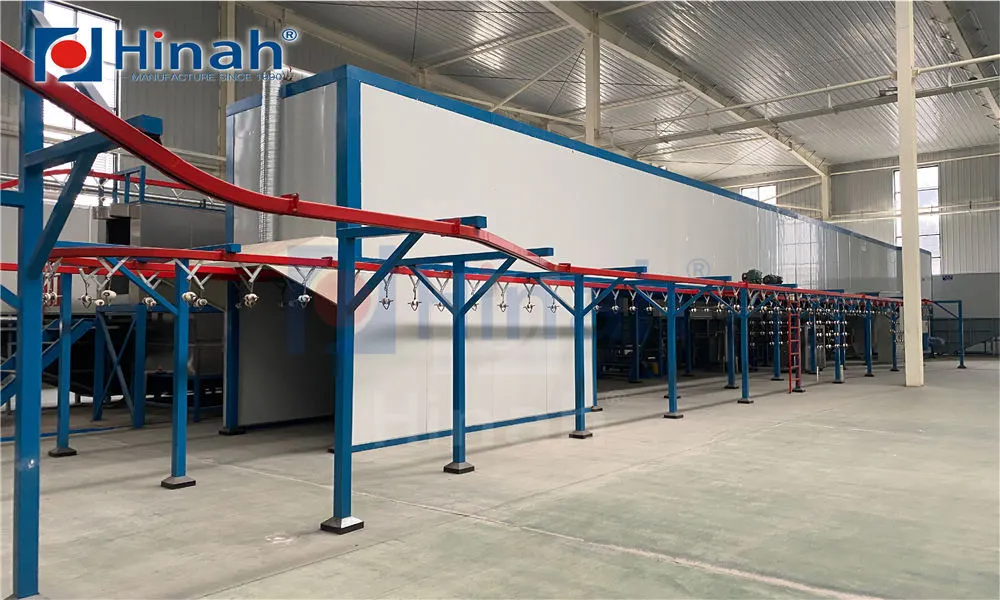
Production lines operate under varied transport methods, including continuous overhead monorails, power-and-free systems, floor conveyors, or manual batch carts. Curing chamber layouts must accommodate these mechanical configurations seamless, ensuring minimal thermal energy escapes through product openings.
For automated high-throughput operations, engineered configurations designed by HANNA integrate specialized air seal curtains and A-frame elevated profiles. Elevated "camel-back" designs utilize the physical law that hot air rises: by raising the main heating zone above the inlet and outlet slots, hot air remains naturally trapped within the upper loop, dramatically reducing thermal migration out of the chamber ends.
When physical space limits prevent camel-back geometry, high-velocity air seals must be mounted at entry and exit apertures. These air knives direct focused streams of heated air across the opening at precise angles, creating a dynamic pressure barrier that retains internal thermal energy while allowing continuous part travel through the line.
Modern thermal processing requires real-time data collection and dynamic control interfaces. Static, single-point thermocouple feedback is insufficient for high-precision manufacturing. System control panels must integrate programmable logic controllers (PLCs) tied to multi-point temperature sensors distributed along the transport path.
Advanced digital controls supplied by custom equipment creators like HANNA incorporate automated eco-mode logic. When sensors detect gaps in part loading along the conveyor belt, the control system automatically throttles down burner input and reduces fan speeds, lowering energy usage until new workload arrives at the entrance portal.
Identifying the root cause of surface coating defects often points back to thermal equipment miscalibration or airflow imbalances. Leading Powder coating oven manufacturers design equipment features specifically to mitigate these common surface issues.
Orange peel occurs when powder particles do not melt and flow smoothly before cross-linking begins. If the thermal ramp-up rate is too slow, the resin viscosity remains high, preventing the fluidization and leveled flow of the coating film. Increasing convective airflow velocity or introducing localized infrared pre-heating zones rapidly drops resin viscosity, allowing full film levelling prior to initiating the chemical cure reaction.
Cast items, hot-dip galvanized steel, and heavy aluminum castings contain trapped air and moisture within micro-porosities. If the top layer of powder gels too fast while the substrate beneath is still expanding gas, trapped air bubbles pop through the semi-solid film, leaving small pinholes or micro-voids. Curing architectures must accommodate step-profile ramping, allowing substrate gases to evacuate before the surface coat forms an impenetrable skin.
Color variation across single parts or between batches typically signals non-uniform heating within the chamber. Hot spots cause localized over-curing, which turns light or pastels yellow, while cold spots leave regions under-cured, resulting in lower gloss levels and reduced chemical resistance. Balancing air distribution through plenum adjustment and auditing heat exchanger integrity prevents localized hot spot formation.
Different industrial sectors demand distinct structural and operational configurations for thermal curing equipment. Matching system design to industry requirements is essential for long-term operational success.
Heavy machinery and structural steel components feature high thermal mass. These components absorb large amounts of heat before reaching curing temperature. Curing equipment designed for heavy structural lines must utilize high-volume recirculation blowers and robust burner capacities to handle high heat absorption loads without driving down ambient chamber temperatures.
Conversely, thin aluminum extrusions and automotive sheet metal parts require rapid, highly controllable heat delivery with minimal turbulent air movement to prevent part swinging or surface contamination. Standardized, high-precision equipment offered by HANNA addresses these challenges through smooth, variable-speed convective airflow configurations combined with precise multi-zone temperature controls.
Evaluating qualified Powder coating oven manufacturers requires a clear understanding of production capacity, line speed, material handling methodology, and substrate temperature requirements. Engaging with experienced application engineers ensures that the selected thermal curing system meets rigorous quality benchmarks while delivering repeatable, continuous performance.
Q1: What is the difference between direct-fired and indirect-fired gas heating in curing ovens?
A1: Direct-fired gas systems mix combustion air directly into the recirculating air chamber, maximizing energy conversion efficiency. Indirect-fired systems pass combustion gases through an internal heat exchanger tube assembly, exhausting combustion byproducts outside while heating clean process air. Indirect systems are selected when processing gas-sensitive powders, clear coats, or white formulations susceptible to yellowing from combustion byproducts.
Q2: How is Peak Metal Temperature (PMT) measured accurately inside an operating curing system?
A2: Peak Metal Temperature is measured using a specialized trailing-wire thermal logger or an insulated data logger (a heat box) that travels through the oven alongside the product. Thermocouples are attached directly to various sections of the metal substrate—including high-mass and low-mass areas—to record exact temperature curves over time, ensuring the metal reaches the powder manufacturer's target cure parameters.
Q3: Why is airflow balance critical near the entrance and exit of a continuous curing oven?
A3: Unbalanced airflow near openings creates thermal loss into the surrounding plant room, wasting energy and causing temperature drops near the oven ends. Additionally, excessive air velocity at the entry zone can disturb uncured, electrostatically applied powder from the substrate before it melts, resulting in uneven coating coverage, bare spots, or powder dust contamination inside the plant.
Q4: How does panel insulation thickness impact long-term equipment operation?
A4: Panel insulation thickness and density directly control external shell temperatures and conductive heat loss. High-density rockwool insulation (typically 100 mm to 200 mm thick) maintains low outer casing temperatures, protects factory personnel from hot surfaces, reduces internal heat loss, and maintains stable internal processing temperatures regardless of ambient factory temperature swings.
Q5: Can electric infrared heating replace convection heating entirely for powder curing applications?
A5: Electric infrared heating can replace convection heating for flat, simple, or uniform parts where line-of-sight exposure is continuous across all surfaces. However, for complex 3D metal fabrications with deep channels, shadowed regions, or varied wall thicknesses, convection heating—or a combination of infrared pre-heating followed by convection soaking—is necessary to ensure uniform heat distribution across all part surfaces.
To receive custom engineering support, detailed system specifications, or a comprehensive proposal tailored to your specific finishing requirements, submit an official project inquiry to our technical team today.