


Advanced Paint Curing Oven Technology: Thermal Dynamics and System Sizing
In modern industrial finishing, the transition of an applied liquid or powder coating into an impenetrable, cross-linked protective barrier is entirely dictated by thermal kinetics. While application equipment determines film thickness and uniformity, the actual structural integrity, chemical resistance, and aesthetic performance of the finish develop within the controlled thermal boundary of an industrial paint curing oven. Achieving repeatable finishing standards across diverse substrate geometries requires an exhaustive understanding of thermodynamics, mechanical air delivery, burner efficiency, and polymer chemistry.
Surface finishing engineers continually balance energy input against line speed and cured film properties. Variations in metal mass, line density, and thermal conductivity demand sophisticated thermal engineering. This guide examines the fundamental mechanics, structural design considerations, and performance variables that define industrial curing operations, providing a detailed reference for plant managers and finishing system engineers.
Thermodynamic Principles: Polymerization versus Evaporation
Industrial coatings fall broadly into two operational categories: solvent- or water-borne liquid formulations and dry thermoset powders. The thermal processing requirements for these two categories differ substantially in their chemical objectives, yet both rely on precise temperature regulation.
Liquid coatings undergo a dual-stage cure cycle. The initial stage demands controlled heat input to volatilize carrier solvents or water without causing surface skinning. If the outer layer of the film vitrifies before the underlying volatile organic compounds escape, the coating develops micro-voids, pinholes, or severe solvent popping. Once the volatile elements clear the film, elevated temperatures initiate cross-linking among resin polymers—typically epoxies, polyurethanes, or polyesters. Here, heat acts as an activation catalyst for hydroxyl, carboxyl, or isocyanate groups to form rigid, three-dimensional molecular lattices.
Powder coatings dispense with the evaporation phase, shifting immediately through three distinct physical-chemical states: melt, flow, and cross-linking. As the temperature of the substrate climbs toward the glass transition temperature (Tg) of the polymer, electrostatic particles liquefy and coalesce into a continuous film. The duration the coating remains in this low-viscosity liquid state determines substrate wetting, mechanical adhesion, and orange-peel mitigation. Immediately following the flow window, thermal energy triggers chemical curing agents—such as blocked isocyanates, TGIC, or HAA curing agents—locking the polymer chain into its final mechanical state.
Industrial thermal processing requires a system that delivers energy at rates matched directly to these polymer dynamics. Insufficient heat yields an under-cured matrix with poor chemical resistance, low impact tolerance, and reduced corrosion protection. Conversely, excess thermal exposure induces thermal degradation, resulting in polymer chain scission, discoloration, loss of gloss, and brittle surface films.
Heat Transfer Modes and Airflow Dynamics
The efficiency of any paint curing oven depends on the predominant mode of thermal transfer utilized within the process envelope. Industrial thermal systems employ three primary mechanisms: convection, radiant infrared, or an engineered hybrid combination of both.
Convection Curing Mechanics
Convection remains the standard method for curing complex three-dimensional components with diverse wall thicknesses, deep recesses, and varying structural orientations. Heated air acts as the transport medium, transferring energy across the thermal boundary layer that naturally blankets cold workpieces.
- Air Turnover Rates: Effective convective heat transfer demands rapid air turnover, typically between 30 and 50 air changes per minute within the active heating zone, ensuring thermal uniformity.
- Nozzle Velocity: Discharge air velocities must be calculated precisely. Velocities between 1,000 and 2,500 feet per minute strip away the stagnant insulating air boundary layer from the component, speeding up the thermal ramp rate.
- Recirculation Balance: Industrial air distribution employs either bottom-up, top-down, or fully adjustable lateral slot nozzles. Equalizing static pressure across the entire duct network prevents temperature stratification from floor to ceiling.
Infrared Radiation (IR) Dynamics
Infrared systems bypass the air medium entirely, transferring energy through electromagnetic radiation directly to the component. IR emitters generate wavelengths classified as short-wave, medium-wave, or long-wave, each interacting differently with the coating chemistry and base substrate.
- Short-Wave IR: Characterized by high penetration depth and immediate response times, short-wave systems excel at heating the underlying substrate, facilitating inside-out curing that minimizes surface blistering.
- Medium-Wave IR: Matches the molecular absorption spectrum of organic coating resins and liquid water carriers, providing rapid surface gelation and high energy conversion rates.
- Line-of-Sight Limitations: Radiation travels in straight trajectories. Complex parts with shadowed areas, blind pockets, or dramatic profile shifts cannot achieve uniform cures via IR alone, often resulting in localized under-cured zones.
Engineered Combination Systems
Modern automated finishing lines combine high-intensity catalytic or electric infrared booster sections with high-velocity convection tunnels. The booster zone raises the incoming component to the necessary target temperature within two to three minutes. The component then enters the convection zone, which maintains uniform peak metal temperature over the required cross-linking window. System designs configured by engineering groups such as HANNA deploy this hybrid arrangement to reduce total oven footprint by up to 40% while lowering overall fuel consumption.
Thermal Profiling and Peak Metal Temperature (PMT) Control
The universal metric for validating an industrial coating process is not air temperature; it is Peak Metal Temperature (PMT) maintained over an unbroken duration, commonly termed dwell time. Technical data sheets specify operational curing windows as a curve (e.g., 10 minutes at 180°C or 15 minutes at 160°C). Air temperature gauges provide zero insight into whether the thickest section of a cast structural part has reached chemical reactivity.
Data loggers equipped with trailing thermocouple sensors (such as Datapaq systems) measure temperatures at multiple points on the component as it travels through the heated tunnel. Sensors must be secured to the thinnest structural wall, the heaviest structural mass, and internal shadowed sections.
Thermal profiling maps the system performance through three distinct technical phases:
- Temperature Ramp Rate: The rate of temperature increase per unit of time (typically expressed in °C/second). Excessive ramp rates promote boil-out defects in high-solids liquid paints. Slow ramp rates lengthen cycle times and cause powder coatings to set before adequate flow occurs, ruining surface leveling.
- Temperature Uniformity Survey (TUS): Validates that all sectors within the active curing envelope maintain spatial consistency, generally within ±3°C to ±5°C of the process setpoint.
- Cure Window Calculation: The mathematical integration of the area beneath the time-temperature curve. Sophisticated analysis software calculates a Cure Index value, establishing whether full cross-linking was achieved without venturing into thermal over-cure regimes.
Structural Design and Mechanical Architecture of a Paint Curing Oven
The physical structure of a high-performance paint curing oven must balance structural rigidity, thermal retention, and continuous resistance to thermal cycling. Every aspect of the mechanical construction directly influences operational overhead and process reliability.
Wall Panel Construction and Insulation
Industrial curing chambers are fabricated using tongue-and-groove or modular double-wall panel construction. Premium installations utilize internal skins of aluminized or galvanized sheet steel, backed by high-density structural rockwool or ceramic mineral wool insulation ranging from 100mm to 200mm in thickness. Structural design requires the elimination of through-metal connections—structural points where the inner sheet metal directly connects to outer steel supports. Through-metal conductivity causes localized heat leaks, warping outer panels and substantially inflating facility operating costs.
Thermal Expansion Management
A continuous industrial oven measuring 30 to 60 meters in length undergoes physical elongation during daily startup cycles. Expansion joints, sliding saddle floor supports, and articulating internal duct mounts must be engineered into the structural steel framework. Failure to accommodate this thermal expansion leads to panel shearing, degraded insulation pockets, duct misalignment, and seal failures.
Air Seals and Silhouette Openings
Continuous conveyorized systems demand open entrance and exit vestibules. These openings are primary points of heat loss and balance disruption. Modern systems utilize high-velocity air seals—also known as air curtains—positioned at the transition vestibules. These units recirculate air across the opening at angles calculated to resist the natural chimney effect, retaining internal process heat while preventing cooler ambient plant air from infiltrating the hot zone.
The mechanical architecture engineered by industrial manufacturers like HANNA incorporates aerodynamically profiled silhouette openings tailored strictly to the maximum part envelope, minimizing energy egress while optimizing conveyor transit.
Burner Technology, Exhaust Control, and Thermal Efficiency
Thermal generation accounts for the largest ongoing operational expenditure within any coating and finishing enterprise. Sizing and configuring combustion systems requires balancing heat supply with energy conservation protocols.
Combustion Systems: Direct vs. Indirect Firing
Direct-fired burners introduce combustion gases directly into the recirculating air stream. This provides near 100% combustion efficiency and rapid thermal response. Direct firing is well-suited for non-critical industrial coatings and heavy structural powder applications. However, direct-fired systems introduce combustion byproducts—including nitrous oxides, carbon dioxide, and residual moisture—into the curing environment. For Class-A automotive finishes, clear-coats, and sensitive white or pastel powders, these byproducts can cause yellowing, gloss loss, or hazing.
Indirect-fired systems utilize a 304 or 316 stainless-steel heat exchanger. Combustion products pass internally through the exchanger tubes and vent directly outdoors, while clean recirculation air warms by washing over the external tube surfaces. While thermal transfer efficiency drops to 80–85% in basic configurations, indirect heating eliminates atmospheric contamination within the process chamber.
Exhaust Rate Calculation and VOC Management
Industrial curing of solvent-borne coatings is subject to strict safety mandates regarding lower explosive limits (LEL). Design standards dictate that oven atmospheres must never exceed 25% of the LEL during standard running states. Meeting this requirement demands continuous forced exhaust, pulling solvent-laden air out of the enclosure and replacing it with filtered make-up air.
Excessive exhaust rates pull useful heat out of the building, wasting substantial fuel. Inadequate exhaust leads to solvent saturation, preventing further coat evaporation and creating quality variations across batches. Modern operations implement variable-frequency drive (VFD) exhaust fans coupled with solvent concentration sensors to dynamically balance exhaust volumes against real-time operational loading.
Thermal Recovery and Heat Exchangers
Sustainable finishing design mandates heat recovery strategies. High-temperature exhaust streams represent significant recoverable heat. Air-to-air plate heat exchangers or thermal wheel systems capture thermal energy from the exhaust stack to preheat incoming fresh combustion or make-up air, lowering primary fuel consumption by 15% to 30%. In large-scale operations, exhaust output is routed directly through regenerative thermal oxidizers (RTOs), destroying VOCs while returning superheated clean air back to the process heaters.
Common Curing Defects and Process Remediation
Process deviations in thermal curing reveal themselves as visual, mechanical, or chemical defects on the finished part. Systematic diagnosis identifies the underlying thermal variable responsible.
| Observed Coating Defect | Underlying Thermal Mechanism | Engineering Remediation Strategy |
|---|---|---|
| Solvent Popping / Pinholing | Ramp rate too aggressive; outer coating skins over before deep solvents volatilize. | Reduce initial zone heat input; establish a gradual pre-heat dwell profile; adjust flash-off timing. |
| Orange Peel / Poor Leveling | Convective airflow rate too aggressive; powder melts and gels prematurely without flowing. | Lower initial air velocities around entrance; calibrate infrared booster to extend low-viscosity flow phase. |
| Under-cure / Soft Film | Substrate mass prevents component from achieving required Peak Metal Temperature within cycle. | Lengthen dwell time; increase operating setpoint; adjust duct nozzles toward high-mass structural nodes. |
| Color Shifting / Yellowing | Excessive heat exposure or direct exposure to burner combustion byproducts (NOx). | Convert to indirect-fired heat exchanger; balance line speed; eliminate thermal air pockets in chamber. |
| Particulate Contamination | Turbulent, unconditioned airflow stirring up environmental debris or burner soot. | Install high-temperature internal HEPA/ceramic filters; balance supply and return duct static pressures. |
Integration into Automated Industrial Finishing Lines
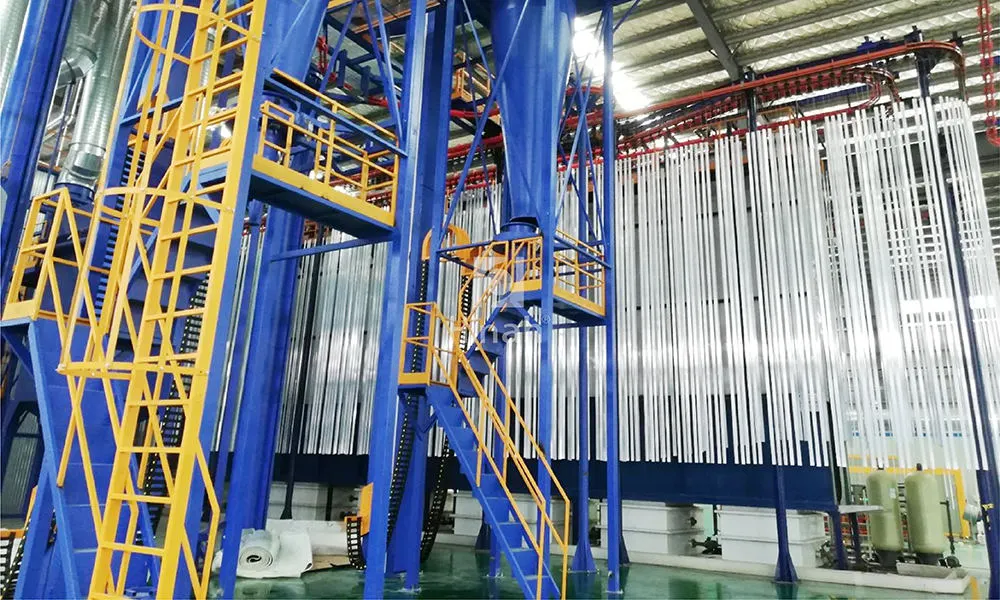
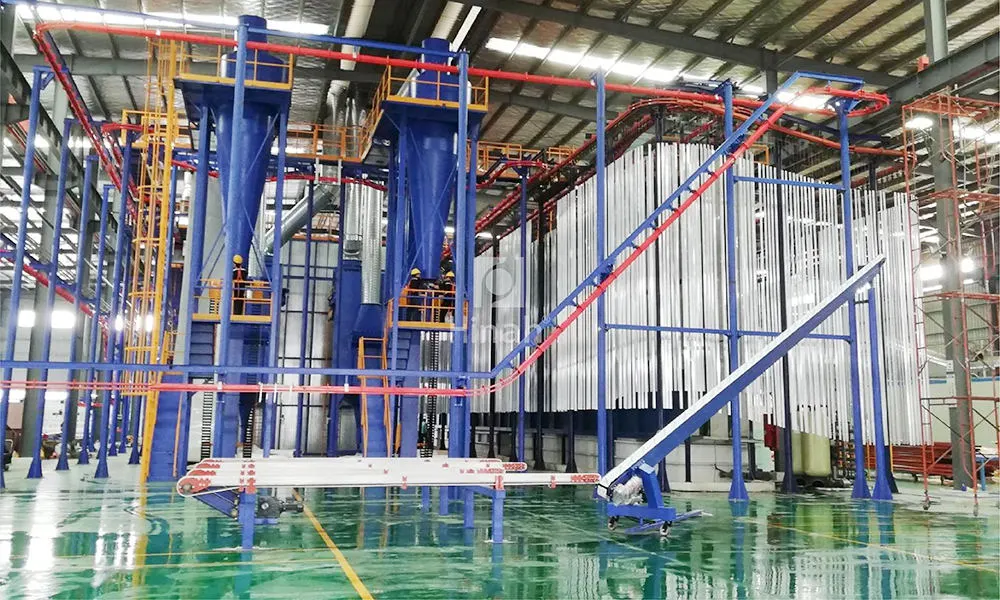
An industrial paint curing oven cannot be specified in isolation; it must integrate with upstream and downstream processing stages. The method of component transit dictates the layout and internal airflow distribution of the thermal envelope.
Continuous monorail overhead conveyors are standard in high-volume, single-geometry operations. The thermal chamber is engineered as a straight-pass or U-turn tunnel. In these systems, internal air loops must be counter-directional to conveyor travel, ensuring maximum thermal exchange before components exit the enclosure.
For operations processing varied part portfolios—where light sheet metal and thick structural castings run down the same line—power-and-free conveyor technology is preferred. Power-and-free systems allow carriers to accumulate, stop, or divert into parallel curing cells. This allows different components to dwell for disparate time intervals, matching the precise PMT curve required by their individual masses without halting overall plant production.
Floor-mounted multi-strand conveyors, skid systems, and automated guided vehicles (AGVs) present unique thermal obstacles. Their heavy structural carts draw thermal energy away from the process environment. Engineers must include the thermal mass of these carriers when sizing burner heat output, air circulation systems, and exhaust requirements.
Industrial Paint Curing Oven: Frequently Asked Questions
What is the difference between an air-dry oven, a baking oven, and a curing oven?
Air-dry systems typically operate at lower temperatures (30°C to 60°C) simply to accelerate the physical evaporation of water or solvents without altering the coating's molecular structure. A baking oven removes volatile carriers and softens materials (up to 120°C). A true curing oven achieves elevated temperatures (140°C to 230°C+) required to cross-link polymer chains chemically, permanently altering the physical and mechanical characteristics of the coating layer.
How does substrate mass influence required dwell time in a paint curing oven?
Substrate thickness directly determines thermal inertia. A 1mm sheet of stamped steel absorbs heat and reaches Peak Metal Temperature in minutes, whereas a 25mm structural steel casting acts as a thermal heat sink, absorbing massive amounts of convective energy before its surface reaches cure temperature. Curing schedules must be timed based strictly on when the heaviest substrate section reaches cross-linking temperature, rather than when the ambient air reaches the setpoint.
Why are indirect-fired heating systems preferred for sensitive color formulations?
Direct-fired burners release combustion byproducts, including moisture, carbon oxides, and nitrogen oxides (NOx), into the recirculating air stream. Certain reactive compounds in powder coatings and high-solids paints—particularly clear-coats, brilliant whites, and light pastels—react with trace NOx gases at elevated temperatures. This atmospheric exposure results in optical yellowing, surface hazing, and unrepeatable gloss levels across production runs.
How often should an industrial paint curing oven undergo thermal profiling?
High-volume automotive and architectural component manufacturers perform profiling once per month or upon any change in substrate geometry, line speed, or chemical formulation. For general industrial applications, thermal profiling should be conducted quarterly. Continuous profiling verifies that duct nozzles have not shifted, burner efficiency remains within operating specifications, and insulation has not settled or degraded.
What steps are necessary to balance airflow within an industrial convection oven?
Airflow balancing involves adjusting individual supply duct damper positions, nozzle angles, and return air slots across the system. Technicians use hot-wire anemometers and digital manometers to measure dynamic and static pressure profiles. The goal is to generate uniform laminar or semi-turbulent airflow sweeps that bathe parts evenly without creating localized high-velocity jets, which can dislodge uncured powder or disrupt wet liquid films.
Custom Thermal Engineering and System Specification
Selecting, sizing, and configuring industrial thermal curing equipment demands a precise alignment of thermodynamic calculations, materials science, and production planning. Off-the-shelf equipment rarely delivers optimized operating economy or the tight thermal tolerances required by contemporary chemical coating formulations. Every variable—from conveyor throughput and part envelope dimensions to fuel source availability and environmental exhaust mandates—must be engineered into the final system architecture.
Industrial manufacturing plants seeking to enhance finishing quality, eliminate production bottlenecks, or reduce fuel consumption benefit from an empirical review of their heating protocols. Consult with the thermal process engineering specialists at HANNA to evaluate your component drawings, substrate parameters, and line speed requirements. Our engineering team develops custom-designed thermal processing systems engineered to maximize transfer efficiency, ensure uniform temperature profiles, and deliver durable finishes. Submit your project requirements to initiate a technical review and request a detailed system proposal tailored to your production demands.
Related News
Learn More + -
7 Essential Tips for Selecting the Perfect Paint Curing Oven for Your Powder Coating Business
As a professional in the powder coating industry, you know that the right equipment can make or break your operations. Among the most critical pieces ...View Details2026-11-06 -
The Ultimate Guide to Paint Curing Ovens: Boost Coating Efficiency & Durability
In the world of industrial finishing, a paint curing oven is not just an accessory—it’s the heart of the process. Whether you’re working with powder c ...View Details2026-11-06 -
How to Choose the Right Paint Curing Oven for Your Finishing Line
Selecting the correct paint curing oven is a critical decision for any coating operation. This piece of equipment does more than just dry paint; it in ...View Details2026-11-06 -
Engineering Precision: Paint Curing Oven Thermal Dynamics & Industrial Coating Performanc
In modern industrial coating operations, the difference between a high-durability finish and a premature coating failure is often determined by a si ...View Details2026-11-06 -
Paint Curing Oven Excellence:Industrial Powder Coating Thermal Systems
In industrial powder coating, the Paint curing oven is the single most critical piece of equipment determining final coating adhesion, corrosion resi ...View Details2026-11-06 -
Advanced Paint Curing Oven Technology: Thermal Dynamics and System Sizing
A comprehensive technical guide to industrial paint curing oven design, thermodynamics, thermal profiling, and system engineering for high-throughput ...View Details2026-11-09