
Achieving a durable, high-spec powder coated finish depends heavily on the thermal cross-linking phase. Applying powder onto a substrate is only half the equation. The transformation from loose powder into an impermeable protective barrier requires precise thermal regulation inside an enclosed chamber.
An industrial curing oven provides the controlled temperature curve needed to melt, flow, and chemically cure thermoset coatings. Without reliable thermal management, finished parts suffer from poor adhesion, orange peel texture, and premature corrosion.
This technical guide examines how commercial curing equipment works, evaluates structural configurations, highlights thermal profile management, and presents maintenance practices for production lines.
Powder coating relies on thermosetting polymers, such as epoxy, polyester, polyurethane, or hybrid chemistries. These powders remain chemically stable at room temperature but undergo irreversible cross-linking under sustained heat.
The curing reaction involves distinct stages as heat penetrates the workpieces:
Melt phase: Powder particles absorb heat, soften, and coalesce into a semi-liquid state.
Flow and leveling: The melted polymer flattens across the metal surface to create a continuous film.
Gel phase: Cross-linking starts, significantly increasing material viscosity.
Final cure: Chemical bonds lock in, providing mechanical hardness, impact resistance, and corrosion protection.
Each formulation has a specific cure window determined by the powder manufacturer. This window represents the minimum time at metal temperature (not air temperature) required for full molecular bonding.
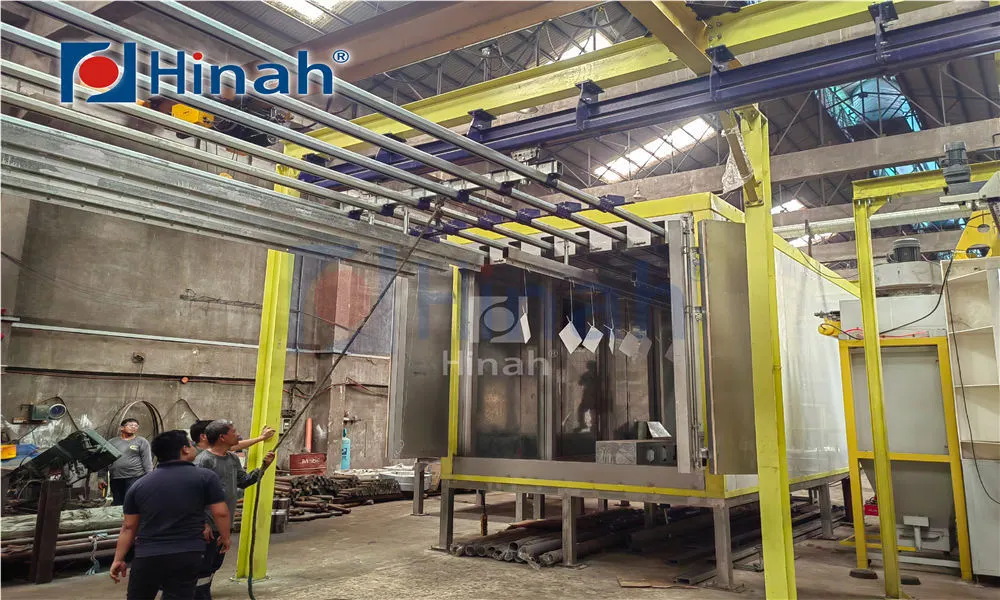
For high-volume manufacturing, equipment builders such as HANNA engineer convection chambers that minimize thermal stratification, ensuring the entire part hits target temperature uniformly.
One common misconception in finishing shops is equating oven ambient air temperature with curing temperature. Thermoset powder does not cure based on the heat of the air; it cures according to the temperature of the underlying metal substrate.
Heavy steel castings absorb heat slowly and lag behind ambient air temperature. Thin-gauge sheet metal heats up rapidly. Operators must track the actual substrate temperature to avoid under-curing thick components or scorching thin assemblies.
Finishing facilities choose their thermal equipment based on part dimensions, production volume, cycle variations, and plant floor layout.
Selecting the right industrial curing oven design directly affects energy consumption, labor requirements, and line throughput.
Batch systems are enclosed walk-in or roll-in chambers designed for intermittent processing. Parts are loaded onto carts, racks, or manual rolling conveyors and wheeled inside before the doors are sealed.
Suited for job shops handling diverse, non-standard part geometries.
Accommodates varying cure cycles and small production runs.
Requires lower initial capital investment compared to automated lines.
Results in thermal loss each time the doors open between cycles.
Continuous systems integrate directly with overhead or floor-mounted conveyor chains. Parts travel continuously through an entrance vestibule, move through heated zones, and exit through a cooling area.
Built for medium to high-volume manufacturing lines.
Equipped with air seals or silhouette openings to prevent heat leakage.
Provides repeatable dwell times and consistent heat exposure.
Reduces manual handling and labor overhead.
Manufacturers like HANNA often design multi-pass continuous systems to fit long dwell cycles into compact plant footprints.
Infrared systems use radiant energy to transmit electromagnetic waves straight to the coated surface. Rather than heating the surrounding air volume first, radiant energy warms the powder and outer metal layer directly.
Short cycle times: Radiant systems rapidly liquefy and set powder within minutes.
Line speed boosts: Booster IR zones placed ahead of convection tunnels shorten overall cycle times.
Line-of-sight limits: Complex, three-dimensional parts with recessed areas risk uneven exposure.
Hybrid configurations: Combining IR boosting with convection soaking ensures fast melting and uniform cures across hidden faces.
Thermal stability requires sound mechanical design. A well-constructed industrial curing oven balances heat transfer, airflow velocity, and containment insulation.
Forced convection systems use circulation blowers and adjustable supply ducting to move heated air across parts. Uniformity throughout the active work envelope should ideally remain within +/- 5°C (+/- 9°F).
Duct nozzles must distribute air evenly from ceiling to floor. Excessive air velocity, however, can dislodge uncured powder from parts, contaminating the oven floor and degrading film quality. Balanced laminar flow keeps the powder undisturbed during the initial melting phase.
Choosing a fuel source depends on utility rates, local regulations, and production demands:
Direct-fired gas: Burner exhaust mixes directly with circulating oven air. It offers high thermal efficiency and fast response, but burner combustion byproducts can occasionally react with sensitive powder chemistries.
Indirect-fired gas: Incorporates a heat exchanger to vent combustion gases outside. This keeps circulating air completely clean, preventing powder blooming, yellowing, or clear-coat contamination.
Electric heating: Uses industrial resistance elements. It provides clean, quiet operation and precise temperature control, though running costs run high in regions with elevated electric tariffs.
Structural thermal efficiency relies on tongue-and-groove insulated panels. High-density rock wool or ceramic fiber blankets (typically 100mm to 200mm thick) prevent heat migration to outer skins.
Advanced engineering incorporates structural thermal breaks. These breaks isolate internal structural steel from the external skin, minimizing conductive heat transfer, lowering outer surface temperatures, and protecting plant workers.
Operating a high-grade finishing line requires regular verification of curing metrics. Guesswork creates inconsistent mechanical properties that lead to field failures.
Relying solely on fixed cabinet sensors can be misleading. Wall-mounted thermocouples reflect air temperatures in one spot, not the thermal profile of moving parts.
Quality assurance programs utilize multi-channel data loggers packed inside thermal barrier boxes. These units ride along the conveyor directly alongside production parts.
Thermocouples are physically attached to thin, medium, and heavy cross-sections of the component.
The datalogger records time-versus-temperature data throughout the entire tunnel.
Software calculates the total cure index (Cure Window Value) to verify complete resin polymerization.
Regular thermal profiling identifies burner drift, failing blowers, and imbalanced duct dampers before defective batches leave the factory floor.
An incorrectly calibrated industrial curing oven produces specific physical defects on the coating film:
Under-cured powder: Results in low impact resistance, poor MEK solvent rub resistance, brittle adhesion, and premature chalking.
Over-cured powder: Triggers yellowing or discoloration (especially in white and light tints), loss of gloss, and polymer embrittlement.
Fish eyes and pinholes: Caused by residual moisture, degassing from porous substrates, or combustion contaminants in direct-fired systems.
Uneven gloss levels: Caused by thermal stratification, where the top of the chamber runs significantly hotter than the floor.
Industrial heating chambers operate under continuous thermal stress, requiring disciplined preventive maintenance to maintain safety, fuel economy, and process repeatability.
Accumulated powder fines, failing safety switches, or neglected exhaust fans can introduce safety hazards or hurt finish quality.
During the curing cycle, powders release small volumes of volatile organic compounds (VOCs), water vapor, and degassing agents. Exhaust blowers must continually vent a calculated percentage of internal air to the outside atmosphere.
Standard safety regulations (such as NFPA 86 standards) dictate specific air exchange rates. This prevents volatile compounds from reaching concentrations that could lead to explosive conditions.
Finishing teams should adhere to a strict inspection schedule to maximize uptime and extend equipment service life:
Daily: Inspect exhaust fan operation, check static pressure gauges, and verify door seals on batch units.
Weekly: Clean floor debris, inspect burner flame characteristics, and wipe sensor probes.
Monthly: Lubricate circulation fan bearings with high-temperature grease, inspect belt tensions, and clean intake filtration panels.
Quarterly: Perform full multi-point temperature profiling across empty and fully loaded production cycles.
Annually: Inspect burner gas trains, test safety shutoff valves, check internal ductwork for loose fasteners, and inspect insulation integrity.
Turnkey powder coating line systems engineered by HANNA feature accessible cleanout ports and modular ducting, simplifying periodic maintenance and helping production plants run reliably year after year.
Investing in a well-built industrial curing oven is essential for any modern finishing operation. Consistent airflow, accurate thermal profiles, and efficient insulation ensure that every cured component meets rigorous mechanical and anti-corrosion standards.
By matching oven specifications to production demands, regularly profiling substrate temperatures, and following scheduled maintenance, coating facilities can reduce fuel usage, avoid finish defects, and run an efficient, dependable finishing line.
Q1: What is the typical curing temperature and dwell time for powder coatings?
A1: Standard powder chemistries generally cure between 180°C and 200°C (356°F to 392°F) for 10 to 20 minutes of metal temperature. Low-cure formulations can react at temperatures as low as 150°C to 160°C (302°F to 320°F), which works well for heat-sensitive materials or thick, energy-intensive components.
Q2: Why are parts under-cured even when the oven thermometer shows the correct temperature?
A2: Built-in oven thermometers measure ambient air temperature, not the actual temperature of the part. If heavy parts enter the oven, they require extra soak time to reach the required curing threshold. The cure timer should only start once the metal substrate reaches the specified target temperature.
Q3: What is the difference between direct-fired and indirect-fired gas ovens?
A3: Direct-fired systems introduce burner combustion products directly into the curing space, maximizing fuel efficiency. Indirect-fired systems direct combustion through a heat exchanger and vent fumes outside. This separation keeps circulating air clean, which helps prevent yellowing on light powders or clear coats.
Q4: How do I test whether powder coating has fully cured?
A4: Common quality checks include the MEK (Methyl Ethyl Ketone) solvent rub test (ASTM D5402), cross-hatch adhesion testing (ASTM D3359), and direct/indirect impact resistance testing (ASTM D2794). If a coating fails cross-hatch testing or softens under solvent rubs, it was likely under-cured.
Q5: How does proper airflow design prevent powder blow-off?
A5: A well-engineered industrial curing oven uses variable-speed circulation fans and wide-mouth adjustable supply ducts. Air moves gently across components at low velocities during the initial melt stage, keeping electrostatically charged powder firmly attached until it fuses into a continuous film.
Q6: How much energy can be saved with high-efficiency insulation panels?
A6: Premium high-density insulation paired with structured thermal breaks can cut continuous heat loss through oven walls by 20% to 35%. This design also keeps exterior skins cool and comfortable, lowering ambient temperatures in the surrounding plant and reducing air-conditioning loads.