
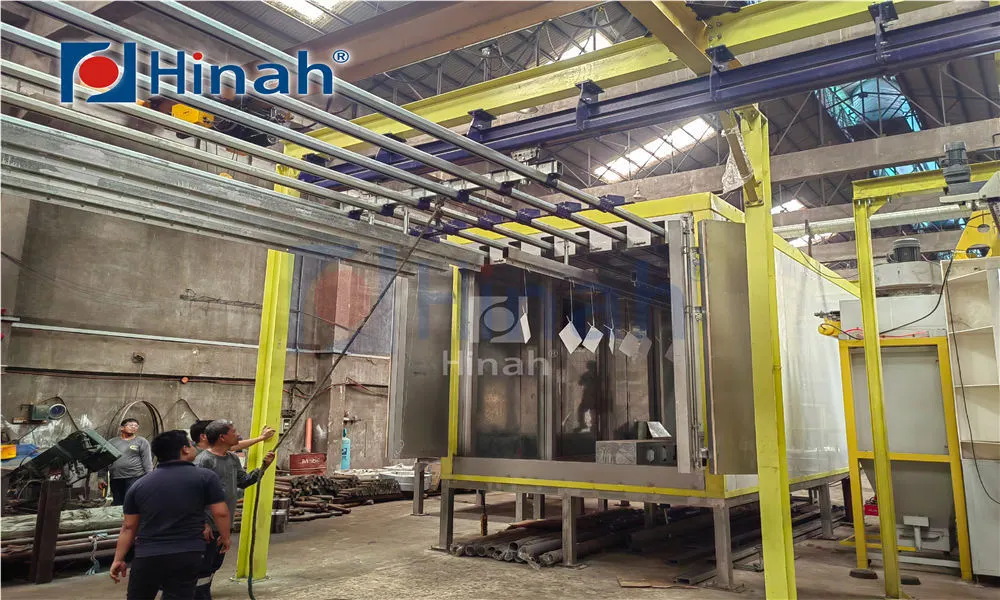
The Ed coating process (electrophoretic deposition or E-coat) remains the benchmark for corrosion-resistant primers in automotive, agricultural equipment, and heavy machinery sectors. Unlike spray-applied primers, this immersion method uses direct current to deposit paint particles onto conductive substrates, covering recesses, edges, and internal cavities with exceptional uniformity. For manufacturers facing salt spray requirements exceeding 500 hours, a properly tuned Ed coating process delivers film thickness consistency that other methods cannot match. This guide examines the electrochemical principles, equipment configurations, troubleshooting protocols, and integration strategies — supported by HANNA‘s field experience across dozens of industrial coating lines.
The Ed coating process relies on charged paint particles migrating toward an oppositely charged electrode. Two primary variants exist: anodic epoxy (workpiece is anode) and cathodic acrylic or epoxy (workpiece is cathode). Cathodic systems dominate high-corrosion-resistance applications because they minimize metal ion dissolution and provide superior adhesion. Key electrochemical parameters include:
Voltage gradient (150–350 V DC): Determines initial throwpower into recessed areas.
Bath conductivity (1500–2500 µS/cm): Affects film build and rupture voltage threshold.
pH control (5.8–6.2 for cathodic): Stabilizes the emulsion and prevents coagulation.
Solids content (15–22% by weight): Directly influences deposited film thickness per second of immersion.
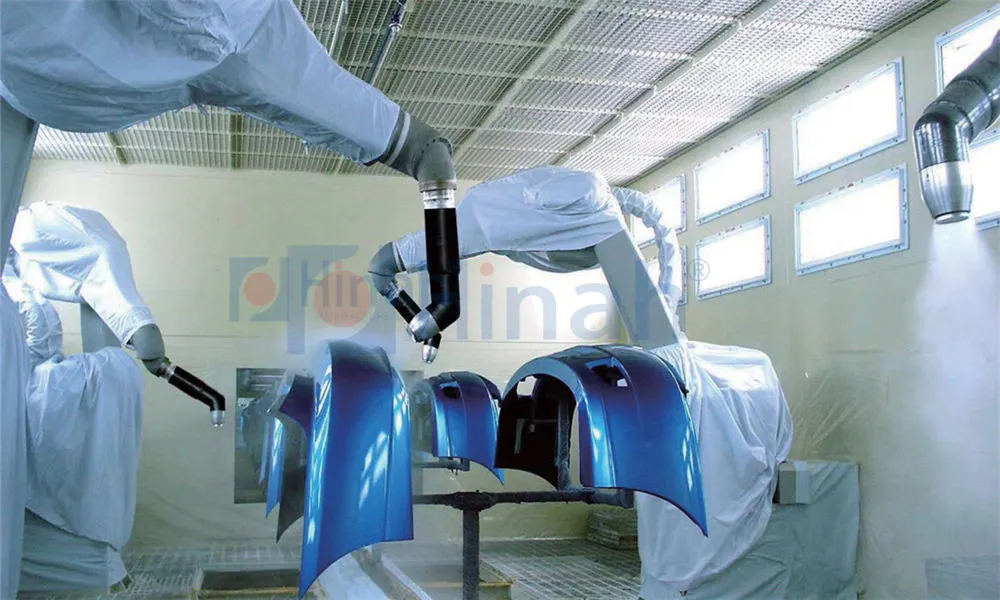
Modern cathodic Ed coating process lines achieve throwpower of 20–30 cm into box sections, eliminating the need for wax injection in many chassis components. Powder coating plant integrators often pair E-coat with a topcoat powder line for maximum durability — a combination that HANNA has implemented for off-highway vehicle manufacturers.
A complete Ed coating process consists of seven tightly controlled stages. Any deviation compromises final coating quality.
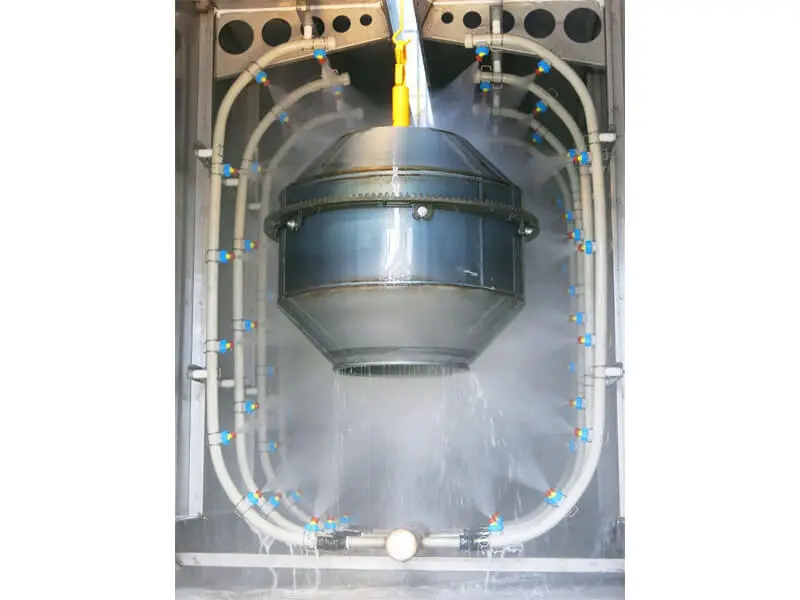
Substrate cleanliness determines adhesion and corrosion resistance. The sequence typically includes alkaline spray cleaning, hot rinse, surface conditioning (titanium-based), and zinc phosphate application (2–4 g/m² crystal weight). For mixed-metal assemblies (steel + aluminum), non-chrome sealers maintain bath stability. Without proper pretreatment, the E-coat film delaminates during humidity testing.
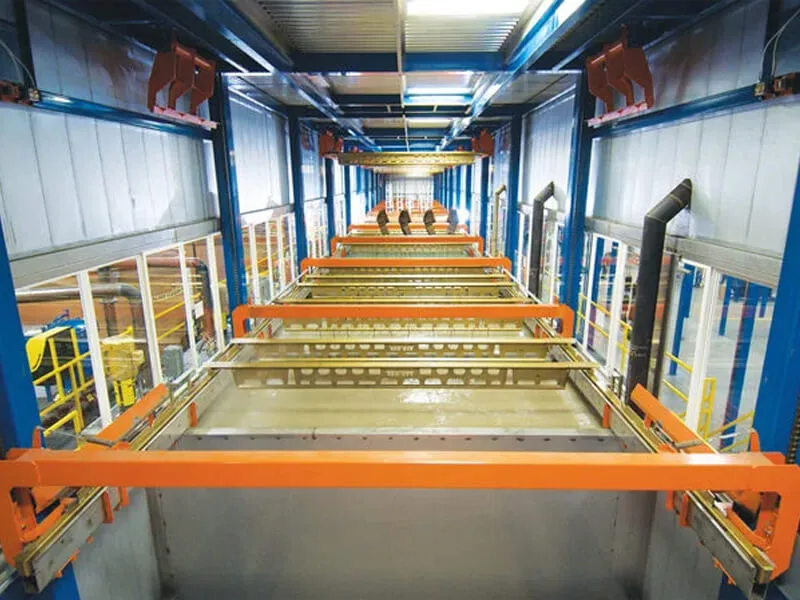
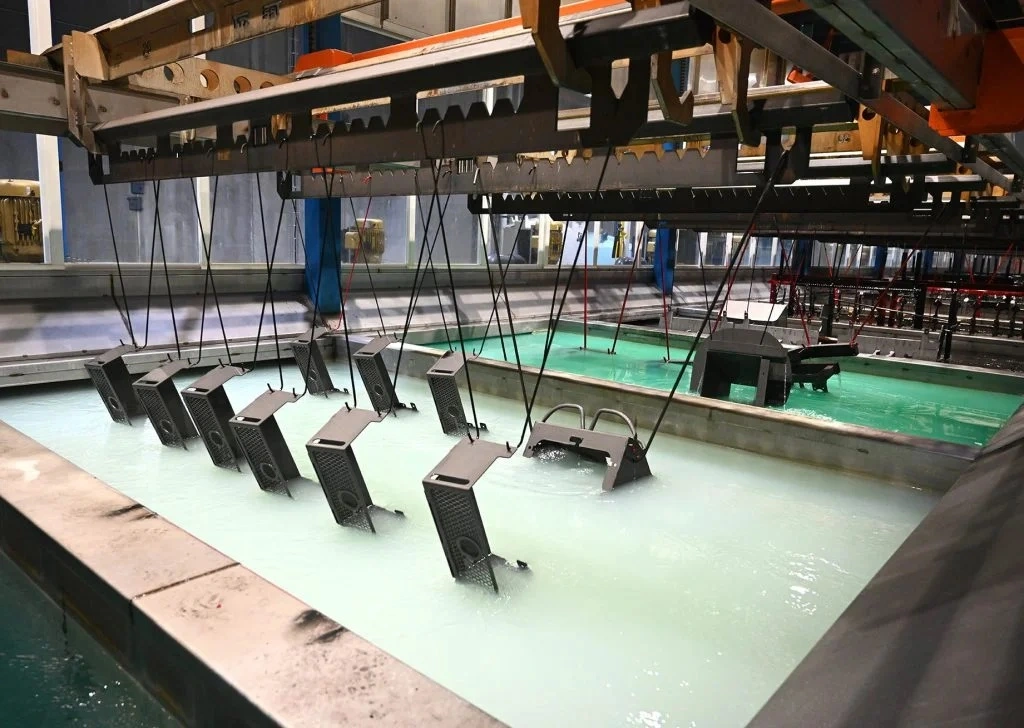
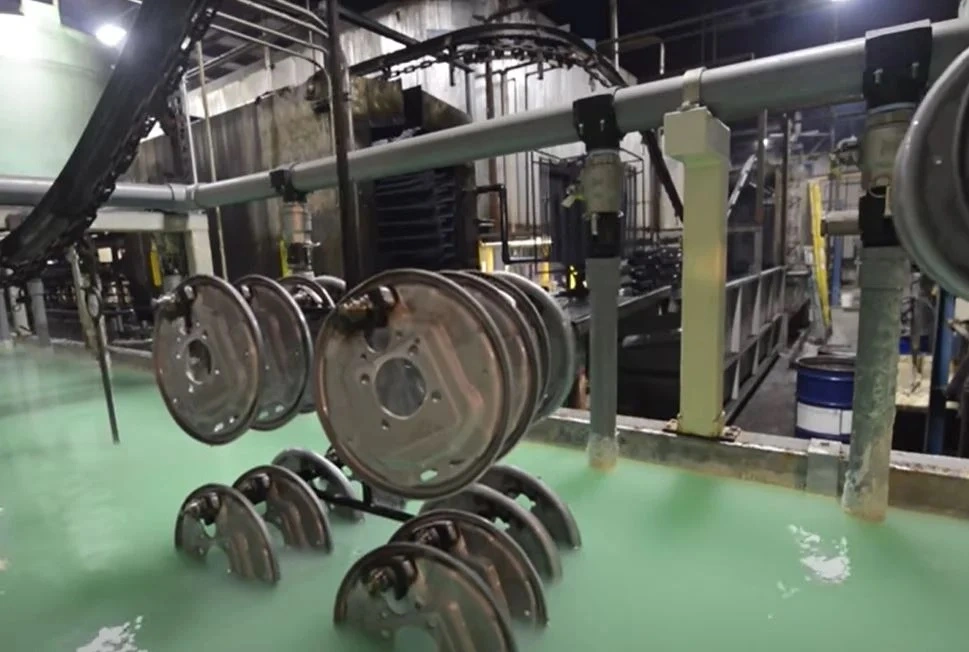
The heart of the Ed coating process is a 30,000–80,000 liter stainless steel tank with integrated heat exchangers, circulation pumps, and ultrafiltration (UF) systems. Parts travel through the tank on an overhead conveyor, typically remaining submerged for 90–150 seconds. Anode cells (316L stainless steel or mixed metal oxide) are arranged at specific distances to maintain uniform current density. Key design parameters:
Anode-to-cathode ratio: 1:1 to 1:2 — higher ratios improve throwpower but risk burning on sharp edges.
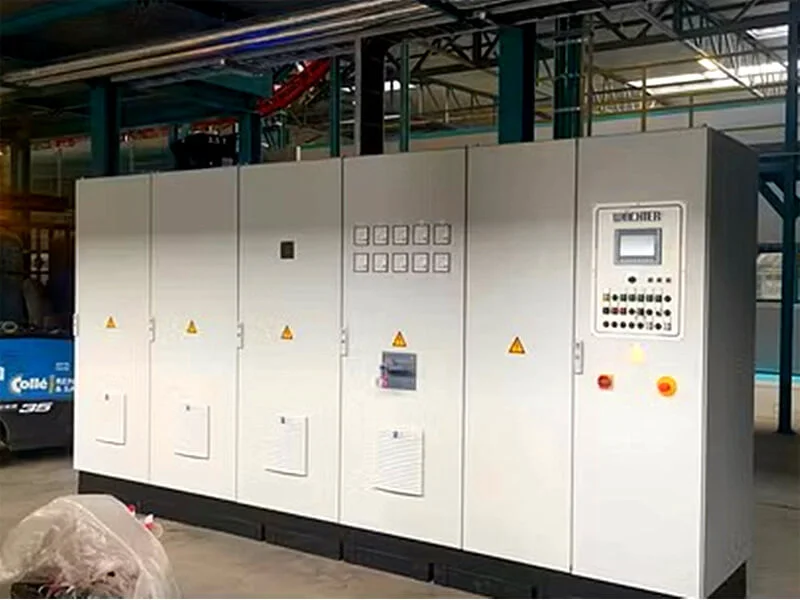
Rectifier capacity: 400–1500 A at 400 V, with ramp-up/ramp-down programming to avoid pinholes.
UF permeate rinsing: Recovers 95% of drag-out paint, reducing waste and chemical costs.
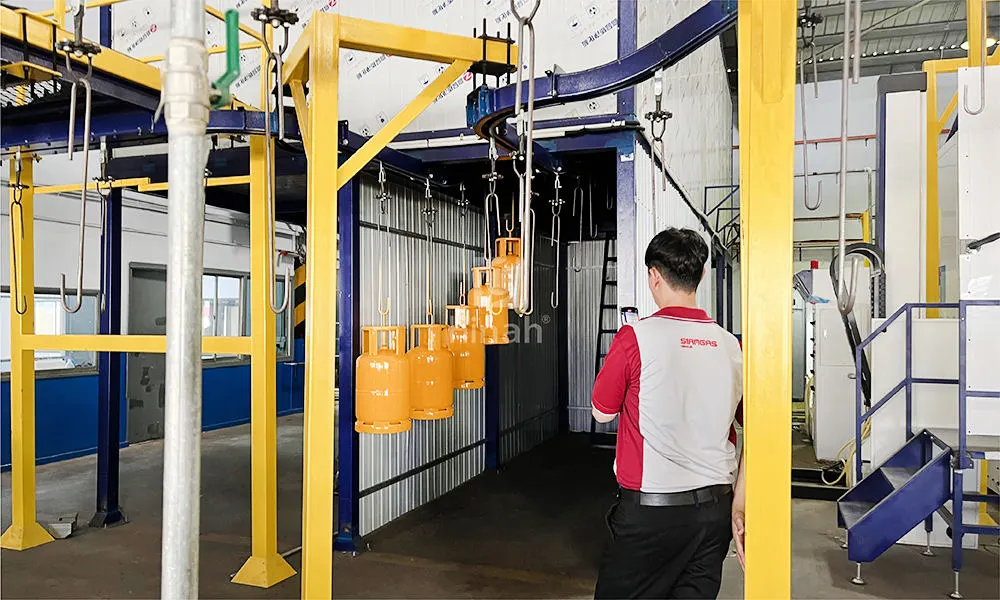
After deposition, parts receive multiple UF permeate and deionized water rinses to remove non-deposited paint. The wet film then enters a powder coating plant style curing oven (typically 175–200°C for 20–30 minutes), cross-linking the epoxy or acrylic resin into a hard, solvent-resistant film.
Despite robust design, Ed coating process lines encounter recurring issues. Below are four common failures and field-proven solutions from HANNA’s project archives.
Pain point: Edge buildup and rough nodules
Occurs when
voltage is too high or anode spacing is irregular. Solution: Implement stepped voltage (200V → 280V → 250V) with 10-second intervals. Install
auxiliary auxiliary cathodes (shadow masks) near sharp edges to locally reduce
current density. Regular anode cleaning (every 2 weeks) removes precipitated
paint that alters conductivity.
Pain point: Low throwpower (uncoated interior box
sections)
Solution: Increase bath conductivity by
adding conductivity salts (e.g., potassium acetate) up to 2200 µS/cm. Verify
rectifier can deliver peak voltage for 5–8 seconds longer. For high-volume
production, HANNA recommends a second dip tank with reversed polarity to coat
internal cavities from the opposite direction.
Pain point: Cratering or pinholes after
curing
Solution: Most pinholes originate from gas
evolution during deposition (water electrolysis). Reduce voltage ramp rate to 20
V/sec and ensure adequate bath agitation (surface velocity 0.3–0.5 m/s). Check
for oil contamination via Fourier-transform infrared (FTIR) analysis — even 50
ppm of silicone oil causes craters. Install a coalescing oil skimmer on the UF
tank.
Pain point: Poor adhesion on galvanized or aluminum
parts
Solution: Switch to a zirconium-based
pretreatment instead of zinc phosphate for mixed-metal lines. Adjust bath
temperature to 28–30°C (standard is 30–32°C) to reduce hydrogen embrittlement on
high-strength steel. Incorporate a post-rinse with chromium-free sealer
containing 0.1% silane coupling agent.
To maintain a stable Ed coating process, operators must track at least the following parameters daily:
Permeate flux (L/m²/h): Declining flux indicates membrane fouling — cleaning with nitric acid every 400 hours restores performance.
P/B ratio (pigment-to-binder): Measured by ash content. Target 0.15–0.25. High pigment leads to chalky film; low pigment reduces corrosion protection.
MEQ (milliequivalents of amine/epoxy): Titration determines bath activity. Drift beyond ±2 from setpoint requires replenishment with virgin paint.
Film thickness profile: Minimum 18 µm on flat surfaces, 12 µm on recesses (automotive standard). Use a calibrated eddy current gauge on 10 parts per shift.
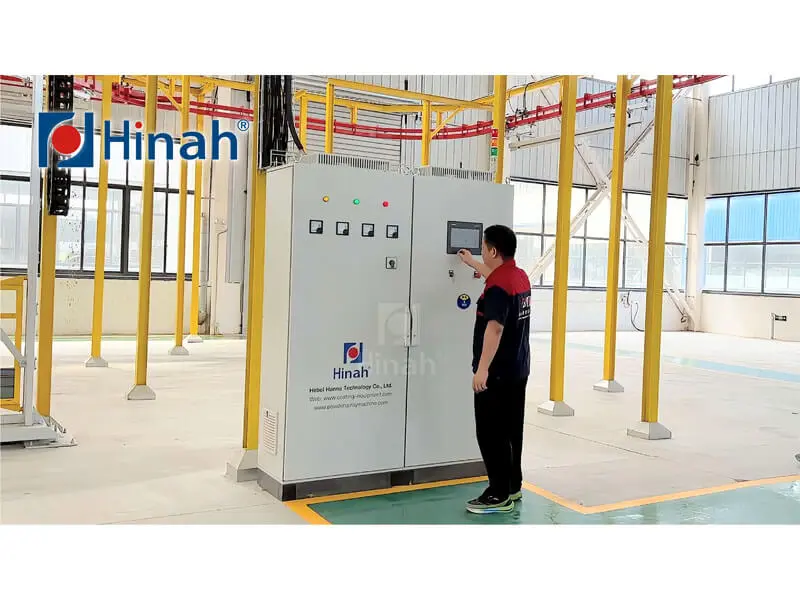
HANNA supplies automated bath analysis systems that sample and adjust conductivity, pH, and solids every 30 minutes — reducing operator errors and scrap rates by up to 40%.
Traditional Ed coating process lines consume significant water and energy. However, modern retrofits can achieve ISO 14001 compliance with manageable investment. High-impact measures include:
Counterflow rinsing: Cascading rinse stages reduce fresh DI water consumption from 15 L/m² to under 4 L/m².
Closed-loop cooling for rectifiers: Replaces water-cooled transistors with air-cooled IGBT modules, saving 120,000 L/year.
Oven exhaust heat recovery: Preheating E-coat bath from 20°C to 28°C using waste heat cuts gas usage by 12–18%.
For facilities integrating an E-coat primer line before a powder coating plant, HANNA designs shared utility systems (boiler, wastewater treatment, compressed air) that lower total capital expenditure by 20%.
Resin chemistry continues to evolve. Next-generation cathodic epoxies achieve full cross-linking at 150°C (down from 180°C), enabling E-coat on temperature-sensitive assemblies with plastic or rubber inserts. Additionally, new conductive polymer additives improve throwpower on complex castings without raising voltage — a breakthrough for transmission housings and engine blocks. HANNA’s testing lab has validated three low-cure formulations that maintain 1,000-hour salt spray resistance while reducing oven energy by 25%.
A1: For most industrial applications, target film thickness is 18–25 microns (0.7–1.0 mil) on exterior surfaces. Internal recesses may see 10–15 microns. Thicker films (30–35 microns) are possible by extending immersion time or increasing solids, but this risks cracking during curing and reduced chip resistance. Automotive OEMs typically specify 20–22 microns ±2 microns.
A2: E-coat provides superior edge coverage and cavity penetration because it is an immersion process. Powder coating (electrostatic spray) cannot coat inside blind holes or faraday cage areas. However, powder offers higher film build in one pass (60–120 microns) and a broader color range. Many high-corrosion applications use E-coat as a primer (20–25 microns) followed by a powder topcoat — this “E-coat + powder” duplex system passes 1,500-hour salt spray tests.
A3: Pinholes visible in the wet film (before oven) usually result from gas bubbles adhering to the surface during deposition. Causes include: (1) excessive voltage causing rapid hydrogen evolution, (2) low bath conductivity leading to localized high current density, (3) bacterial contamination producing gas. Reduce voltage by 20–30 V and increase circulation pump flow. If problem persists, shock-dosed a biocide approved for E-coat baths.
A4: Yes, but modifications are required. Aluminum dissolves in low-pH cathodic baths, so you must reduce bath conductivity and add a non-etch pretreatment (zirconium oxide). Install separate rectifier zones with lower voltage (max 200 V) for aluminum racks. Also, use aluminum-compatible anodes (mixed metal oxide) to avoid galvanic coupling. Powder coating plant integrators like HANNA can perform a feasibility audit and recommend tank zoning or segregated lines.
A5: A mature line with daily bath analysis and preventive maintenance achieves first-pass yield of 97–98.5%. Defects (typically 1.5–3% rejection) include pinholes (0.8%), thickness variation (0.5%), and contamination spots (0.3%). Rejection rates above 5% indicate process instability — HANNA’s diagnostic service identifies root causes within one shift using statistical process control (SPC) software.
Whether you are replacing an outdated anodic system, adding cathodic capability, or building a complete pretreatment-to-cure line, HANNA provides turnkey engineering. Our scope includes bath chemistry formulation, rectifier sizing, anode array design, ultrafiltration specification, and PLC integration with your existing conveyor. We also offer remote monitoring contracts where our chemists review your bath parameters weekly and recommend adjustments.
For a detailed technical proposal, including cycle time analysis, capital cost estimate, and ROI calculation, send your part drawings and desired annual throughput to our industrial finishing team.
Submit your Ed coating process inquiry to HANNA engineering or use the contact form for a prompt response within 24 hours.