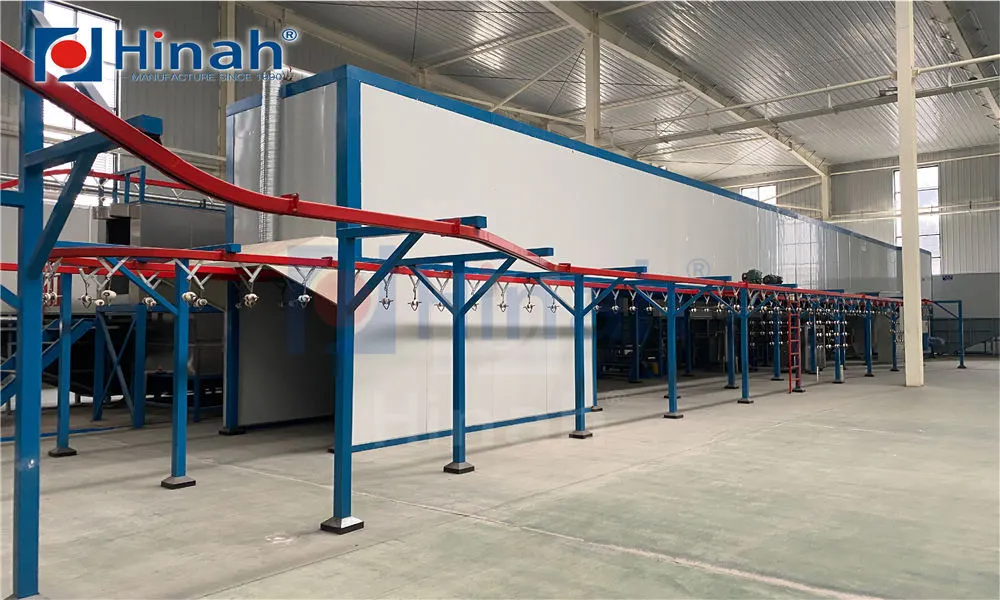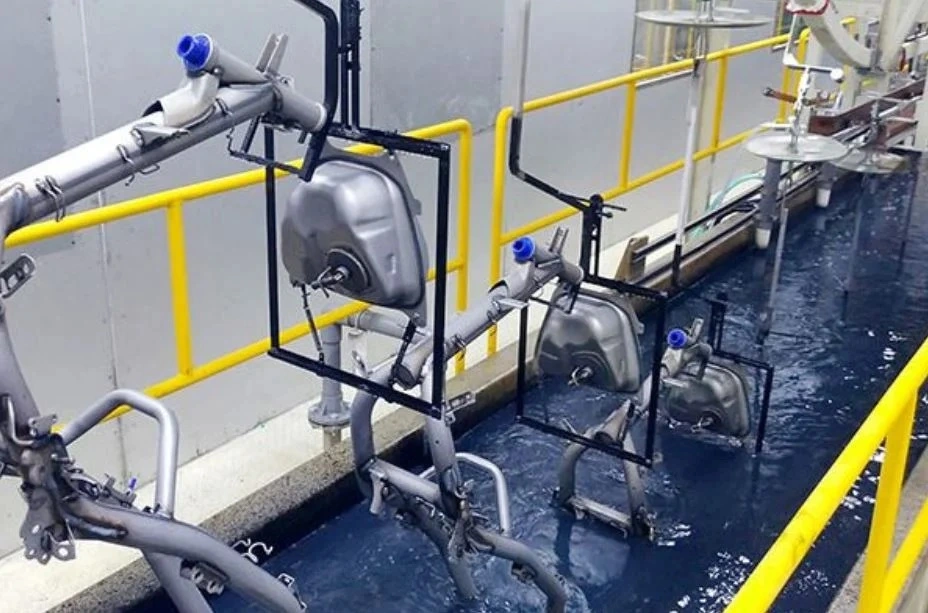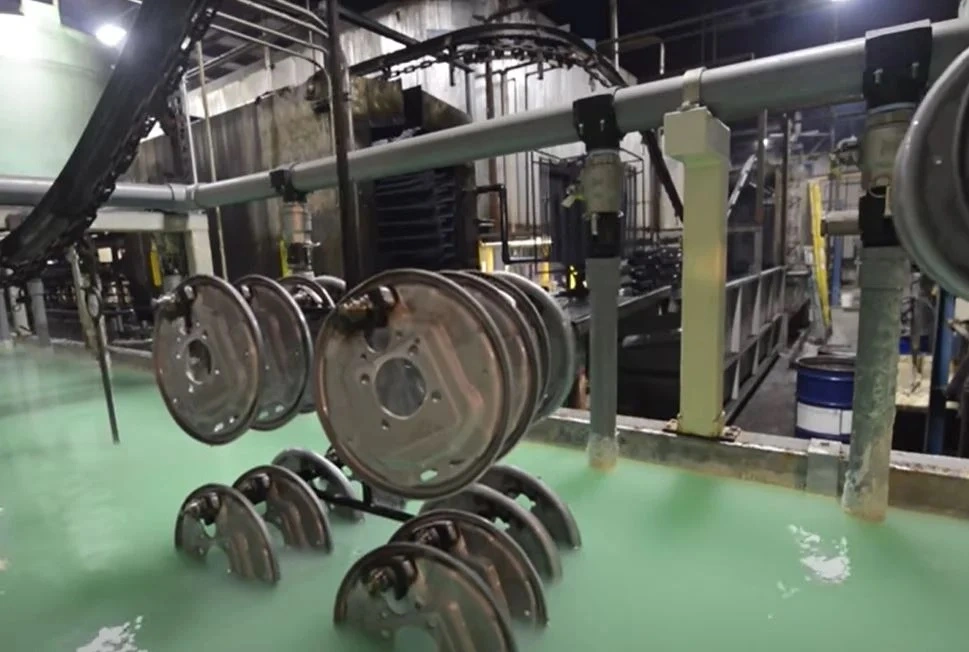
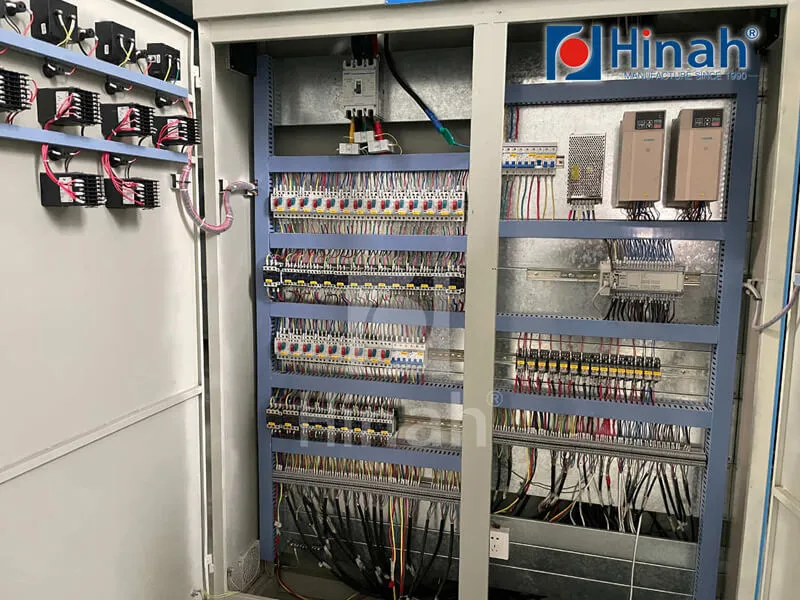

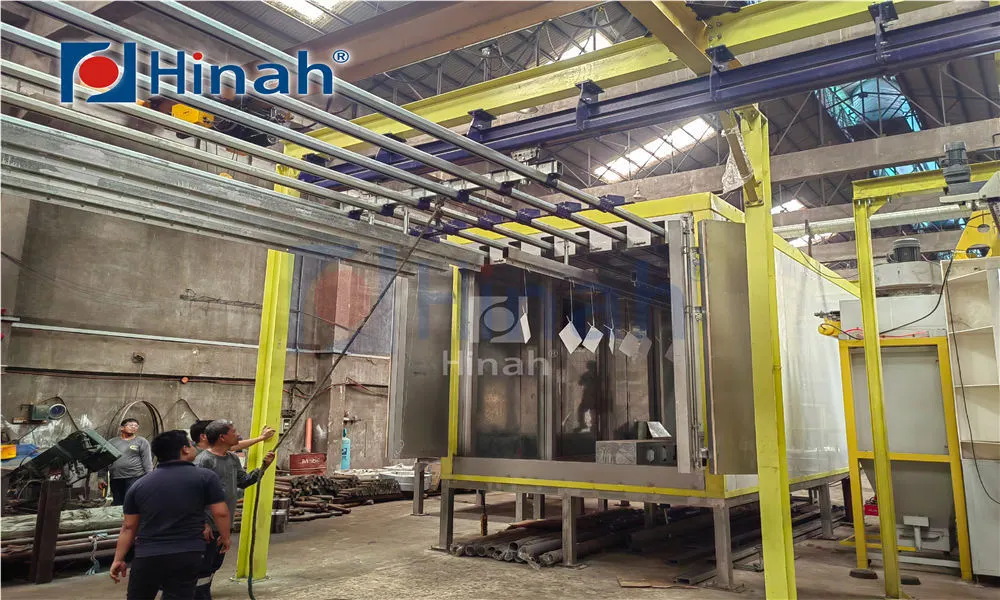
For high-volume industrial finishers, the shift from manual spraying to Automated powder coating represents one of the most significant performance leaps in surface finishing. In a market where coating defects, material waste, and inconsistent film thickness directly impact the bottom line, automation delivers measurable, repeatable outcomes. This article provides a component-level breakdown of modern automated lines, addresses real-world application challenges, and offers quantitative data to support investment decisions—drawn from practical engineering deployments at HANNA integration projects worldwide.
An effective Automated powder coating line is not a single machine but an orchestrated set of subsystems. Each component must be precisely matched to part geometry, production throughput, and coating specifications. Below are the four pillars that define high-performance automation.
Centralized feed centers use dense-phase conveying to transfer powder from bulk boxes to spray booths with minimal air volume—reducing segregation of particle sizes. For job shops running multiple colors daily, automated color change modules (integrated into the powder coating plant design) can flush lines and replace pumps in under 90 seconds. This cuts changeover labor by 70% compared to manual purge-and-clean routines. Modern feed systems also monitor hopper levels and humidity, automatically adjusting fluidization air to maintain consistent cloud density.
Six-axis robots equipped with direct-charge corona or tribo guns are now standard for complex geometries. Key performance parameters include:
Gun-to-part distance control: Laser sensors maintain 150–250 mm standoff, keeping kV efficiency above 90%.
Reciprocator stroke programming: Variable-speed drives adjust vertical traversal speeds to match part leading/trailing edges, eliminating banding marks.
Pattern shaping: Flat-spray and round-spray nozzles with solenoid-actuated puff cycles to penetrate recessed areas (Faraday cage mitigation).
When combined with a closed-loop powder mass flow controller, robotic systems achieve a first-pass transfer efficiency of 85–95%—directly reducing reclaim handling and filter loading.
Even the most uniform powder application fails without proper cure. An Automated powder coating line integrates multi-zone gas or IR/convection ovens with part tracking via RFID. Each zone’s temperature is independently controlled to follow a precise ramp-soak curve. For mixed-product lines, an optical sensor reads part length and mass, then the oven control system dynamically adjusts zone setpoints and conveyor speed to maintain a constant metal temperature. This prevents under-cure (poor adhesion/impact resistance) and over-cure (yellowing or loss of gloss). Data from HANNA installations show that automated thermal profiling reduces cure-related rejects by at least 55%.
Many finishing managers hesitate to automate, concerned about part variability or upfront investment. However, the following five pain points are consistently solved by modern Automated powder coating solutions.
Inconsistent film thickness (extreme variance >±15µm): Manual operators inevitably slow down or speed up on edges, leading to orange peel or thin corners. Closed-loop robots with ultrasonic distance sensing hold thickness to ±5µm CpK >1.33.
High powder waste (30%+ overspray): Automated booth extraction with cyclones and cartridge filters reclaims up to 98% of overspray. The automated system then blends virgin powder at a controlled ratio (typically 70/30) without degrading finish quality.
Labor dependency and ergonomic risks: Recruiting and retaining skilled coaters is increasingly difficult. A single robotic cell replaces three manual sprayers while eliminating repetitive wrist/shoulder injuries.
Faraday cage penetration failures: Robotic guns with variable voltage (60–100 kV) and flow rate modulation deposit powder into inner corners and box sections without the need for secondary touch-up.
Energy waste from poor oven loading: Automated conveyor indexing ensures full utilization of oven cross-section – no empty gaps. This reduces natural gas consumption per square meter coated by 18–25%.
Leading integrators like HANNA now employ off-line programming (OLP) software to simulate the entire powder coating plant before a single part is run. The digital twin uses particle flow dynamics and electrostatic field modeling to predict powder deposition. Engineers can experiment with gun angles, booth air flow patterns, and conveyor speed to eliminate defects virtually. Critical parameters to optimize include:
Powder-to-air ratio: Maintain 25–35 g/m³ for optimal charging; below this, cloud density drops; above it, gun clogging and surging occur.
Gun traversing speed: For long extrusions (e.g., aluminum profiles), a speed of 0.4–0.8 m/s yields uniform laydown; faster speeds cause thin trailing edges.
Relative humidity in booth: Best results at 45–55% RH; automatic humidifiers or dehumidifiers adjust to within ±3%.
Once optimized, these parameters are locked into recipe management software. Operators simply scan a barcode on the part rack, and the entire automated powder coating cell reconfigures itself—including gun voltages, powder output, and oven zone temperatures—within seconds.
While the principles are universal, tailored solutions exist for specific markets. Below are three high-demand segments where automation delivers exceptional ROI.
Wheel coating requires a high-gloss clear topcoat over a metallic base. Automated systems use a “two-pass” process: first a reciprocating bell applicator (rotational atomization) for basecoat, then a separate booth with flat-spray guns for clear coat. Indexing rotary tables with four spindles allow sequential coating and partial curing. Throughput reaches 450 wheels/hour with reject rates below 2%.
The challenge here is parts up to 7 meters long. Horizontal reciprocating machines with 10–12 guns per side travel the entire extrusion length. To avoid “orange peel” on sharp profiles, variable frequency electrostatic generators reduce kV on corners. Automated racking systems with pneumatic grippers ensure consistent grounding—critical for transfer efficiency.
Large fabricated components (e.g., tractor chassis, excavator booms) often have complex weldments. A 3D scanning system mounted on a 7th-axis rail robot maps the part in real time, compensating for variations in fixture placement. The robot then applies powder only to required surfaces, avoiding masked areas. This reduces touch-up time by 80% compared to manual coating.
Financial justification of an Automated powder coating line must look beyond labor savings. Use the following calculator framework (real figures from a medium-sized general finisher with 12,000 m²/week output).
Material savings: Manual system consumed 220 kg/week of powder (includes overspray waste). Automated system uses 150 kg/week – a 32% reduction. At $6/kg, annual savings = (70 kg/week × $6 × 48 weeks) = $20,160.
Rework reduction: Manual defect rate: 9.5% (thickness/Faraday issues). Automated rate: 2.2%. Annual rework cost (labor + stripping + refinishing) drops from $89,000 to $20,500 → saving $68,500.
Direct labor: Three sprayers + one assistant on manual line → 1 robot technician + 1 racking/unracking person. Wage saving of $112,000/year.
Energy savings: Oven scheduling and variable frequency drive (VFD) on booth exhaust fans cut electricity by 41,000 kWh/year → $6,150 at $0.15/kWh.
Total annual benefit: ~$206,800. Investment in a medium-throughput cell (including robot, booth, feed center, and integration) is about $480,000. Payback period: 2.3 years, with a 15-year line life.
Efficiency professionals at HANNA provide detailed ROI simulations based on your exact part mix and volumes, factoring in local utility rates and labor costs.
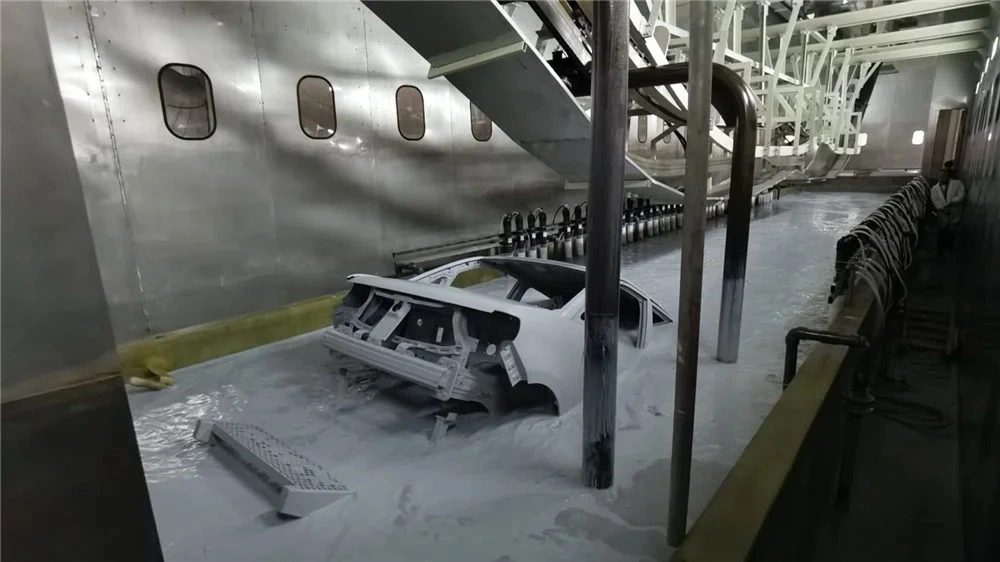
The next generation of powder coating plant operations uses Industrial Internet of Things (IIoT) gateways to stream real-time data to a cloud dashboard. Key parameters monitored include:
Gun kV and micro-amp leakage (early indicator of worn gun electrodes or insufficient grounding).
Pressure differential across booth cartridge filters (predicts need for pulse cleaning or replacement).
Bearing vibration on reciprocator drives and conveyor chain pull force.
Oven burner flame signal and exhaust stack composition (CO, O₂).
Machine learning algorithms detect anomalies 10–20 production cycles before a failure would cause line stoppage. For high-volume coaters, this predictive maintenance avoids losses of $8,000–$15,000 per hour of unscheduled downtime.
Q1: What is the typical payback period for an automated powder
coating system?
A1: Based on over 60 industrial installations,
payback ranges from 18 to 36 months for medium-to-high volume operations (≥8,000
m²/week). The variance depends on local labor rates, powder cost, and current
defect levels. For job shops with frequent color changes and lower volumes,
robotic cells with fast color change modules still achieve payback under 3 years
due to material savings alone.
Q2: Can automated powder coating handle complex part geometries with
deep recesses and inner corners?
A2: Yes, when properly engineered.
The combination of multi-axis robotics, variable kV (adjustable from 40–100 kV),
and specific spray patterns (e.g., conical nozzles with pulsed air) successfully
coats faraday cage areas. For extreme parts like closed motor housings, a
“back-etch” ion collector can be integrated. Pre-programmed path planning
ensures the gun orientation remains normal to each surface.
Q3: How does an automated line manage rapid color changes (every 1–2
hours)? What is the waste?
A3: Modern dense-phase feed systems with
integrated blow-off valves reduce changeover powder loss to under 200 grams per
color. The automatic booth walls are non-stick (e.g., stainless steel with a
special coating) and a pneumatic wiper system clears internal surfaces in <60
seconds. Total downtime for a full color + gun cleaning is typically 5–8
minutes, compared to 25 minutes for manual booths.
Q4: What level of operator training is required after installing an
automated system?
A4: Operators shift from “spraying skills” to
“process supervision.” Training typically takes 3–5 days covering HMI
navigation, recipe management, quality checking (wet film gauges, orange peel
standards), and simple maintenance (nozzle replacement, booth cleaning). Robot
programming for new parts is done offline by an engineering lead. Most
technicians become proficient within two weeks.
Q5: Can my existing curing oven be retrofitted with automation, or do
I need a new one?
A5: Retrofits are possible if the oven has
sufficient length for the required production rate and can be equipped with
zoning. We often install additional thermocouples, PID controllers, and
variable-speed fans into existing gas ovens. However, if your current oven has
significant temperature maldistribution (±10°C across zones), replacement is
recommended. A free thermal survey by HANNA technicians can assess retrofit
feasibility.
Transitioning from manual or semi-automatic finishing to a fully integrated, Automated powder coating solution requires careful planning—from substrate cleaning stages to final cure. HANNA provides end-to-end support: line simulation, ROI modeling, installation, and post-startup performance monitoring. Every line is built to your specific part portfolio, budget, and production footprint.
Request an engineering consultation and a customized payback analysis today. Our team will provide a detailed proposal within 5 business days, including 3D layout and first-year consumable savings.
Send your project specifications to our inquiry desk: https://www.autocoatinglines.com/contact
Or call directly
for a technical discussion — global support for all time zones.