
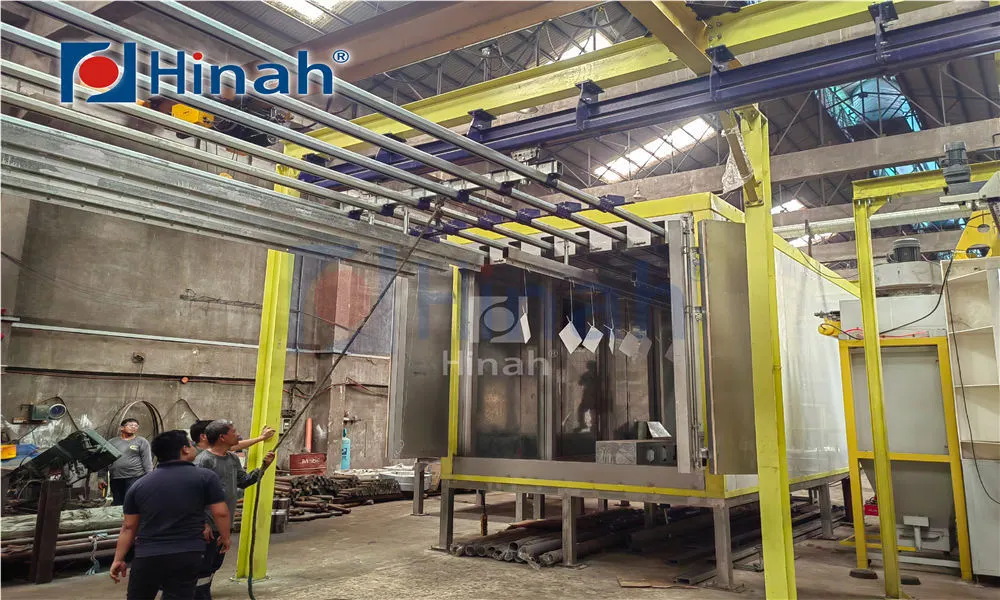
Industrial finishers transitioning from manual booths to automated powder coating systems often encounter unexpected rejects—uneven film build, Faraday cage voids, and lengthy color change downtime. True automation extends beyond replacing a hand gun with a reciprocator. It requires holistic integration of part recognition, spray parameter control, booth air management, and recovery loop sequencing. This guide provides a technical framework for specifying, validating, and operating automated powder coating systems that achieve first-pass yield above 96% with color change under 12 minutes.
HANNA has engineered 85+ automated lines across automotive, appliance, and general metal sectors. Below we dissect the engineering decisions that separate high-performance powder coating plant automation from hobby-level solutions.
Many automated powder coating systems fail because gun arrays assume a rectangular envelope. Real parts have recesses, tubular sections, and variable distance to guns. The solution is a three-stage modeling process:
3D envelope scanning: Laser or photoelectric sensors at the booth entrance map part contours. Outputs feed a PLC that adjusts gun trigger timing and voltage/kV parameters for each zone.
Multi-axis reciprocators: Horizontal traversing with programmable stroke limits, not just vertical oscillation. This reduces Faraday cage penetration issues by maintaining 200–250 mm standoff distance.
Density simulation: Using computational fluid dynamics (CFD) for powder cloud dispersion. A well-designed powder coating plant achieves ±5 µm film thickness variation across complex geometries.
Real-world example: A tractor wheel manufacturer replaced fixed guns with a 12-axis system featuring part-specific gun masking. Reject rate from coating voids dropped from 18% to 2.3%.
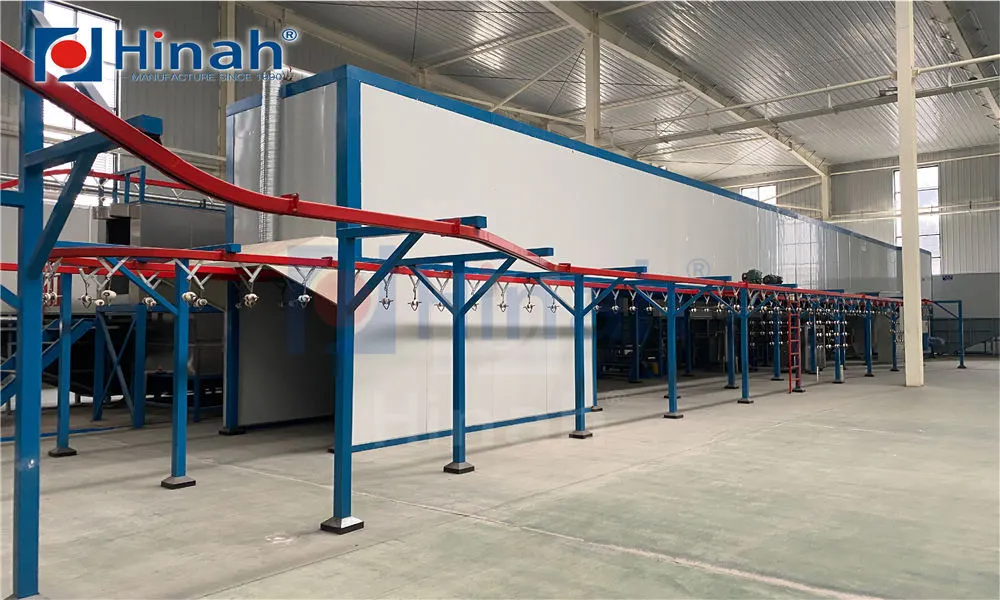
Automated powder coating systems must synchronize conveyor line speed (typically 3–8 m/min) with booth dwell time and oven cure profile. Inconsistent indexing leads to either under-cured coating or wasted powder. Key parameters:
Variable frequency drives (VFD) on conveyor with encoder feedback to the powder controller. Speed regulation within ±0.5%.
Accumulation zones before the booth: Photoelectric sensors trigger indexing to maintain minimum 2-second overlap between parts.
Booth entry and exit light curtains that pause gun operation during gaps, reducing overspray by 22–30%.
For mixed-product lines, a barcode or RFID tag on each carrier stores recipe data (voltage, powder flow, gun pattern). The system automatically adjusts between 12ms and 45ms of part transit.
Automation effectiveness hinges on consistent powder delivery. Traditional venturi pumps produce pulsation that varies output by ±15%. Modern dense-phase pumps (e.g., HD pump technology) achieve ±2% consistency. A properly engineered powder coating plant integrates:
Load cell monitoring on the hopper to calculate real-time consumption and detect feed interruptions.
Automatic sieve station (200–250 µm mesh) to remove agglomerates before they reach the gun nozzle.
Humidity control: Powder absorbs moisture above 55% RH, causing clumping. Dehumidified air supply (dew point ≤ -20°C) is standard.
HANNA integrates a proprietary air management module that adjusts fluidizing air pressure based on powder level, reducing compressed air waste by 38% compared to fixed settings.
For job shops, color change speed is the primary bottleneck. Traditional automated powder coating systems require manual cleaning of booth walls, hoses, and guns. Modern designs incorporate:
Rapid color change (RCC) booth: Smooth polypropylene walls with a purge cycle (compressed air + vacuum) that removes residual powder in 90 seconds.
Cartridge filter indexing: Two or more sets of filter cartridges on a turntable. Contaminated set rotates out while clean set rotates in.
Quick-disconnect powder hoses with pressurized air blow-out to the recovery hopper.
Automated nozzle cleaning station: Ultrasonic bath for gun deflectors during color change, ensuring no cross-contamination.
Data from a European automotive supplier: Switching from a manual change system to an RCC booth reduced average changeover from 47 minutes to 9 minutes, enabling 14 additional color changes per shift.
Closed-loop control separates basic automation from Industry 4.0-ready automated powder coating systems. Sensors and actuators adjust parameters on the fly:
Film thickness gauge (non-contact, laser-based) positioned after the booth but before curing. Measurement triggers gun voltage adjustment (60–100 kV) or powder output (10–200 g/min) to correct deviations.
Back ionization detection: Corona guns can cause pinpoint craters if too much charge accumulates. An arc detection circuit reduces kV automatically.
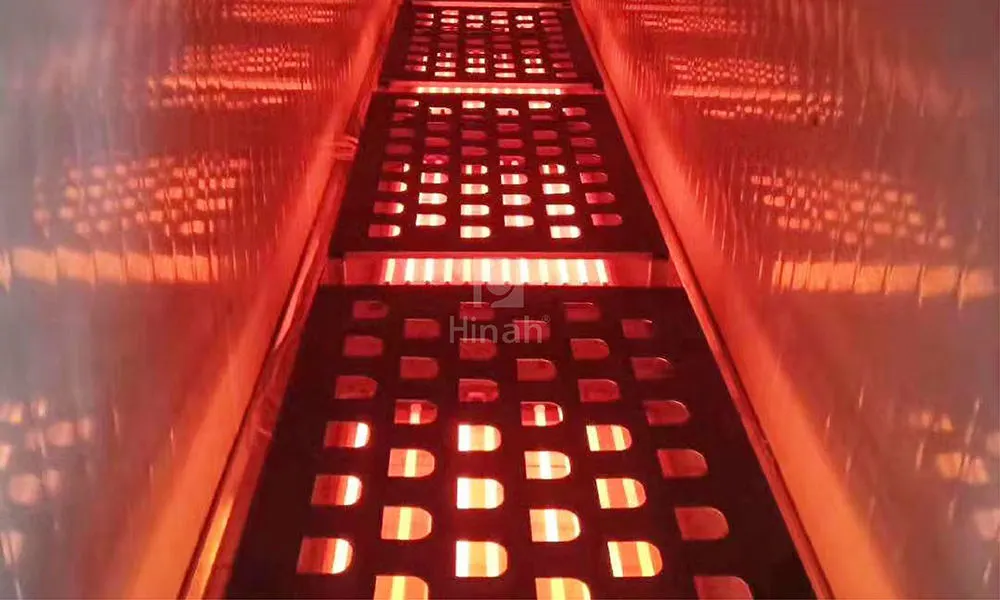
Oven temperature profiling: Infrared sensors across the conveyor width identify cold zones; if temperature drops below 160°C, the system slows conveyor speed by up to 15% to maintain cure schedule.
A HANNA-installed line for aluminum building panels uses these feedback loops to maintain thickness between 60–80 µm with a CpK of 1.33, verified by hourly cross-checks.
Economic justification for automated powder coating systems often hinges on reclaim efficiency. Overspray capture should exceed 95% with automatic sorting:
Cyclone separator: Removes coarse particles (reclaim to feed hopper). Fine fraction (<10 µm) is routed to a separate waste bin to prevent orange peel effect.
Vibratory sieve with automatic screen cleaning: A mesh that rejects fibers and cured beads. Ultrasonic vibration prevents blinding.
Proportional blending valve: Mixes reclaim powder with fresh powder at a programmable ratio (typically 70/30 fresh/reclaim). Density sensors ensure mixture homogeneity.
Without this automation, operators often over-fresh powder, wasting 15–25% of material. A typical high-volume line (200 kg powder per shift) saves €68,000 annually by maximizing reclaim usage.
Requires uniform coating on complex spoke geometry. Powder coating plant solution: Six guns arranged on three reciprocators with independent tilt. A vision system identifies rim diameter (15″ to 22″) and adjusts gun-to-part distance from 180 mm to 250 mm. Cycle time: 45 seconds per wheel, 99.2% first-pass yield.
Internal corners and grounding points need special attention. Automated system uses a pre-programmed "wiggle" motion on the corner guns, plus a conductive primer detection probe to adjust kV downward (prevents back ionization on sharp edges). Rejects due to pinholes decreased by 88% after automation.
Parts up to 6 meters long with variable cross-sections. Solution: A traveling gantry with four guns that move along the stationary part, rather than moving the part through a fixed booth. This configuration avoids costly long conveyor tunnels. HANNA engineered a gantry system for a combine harvester plant, reducing floor space by 40% and powder consumption by 22%.
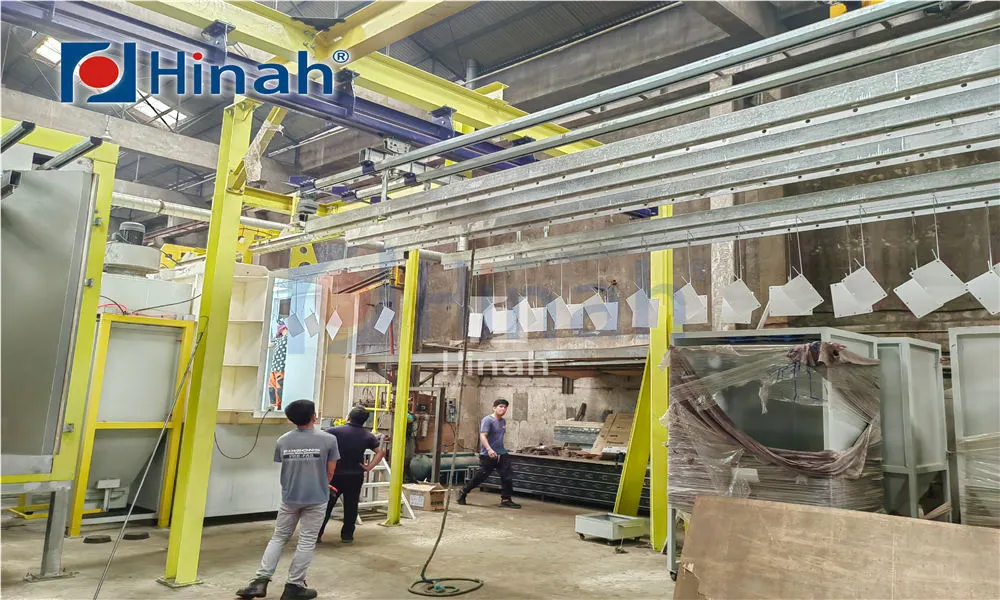
When procuring automated powder coating systems, include the following acceptance criteria in your contract:
Factory Acceptance Test (FAT): Run test panels (300x300 mm) at five conveyor speeds. Measure thickness at 9 points per panel; standard deviation must be ≤4 µm.
Site Acceptance Test (SAT): Produce 200 consecutive parts with no manual touch-up. Measure transfer efficiency: (powder deposited) / (powder delivered). Minimum 65% for complex parts, 80% for flat panels.
Long-term stability: After 500 hours, repeat the thickness test – variation must not increase by more than 1.5 µm.
Data logging is mandatory: record kV, µA, powder flow (g/min), part count, and reject reason codes. Modern systems generate OEE (overall equipment effectiveness) reports automatically, pinpointing whether losses are due to changeover, gun clogging, or conveyor jams.
Q1: What is the minimum production volume that justifies automated
powder coating systems instead of manual
booths?
A1: A reliable threshold is 15,000 parts
per month or 400 kg of powder per week. Below that, the capital investment
(€150k–€500k) typically yields a payback beyond 3 years. However, if you have
frequent color changes (more than 4 per shift) or high reject rates (>12%),
automation may be justified at half that volume due to waste reduction and
consistency gains.
Q2: How do automated powder coating systems handle mixed part sizes
on the same conveyor?
A2: Through part recognition
(barcode, RFID, or laser profile). Each part’s dimensions and required coating
thickness are stored in a recipe database. The PLC retrieves the recipe when the
part enters the booth zone, adjusting gun positions, voltage, and powder flow
within 200 milliseconds. For parts with huge variation (e.g., 200mm to 2m), use
a two-booth layout: one for small, one for large, with a bypass conveyor.
Q3: Can existing manual booths be retrofitted into automated powder
coating systems?
A3: Yes, but with restrictions.
You can add reciprocators, automatic guns, and a PLC. However, the booth must
have enough depth (at least 2.5m) to accommodate gun movement without overspray
escaping. Also, manual booths often lack explosion relief panels and proper air
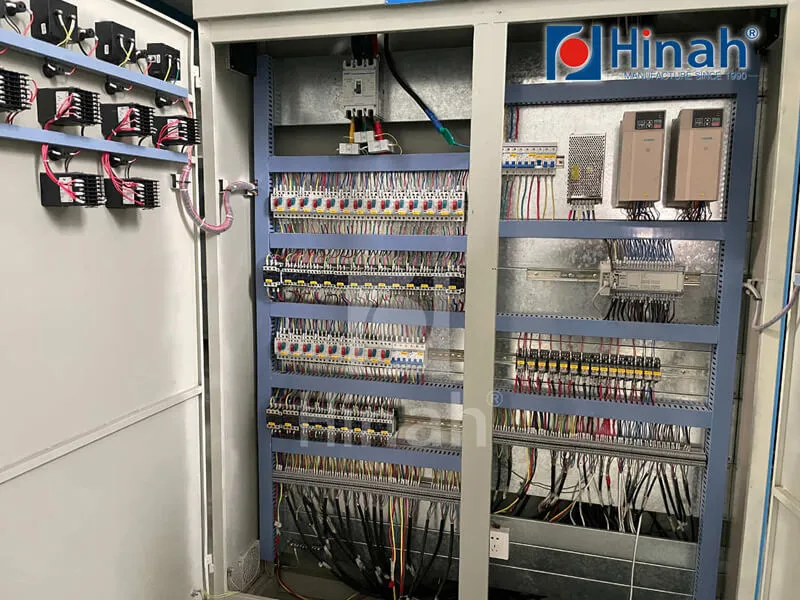
seals for automation. HANNA offers retrofit kits
that include a control cabinet, four guns, two reciprocators, and a learning
pendant. Typical retrofit cost is 60% of a new booth, but with 85% of the
performance.
Q4: How often do automated guns need maintenance compared to manual
guns?
A4: Automated guns in a 2-shift operation
require nozzle and deflector cleaning every 40 hours of spray time (versus 8
hours for manual guns). The high-voltage multiplier should be tested every 500
hours; typical lifespan is 3,000–4,000 hours. Keep a spare gun assembly to swap
during maintenance without stopping production.
Q5: What is the typical energy consumption of an automated powder
coating system (booth + recovery + oven)?
A5: For a
mid-sized line (15 m conveyor, 3-booth, electric oven), total connected load
ranges 180–250 kW. But actual consumption: booth fans (15–22 kW), compressor for
powder feed (11 kW), oven (80–120 kW during heat-up, then 30–50 kW holding).
Energy per coated part: approximately 0.8–1.2 kWh per square meter. Using
high-efficiency motors (IE4) and variable frequency drives reduces this by
18–22%.
Selecting the correct level of automation requires balancing part complexity, volume, and available floor space. HANNA provides a structured four-phase process: (1) part mix analysis and conveyor layout, (2) CFD simulation of powder cloud coverage, (3) ROI modeling based on your labor, powder, and reject rates, and (4) on-site commissioning with operator training.
Request a technical consultation: Submit your part drawings, production targets, and existing facility constraints. Our engineers will return a detailed proposal including 3D line layout, gun count and positioning, color change sequence logic, and a 24-month performance guarantee.
Contact HANNA today:
Email:
sales@autocoatinglines.com
Web: https://www.autocoatinglines.com/
Quote request: Automated powder coating systems inquiry form">Automated powder coating systems inquiry form