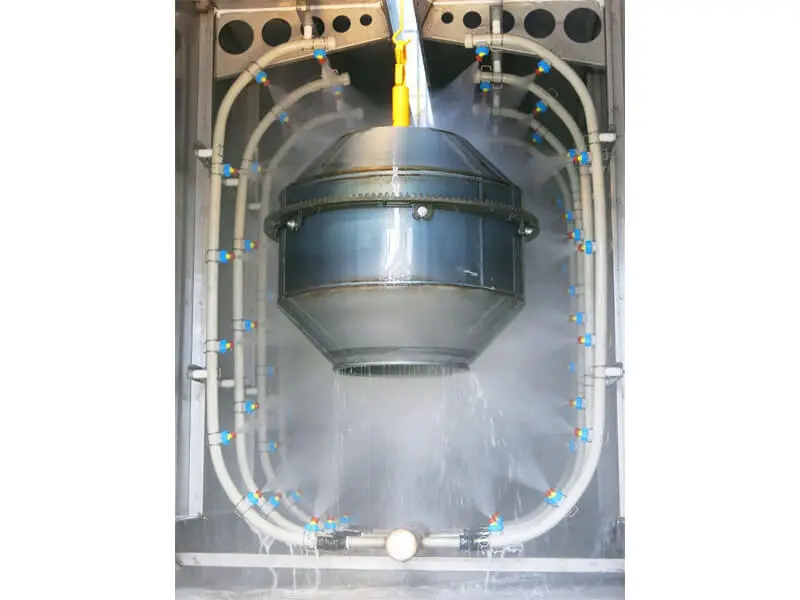
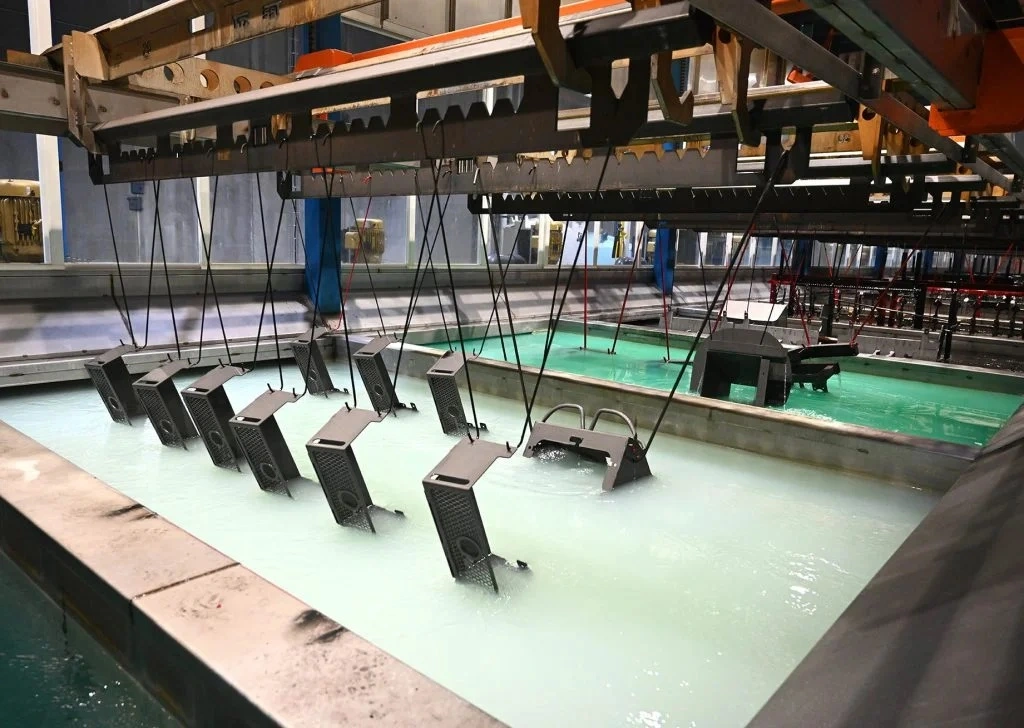
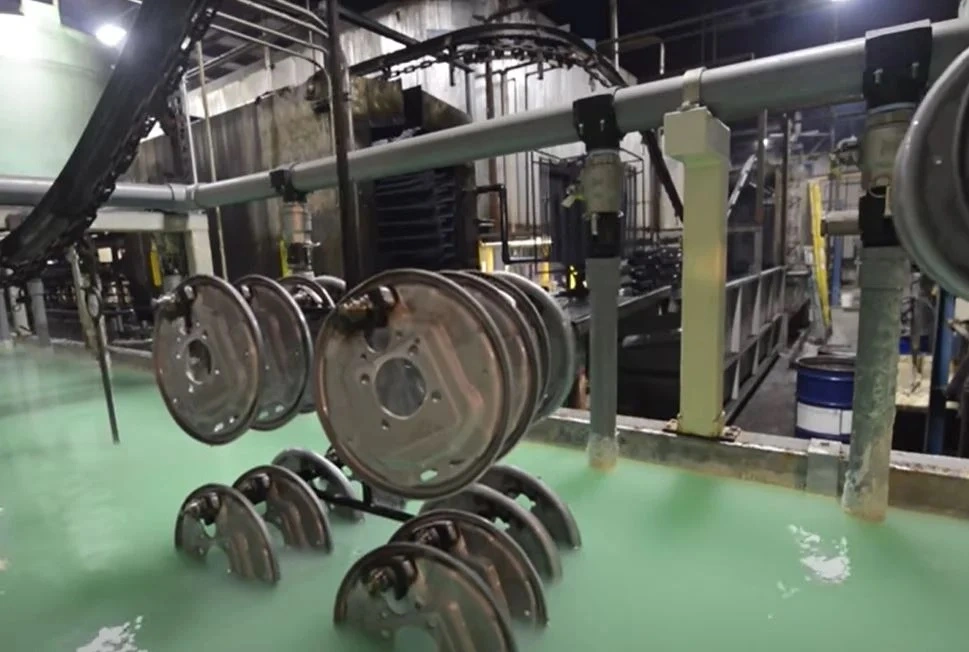
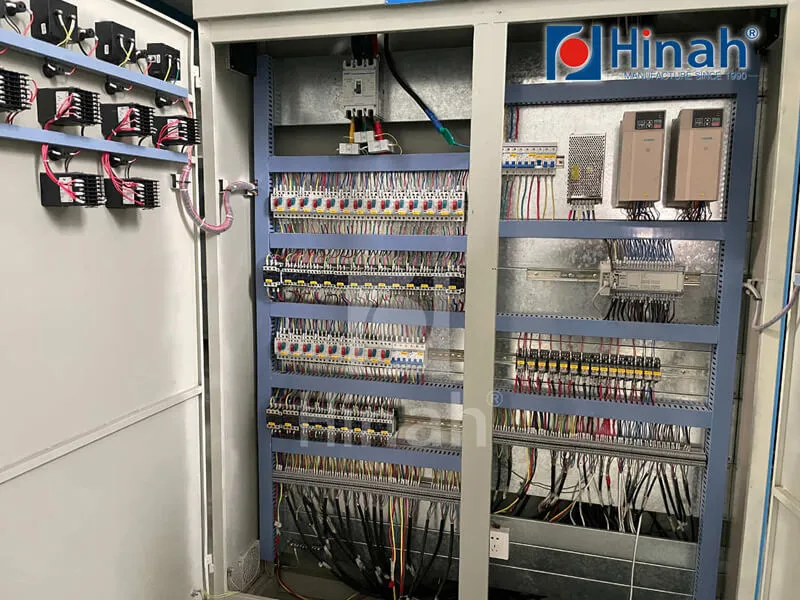
For finishing operations targeting consistent film build, near-zero overspray waste, and scalable throughput, the transition from manual booths to a fully automated powder coating line represents a fundamental process re-engineering. Based on data from over 120 industrial installations, this article examines the engineering controls, material handling logic, and economic thresholds that define high-performance automation in powder application. We will reference proven configurations from HANNA, whose integration of closed-loop feedback and modular booth design has become a benchmark for Tier 1 automotive and appliance suppliers.
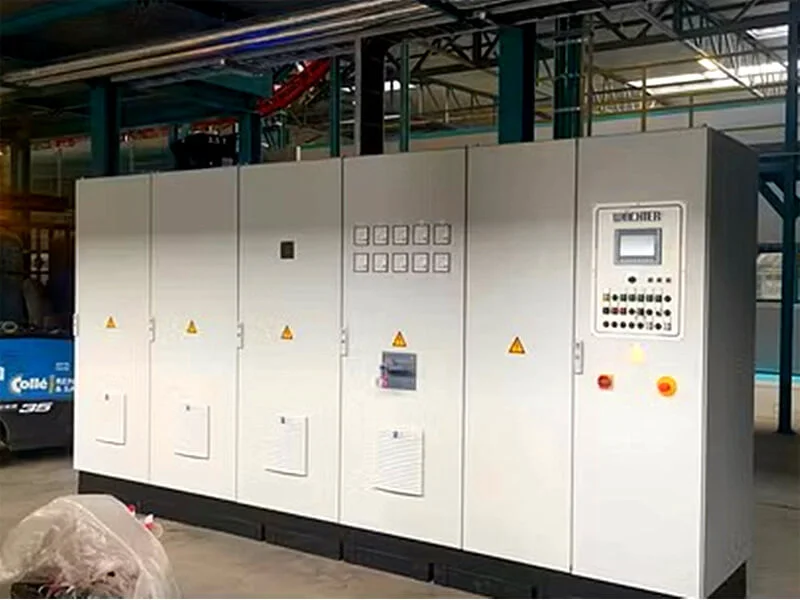
A robust automated powder coating line is not merely a set of robots; it is a synchronized material flow architecture. Five interdependent sub-systems determine overall equipment effectiveness (OEE):
Overhead monorail or power-and-free conveyor: Speed regulation between 2.5 and 8 m/min, with load cells to prevent hanging deflection.
Multi-axis reciprocators & fixed gun arrays: Programmable vertical stroke (300–2000 mm) and horizontal positioning to resolve Faraday cage areas on complex profiles.
Integrated powder management unit (PMU): Dense-phase delivery, fluidized hopper level control, and sieve station to remove agglomerates.
Cartridge or cyclone recovery booth: Achieving 95–98% reclaim efficiency with automatic filter pulsing.
Gas or IR-curing oven: Zoned temperature profiling (160–220°C) with cross-ventilation for even gelation.
Without proper harmonization among these modules, even the best automated powder coating line suffers from tip wear variability and inconsistent film thickness. HANNA’s recent projects integrate conveyor-mounted part recognition (photoelectric arrays) that pre-select gun trajectories, reducing setup errors by 40%.
Finishing shop floors face three chronic inefficiencies that directly justify capital investment in automation:
Operator-dependent film thickness: Manual spraying yields ±25 µm variance; automated systems maintain ±5 µm, directly impacting material cost and rework.
Lengthy color changeovers: Manual clean-up of booth, hoses, and guns takes 45–90 minutes. A well-designed powder coating plant with a two-booth carousel and quick-release injectors cuts changeover to under 12 minutes.
Overspray waste: Manual spraying often achieves only 50–65% transfer efficiency. Automated reciprocators with distance feedback and optimized electrostatic kV (70–90 kV) push efficiency to 85%+.
For job shops running 8–12 color changes per shift, investing in an automated powder coating line with a modular booth exchange system (like HANNA’s QuickColor™ design) recovers the capital premium within 18 months purely from reduced idle time and powder consumption.
Modern lines employ three nested control loops to maintain first-pass yield >92%:
Loop 1 – Electrostatic feedback: Microcurrent sensors at the gun tip adjust kV and µA in real time to prevent back-ionization (pinholing) on recessed areas.
Loop 2 – Powder mass flow control: Coriolis or thermal mass meters regulate dense-phase velocity (1–5 m/s) to avoid surging and clogs.
Loop 3 – Curing profile verification: Thermocouples on dummy parts or IR pyrometers across the oven link to PLC, modulating burner duty cycles.
These loops are particularly critical for mixed-material production (e.g., aluminum extrusions + heavy-gauge steel). HANNA’s HANNA iControl platform records every part’s coating parameters, enabling full traceability to ISO 12944-6 requirements. One agricultural equipment manufacturer reduced field coating failures by 52% after retrofitting such a closed-loop powder coating plant control architecture.
Using a 5-year total cost of ownership (TCO) model for a mid-volume line (600 parts/shift), the break-even point for an automated powder coating line typically occurs between month 14 and 22. Key drivers include:
Labor reallocation: Three spray operators replaced by one robot supervisor + one quality inspector – annual savings $78,000–$110,000 (North America rates).
Powder savings: Moving from 60% to 88% transfer efficiency reduces yearly powder spend by $32,000–$45,000 (assuming $4.50/kg for TGIC polyester).
Energy reduction: Adaptive curing with load-based oven zoning cuts gas consumption by 18–22%.
Lower rework & scrap: Rejects due to runs, sags, or thin edges drop from typical 8–12% to under 3%.
Additionally, automated lines enable unattended “lights-out” shifts, amortizing fixed costs over 20+ hours of daily runtime. HANNA’s case study on a trailer axle line documented 31% lower coating cost per square meter after 24 months of automated operation.
Transitioning to a automated powder coating line is not without challenges. The most frequent engineering hurdles and proven countermeasures include:
Complex part geometries with deep recesses: Deploy tribo-charging guns (friction-based, no electrode) for internal corners, combined with oscillating disk applicators. This hybrid approach ensures coverage in cavities where corona guns fail.
High humidity effects on powder fluidization: Install a dew point-controlled compressed air dryer (≤ -40°C PDP) and hopper air heater to maintain consistent cloud density.
Gun tip fouling from reclaim powder: Implement automatic tip cleaning cycles after every 20 spray cycles using compressed air bursts and a wear-resistant tungsten carbide electrode.
Integration with existing pretreatment washers: Use a dry-off tunnel temperature ramp and sync conveyor speeds to avoid moisture carryover into the spray booth.
Leading integrators like HANNA offer pre-commissioning digital twins to simulate powder cloud deposition and oven heat distribution, de-risking these issues before steel is cut.
Even the most advanced powder coating plant requires structured maintenance. A predictive strategy based on vibration analysis and differential pressure monitoring is far more cost-effective than reactive repairs. Recommended schedule:
Daily: Inspect powder feed hoses for abrasion, clean booth walls with non-stick coating-friendly wipes, check gun electrode pins for buildup.
Weekly: Validate conveyor chain tension and lubricate bearings; check reclaim cyclone pressure drop (baseline: 1200–1500 Pa).
Monthly: Calibrate powder output using weight-per-time test (target ±2% of setpoint); inspect oven recirculation fans and belt alignment.
Quarterly: Replace air filters on the recovery system; measure film thickness on test panels from all gun positions; perform thermographic scan of oven insulation.
HANNA’s remote condition monitoring dashboard flags drift in electrostatic current or hopper fluidization pressure, allowing maintenance planning without unplanned downtime. One user reported 96% OEE after adopting this protocol on their automated powder coating line.
Next-generation automated powder coating line designs embed IIoT connectivity for:
Digital batch records: Each part’s coating parameters (kV, flow rate, oven temperature curve) stored in a cloud historian for ISO/TS 16949 compliance.
AI-driven recipe optimization: Machine learning models recommend gun trajectories and voltage settings based on past part geometries, reducing commissioning time by 60%.
Predictive quality alerts: Real-time comparison of powder cloud density (via laser scattering sensors) triggers an alarm before a defect occurs.
Early adopters of these features have cut color change waste by an additional 15% through optimized purge sequences. HANNA’s 2025 automation roadmap includes self-adjusting booth airflow that maintains face velocity (0.4–0.6 m/s) regardless of filter loading, ensuring consistent overspray capture.
Q1: What is the typical payback period for an automated powder
coating line in a small-to-medium enterprise?
A1: For SMEs running two shifts (1,200–1,500 parts daily), payback ranges from 14 to
24 months, assuming current labor costs $50k–$70k per operator. The largest
savings come from powder material efficiency (jumping from 55% to 85%+ transfer
efficiency) and reduced rework. A detailed TCO calculator using your local
utility rates and powder cost is recommended; HANNA provides free payback
simulations for prospective buyers.
Q2: Can an automated powder coating line handle frequent color
changes efficiently?
A2: Yes, but the design
matters. Systems with a two-booth carousel (one painting while the other is
cleaned) and quick-disconnect powder feed hoses can execute a full color change
in under 10 minutes. Avoid single-booth designs without purge-ready manifold
systems, as they lead to cross-contamination. Many modern powder coating
plants also use color-specific feed centers that reduce changeover
powder loss below 200g per switch.
Q3: What maintenance is unique to an automated line compared to
manual booths?
A3: Automated lines add complexity
in reciprocator linear guides, servo motor drives, and mass flow controllers.
Regular greasing of guide rails (every 500 operating hours), checking encoder
calibration, and cleaning optical part sensors are essential. Additionally, the
reclaim system’s sieve screens must be inspected weekly for wear. However, these
tasks are offset by far less manual booth cleaning due to better
containment.
Q4: How does part geometry affect the selection of an automated
powder coating line?
A4: High-aspect-ratio parts
(e.g., extrusion profiles up to 6m) require long-stroke reciprocators (up to
2.5m) and possibly side-mounted guns. For parts with deep boxes or inner
cavities, you may need to add manual touch-up stations or dedicated bell
applicators. A pre-purchase “shoot test” using your actual parts is strongly
advised to verify coverage. HANNA’s lab in Ohio offers such testing with full
data reporting.
Q5: What are the hidden operational costs after installing an
automated line?
A5: Beyond electricity and
compressed air, the main hidden costs are: (1) higher-grade powder required for
consistent fluidization (some cheap powders bridge in automated hoppers); (2)
specialized training for technicians on PLC and robotics; (3) spare parts
inventory for gun tips, venturi pumps, and filter cartridges. Budget 5–7% of the
system’s capital cost annually for consumables and wear parts. Many lines also
need periodic recalibration of electrostatic generators (every 12 months).
Q6: Does an automated powder coating line support eco-friendly
compliance (low VOC, waste reduction)?
A6: Absolutely. Since powder coatings contain zero solvents, automation simply
enhances their environmental advantage by reducing overspray waste to 2–5%.
Cartridge booths with automatic blow-back cycles send reclaimed powder back to
the feed hopper, achieving near-zero landfill waste. Furthermore, precise film
thickness control prevents over-application, lowering total material usage per
part by 12–20% compared to manual spraying.
The transition to a fully integrated automated powder coating line is no longer exclusive to high-volume OEMs. With modular designs, fast ROI, and Industry 4.0 readiness, it has become a competitive necessity for any finisher aiming for consistent quality, lower variable costs, and the ability to accept complex mixed-work orders. The key lies in selecting a supplier that provides process simulation, training, and lifecycle support—attributes that define HANNA’s approach to industrial coating solutions.
Ready to evaluate an automated powder coating line for your specific part mix and throughput targets? Send a detailed inquiry with your production volumes, part sizes, and current rejection rates. HANNA’s engineering team will provide a customized ROI model, line layout proposal, and a comparative efficiency study.
Request your professional inquiry response now: Submit your
coating line requirements →
Or email directly:
neil@autocoatinglines.com – Reference “Automated Line
Analysis” for priority technical support.