
For any finishing operation — whether powder coating, liquid paint, or e-coat — the coating oven determines final film properties, production throughput, and energy cost per part. A poorly designed or maintained curing oven leads to under-cured coatings (poor adhesion, low chemical resistance), over-cured films (brittleness, discoloration), and rejected batches. Conversely, a precision-engineered coating oven delivers consistent metal temperature profiles, reduces rework rates below 1%, and lowers natural gas consumption by up to 25% compared to outdated equipment. This article examines thermodynamic principles, common failure modes, retrofit strategies, and integration with automated lines — drawing from HANNA‘s four decades of industrial finishing system design.
The primary function of any coating oven is to raise the substrate to a specified cure temperature and hold it for a defined dwell time. For thermoset powders (epoxy-polyester hybrids), this typically means 180–200°C metal temperature for 10–15 minutes. For liquid two-component paints, conditions vary from 80°C for 30 minutes (low-bake) to 160°C for 20 minutes. Key performance parameters include:
Temperature uniformity: ±3°C across the work zone for most industrial parts; ±1.5°C for automotive Class A surfaces.
Ramp rate: Minimum 8°C/min for powder to achieve proper flow and levelling before gelation.
Cross-sectional air velocity: 0.5–1.5 m/s for convection ovens; higher velocities improve heat transfer but risk disturbing uncured powder.
Heat source modulation: Direct gas-fired burners with high-turn-down ratio (10:1) or electric infrared zones for rapid response.
Modern coating oven designs incorporate computational fluid dynamics (CFD) simulations to optimize nozzle placement and recirculation patterns. Powder coating plant integrators like HANNA use thermal mapping during commissioning to validate uniformity before production start.
Selecting the correct coating oven type depends on part size, production volume, and changeover frequency.
Ideal for job shops, maintenance facilities, and low-volume high-mix production. Batch ovens feature roll-up or vertical lift doors and accommodate racks or hanging fixtures. Typical sizes range from 2m x 2m x 2m up to 6m x 4m x 4m. Advantages include lower capital cost and flexibility for odd-shaped parts. However, batch ovens consume more energy per part due to heat loss during door opening and slower ramp-up of cold loads. A well-insulated batch coating oven should have external surface temperature ≤ ambient +15°C.
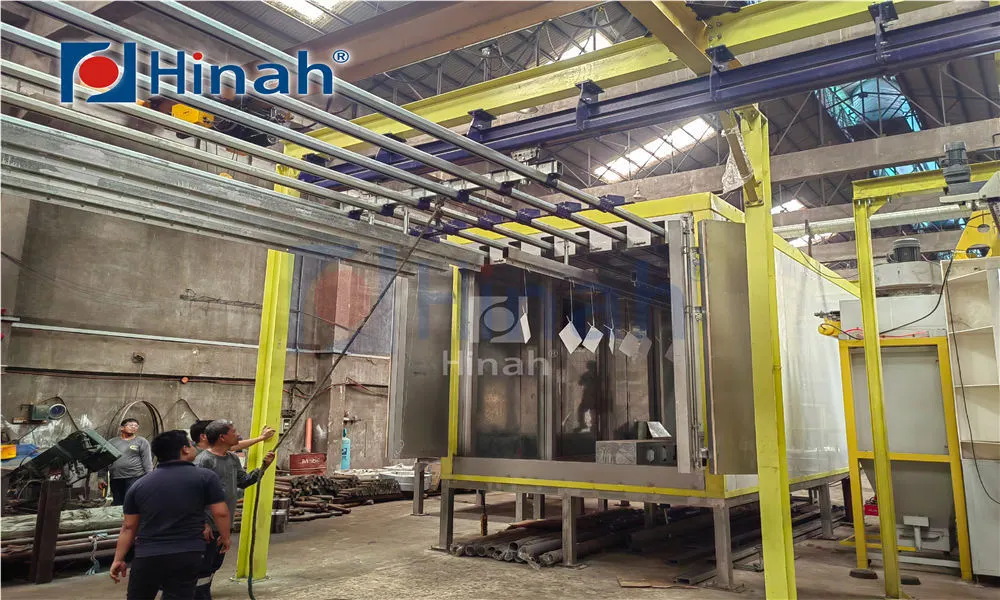
For high-volume production lines (automotive, appliance, general industrial), continuous ovens integrate with overhead monorail or power-and-free conveyors. Parts travel through multiple temperature zones: ramp-up, soak, and optional forced cooling. Zone lengths are calculated based on line speed and thermal mass of the largest part. A well-designed continuous coating oven achieves thermal efficiency of 65–75% (versus 40–55% for batch designs). Powder coating plant layouts often position the oven directly after the application booth, minimizing transport time and heat loss.
Each heating technology offers distinct advantages for specific applications.
Gas-fired convection: Most common for large parts and high throughput. Indirect-fired systems (heat exchanger) keep combustion products separate from oven atmosphere — mandatory for powder coating to prevent contamination. Direct-fired ribbon burners offer lower cost but require clean combustion and are suitable for waterborne or solvent-borne paints with adequate ventilation.
Electric infrared (IR): Medium-wave IR emitters (2.5–3.5 µm) penetrate powder films without disturbing the surface. IR provides very fast ramp-up (seconds) and is ideal for thin sheet metal or parts with high surface-to-mass ratio. However, IR struggles with complex geometries (shadow zones) and cannot replace convection for thick castings.
Hybrid systems: An IR booster zone at the oven entrance preheats parts to 120–140°C within 60 seconds, followed by a convection soak zone. This combination reduces overall oven length by 30–40% and cuts gas consumption by 15–20%. HANNA has installed hybrid coating oven systems for agricultural equipment manufacturers with documented energy savings of $45,000 annually.
Even a well-specified coating oven can produce defects if not properly maintained or operated. Below are four frequent problems with field-tested solutions.
Defect: Orange peel or poor flow (powder coating)
Occurs
when the powder does not fully melt before gelation. Solution: Increase ramp rate by adding IR preheat or raising convection air velocity.
Verify that oven zones are reaching setpoint within 5 minutes of load entry.
Also check powder formulation — some low-cure powders require specific
temperature profiles.
Defect: Discoloration (yellowing or browning) of clear or
light-colored coatings
Solution: Over-cure due to
excessive dwell time or temperature. Perform a thermal profile study using data
loggers on actual parts. Adjust conveyor speed or reduce zone setpoints by
5–10°C. For continuous ovens, check that parts are not stopping inside the oven
during production breaks — implement a purge cycle that indexes racks out.
Defect: Soft coating or poor solvent resistance (MEK rub
fails)
Solution: Under-cure. Most common causes:
thermocouple placement too close to burner flame (reading high while part is
cold), or airflow blocked by dense part loading. Relocate sensing thermocouples
to represent load average. Install baffles to redirect air around tightly packed
fixtures.
Defect: Adhesion failure on one side of a part (shadow
effect)
Solution: Uneven airflow or radiant
asymmetry. For convection ovens, measure air velocity at multiple points —
differences >30% indicate blocked or misaligned nozzles. For IR ovens,
replace aged emitters (output drops after 10,000 hours) and clean reflectors
quarterly. Powder coating plant audits often reveal that recirculation
fan blades are coated with cured powder, reducing airflow by up to 40% —
schedule quarterly cleaning.
With natural gas prices volatile, optimizing coating oven efficiency delivers rapid payback. Retrofit options with 6–18 month ROI include:
Exhaust heat recovery: Install a cross-flow plate heat exchanger on the exhaust stack to preheat fresh combustion air. Recovering 50% of waste heat reduces gas consumption by 12–15%.
Variable-frequency drives (VFDs) on recirculation fans: Reduce fan speed during partial loads or idle periods. A 20% speed reduction cuts fan power by 50%.
Improved insulation: Replace compressed or degraded mineral wool. Adding a 50mm ceramic fiber blanket over existing insulation lowers skin temperature and standby losses.
Automated door closers for batch ovens: Pneumatic or spring-assisted doors that close immediately after part entry/exit reduce heat loss by up to 30%.
HANNA provides turnkey energy audits that include infrared thermography, flue gas analysis, and computational modeling. One client reduced their coating oven gas bill from $87,000 to $62,000 annually after implementing three of the above measures.
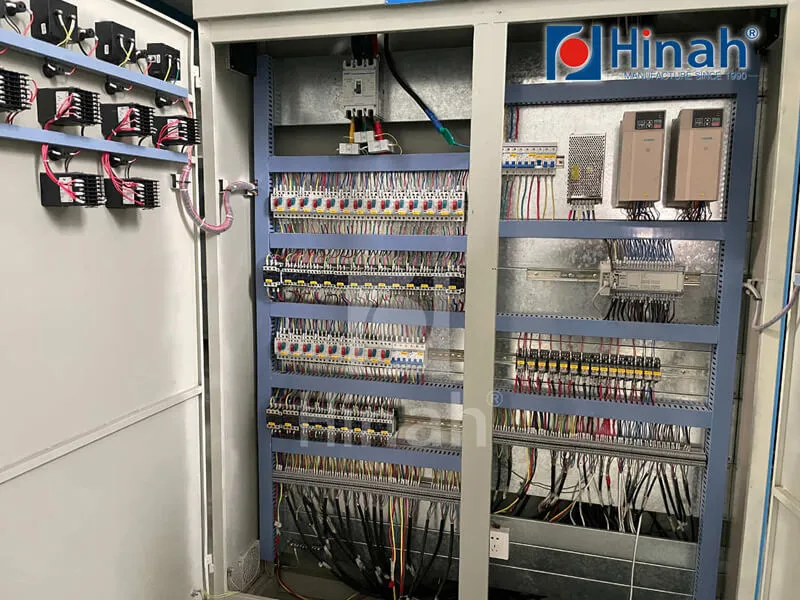
Modern coating oven systems are no longer standalone. They communicate with upstream application booths and downstream cooling tunnels via PLC and SCADA. Features of an advanced control package include:
Recipe management: Store 100+ cure profiles for different product families, automatically recalled by barcode or RFID.
Real-time part tracking: Infrared sensors detect part presence and adjust zone setpoints preemptively.
Predictive maintenance: Vibration sensors on fan bearings, flame failure logging, and insulation degradation alerts.
Remote access: Engineers can diagnose temperature excursions or burner lockouts via VPN, reducing mean time to repair (MTTR) by 60%.
For powder coating plant operators, integrating the oven with booth recovery systems (cyclones or cartridge filters) allows demand-based fan speed control, further reducing electrical consumption.
A1: For most industrial powder applications (agricultural, construction, general fabrication), a uniformity of ±5°C is acceptable. For high-gloss architectural or automotive clear coats, ±3°C is required. Aerospace specifications (e.g., AMS 2750E) may demand Class 2 uniformity (±3°C) or Class 1 (±1.5°C) for critical components. Uniformity is measured using a 9-point or 12-point thermocouple array across the work zone during loaded conditions.
A2: HANNA recommends a full thermal uniformity survey every 12 months for continuous ovens and every 18 months for batch ovens. However, if you observe increased defect rates (orange peel, discoloration) or after any major modification (new fan, burner replacement, ductwork repair), remap immediately. Between professional surveys, use portable data loggers on parts monthly to verify cure conditions.
A3: Yes, but with modifications. Liquid paint ovens often have direct-fired burners (combustion products enter the oven) and lower airflow velocities. For powder, you must convert to indirect heating (heat exchanger) to prevent soot or silicone contamination. Also increase recirculation fan capacity to achieve 0.8–1.2 m/s airflow. Finally, install a fresh air purge system to remove volatiles. Powder coating plant specialists can advise on retrofit feasibility.
A4: With proper maintenance (quarterly burner inspection, annual fan bearing lubrication, insulation checks), the steel structure lasts 25–30 years. Burners and heat exchangers typically require replacement every 8–12 years. Recirculation fan motors (continuous duty) last 15–20 years. Electric infrared ovens have shorter life — emitter panels degrade after 10,000–15,000 hours and need replacement every 5–7 years in high-use lines.
A5: The formula is: Oven length (m) = Line speed (m/min) × Required dwell time (min). For powder coating, dwell time at metal temperature is typically 10 minutes, but you must add ramp-up zone length (time to reach cure temperature). Example: line speed 2 m/min, ramp-up 4 minutes, soak 10 minutes → total 14 minutes → length 28 meters. Add 20% margin for load variation. HANNA provides free line design simulation upon request.
Whether you require a batch oven for small-series production or a high-speed continuous system for automotive volumes, HANNA delivers engineered solutions with guaranteed thermal performance. Our scope includes CFD analysis, burner selection, insulation specification, control system integration, and on-site thermal validation. We also offer retrofits for existing ovens — adding IR boost zones, VFDs, or heat recovery modules.
Send your part drawings, desired throughput, and coating chemistry to our technical sales team. We will respond with a detailed proposal, including energy consumption estimates and ROI calculation.
Submit your coating oven inquiry to HANNA engineering or use the online form for a prompt consultation.