
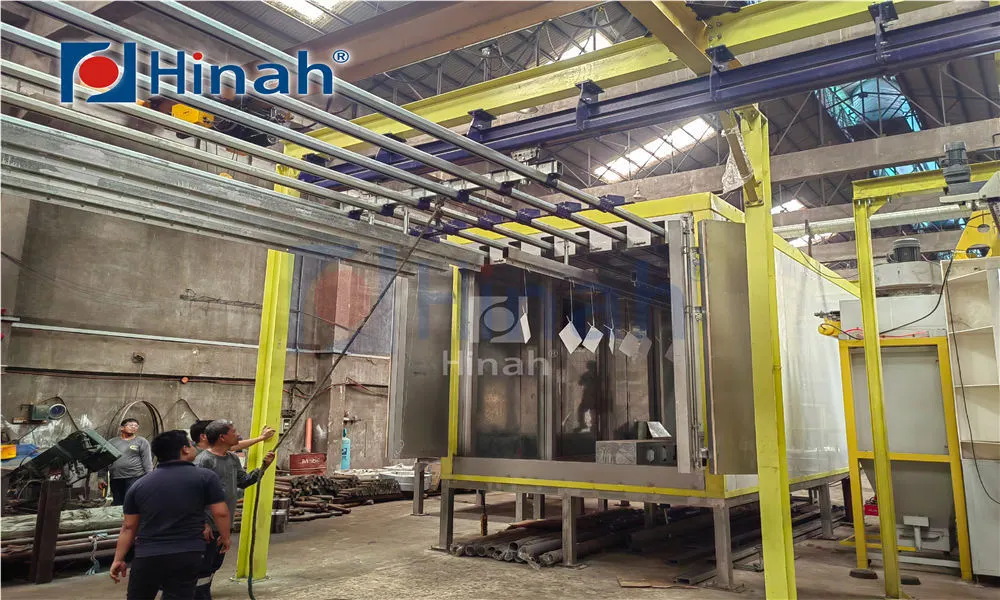
For job shops, R&D facilities, and manufacturers with limited floor space, a properly designed Small powder coating booth delivers the same finish quality as industrial-scale systems while minimizing powder waste and color change downtime. However, downsizing introduces unique challenges: maintaining uniform airflow velocity, achieving adequate powder recovery with compact filter arrays, and preventing cross-contamination between colors. This guide examines technical specifications, application scenarios, and performance validation methods for compact booths. Drawing on data from over 60 installations – including solutions from HANNA – we analyze how to select, configure, and operate a Small powder coating booth that meets high-mix production demands without compromising transfer efficiency or operator safety.
Industry practice classifies a Small powder coating booth as any enclosure with a face opening below 2.5 m² and an overall footprint under 12 m². Typical applications include:
Job shops coating parts up to 1.2 m × 0.8 m × 0.6 m.
In-house finishing lines for OEMs producing 50–500 parts per shift.
Laboratory and pilot plant booths for powder formulation testing.
Secondary touch-up stations adjacent to larger automatic lines.
Despite their compact size, these booths must incorporate the same core subsystems as full-scale units: extraction airflow, filtration (cyclone or cartridge), powder reclaim, and lighting. The key difference lies in component integration and modularity.
Proper airflow is the most critical factor for operator safety and coating quality. In a small powder coating booth, the face velocity must remain between 0.4 and 0.7 m/s (80–140 fpm) to contain overspray without pulling powder away from the target. Three common airflow architectures:
Crossdraft booths – Air moves horizontally from the operator side to the rear exhaust plenum. Simple and low-cost, but prone to turbulence at the booth edges. Best for non-critical applications or occasional use.
Downdraft booths – Air enters through a perforated ceiling and exits through floor grates. Provides superior particle containment and is preferred for high-quality finishes. Requires deeper floor pit or raised platform, increasing installation cost.
Semidowndraft (hybrid) – Air moves diagonally from upper rear to lower front. Compromise between cost and performance. Many Small powder coating booth designs use this configuration.
Critical measurement: perform an airflow velocity traverse across the face opening using a hot-wire anemometer. Variation should not exceed ±15% from the average. If dead spots exist, adjust the exhaust damper or add perforated baffles.
Compact booths typically employ one of three recovery methods, each with trade-offs in reclaim efficiency and color change speed.
Filter cartridges (polyester or cellulose, 0.5–1 µm rating) are mounted directly on the booth rear wall. A pulse-jet system cleans filters at set differential pressure (typically 1.0–1.2 kPa). Advantages: low initial cost, small footprint. Disadvantages: recovered powder is often contaminated with fines and cannot be reused for critical finishes. Suitable for single-color operations or low-value parts.
A small cyclone (diameter 300–600 mm) separates 80–90% of overspray before air reaches the secondary cartridge filter. The cyclone-collected powder remains clean enough for direct reclaim (typically up to 30% virgin blending). This configuration adds about 1.5 m to booth length but improves powder utilization by 25–35%. Many powder recovery systems from leading suppliers follow this architecture.
The booth connects to a central dust collector shared with other processes. Lowest capital cost, but reclaim is impossible (powder is discarded). Only recommended for very low throughput or when powder is inexpensive.
When selecting a Small powder coating booth, request the filter area-to-airflow ratio. A minimum of 10:1 (m² filter area per 1000 m³/h airflow) ensures reasonable pulse-jet intervals. For example, a booth with 2000 m³/h extraction needs at least 20 m² of filter media.
Frequent color changes are the primary operational bottleneck for compact booths. Manual cleaning of a single-stage cartridge booth can take 45–75 minutes. Engineered solutions reduce this to 15–20 minutes:
Quick-release cartridge modules – Filters mounted on swing-out frames with tool-less clamps. Complete filter exchange in under 5 minutes.
Smooth interior surfaces – Stainless steel with 2B finish (Ra <0.8 µm) and rounded corners prevent powder accumulation. Avoid booths with exposed fasteners or crevices.
Integrated blow-off ring – Compressed air nozzles inside the booth automatically purge residual powder from walls and floor after each job.
Modular cyclone with quick-disconnect hopper – Allows removal of the cyclone body for thorough cleaning between colors.
For shops running more than four colors per shift, consider a Small powder coating booth with a mobile cartridge module: keep one clean module in reserve while the other is in use, reducing downtime to the time needed to roll in the replacement.
The ideal booth size depends on part envelope and annual powder consumption. Below are three real-world configurations.
Part size: Up to 400 mm × 300 mm × 200 mm.
Booth dimensions: 1.2 m wide × 1.0 m deep × 1.8 m high (face opening 0.8 m).
Airflow: 1200 m³/h (face velocity 0.42 m/s).
Recovery: Single-stage cartridge with manual shaker (no pulse-jet).
Typical throughput: 10–50 parts per day, 1–2 color changes.
Part size: Up to 900 mm × 600 mm × 500 mm (e.g., bicycle frames, small enclosures).
Booth dimensions: 1.8 m wide × 1.5 m deep × 2.2 m high.
Airflow: 2800 m³/h (face velocity 0.55 m/s).
Recovery: Cyclone + cartridge with pulse-jet cleaning; reclaim hopper capacity 30 kg.
Color change time: 18 minutes (including gun cleaning).
HANNA supplied a similar booth to a Midwest job shop, reducing powder waste by 42% compared to their previous filter-only unit.
Part size: 300 mm × 200 mm × 100 mm (aluminum).
Booth dimensions: 1.0 m wide × 0.8 m deep × 1.6 m high (bench-top model).
Airflow: 800 m³/h (face velocity 0.5 m/s).
Recovery: External dust collector (no reclaim – powder discarded).
Throughput: 500 parts per shift, single color.
Based on post-installation audits, the following errors frequently occur with compact booths.
Underestimating filter area – A filter that loads too quickly forces frequent pulsing, which can blow powder back into the booth. Calculate the required filter area based on expected powder usage (typically 1 m² per 2–3 kg/hour of powder sprayed).
Ignoring compressed air quality for pulse cleaning – Oil or moisture in the pulse air ruins filter efficiency. Install a dedicated refrigerated dryer and coalescing filter (0.01 µm) for the pulse system.
Insufficient lighting – Many small booths come with only one fluorescent tube. Add LED floodlights (5000K, >1000 lumens) on both sides to properly inspect the coated part before curing.
No floor grating or anti-static flooring – Powder accumulation on a painted steel floor creates static discharge hazards. Specify stainless steel grid flooring grounded to the booth frame.
Overlooking explosion venting – Even small booths handling combustible powder require deflagration venting per NFPA 33 or local codes. Ensure the supplier provides certified burst panels or flameless vents.
Before final acceptance of a Small powder coating booth, verify the following parameters on site:
Face velocity uniformity – Measure at nine points across the opening. Maximum deviation ≤15%.
Filter pressure drop – Clean filters should show 0.3–0.5 kPa at rated airflow. After 30 minutes of spraying, increase should be less than 0.3 kPa.
Overspray capture efficiency – Spray a known weight of powder (e.g., 500 g) onto a target. Weigh the powder collected in the reclaim hopper. Efficiency should exceed 90% for cyclone designs, 75% for cartridge-only.
Sound pressure level – Below 80 dBA at operator position (measured with a Type 2 sound level meter).
HANNA provides a commissioning checklist with calibrated instruments for each booth delivered, including a hot-wire anemometer and micro-manometer.
Recent innovations make compact booths more productive and safer.
IoT-enabled filter monitoring – Sensors transmit differential pressure and pulse cycle counts to a cloud dashboard. Alerts are sent when filter loading exceeds a threshold or when pulse frequency indicates abnormal wear.
Modular explosion panels – Lightweight carbon-fiber burst panels replace heavy steel doors, reducing installation weight by 60%.
Electrostatic grounding verification – Continuous monitoring of booth resistance to ground (target <10 ohms) with an interlock that disables powder spray if grounding fails.
Integrated powder feed center – Small fluidizing hopper (5–10 kg) with a pick-up lance and venturi pump mounted directly on the booth side, eliminating external feed hoses.
A1: For a downdraft booth with a floor pit for exhaust, total height from floor to ceiling must be at least 3.2 m (2.0 m booth height + 1.0 m pit + 0.2 m clearance). For semidowndraft booths without a pit, 2.5 m is sufficient. Always consult the supplier's dimensional drawings before site preparation.
A2: No. Powder booths are designed for dry particulate extraction and require explosion-proof components (filters, fans). Liquid paint booths need water wash or dry filters for solvent-borne overspray, and different fire suppression systems. Cross-using a powder booth for liquid paint creates a severe fire and health hazard.
A3: With proper pulse-jet cleaning and weekly blow-down, polyester cartridges last 12–24 months. Replace when the pressure drop at rated airflow exceeds 1.5 kPa after pulsing, or when visible tears or pinholes appear. Keep a log of differential pressure to predict replacement needs. Powder coating booth manufacturers like HANNA offer filter life monitoring kits.
A4: Assume powder cost $6/kg, weekly consumption 50 kg, reclaim efficiency improves from 75% (cartridge only) to 92% (cyclone + cartridge). Recovered powder value = 50 kg × 52 weeks × 0.17 (increment) × $6 = $2,652 annual savings. Cyclone module costs ~$3,500 installed → payback ~16 months. For two-shift operations, payback drops below 12 months.
A5: No. The booth requires compressed air for pulse-jet filter cleaning (typically 6–8 bar, 200–500 L/min). Additionally, most powder spray guns need atomization air (4–6 bar). A small 3–5 HP compressor with a 200 L receiver is sufficient. Ensure the compressed air is dry and oil-free to prevent powder clumping.
A6: Follow NFPA 33 guidelines: disconnect power, ground all tools, use only non-sparking scrapers (brass or plastic), and vacuum powder with an anti-static vacuum cleaner rated for Class II dust. Never use compressed air to blow powder off walls – this creates a dust cloud and static risk. After vacuuming, wipe surfaces with a damp microfiber cloth (water only).
Selecting the right Small powder coating booth requires balancing floor space, color change frequency, and reclaim economics. Generic quotations often overlook your specific part mix and shift patterns. HANNA provides a no-cost, two-step engineering review: (1) remote evaluation of your current powder usage and defect rates, (2) a 3D layout of a recommended booth configuration with projected material savings and color change downtime reduction.
Send the following details to receive a technical comparison within 2 business days: part dimensions (max L×W×H), weekly powder consumption (kg), number of colors per shift, and available floor space (m²). All inquiries receive a CFD airflow simulation video showing powder containment performance inside the proposed booth.
Contact HANNA’s powder coating specialists now: https://www.autocoatinglines.com/contact.html – mention “Small booth inquiry” in the subject line for priority engineering support.