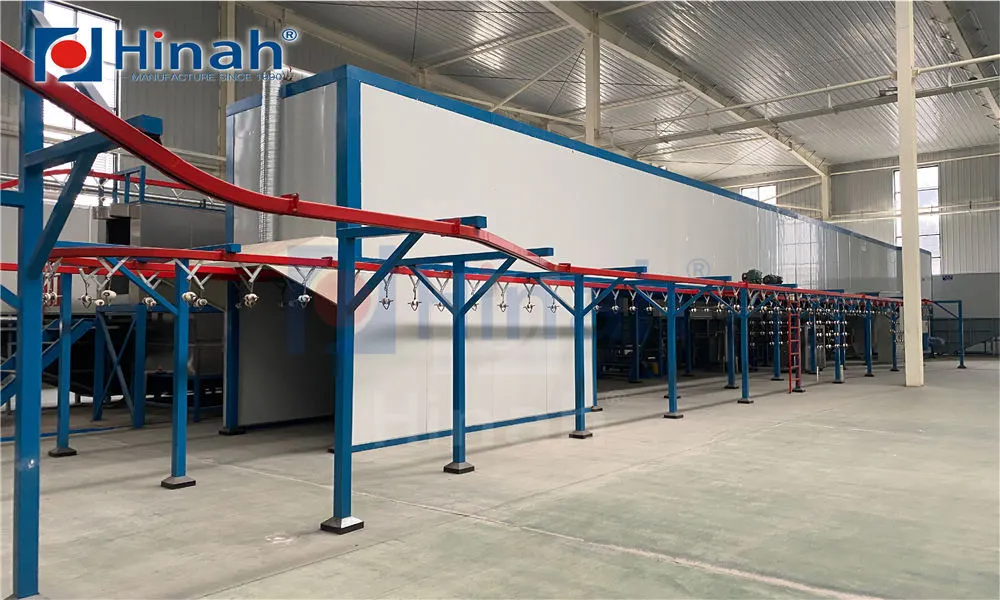

In modern metal finishing lines, the powder coating spray booth is far more than an enclosure. It determines transfer efficiency, reclaim rates, surface quality, and operator safety. When improperly configured, even a premium powder formulation yields orange peel, back-ionization, or excessive overspray waste. This guide analyzes technical parameters, common failure modes, and engineered solutions from a practitioner’s perspective — grounded in fluid mechanics, electrostatic principles, and real production constraints. HANNA integrates these principles into turnkey coating lines, but the knowledge applies to any facility aiming for leaner, cleaner, and more consistent powder application.
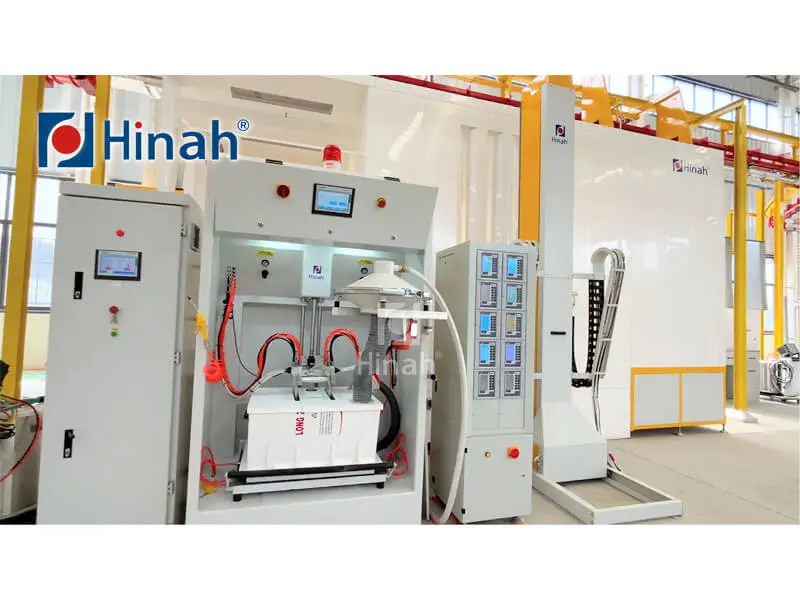
A professional powder coating spray booth fulfills four simultaneous objectives: containment of airborne powder, recovery of overspray for reuse, operator protection against particulate exposure, and prevention of cross-contamination during color shifts. Beyond these basics, high-throughput lines demand rapid booth cleaning (<10 minutes for color change) and stable air curtains that prevent powder drift into the factory environment.
Industry benchmarks (based on ISO 16000-9 and NFPA 33) define acceptable performance metrics:
Face velocity – 0.4 to 0.7 m/s (80–140 fpm) for consistent powder capture without disturbing the spray pattern.
Recovery efficiency – >95% for cartridge-filter booths with pulse-jet cleaning; >98% for cyclonic + secondary filter systems.
Airborne particulate concentration – below 0.5 mg/m³ at operator breathing zone (OSHA PEL for nuisance dust is 15 mg/m³, but powder coating requires stricter limits).
Color change downtime – under 15 minutes for well-designed modular booths with quick-release floors and non-stick coatings.
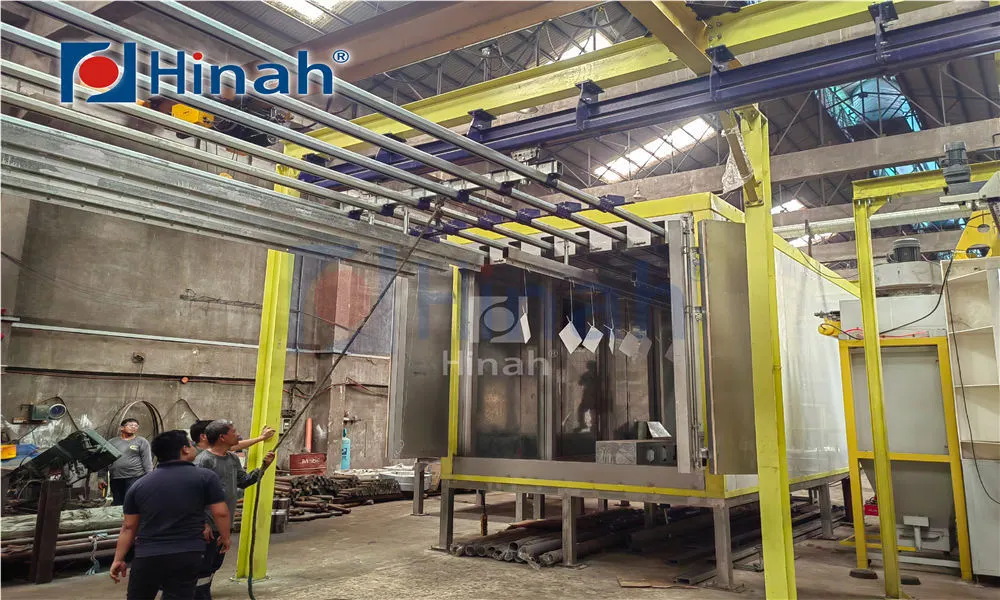
Airflow pattern dictates powder transport and deposition uniformity. Cross-draft booths (horizontal airflow from rear to front or side-to-side) are common for manual operations but risk turbulence around complex parts. Downdraft designs, where filtered air enters from the ceiling and exits through the floor grates, minimize eddies — ideal for robotic coating of recessed surfaces. However, downdraft requires raised floor structures and higher capital investment. A hybrid semi-downdraft configuration (air pushed from ceiling and extracted at lower sidewalls) balances performance and cost, especially for mixed-product job shops.
For high-reclaim applications, the powder coating spray booth must maintain laminar flow across the entire cross-section. Turbulence leads to overspray migration into the clean room, uneven film build, and premature filter loading. Computational fluid dynamics (CFD) pre-design is now standard among suppliers like HANNA to predict dead zones before fabrication.
The heart of any recirculating booth is its filter array. Two dominant technologies exist:
Cartridge filter booths – Pleated cellulose-polyester media with pulse-jet backflushing. They capture particles down to 0.5 micron and allow direct powder reclaim into the feed hopper. However, moisture or improper grounding can cause blinding.
Cyclone + after-filter booths – Centrifugal separation extracts 90–95% of overspray mass, with the after-filter (cartridge or bag) capturing fine fractions. Cyclones are more tolerant to powder agglomerates but require larger footprint.
Selection factors: powder chemistry (epoxy/polyester hybrids release fines differently), production volume (batch vs. continuous), and color-change frequency. For multi-color operations, cyclone booths are harder to clean thoroughly, leading to cross-contamination. Cartridge systems with rapid-access filter doors and non-stick interior liners (e.g., PTFE-coated walls) drastically reduce cleaning time.
Powder-air mixtures are combustible. Every legal powder coating spray booth in North America must meet NFPA 33 requirements for deflagration venting. This includes pressure-relief panels sized to the booth volume, vent ducts directed to a safe exterior area, and electrically conductive booth materials (resistance <1 MΩ). Grounding continuity must be verified weekly; isolated powder hoses without embedded grounding wires are a frequent source of static ignition. HANNA designs all its booths with integrated ground verification ports and explosion vents certified to FM or ATEX standards.
Root causes include improper gun positioning, excessive air pressure, or poor booth airflow. Mitigation: Use electrostatic field mapping (Faraday cage avoidance) and install multi-axis reciprocators or robots. Add manual touch-up stations with adjustable voltage controls. A CFD-optimized booth reduces overspray drift, lifting first-pass efficiency to >65% even for recessed profiles.
Solution: Modular booth design with quick-disconnect floor panels, snap-in filter cassettes, and internal surfaces finished with silicone-free release coatings. For ultra-fast changeover (under 8 minutes), invest in a movable cartridge bank that slides out for cleaning while a spare bank operates. HANNA's slide-out filter trolley system reduces manual labor by 60% compared to fixed-cartridge booths.
Leakage stems from negative pressure imbalances or gaps around part entry/exit openings. Install velocity pressure sensors linked to variable-frequency drives (VFDs) on exhaust fans, maintaining constant face velocity regardless of filter loading. Sealed vestibules or double-door entry tunnels further contain powder in high-volume lines.
No single booth fits every application. Below are common configurations based on throughput and part geometry:
Batch (manual) booth – Small footprint, typically cross-draft, with single cartridge module. Suited for job shops with less than 3 color changes per shift.
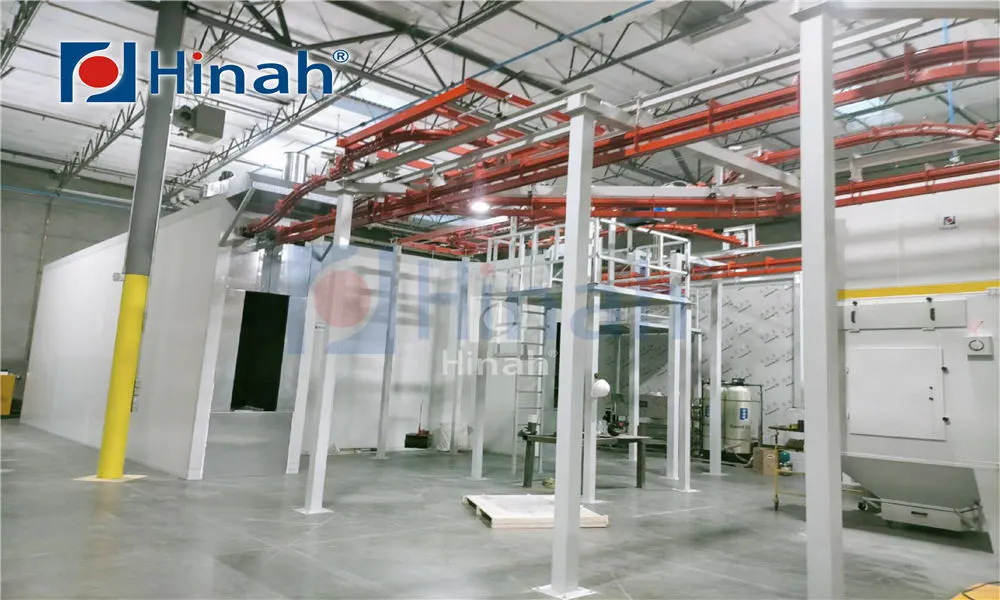
Continuous-motion automatic booth – Integrated with overhead conveyor or power-and-free system. Includes part-sensing guns, automatic cleaning cycles, and reclaim hoppers that feed directly into sieves. Downdraft is preferred for high-speed lines.
Compact all-in-one booth – Preassembled units with integrated dust collector, fan, and lighting. Ideal for low-volume manufacturers with limited floor space. Many of these are portable.
Stainless steel hygienic booth – For food-contact or medical components, featuring rounded corners, wash-down capable construction, and HEPA after-filtration.
When evaluating a new powder coating spray booth, always request face velocity mapping reports and filter loading test curves. A reputable supplier will provide these data for your specific powder type (e.g., TGIC-free, super-durable weatherable polyesters).
Modern factories integrate the booth with upstream pretreatment (washers, dry-off ovens) and downstream curing ovens. Communication via PLC ensures conveyor indexing stops when the booth performs self-cleaning or filter pulsing. Laser-based part profiling triggers zone-specific gun activation, reducing powder consumption by 15–25%. HANNA offers pre-engineered automation packages that synchronize the booth parameters with reciprocator stroke patterns and reclaim sieve timing.
Real-time IoT sensors now track differential pressure across each filter, hopper powder level, humidity inside the booth, and grounding continuity. Alerts are sent to maintenance dashboards before performance degrades. These smart features are particularly valuable for high-volume automotive and architectural aluminum extruders.
Preventive maintenance directly impacts the service life of your booth. Establish a weekly checklist:
Inspect all grounding clamps and ohmic continuity; clean any powder buildup from contact points.
Measure face velocity at three booth cross-sections using an anemometer; recalibrate VFDs if deviation exceeds ±10%.
Check pulse-jet timing and pressure; clogged diaphragms cause filter blinding and reduce suction.
Examine booth interior for powder caking on walls – use PTFE-based release spray where needed.
Replace cartridge filters when differential pressure exceeds 1.0 kPa (for new filters) or 1.5 kPa (end of life).
Annual recertification should include explosion vent inspection (look for corrosion or seal degradation) and ductwork leakage testing (smoke pencil method). For facilities running abrasive powders (e.g., metallic or textured finishes), upgrade to hardened floor plates and ceramic-lined cyclone cones.
When comparing suppliers, look beyond brochure specifications. Request documented evidence of:
CFD simulation reports customized to your part dimensions and line speed.
Certified laboratory data on filter efficiency for the specific powder particle size distribution (PSD).
Third-party verification of airborne dust concentration during simulated color change.
Availability of on-site commissioning with real-time face velocity verification.
HANNA provides each client with a detailed engineering binder containing all CFD files, filter certification sheets, and explosion vent calculations. Their service team also offers annual borescope inspections of duct interiors — a rarely offered value that prevents hidden fire hazards.
Q1: What is the acceptable face velocity range for a powder coating spray booth when coating heavy parts?
A1: For heavy parts (e.g., engine blocks, structural steel), maintain 0.5–0.7 m/s (100–140 fpm). Lower velocities (0.4 m/s) may cause powder fallout, while higher velocities blow powder off the part before melting. Always validate with an anemometer at the booth opening during peak production.
Q2: How often should cartridge filters be replaced in a high-volume powder coating line?
A2: Typically every 1,000–1,500 operating hours for polyester/cellulose cartridges, or 2,000 hours for nanofiber-coated media. Monitor differential pressure: when cleaning pulses no longer reduce pressure below 1.0 kPa (starting baseline), replacement is due. Heavy reclaimed powder with contaminants (zinc phosphate dust) accelerates wear.
Q3: Can a single powder coating spray booth handle both epoxy and TGIC-free polyester without cross-contamination?
A3: Yes, if the booth includes full cleanout features: removable floor panels, pull-out filter racks, and non-stick interior coating. However, for strict industrial or architectural finishes, dedicated booths per chemistry are safer. Cartridge systems with dedicated filter sets for each color family reduce cross-contamination risk.
Q4: What is the difference between a "recirculating" and "once-through" powder booth?
A4: Recirculating booths filter and return cleaned air to the factory (energy saving, climate control). Once-through booths exhaust air directly outdoors after filtration, requiring makeup air units. Recirculating is standard for powder due to low VOC emissions; once-through is rare and only used for toxic powders.
Q5: Does the booth material affect electrostatic wrap-around performance?
A5: Yes. Non-conductive materials (PVC, untreated polypropylene) accumulate surface charge, repelling charged powder particles and reducing wrap-around. Use grounded stainless steel or coated carbon steel booth walls. HANNA’s booths feature conductive composite panels that maintain field integrity without expensive stainless costs.
For a comprehensive evaluation of your production requirements — including line speed, part mix, and filter selection — contact the engineering team at HANNA. We provide site-specific CFD analysis, explosion safety audits, and turnkey integration with existing conveying systems. Send your project inquiry now to receive a detailed technical proposal and layout drawing within 48 hours.