
The curing process is the decisive stage in any painting operation. It is where wet paint transforms into a durable, protective film, and powder coating undergoes chemical cross-linking to achieve its final mechanical properties. A suboptimal paint curing oven leads to soft films, poor adhesion, color variation, and catastrophic adhesion failures. With energy costs rising and production demands intensifying, selecting the correct oven technology is a strategic financial and quality decision. This guide provides a technical roadmap for engineers and operations managers evaluating a new paint curing oven for their facility.
Understanding the dominant heat transfer method is fundamental to matching the oven to your product profile.
Convection ovens use heated air circulated by fans to transfer energy to the part. They are the workhorses of the industry, ideal for complex geometries, heavy-mass parts, and consistent temperature uniformity. Within convection, two sub-types dominate:
Direct-Fired: Combustion occurs inside the oven chamber. High efficiency (near 100% of the heat input is usable), but introduces products of combustion (water vapor, CO2) which may affect某些 chemistries.
Indirect-Fired: A heat exchanger isolates combustion byproducts from the oven atmosphere. Essential for cleanroom applications, certain medical coatings, or when using solvents sensitive to contamination.
IR ovens use electromagnetic radiation to directly heat the part surface, skipping air heating. They offer rapid ramp-up times and a smaller footprint. However, they are line-of-sight and struggle with shadowed areas. Many high-speed lines use a combination: an IR booster for rapid gelation, followed by a convection hold zone for complete cure. When you evaluate a paint curing oven for sale, consider whether a hybrid system could reduce your line length and energy consumption.
The physical layout must match your material flow and throughput requirements.
Batch Walk-In Ovens: Suitable for job shops, large parts, or low-volume production. Parts are loaded and cured in discrete loads. They offer flexibility but high labor costs per part.
Conveyorized Monorail Ovens: The standard for medium to high-volume production. Parts hang from an overhead conveyor and travel through a continuous oven. This design supports steady-state operation, maximizing thermal efficiency once at temperature.
Multi-Pass or “Z” Style Ovens: Designed to fit long cure times into compact floor space by moving parts vertically and horizontally through multiple passes inside a single insulated enclosure.
Calculating your required line speed and cure time is essential. A typical rule: oven length (ft) = line speed (ft/min) × cure time (min). If you need a 20-minute cure at 10 ft/min, you need a 200 ft long oven.
Energy represents the largest variable operating cost of a finishing line. When comparing a paint curing oven, efficiency metrics are non-negotiable.
Insulation Quality: Look for 4" to 6" of high-density mineral wool or ceramic fiber. Higher R-value reduces skin temperature and heat loss. Verify that panel joinery is airtight to prevent thermal bypass.
Recuperation Systems: Advanced ovens can incorporate heat recovery wheels or run-around coils to pre-heat combustion air using exhaust heat. This can reduce gas consumption by 15-20%.
Variable Frequency Drives (VFDs): On recirculation fans, VFDs adjust airflow based on actual load, saving significant electricity during idle or low-production periods.
Simply reaching a setpoint is insufficient. The part must experience the correct time-at-temperature profile. ASTM standards often require ±5°C (±9°F) uniformity across the workspace after stabilization.
Achieving this requires computational fluid dynamics (CFD)-designed plenums and nozzle configurations. High-velocity air impingement (slot nozzles) can penetrate part clusters and break up thermal boundary layers. Without proper air seals at entry and exit points, cold air infiltration destroys uniformity. HANNA engineers utilize thermal profiling during commissioning to validate that every square inch of the product meets the cure window.
The oven is a tool to execute a chemical reaction defined by your coating supplier. Different chemistries impose specific constraints:
Powder Coatings: Require precise substrate metal temperature (typically 180°C-200°C for 10-20 minutes). Under-bake results in poor impact resistance; over-bake causes yellowing or brittleness.
Liquid High-Solids/Solvent-Borne: Require controlled solvent evaporation before cross-linking. Too fast a ramp can cause solvent popping (blisters).
Waterborne Coatings: Often require a de-gas flash-off stage prior to the main cure zone to prevent boiling and film defects.
Your paint curing oven for sale must accommodate these profiles, potentially with multi-zone temperature control.
For liquid paint lines, the oven exhaust contains Volatile Organic Compounds (VOCs) evaporated during cure. In many jurisdictions, these emissions must be treated before release. This is typically achieved via:
Thermal Oxidizers (Direct-Fired or Regenerative - RTO): Destroy VOCs at high temperature (760°C+). RTOs are highly efficient (95%+ heat recovery) for large air volumes.
Catalytic Oxidizers: Operate at lower temperatures (315°C-425°C) by using a catalyst. Lower operating cost but sensitive to catalyst poisons (e.g., silicones).
Integrating the oven control system with the oxidizer is critical for safety (ensuring LEL limits are not exceeded) and energy optimization.
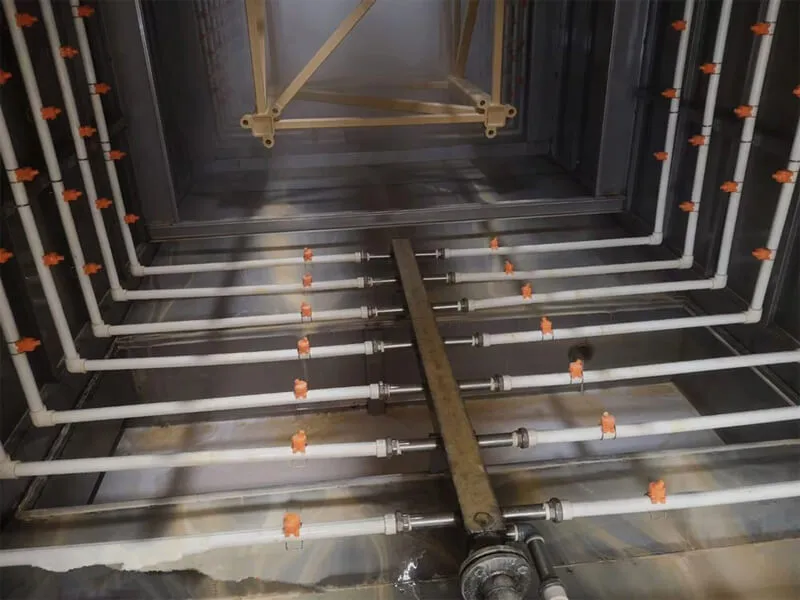
Modern Industry 4.0 principles demand more than a simple thermostat. A best-in-class paint curing oven features a PLC-based control system with:
PID loop control for precise temperature management.
Data logging of actual part temperatures (via trackable thermocouples or IR sensors).
Remote monitoring and alarm capabilities.
Integration with plant-wide MES systems for batch traceability.
This data is essential for quality assurance in sectors like automotive, aerospace, and defense, where cure traceability is a contractual requirement.
HANNA brings decades of thermal process engineering to every project. Their curing ovens are not assembled from generic components but are designed as integrated systems. From the structural integrity of the steel framework to the selection of burners (Eclipse, Maxon, etc.) and the logic of the control architecture, HANNA focuses on long-term reliability. They offer modular oven designs that can be expanded as production grows, and their systems are pre-wired and tested to reduce on-site installation time. For operations where uptime is critical, HANNA's predictive maintenance alerts, based on real-time pressure and temperature trends, prevent unexpected shutdowns.
Use this technical checklist during vendor evaluation:
Define your product mix: Maximum part mass, material (steel vs. aluminum heats at different rates), and line speed.
Obtain a thermal profile guarantee: Require the vendor to guarantee part temperature uniformity, not just air temperature.
Calculate total connected load: Understand the BTU/hr gas consumption and electrical amperage.
Review material specs: Ensure interior linings are appropriate (e.g., stainless steel for corrosion resistance).
Verify safety systems: Compliance with NFPA 86 (Standards for Ovens and Furnaces) is mandatory, including purge cycles, high-limit controls, and safety shut-off valves.
Assess maintenance access: Are burner trains easily accessible? Are there viewing ports and light fixtures for internal inspection?
Q1: How do I determine the correct size for a paint curing oven?
A1: Size is dictated by part dimensions and required dwell time. For a continuous oven, length = line speed (ft/min) × required cure time (minutes). Add 2-3 ft of entry/exit vestibules for air seals. For a batch oven, interior dimensions must accommodate your largest rack/fixture with 12-18 inches of clearance on all sides for air circulation.
Q2: What is the difference between a gas-fired and electric infrared curing oven?
A2: Gas-fired convection ovens heat the air, which then heats the part. They are best for mixed loads and thick parts. Electric infrared ovens emit radiant energy that directly heats the part surface. IR is faster and more energy-efficient for thin, flat parts or for rapidly gelling powder coatings, but it cannot cure recessed areas effectively without supplemental convection.
Q3: What does "NFPA 86 compliant" mean for my oven?
A3: NFPA 86 is the US standard for ovens and furnaces. Compliance means the oven includes mandatory safety features: pre-ignition purge cycles to remove flammable vapors, high-temperature limit controllers independent of the operating controller, flame safety systems, and proper interlocks. It is essential for insurance approval and operator safety.
Q4: Can I retrofit my existing oven to be more energy efficient?
A4: Yes. Common retrofits include adding VFDs to recirculation fans, upgrading insulation, installing better door seals, and adding a heat recovery system to pre-heat combustion air. Retrofitting can often pay for itself in 1-3 years through reduced energy bills.
Q5: How often should I perform a thermal profile study on my curing oven?
A5: At a minimum, annually, or whenever there is a significant change in product mix, line speed, or oven settings. Regular profiling (using a data logger with thermocouples attached to actual parts) verifies that your cure schedule is still being met and can identify developing issues like burner degradation or airflow blockages before they cause rejects.
Q6: What materials are typically used for the interior lining of a curing oven?
A6: Aluminized steel is common for general-purpose ovens operating up to 500°F (260°C). For higher temperatures, corrosive environments, or cleanroom applications, stainless steel (304 or 316) is used. The floor often uses heavier-gauge tread plate to withstand cart traffic.
Selecting the right paint curing oven is a complex engineering decision with long-term implications for quality and cost. By focusing on heat transfer science, energy recovery, and safety compliance, and by partnering with an experienced integrator like HANNA, you ensure your finishing line delivers consistent, high-value results. Visit https://www.autocoatinglines.com/ to discuss your thermal process requirements with our engineering team.