When finishing oversized components — from agricultural machinery frames to wind turbine towers — the large powder coating oven determines line capacity and finish durability. Unlike small batch units, a large powder coating oven must resolve non-linear thermal gradients across parts that may exceed 12 meters in length. This article examines heat transfer physics, recirculation architecture, and energy recovery methods, backed by field data from HANNA installations in North America and Europe.
Industry practice classifies a large powder coating oven based on chamber volume (>150 m³) or conveyor width (>2.5 meters). Critical thresholds:
Batch ovens – internal height >3.5 m to accommodate stacked racks of castings.
Continuous (walk-in) tunnels – heated length >10 m with multiple temperature zones.
Mass throughput >2,000 kg/hour of steel parts, requiring rapid heat recovery after cold load entry.
Heavy fabrications demand a large powder coating oven with forced vertical airflow to defeat thermal stratification — a known failure in under-designed units. Powder coating plant integration further requires synchronization between the oven and upstream spray booth to avoid partially cured powder sagging.
Physical scale introduces three persistent issues:
In a 3.5m-wide oven, side-wall losses can create a 15°C drop from center to edge. This results in under-cured powder on outer flanges. Solutions include:
Adjustable side-wall air nozzles (60° deflection toward load).
Dual plenum chambers with independent damper control.
Computational fluid dynamics (CFD) validation before construction — a standard step in powder coating plant design from HANNA.
Heavy-duty I-beam monorails or skids act as parasitic heat sinks. A 100m-long conveyor absorbs energy continuously, increasing gas consumption by 18-25%. Mitigation: install thermal breaks (ceramic fiber pads) at conveyor penetrations and use variable-frequency drives (VFDs) on fans to modulate airflow during idle periods.
When processing thin sheets (2mm) alongside 50mm solid bars, the thin parts reach cure temperature three times faster. Over-curing degrades impact resistance. Advanced ovens employ zoned heating with independent PID loops and traversing thermocouples to adjust conveyor speed dynamically — a feature available on HANNA continuous lines.
Natural gas remains dominant for high-throughput facilities due to lower operating cost (approximately 0.03 USD per kWh-equivalent vs. 0.12 USD for electric resistance). However, two gas-fired configurations exist:
Direct-fired (open flame): Efficiency up to 92%, but combustion moisture (≈10% H₂O by volume) can degrade TGIC-free polyester powders. Only recommend if powder manufacturer confirms moisture tolerance.
Indirect-fired (air-to-air heat exchanger): Protects powder chemistry completely, but efficiency drops to 78-84%. Powder coating plant designs from HANNA use condensing heat exchangers on indirect units to recover latent heat, reaching 91% efficiency.
For facilities with strict NOx permits (Southern California, Germany), catalytic infrared panels offer an electric alternative with zone control — though radiant transfer requires line-of-sight, unsuitable for complex geometries.
A large powder coating oven predominantly uses forced convection for uniform heating of blind cavities and internal surfaces. Key performance parameters:
Air velocity at part surface: 3–6 m/s (higher for heavy sections to break boundary layer).
Air change rate: 6–10 volumes/minute to maintain uniform temperature profile.
Crossflow vs. updraft design: Updraft (floor-to-ceiling) reduces dust settlement but requires high-static fans (≥1,500 Pa).
Infrared boosters can be added at the oven entrance to rapidly raise powder gel temperature, reducing total dwell time by 15-20%. However, IR alone fails for internal walls — a combined IR-convection hybrid is preferred for tractor chassis or engine blocks.
Surface heat loss through oven walls is proportional to exposed area. For a 20m x 4m x 3m oven, wall losses exceed 80 kW at 200°C without proper insulation. Standards:
Mineral wool density 128–160 kg/m³, thickness 150 mm for sidewalls, 200 mm for roof.
Thermal break floor design using aerated concrete blocks (conductivity <0.2 W/mK).
Air-to-air heat recovery on exhaust: plate exchangers capture 60-70% of waste heat to pre-heat fresh combustion air. Payback period 9–14 months for 2-shift operation.
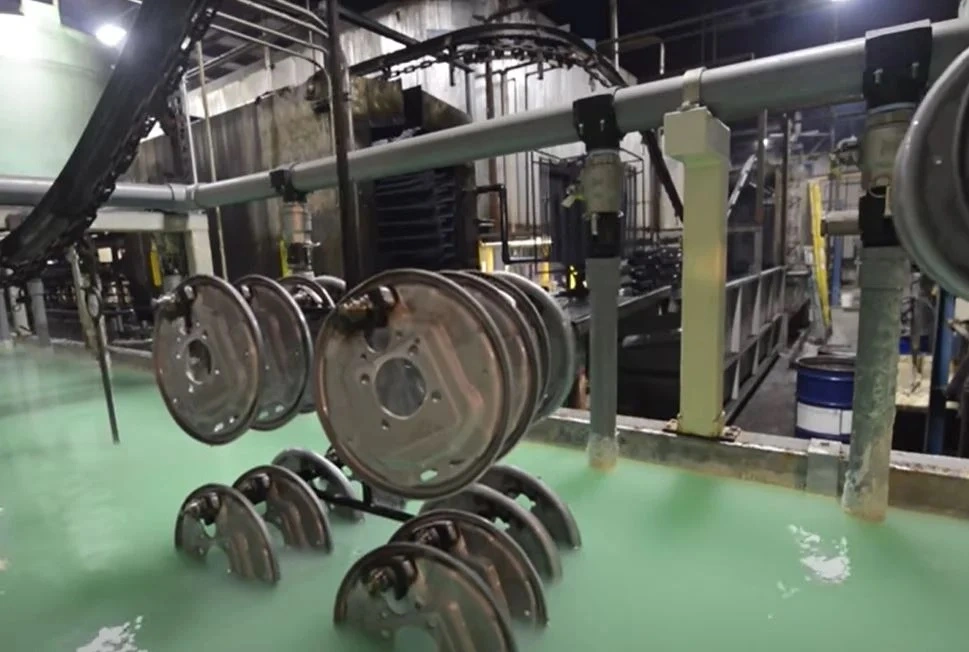
Case example: A Midwest US fabricator running a large powder coating oven for agricultural discs reduced gas consumption by 31% after retrofitting a condensing heat exchanger and adding 50mm of ceramic blanket over existing insulation. The powder coating plant upgrade was supplied by HANNA with a 22-month ROI guarantee.
Material handling inside a large powder coating oven must withstand 200–230°C without lubrication degradation. Recommended solutions:
Overhead power-and-free chain with high-temperature grease (Mobil SHC 100 series).
Skids on roller slats using ceramic bearings (zirconia or silicon nitride).
Monorail expansion joints every 12 m to accommodate thermal expansion (calc: ΔL = α × L × ΔT; α for steel = 12×10⁻⁶ /°C).
Loading density directly affects cure consistency. Parts should maintain 300–500 mm clearance from walls and between adjacent hangers. CFD studies show that random packing creates flow recirculation zones; use standardized racking patterns as defined in the powder coating plant layout from HANNA.
For large industrial components, destructive testing (mandrel bend, impact resistance) is impractical for every batch. Non-destructive methods include:
Data-logged thermocouples attached to three critical points (thin, medium, thick mass).
Infrared thermal imaging of parts exiting the oven — detect cold spots >5°C below setpoint.
Conductivity probes: fully cured powder acts as a dielectric; capacitance changes indicate degree of cross-linking.
ISO 2360 measurement of film thickness should be done after cooling. If thickness is within spec but adhesion fails, review the dwell time at gel phase — a common issue in large powder coating oven operations with variable load size.
Field audits across 34 heavy industrial sites revealed these high-frequency problems:
Powder orange peel on vertical surfaces → air velocity too high (>8 m/s) blowing powder off before gelation.
Pinholes on flat horizontal surfaces → moisture contamination of powder (check compressed air dryer or oven humidity).
Edge corrosion after 6 months → under-cured powder in recesses; increase dwell time by 5 minutes.
Higher gas bills without load change → slipping VFD belts or dirty burner nozzles (clean quarterly).
Conveyor stops during peak hours → overload due to thermal expansion misalignment; install spring-loaded take-up units.
Each fault has a documented correction procedure. HANNA offers remote diagnostic services using live PLC data to identify these issues without a site visit.
Different industries demand customized large powder coating oven configurations:
Wind tower sections (20m long): Requires segmented oven with retractable end doors and multiple IR panels for internal flange curing. Conveyor speed 0.8 m/min, dwell 45 minutes.
Railway wagons: Walk-in oven width 5m, height 4.5m. Uses downdraft airflow to clear outgassing from rubber suspension components. Maximum temperature 180°C for hybrid powder-paint systems.
Aluminum extrusion (6-12m): Horizontal airflow from side walls prevents distortion (temperature gradient ≤±3°C). Gas-fired indirect with ceramic recuperators.
Heavy truck chassis (10,000 kg): Floor-type chain conveyor with ceramic rollers. Oven includes a 6-zone heating profile to slowly ramp thick sections (max rate 5°C/min).
For each, the integration with a complete powder coating plant ensures upstream chemical pretreatment and downstream cool-down match oven throughput.
A1: Custom-built ovens can process parts up to 25 meters in length, 5 meters in width, and 4.5 meters in height — common for mining equipment or marine containers. For longer components (e.g., wind blades), modular ovens are built in sections and assembled on-site. Standard Large powder coating oven designs from HANNA start at 6m length and scale in 2m increments.
A2: Use the thickest part's time-to-temp as the minimum dwell. Measure with a surface thermocouple attached to the heaviest section. Multiply that measured time by 1.15 (safety factor for powders requiring cross-linking). For example, if a 40mm plate reaches 200°C after 18 minutes, set dwell to 20.7 minutes. Never reduce dwell to protect thin parts — instead, shield thin parts with perforated metal sheets during curing.
A3: Yes, but three modifications are mandatory: (a) remove all solvent residue by baking at 250°C for 24 hours, (b) install high-efficiency particulate air (HEPA) filters to capture airborne powder before it recirculates, and (c) reduce maximum temperature to ≤200°C for polyester powders. Gas-fired ovens with direct combustion may need an indirect heat exchanger to prevent moisture absorption by hygroscopic powders. Powder coating plant retrofits are a standard service from HANNA.
A4: A batch oven (20m³ capacity) costs approximately $85,000–$120,000, while a continuous tunnel (15m long, 2.5m wide) starts at $210,000, plus conveyor integration ($45,000–$90,000). However, continuous ovens achieve 3–4 times higher throughput (2,500 parts/day vs. 600 parts/day). For production >8,000 kg/day, continuous is more economical within 18 months.
A5: Most likely cause: recirculation fan impellers have eroded from powder abrasion, reducing airflow. Perform a pitot tube traverse at six points across the oven width. If velocity variation exceeds 20%, replace impellers with hardened steel (AR400) or install new VFDs to rebalance. Also inspect insulation for sagging — mineral wool compresses over time, creating thermal bridges. Re-pack compressed sections and add a 25mm ceramic fiber blanket overlay.
Selecting a large powder coating oven requires more than just size — it demands thermal modeling, load-specific airflow design, and energy recovery that fits your production profile. HANNA provides CFD-validated designs, modular construction for rapid installation, and global commissioning support. Whether you need a batch oven for 5-ton castings or a continuous tunnel for railcar sidings, our engineering team delivers guaranteed temperature uniformity (±4°C) and gas consumption below 0.8 kWh per kg of processed steel.
Request your customized solution now → Send inquiry to Nasar specialists for a no-cost thermal audit and ROI projection.