A large powder coating oven is a major investment for industrial finishing operations. It is the final, critical step that transforms a sprayed powder layer into a tough, durable, and visually consistent finish. Choosing the right system impacts your throughput, product quality, and long-term operational costs.
This guide details the essential considerations when you are in the market for a large powder coating oven. We will examine design principles, heating methods, and key features. Understanding these factors will help you select an oven that meets your production goals and provides reliable performance for years.
In industrial terms, "large" refers to both physical size and thermal capacity. These ovens are built for high-volume production or exceptionally big parts.
A large powder coating oven typically has one or more of these characteristics:
Designing an effective large powder coating oven presents unique engineering challenges not found in smaller units. Overcoming these is key to performance.
Achieving Temperature Uniformity
Maintaining a consistent temperature (±10°F or better) throughout a vast chamber is the primary challenge. Hot or cold spots lead to under-cured or over-cured finishes.
Solutions include:
Structural Integrity and Sealing
The structure must support its own weight, insulation, and internal components over a large span.
Energy Efficiency at Scale
Heating a large volume of air is expensive. Efficient design directly reduces operating costs.
The choice of heating technology is crucial for your large powder coating oven. Each has distinct advantages.
Direct-Fired Gas Convection
This is the most common method for large industrial ovens. Burners fire directly into the air stream circulating within the oven.
Indirect-Fired Gas Convection
Burners heat a heat exchanger, and clean air is circulated across it. This separates combustion gases from the curing chamber air.
Electric Convection
Resistive heating elements warm the circulating air. This is a clean and simple heating method.
Infrared (IR) or Combination Systems
For some large applications, IR panels can be effective, often in a hybrid "IR/Convection" system.
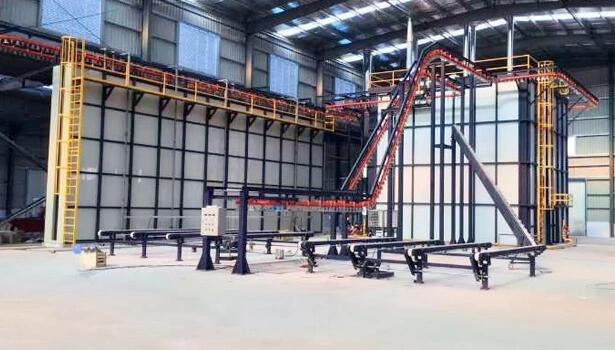
When evaluating a large powder coating oven, inspect the quality and design of these core components.
Air Recirculation System
This is the heart of a convection oven. For large ovens, multiple high-pressure fans are used.
Exhaust System
A properly sized exhaust removes volatiles released during curing and maintains a slight negative pressure.
Control and Monitoring System
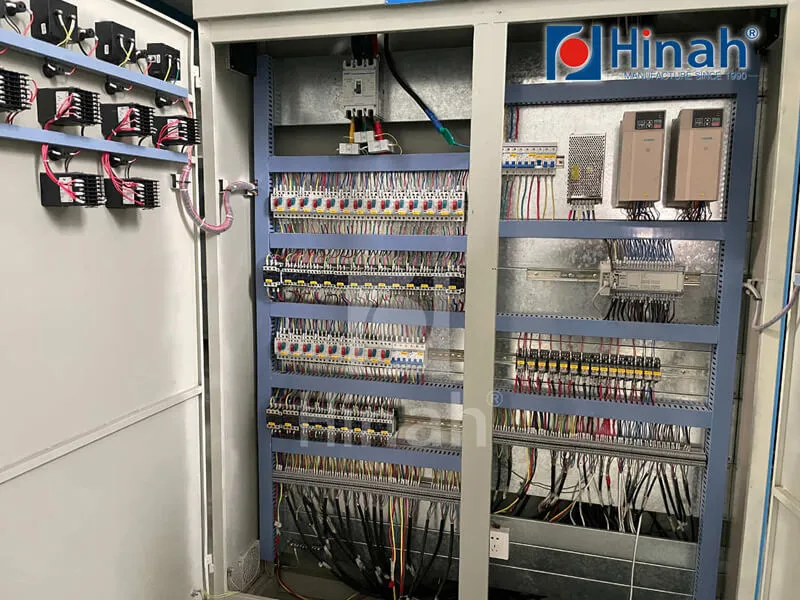
Advanced controls are non-negotiable for consistent results in a large oven.
Working with a manufacturer like HANNA requires clear specifications. Provide this information for an accurate design.
Your Curing Process Parameters:
Your Production Requirements:
Your Facility Constraints:
HANNA designs and builds large powder coating oven systems for demanding, continuous industrial use. Our focus is on delivering repeatable thermal performance and long-term structural reliability.
We address the scale challenge with proven engineering. From the initial framing to the final control panel, every component is selected for durability in your production environment.
Investing in a large powder coating oven is a strategic decision that will define your finishing capability for the next decade or more. A well-designed oven becomes a reliable, predictable asset on your production floor.
By understanding the engineering considerations and clearly defining your needs, you can select a system that delivers quality, efficiency, and value. A HANNA large powder coating oven is built to provide that performance consistently, supporting your business growth with dependable curing technology.
Frequently Asked Questions (FAQs)
Q1: What is the typical lead time for fabricating and installing a custom large powder coating oven?
A1: Lead times vary based on complexity and current project load. For a custom-designed large powder coating oven, expect a timeline of 14 to 22 weeks from finalized design to factory shipment. Site preparation and installation add additional time, which HANNA project managers help you plan.
Q2: How is temperature uniformity measured and verified in such a large space?
A2: Uniformity is verified through a temperature survey ("temp map"). Multiple data loggers or thermocouples are placed throughout the oven's workspace on a test rack. The oven is run at operating temperature, and data is collected. A well-designed HANNA oven should achieve a uniformity of ±10°F or better across the entire work zone.
Q3: Can a large oven be designed for both powder coating and liquid paint curing?
A3: Often, yes. The primary difference is the required cure temperature and the need to manage solvents. An oven for liquid paints typically requires a higher exhaust rate. When specifying your oven, discuss all potential coatings with your HANNA engineer so the system can be designed with the necessary flexibility.
Q4: What are the ongoing maintenance requirements for an industrial oven of this scale?
A4: Key maintenance tasks include:
Q5: Our facility has limited ceiling height. Can a large oven be designed in a "U" or "L" shape to fit?
A5: Yes, this is a common solution. Horizontal "U"-shaped (or "Dog-Leg") conveyor paths within the oven can maximize curing time within a limited building footprint. HANNA frequently designs these space-efficient layouts, ensuring proper airflow and temperature control through each zone of the oven's path.