
In industrial finishing, the powder coating production line is a complex, integrated system where each stage must perform in precise harmony. From soil removal to the final cured film, inefficiencies in one area cascade into defects and downtime in another. This article provides a technical deep dive into the complete powder coating production line—design parameters, common bottlenecks, and real‑world solutions—to help manufacturers achieve first‑pass yields above 98% and reduce total operating costs.
1. Pretreatment: The Foundation of Coating Adhesion and Corrosion Resistance
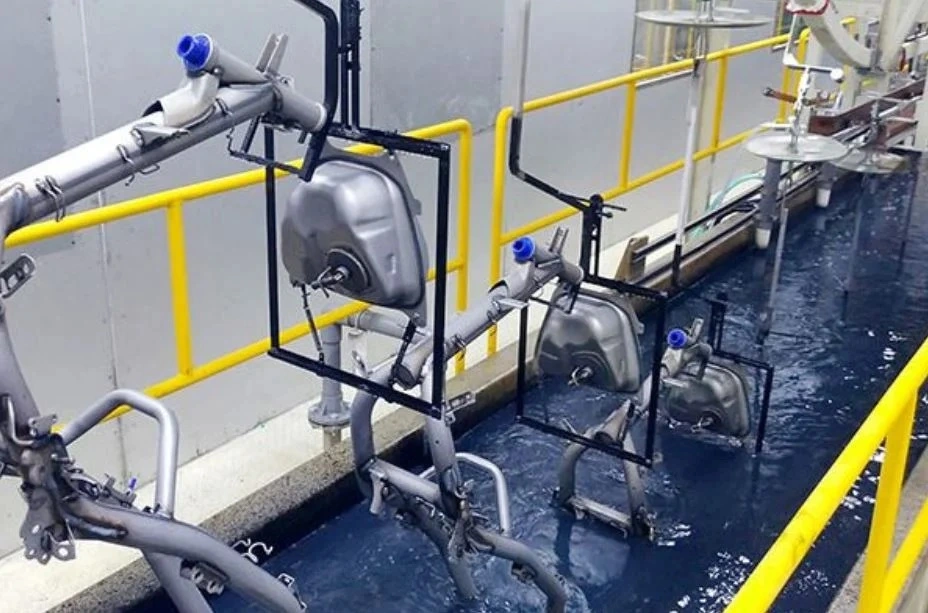
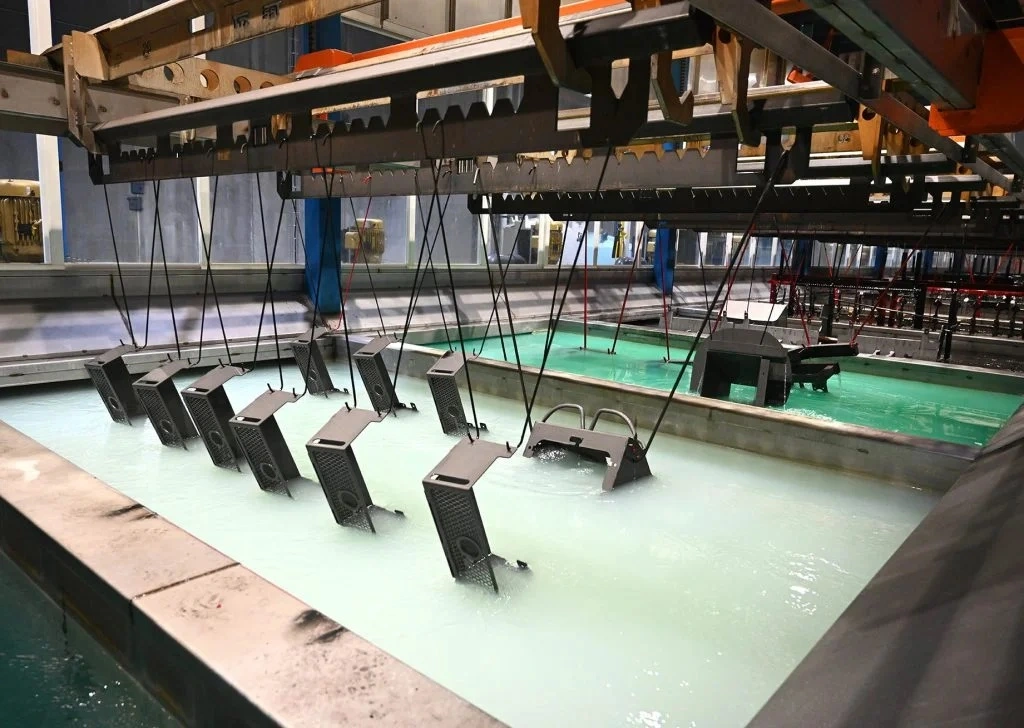
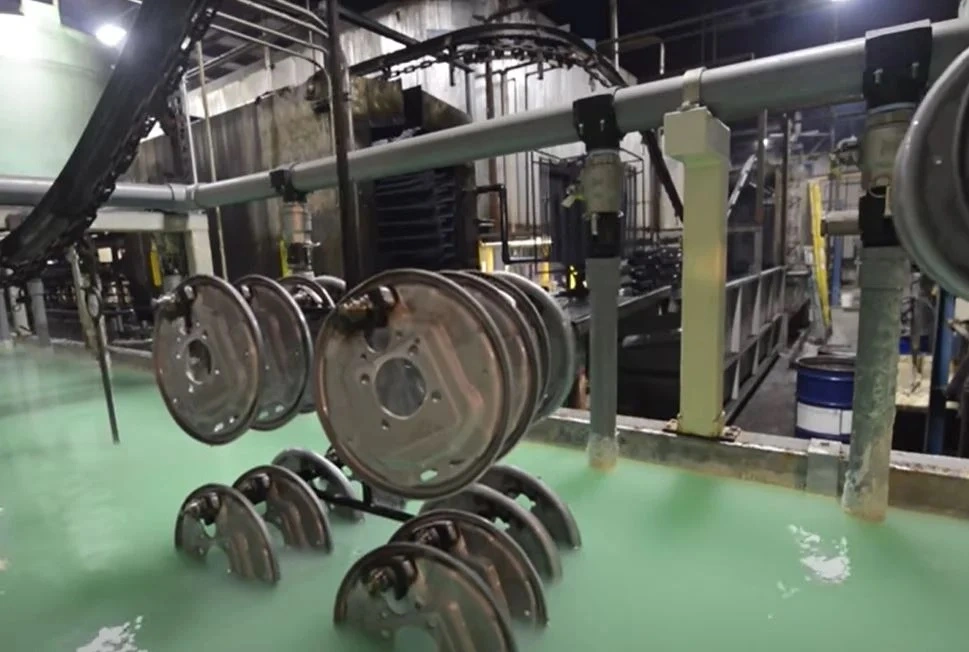
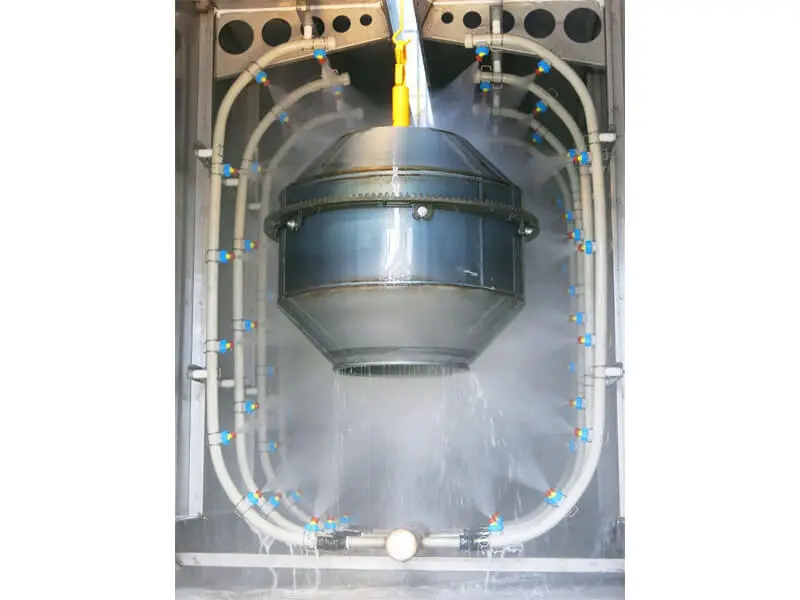
Long before powder touches the part, the pretreatment stage dictates final quality. A modern powder coating production line typically employs multi‑stage spray washers or immersion tanks. Critical parameters include:
Cleaning efficiency: Removal of mill oils, stamping lubricants, and soils using alkaline or acidic cleaners at 50‑60°C.
Conversion coating: Iron phosphate (2‑5 g/m²) or zinc phosphate (2‑4 g/m²) for steel; chrome‑free zirconium treatments for aluminum to meet environmental regulations.
Water quality: Final rinse stages often require deionized water (<20 µS/cm) to prevent surface salts that cause osmotic blistering.
Automated chemical feed systems and conductivity controls ensure consistent bath chemistry. HANNA integrates smart monitoring into their lines, alerting operators to bath depletion and reducing chemical waste by up to 20%.
2. Drying and Cooling: The Critical Transition Zone
After pretreatment, parts enter a dry‑off oven (typically 100‑120°C) to remove moisture. Inadequate drying leads to outgassing during cure. Following dry‑off, a cooling tunnel brings parts to below 35°C before powder application. This step is often overlooked but essential: warm parts attract more powder (Faraday cage effect) and can cause fluidization issues in the powder feed.
3. Powder Application: Precision Deposition and Recovery
The heart of the powder coating production line is the spray booth. Key engineering considerations:
Booth Design and Airflow
Downdraft or side‑draft booths with balanced airflow (0.3‑0.5 m/s face velocity) contain overspray and direct it to recovery systems. Cartridge filter efficiency (>99.9%) is standard for powder retention.
Gun Technology
Corona charging guns (50‑100 kV) are versatile; tribo guns are preferred for complex shapes and metallic powders. Modern lines use reciprocators with programmable stroke patterns and gun‑mounted controls for real‑time voltage and current adjustment, minimizing back‑ionization and improving first‑pass transfer efficiency (typically 60‑85% depending on part geometry).
Color Change Speed
For job shops, quick color change is a competitive advantage. Modular booth designs with polished stainless steel interiors and automated purge cycles can reduce changeover time from 45 minutes to under 10 minutes, a feature HANNA has optimized in their compact lines.
4. The Curing Oven: Thermal Uniformity and Energy Management
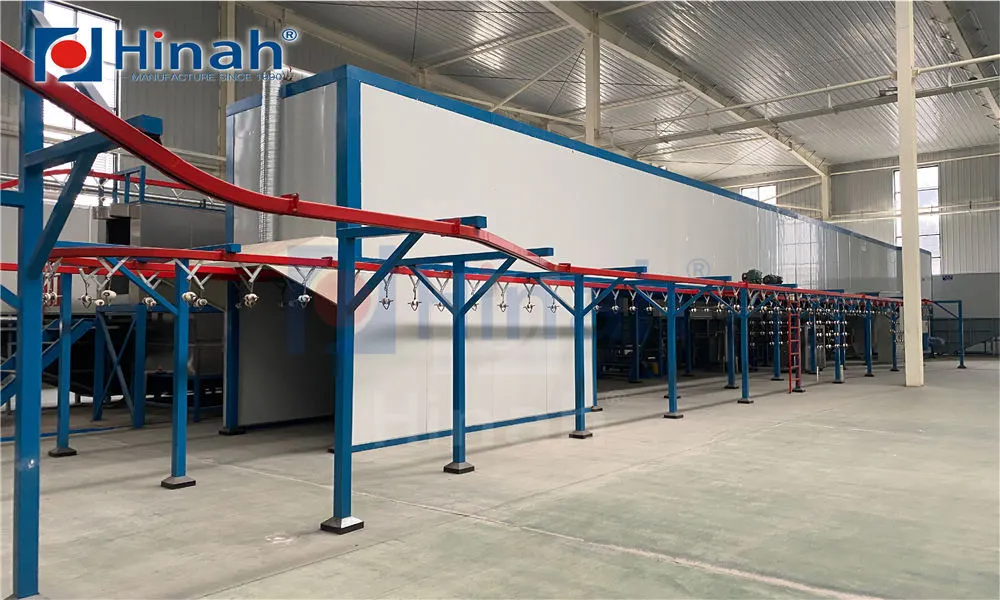
After application, parts enter the curing oven—typically a gas‑fired convection oven for complex geometries or an infrared booster for rapid heating. A well‑designed powder coating production line ensures:
Thermal uniformity: ±3°C across the workspace, validated by 12‑channel data loggers per AMS2750.
Ramp rates: Parts must reach cure temperature (typically 180‑200°C) within 5‑8 minutes to avoid over‑cure of thin sections while thick sections reach gel point.
Energy efficiency: Recuperative burners, VFD‑controlled fans, and high‑R insulation (e.g., 100mm rockwool) cut gas consumption by 15‑25%.
The oven length is calculated from line speed and dwell time. For example, a 6 ft/min line with a 20‑minute cure requires 120 linear feet of oven, plus entry/exit seals.
5. Cooling and Unload: Maintaining Finish Integrity
After cure, parts must be cooled sufficiently for handling—typically below 40°C. Forced ambient air cooling tunnels prevent marring and allow immediate downstream assembly. In high‑speed lines, cooling length can exceed oven length, a space consideration often underestimated in facility planning.
6. Material Handling Systems: Conveyors and Racking
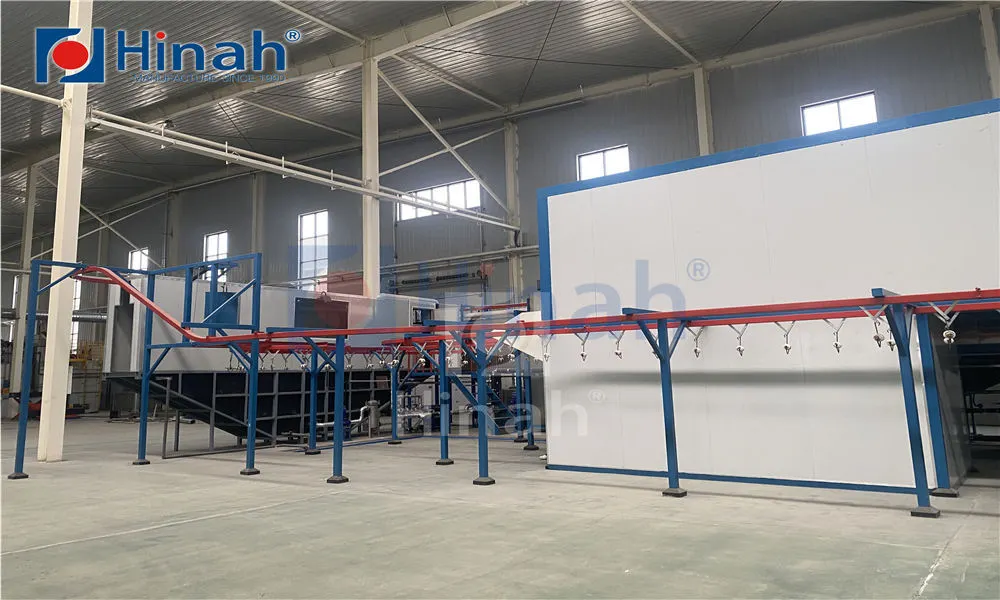
The conveyor is the circulatory system of the powder coating production line. Overhead power‑and‑free conveyors allow accumulation and diagonal banking for variable process times. Key design parameters:
Chain speed: Typically 1‑8 m/min, adjustable via VFD.
Load capacity: Hangers designed for maximum part weight with safety factors of 3:1.
Grounding: Continuous electrical contact through the conveyor is essential for electrostatic application; worn brushes or greasy rails cause powder rejection.
Racking density directly impacts productivity. Modular racks and custom fixtures maximize part count per hanger while ensuring Faraday cage areas are accessible to spray.
7. Industry 4.0 Integration and Process Control
Modern powder coating production line systems leverage IoT for predictive maintenance and quality assurance. Sensors monitor:
Pretreatment bath concentrations and temperatures.
Booth airflow and differential pressure across filters.
Oven zone temperatures and conveyor amperage.
Real‑time part tracking via RFID for recipe‑based gun control.
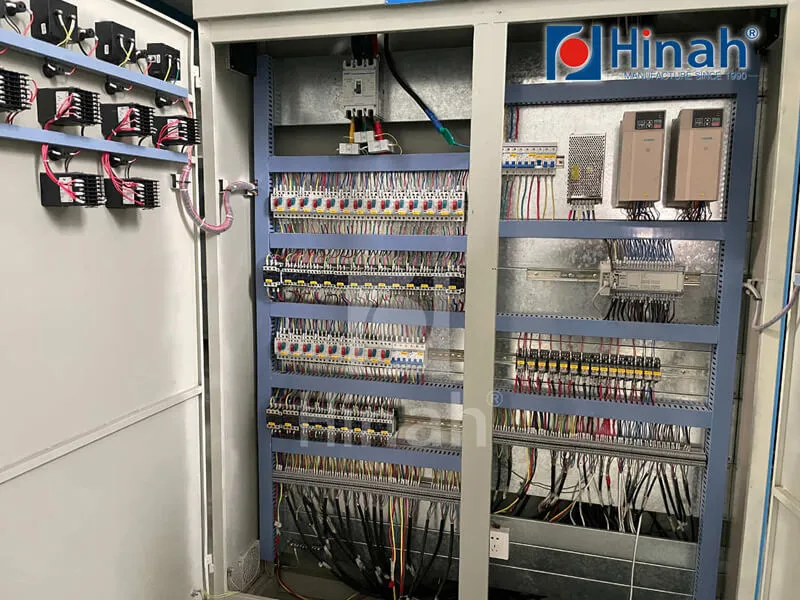
Data loggers provide full traceability for ISO 9001 or automotive certifications. HANNA offers a proprietary line management system that aggregates this data into a single HMI, with remote access for troubleshooting and performance analytics.
8. Addressing Common Production Line Bottlenecks
Even well‑designed lines face throughput challenges. Here are frequent issues and engineering solutions:
Bottleneck: Slow color change limiting flexibility.
Solution: Install a second booth in parallel or upgrade to a quick‑change cyclone recovery system.Bottleneck: Insufficient oven capacity for peak loads.
Solution: Add an IR pre‑heat zone to reduce convection dwell time; increase line speed if other stages permit.Bottleneck: High reject rate due to contamination.
Solution: Upgrade pretreatment filtration; install positive pressure in clean zones; audit air make‑up units for oil carryover.Bottleneck: Excessive energy costs.
Solution: Retrofit oven burners with high‑turndown ratios; add variable drives on all fans; insulate washer tanks.
Addressing these requires a holistic view of the entire powder coating production line, not isolated fixes.
9. HANNA’s Approach to Turnkey Production Line Engineering
With decades of experience, HANNA provides fully integrated powder coating production line solutions tailored to specific throughput and part mix requirements. Their engineering process includes:
Line layout optimization using 3D simulation to minimize floor space and material handling.
Custom washer design with counterflow heating to reduce water and energy use.
Modular oven panels allowing future capacity expansion.
Turnkey installation with single‑source responsibility for all mechanical and electrical systems.
Recent projects have demonstrated first‑pass yield improvements from 85% to 96% through better gun positioning and oven uniformity.
10. Future Trends: Sustainable and Flexible Lines
The next generation of powder coating production line design focuses on sustainability and adaptability. Low‑temperature cure powders (150‑160°C) reduce energy demand. Water‑based pretreatments eliminate heavy metals. Modular lines allow quick reconfiguration for new products. Industry 4.0 enables self‑optimizing lines that adjust parameters in real‑time based on sensor feedback, reducing waste and energy.
Frequently Asked Questions About Powder Coating Production Lines
Q1: What is the typical cost range for a complete powder coating
production line?
A1: Costs vary widely based on size, automation,
and throughput. A basic batch line with a walk‑in oven and manual booth might
start around $150,000. A high‑volume continuous line with multistage washer,
automated booths, and convection oven can exceed $2‑5 million. HANNA provides detailed ROI analysis
based on your production goals.
Q2: How do I calculate the required line speed for my production
volume?
A2: Determine the number of parts per hour, hanger density
(parts per foot), and required process times (pretreatment, cure). Line speed
(ft/min) = (parts per hour × hanger spacing in feet) / 60. Example: 200
parts/hour on 2‑foot centers requires 200 × 2 / 60 = 6.67 ft/min.
Q3: What is the difference between a manual and an automated powder
coating line?
A3: Manual lines rely on operators for gun movement
and are suitable for low volumes and complex parts. Automated lines use
reciprocators, fixed guns, and programmable logic controllers (PLC) for
consistent, high‑speed application. Hybrid lines combine both for
flexibility.
Q4: How can I improve first‑pass transfer efficiency on my
line?
A4: Optimize gun distance (150‑250 mm), voltage settings
(adjust for part geometry), and powder flow rates. Ensure proper part grounding
(<1 megohm). Use tribo guns for deep recesses. Regularly audit booth airflow
to prevent powder drift.
Q5: What safety standards apply to a powder coating production
line?
A5: Key standards include NFPA 33 (spray application) and NFPA
86 (ovens) in North America; ATEX directives for explosive atmospheres in
Europe. Systems must include explosion venting, fire suppression interlocks, and
proper grounding. HANNA ensures all
equipment meets or exceeds local codes.
Q6: How much floor space is needed for a continuous powder coating
line?
A6: Space depends on throughput. A typical medium‑volume line
(4‑6 ft/min) might require 150‑200 linear feet for washer, dry‑off, booth, oven,
and cool‑down. Width adds 15‑25 feet including walkways. HANNA offers compact layouts that
reduce footprint by up to 30% using multi‑pass ovens and stacked washers.
Designing, installing, and optimizing a powder coating production line requires multidisciplinary expertise—from chemical engineering in pretreatment to thermal dynamics in curing. By focusing on integrated design and leveraging modern controls, manufacturers can achieve consistent quality, high throughput, and sustainable operations. For tailored solutions, consult with specialists like HANNA who combine decades of application knowledge with modern design tools.