The powder coating booth is the operational heart of any finishing line—it dictates transfer efficiency, colour‑change speed, material recovery, and operator safety. While often viewed as a simple containment structure, modern booths integrate sophisticated airflow dynamics, filtration science, and automation. Drawing on engineering data from HANNA installations across automotive, architectural, and industrial sectors, this article breaks down seven parameters that separate world‑class powder coating booth designs from conventional enclosures.
The choice of booth architecture directly impacts material recovery efficiency, maintenance intervals, and floor space. Three dominant types exist:
Cartridge‑filter booths with integrated recovery: These recirculate air through high‑efficiency cartridge filters (typically cellulose/polyester blend). Powder is pulse‑cleaned from the filters and returned directly to the feed hopper or a recovery drum. Transfer efficiency (TE) remains high (85%+), and the system is compact. Ideal for dedicated colours or low‑mix production.
Cyclone‑plus‑polishing booths: A cyclone separator removes 95–98% of overspray before air passes to a secondary polishing filter. This design allows rapid colour changes—cyclone powder can be stored in a dedicated container while the polishing filter stays clean. Colour‑change downtime can drop below 10 minutes, making it the choice for job shops and high‑mix environments.
Open‑face or cross‑draft booths: Simpler and lower cost, but with lower TE (60–70%) and higher filter loading. Used primarily for low‑volume, large parts where automation is minimal.
HANNA offers both cartridge and cyclone designs, with computational fluid dynamics (CFD) used to optimise airflow for each customer’s part mix.
Containment of overspray and operator visibility depend on uniform airflow. For manual booths, face velocity is typically 0.5–0.7 m/s; for automatic booths, 0.4–0.5 m/s is sufficient. Key factors include:
Plenum design: Perforated panels or diffusers ensure laminar flow without turbulence that could disturb the powder cloud.
Exhaust fan sizing: Variable‑frequency drives (VFDs) maintain constant velocity as filters load, reducing energy consumption.
Pressure differential monitoring: Sensors alert when filters require cleaning, preventing blow‑by of powder.
Incorrect airflow can cause powder fallout on parts or excessive booth wall deposition. Powder coating booth designs from HANNA incorporate CFD‑validated plenums that maintain ±5% velocity uniformity across the booth cross‑section.
Cartridge filters are the most common, but material selection matters:
Cellulose/polyester blends: Good for standard powders, but may blind with fine‑particle or metallic powders.
PTFE‑membrane filters: Offer superior release, longer life, and lower differential pressure—essential for high‑volume or difficult‑to‑clean powders.
Pulse‑cleaning systems use solenoid valves to blast compressed air (6–8 bar) in short bursts. The cleaning interval and duration are critical: too frequent pulsing wastes compressed air; too infrequent leads to high pressure drop. Modern controllers adjust pulse timing based on real‑time differential pressure, reducing air consumption by 20–30%.
For facilities running multiple colours per shift, the powder coating booth must enable rapid changeovers. Key engineering features:
Smooth, non‑stick walls: Stainless steel or conductive plastic with low surface energy minimises powder adhesion, allowing quick wipe‑down.
Automated purge sequences: Programmable logic controllers (PLCs) cycle feed hoses, guns, and pumps with compressed air to evacuate residual colour.
Modular hopper and sieve designs: Quick‑release clamps and mobile recovery bins reduce manual intervention.
Data from HANNA‑installed cyclone booths show colour‑change times under 8 minutes for a two‑colour system, with powder waste reduced to less than 2 kg per change—savings that can exceed €25,000 annually in high‑mix operations.
A powder coating booth must provide a safe, electrically conductive environment. Key requirements:
Booth walls and floors: Must be grounded to <1 MΩ resistance to prevent charge accumulation that could ignite dust.
Gun and cable routing: High‑voltage cables (up to 100 kV) should be shielded and routed away from operators.
Faraday cage mitigation: Booth design should allow gun access to recessed areas; some booths incorporate movable side walls or turntables.
Proper grounding also improves transfer efficiency: when parts are well‑grounded, electrostatic attraction pulls powder more effectively. HANNA booths include continuous ground monitoring with alarms for open circuits.
Powder coatings are combustible dusts. A compliant powder coating booth must meet NFPA 33 (Americas) or ATEX (Europe) standards:
Explosion venting panels: Installed on the booth roof or rear wall to relieve pressure in case of deflagration. Vent area is calculated based on booth volume (typically 0.05–0.1 m² per m³).
Fire suppression systems: Often using high‑rate discharge (HRD) cylinders with dry chemical or CO₂, activated by ultraviolet/infrared flame detectors.
Electrical classification: All components inside the booth (lights, motors, sensors) must be rated for hazardous locations (Class II, Division 1 or Zone 22).
Powder coating booth designs from HANNA are third‑party certified for explosion protection, with documentation packages for local fire marshals.
Modern booths are no longer passive enclosures—they are data nodes. Advanced powder coating booths feature:
Integrated sensors: Monitoring airflow, filter pressure, temperature, humidity, and powder level in hoppers.
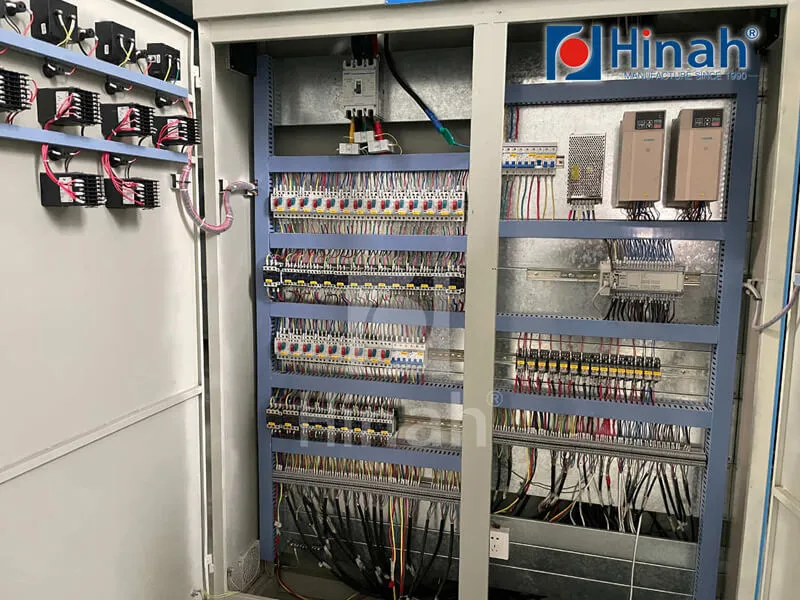
PLC/HMI interfaces: Operators can call up recipes (colour, gun settings, belt speed) that automatically adjust booth parameters.
Connectivity to MES/ERP: Real‑time reporting of powder consumption, cycle counts, and alarm history.
Predictive maintenance algorithms analyse trends (e.g., rising filter pressure) to schedule cleaning before downtime occurs. HANNA offers a cloud‑connected booth controller that reduces unplanned stops by 25% in documented case studies.
Q1: How do I determine the correct size (width, height, depth) for a
powder coating booth?
A1: Booth dimensions must accommodate the
largest part with adequate clearance (typically 300–500 mm on each side for
manual spraying, 200–300 mm for automatic guns). Height should allow gun access
to the top of the part. For conveyorised lines, booth length is based on line
speed and required spray time. HANNA engineers use 3D models to optimise booth size
for your specific part envelope.
Q2: What is the typical air velocity inside a powder coating booth,
and why does it matter?
A2: For manual booths, face velocity of
0.5–0.7 m/s is standard; for automatic booths, 0.4–0.5 m/s. This velocity
ensures overspray is captured while not disturbing the charged powder cloud. Too
high a velocity can pull powder away from the part; too low may allow fugitive
emissions.
Q3: How often should cartridge filters be replaced in a powder
coating booth?
A3: Filter life depends on powder type, volume, and
cleaning effectiveness. With proper pulse‑cleaning, cellulose/polyester
cartridges typically last 1–2 years; PTFE‑membrane filters can last 3–4 years.
Weekly visual inspection and monthly differential pressure trending help predict
replacement.
Q4: Can a powder coating booth be retrofitted for faster colour
changes?
A4: Yes. Retrofits may include: (1) installing non‑stick
booth liners, (2) upgrading to a cyclone or dual‑cyclone recovery, (3) adding
automated purge valves and hopper dump stations, (4) implementing recipe‑based
PLC control. Powder coating booth retrofits by HANNA typically pay back in under 18 months.
Q5: What safety certifications are required for a powder coating
booth in the EU vs. USA?
A5: In the EU, the booth must comply with
ATEX Directive 2014/34/EU (equipment category for dust, Zone 22) and EN 12981
for coating booths. In the USA, NFPA 33 (Standard for Spray Application Using
Flammable Materials) and NFPA 70 (NEC) apply. OSHA also enforces housekeeping
and ventilation standards. Always request a declaration of conformity from your
supplier.
Q6: How does a cyclone powder coating booth differ from a cartridge
booth in terms of material recovery?
A6: A cyclone uses centrifugal
force to separate powder from the airstream, collecting it in a drum or bin. The
air then passes to a polishing filter before exhaust. This means colour change
involves only the cyclone and feed system—the polishing filter stays clean. In a
cartridge booth, all overspray lands on the same set of filters, requiring
thorough cleaning between colours. Cyclones are preferred for high‑colour‑mix
operations.
Q7: What is the role of humidity control in a powder coating
booth?
A7: Relative humidity (RH) affects powder flow and charge
retention. Ideally, booth environment should be 45–55% RH at 20–25°C. Low RH
(<30%) increases static and fire risk; high RH (>65%) can cause powder
clumping and poor fluidisation. In humid climates, climate‑controlled powder
rooms or booth air conditioning is recommended.
For detailed engineering assessments or to request a proposal for a custom‑engineered powder coating booth, visit HANNA’s official website.