

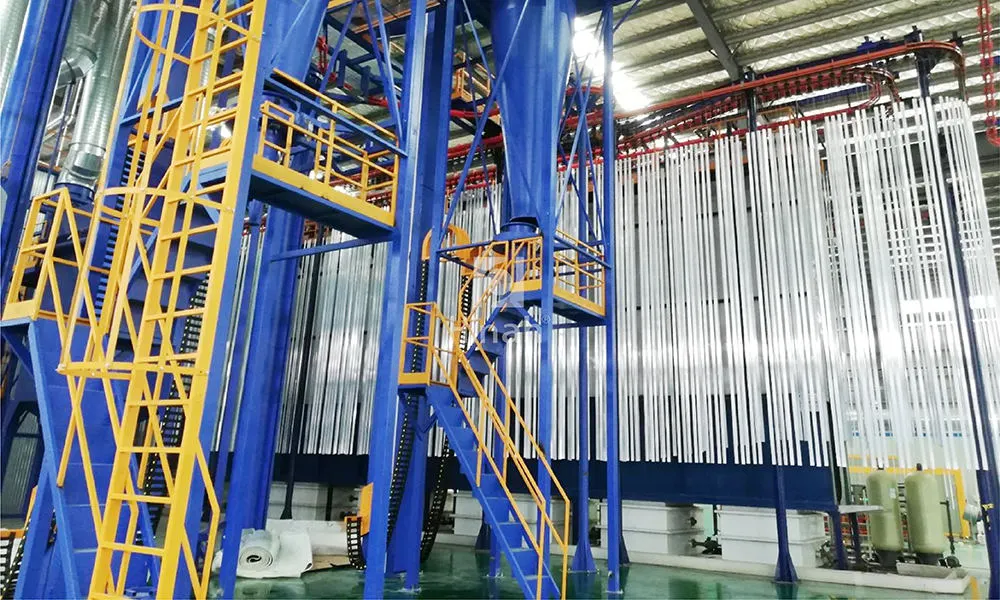
Automated Powder Coating: Line Design, Process Control, and Throughput
For finishing operations weighing a move away from manual application or liquid coating, automated powder coating is not a single equipment purchase but a system-level decision that ties together pretreatment chemistry, part presentation, electrostatic application, powder recovery, and cure. The variables that determine first-pass yield are interdependent, and a line optimized around one subsystem will underperform when adjacent stages are not matched to it. HANNA works with finishing engineers to map these dependencies before equipment specification begins, and project-specific questions can be directed through an inquiry at the earliest evaluation stage.
The distinction between a manual booth with added reciprocators and a genuinely automated powder coating line lies in closed-loop control. In a manual operation, the applicator compensates for variation in part geometry, hanger density, and gun-to-target distance in real time. Automation removes that human compensation and replaces it with mechanical repeatability, which only delivers consistent film build when the upstream and downstream stages are engineered to tolerate the same level of variation. Understanding where that tolerance is consumed is the starting point for any credible line design.
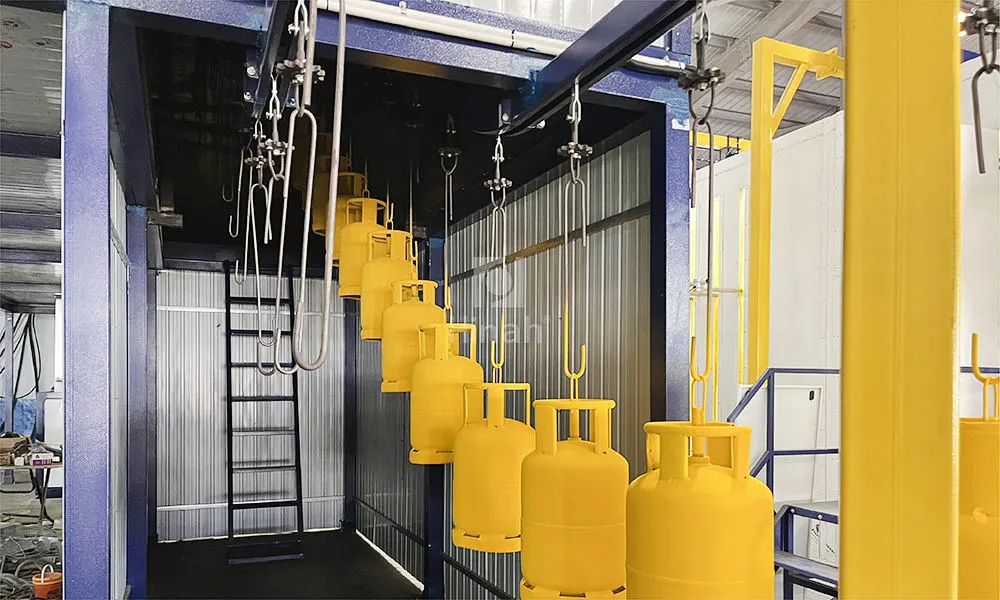
What Automated Powder Coating Actually Means on the Line
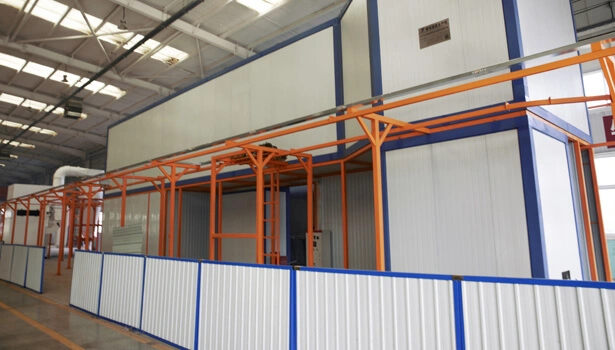
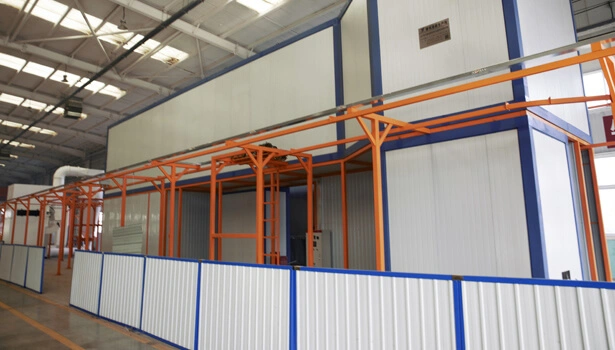
Automation in powder coating spans a spectrum. At the lower end, a conveyorized line with fixed reciprocators and photo-eye part detection removes manual gun handling while keeping operator oversight of gun triggering and powder output. At the upper end, six-axis robots mounted on linear tracks, guided by part-recognition sensors and recipe-driven programs, apply powder to complex geometries with gun angles and standoff distances that are reproduced part to part. Between these extremes sit hybrid configurations in which reciprocators handle large flat surfaces and robots address recesses, edges, and secondary features.
The practical definition that matters for specification is the degree to which the line can hold film thickness without operator intervention. A line that requires an applicator to touch up 30 percent of parts is conveyorized but not fully automated in any meaningful production sense. The automation index of a line is better measured by first-pass yield and film build standard deviation than by the number of robots installed.
Subsystems That Determine Line Performance
Pretreatment and Part Presentation
Powder adhesion and cure behavior begin in the washer, not at the gun. Multi-stage pretreatment—alkaline cleaning, rinse, conversion coating or zirconium-based pretreatment, and final deionized rinse—establishes the surface chemistry that electrostatic deposition depends on. Variations in conversion coating weight translate directly into variation in transfer efficiency and adhesion after cure. For aluminum substrates, chrome-free conversion coatings have become the default in many regions, and their process windows are narrower than traditional iron phosphate, which places a premium on bath concentration and temperature control.
Part presentation is the second constraint. Hanger density, grounding path, and part orientation determine whether the electrostatic field reaches recessed areas. A hanger that carries too many parts per square meter creates shadowing and blocks powder from reaching interior surfaces; a hanger with poor ground contact produces uneven charge decay and inconsistent deposition. Ground monitoring at the conveyor is a basic diagnostic that many lines install only after film build problems appear.
Electrostatic Application and Gun Motion
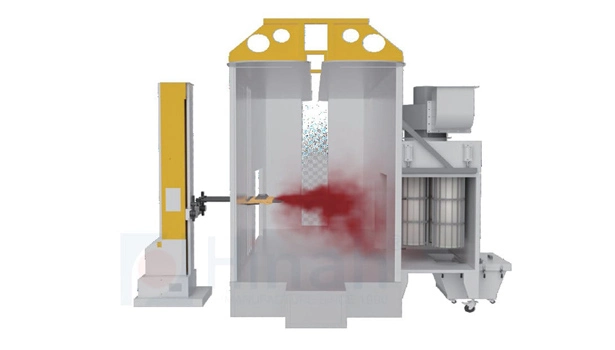
Corona charging remains the dominant method for industrial powder application, with triboelectric charging reserved for specific geometries where Faraday cage effects are severe. Gun current, voltage, and powder flow rate interact: raising voltage improves wraparound but can produce back-ionization on thick films, while lowering flow rate improves film thickness control at the cost of coverage speed. The reciprocator stroke, speed profile, and gun-to-target distance must be tuned to the part envelope, not to a generic default.
Robot-based application changes the tuning problem. Instead of a fixed stroke, the robot follows a programmed path with variable standoff, and the quality of that path determines whether edges and recesses receive adequate coverage. Path programming is therefore a process engineering task, not a motion programming task, and it should be validated against film thickness measurements on sectioned parts rather than visual inspection alone.
Recovery, Reclaim, and Color Changeover
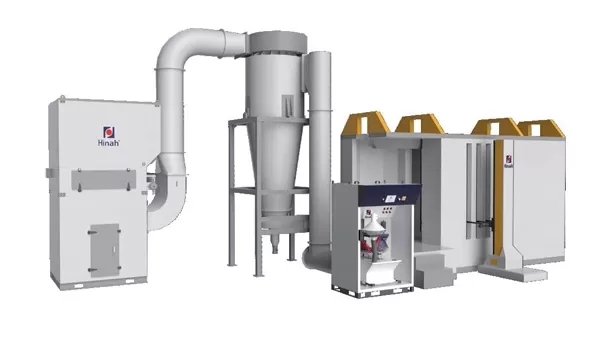
Powder recovery economics depend on the recovery method and the reclaim ratio. Cyclone recovery with a secondary filter module can return a high percentage of overspray to the feed hopper, but the reclaimed powder accumulates fines that shift its flow and charging behavior. A reclaim blend ratio that is too aggressive produces film defects that are difficult to trace back to their source. Cartridge filter recovery is simpler but generates more waste and is better suited to lines with frequent color changes.
Color changeover time is the hidden throughput constraint on multi-color lines. Booth design, gun cleaning, and powder circuit purging determine how many minutes are lost per change, and that number directly sets the minimum economic batch size. A line specified for fast changeover but operated with long reclaim cycles will not achieve the changeover target in practice.
Cure Ovens and Film Build Finalization
Powder cure is a time-temperature relationship, and oven airflow determines whether the part surface actually sees the setpoint. Convection ovens with balanced supply and return air produce uniform cure across the part envelope; poorly balanced ovens create hot and cold zones that show up as gloss variation and incomplete crosslinking. Infrared boost zones can shorten cycle time for thick sections, but they require part-specific tuning because IR absorption varies with substrate and coating color.
Film thickness measurement after cure closes the control loop. Dry film thickness readings taken at defined points on a reference part, tracked over shifts, reveal drift in gun output, reclaim ratio, or conveyor speed before those drifts become visible as defects. Lines that treat DFT measurement as a periodic audit rather than a continuous control variable lose the diagnostic value of the data.
Process Parameters That Drive Film Build Consistency
Film build consistency is a function of four interacting variables: powder feed rate, gun current and voltage, gun-to-target distance and dwell time, and substrate grounding. Each variable has a process window, and the windows overlap. Increasing line speed to raise throughput reduces dwell time, which must be compensated by higher feed rate or additional guns; that compensation changes the charge-to-mass ratio at the gun and can push the film toward back-ionization. The practical approach is to define a target DFT range for each part family, establish the parameter set that holds the center of that range, and monitor drift with statistical process control rather than reacting to out-of-spec parts after cure.
- Powder feed rate should be tuned per part family, not set globally across the line.
- Gun current and voltage settings should be validated against DFT on recessed and edge areas, not flat panels alone.
- Conveyor speed changes require corresponding adjustment of reciprocator stroke overlap.
- Ground resistance at the hanger should be checked at defined intervals and logged.
- Reclaim blend ratio should be capped and documented to prevent fines accumulation drift.
Integrating Automated Powder Coating with Existing Finishing Operations
Most automation projects are retrofits rather than greenfield builds, and the integration constraints usually sit at the interfaces. Conveyor pitch and speed must match the new booth and oven without creating accumulation points. The pretreatment line's cycle time sets the minimum takt time for the entire system. Existing overhead conveyor hangers may not provide adequate grounding or may not be rated for the part weights that robot cells can handle at higher density.
Controls integration determines how much of the line can run unattended. Recipe management that links part number to gun programs, conveyor speed, and oven profile reduces changeover errors and makes the line's performance reproducible across shifts. Data capture from guns, ovens, and conveyors supports the trend analysis that process control depends on. HANNA addresses these interface questions during front-end engineering, because the cost of resolving them after installation is materially higher than designing for them from the start.
Defect Modes and Diagnostic Priorities
When film build or appearance deviates, the diagnostic sequence should follow the process flow rather than jump to the gun. Back-ionization, for example, presents as cratering or pinholes and is often blamed on powder quality, while the actual cause is excessive gun current or standoff distance on a specific geometry. Faraday cage effects in recesses point to gun angle and charging method before they point to powder formulation. Orange peel after cure usually traces to film thickness above the recommended range or to oven airflow imbalance rather than to the powder itself.
Grounding faults produce a characteristic pattern: film thickness tapers across a part in a way that follows the current path to ground. Tracking that pattern back to hanger contact points is faster than adjusting gun parameters. Reclaim-related defects tend to appear gradually and correlate with time since the last hopper cleaning, which makes logging reclaim cycles a useful diagnostic habit.
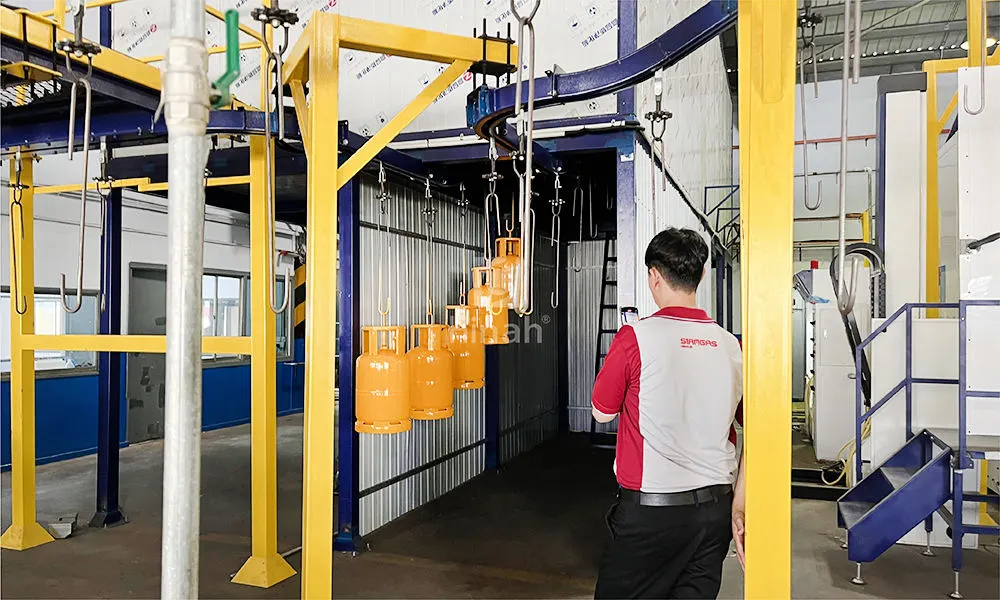
Throughput, Cost per Part, and Total Cost of Ownership
Throughput on an automated powder coating line is governed by the slowest stage, which is frequently the cure oven rather than the application booth. Oven cycle time, part density on the conveyor, and conveyor speed set the practical parts-per-hour ceiling. Application automation can raise first-pass yield and reduce touch-up labor, but it cannot exceed the oven's throughput without a second oven or a faster cure chemistry.
Cost per part analysis should include powder consumption per square meter, reclaim utilization rate, energy consumption of the washer and oven, labor for hanger loading and unloading, and maintenance of guns and recovery modules. Transfer efficiency improvements from automation show up in powder consumption, while first-pass yield improvements show up in labor and rework. Both metrics should be tracked separately, because a line can improve one while degrading the other if the reclaim ratio is pushed too far.
Frequently Asked Questions
What parts-per-hour rate can an automated powder coating line realistically achieve?
Throughput depends on part envelope, hanger density, and oven cycle time more than on gun count. A line with a 20-minute cure cycle and dense hanger loading will be oven-limited regardless of how many reciprocators are installed. Establishing the takt time from the oven backward is the reliable method.
How is film thickness controlled in an automated powder coating system?
Film thickness is controlled through the interaction of feed rate, gun current and voltage, standoff distance, dwell time, and grounding. The control loop is closed by measuring dry film thickness on reference points and adjusting parameters when drift appears, rather than by inspecting finished parts.
What causes Faraday cage defects, and how are they addressed?
Faraday cage effects occur when the electrostatic field cannot penetrate recessed areas, leaving them with low film build. Adjusting gun angle, reducing voltage, increasing standoff, or switching to triboelectric charging for specific geometries are the standard responses. Part orientation on the hanger also affects the severity of the effect.
How does color changeover time affect automation design?
Changeover time sets the minimum economic batch size for multi-color lines. Booth design, powder circuit purging, and gun cleaning determine how many minutes are consumed per change. Lines specified for fast changeover must also be operated with reclaim practices that support it, or the design target will not be met in production.
When is robotic application preferred over reciprocator-based systems?
Robotic application is preferred when part geometry includes recesses, edges, or secondary features that fixed strokes cannot reach consistently. Reciprocators remain efficient for large flat surfaces and high-volume runs with stable part families. Many lines combine both to match the applicator to the geometry.
What data should be captured from an automated powder coating line?
Gun parameters, conveyor speed, oven zone temperatures, DFT readings, ground resistance at hangers, and reclaim cycle logs form the core data set. Trend analysis on these variables supports process control and shortens the diagnostic path when defects appear.
Line design decisions in automated powder coating reward early engagement between process engineering and equipment specification. The parameters that govern yield are established before the first gun is mounted, and the interfaces between pretreatment, application, recovery, and cure determine whether the installed system holds its performance over time. HANNA supports finishing teams through front-end engineering, subsystem matching, and commissioning validation; inquiries covering specific part families and throughput targets can be submitted for a technical review.
Related News
Learn More + -
5 Ways Automated Powder Coating Systems Transform Production Efficiency
For manufacturers facing rising costs and tighter quality standards, the finishing department often becomes a bottleneck. Manual powder coating operat ...View Details2026-11-06 -
5 Key Benefits of Automated Powder Coating: Systems, Applications & How HANNA Delivers
Automated powder coating is a standard industrial finishing process. It uses programmed systems to apply and cure powder coatings on products with min ...View Details2026-11-06 -
Maximizing OEE and First‑Pass Yield: The Engineering of Automated Powder Coating Lines
7 Critical Metrics for Your Automated Powder Coating Line | 2025 ROI DataIn modern surface finishing, the transition to an automated powder coating li ...View Details2026-11-06 -
Automated Powder Coating: Engineering Consistency and Throughput in Industrial Finishing
Automated Powder Coating: Precision, Efficiency, and Scalability in Modern FinishingTransitioning from manual spray booths to an automated powder coat ...View Details2026-11-06 -
Automated Powder Coating Line Integration: 9 Stages of Process Engineering for Zero-Defect Finishing
Transitioning from manual batch processing to a fully integrated automated powder coating line represents a fundamental shift in manufacturing capabi ...View Details2026-11-06 -
Mastering Automated Powder Coating for High-Yield Finishing Lines
In the shift toward Industry 4.0, the finishing industry has witnessed a paradigm shift from manual spraying to fully integrated, sensor-driven syste ...View Details2026-11-06