
Transitioning from manual spray booths to an automated powder coating line represents a fundamental shift in how manufacturers approach quality, labor, and material efficiency. Automation replaces human variability with programmable precision, enabling 100% part tracking, repeatable film builds, and integration with upstream fabrication. This article examines the core technologies, application strategies, and performance metrics that define modern automated powder coating systems, with a focus on engineering data and real-world implementation.

The Evolution from Manual to Automated Powder Coating
Manual powder coating relies on operator skill to maintain gun distance, angle, and traverse speed—factors that fluctuate with fatigue and part complexity. In contrast, automated powder coating uses programmable logic controllers (PLCs) and robotic manipulators to execute the same motion profile every cycle. Key drivers for automation include:
Repeatability: ±5 µm film thickness variation across thousands of parts.
Labor optimization: One operator can oversee multiple booths instead of coating manually.
Material savings: Automatic gun triggering and closed-loop flow control reduce overspray by 15–25%.
Throughput: Continuous conveyors with automated guns achieve line speeds exceeding 6 m/min.
HANNA has documented cases where a switch to automation reduced per-part coating cost by 30% while improving first-pass yield from 82% to 96%.
Core Components of an Automated Powder Coating System
Robotic Manipulators vs. Reciprocators
Reciprocators (vertical traversing machines) are cost-effective for simple, flat products. However, for complex geometries—such as automotive wheels or welded fabrications—six‑axis robots provide the necessary articulation. Modern automated powder coating cells often combine both: reciprocators for broad coverage and robots for recessed areas. Integration considerations:
Robots must be rated for hazardous locations (ATEX / NFPA 33) when operating inside the spray booth.
Offline programming (OLP) software simulates paths and predicts film thickness, reducing commissioning time.
Force/torque sensors enable adaptive control—robots adjust to slight part variations.
Automatic Gun Control and Powder Delivery
High‑efficiency corona or tribo guns are mounted on the automation equipment. Key parameters under PLC control:
Voltage and current: Regulated to prevent back‑ionization and ensure smooth film.
Flow rates: 50–300 g/min per gun, modulated via digital flow meters.
Pattern shaping: Variable diffuser air pressure adjusts spray width for part edges.
Closed‑loop densitometers mounted after the booth measure film thickness on test coupons and automatically adjust gun parameters—a feature now standard in HANNA‑engineered lines.
Conveyor Interface and Part Tracking
Automation requires precise part positioning. Overhead power‑and‑free or floor‑type conveyors with encoder feedback tell the control system exactly where each SKU is located. Radio‑frequency identification (RFID) tags on carriers allow the automated powder coating system to retrieve the correct program—for example, switching from a large chassis to a small bracket without manual intervention.
Technical Deep Dive: Process Control and Software Architecture
Programmable Logic Controllers (PLC) and Human‑Machine Interfaces (HMI)
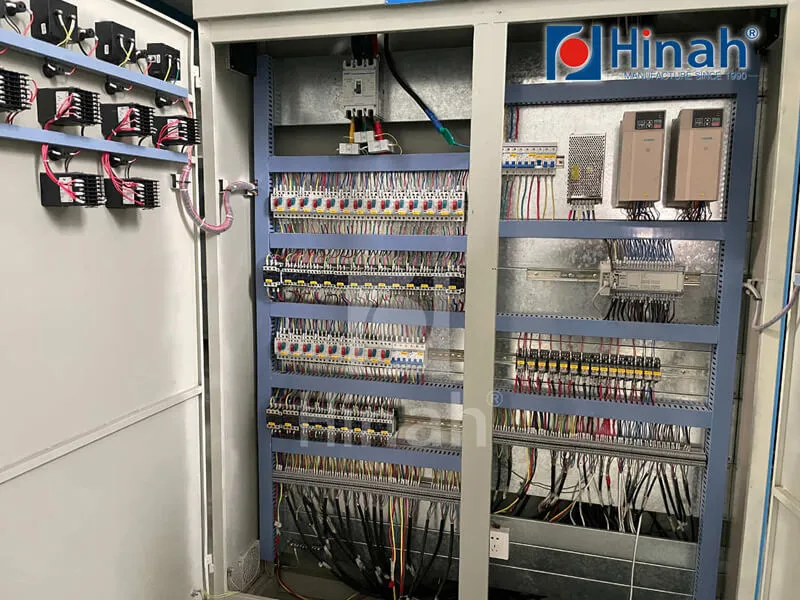
Industrial automation relies on robust PLCs (Siemens, Rockwell, Mitsubishi) that execute ladder logic for gun triggering, color changes, and safety interlocks. The HMI provides operators with real‑time data: gun status, powder consumption, and alarm logs. Modern systems also include:
Remote monitoring: Web‑based dashboards showing overall equipment effectiveness (OEE).
Recipe management: Thousands of part programs stored with parameters such as gun speeds, voltages, and conveyor speed.
Data logging: Every coated part is associated with a timestamp, film thickness (if measured inline), and cure temperature from the oven—critical for traceability in aerospace or automotive.
Color Change Automation
One of the biggest challenges in automated powder coating is rapid color change. Traditional systems may require 20–30 minutes of purging. Advanced solutions include:
Self‑cleaning gun blocks: Compressed air blasts remove residual powder.
Dedicated feed lines per color: Multiple hoppers with fast‑switching valves.
Super‑sack or box feeder connections: Minimize changeover time to under three minutes.
These innovations allow just‑in‑time production with minimal inventory of coated parts.
Industry Verticals Benefiting from Automation
While any high‑volume coating operation can benefit, certain sectors have driven the adoption of automated powder coating:
Automotive OEM and suppliers: Wheels, suspension components, engine parts—thousands per day with zero defects. Robots with vision systems locate each part despite conveyor variation.
Agricultural and construction equipment: Large, heavy implements require robust handling; automation ensures coverage in corners while maintaining film build on edges.
Architectural aluminum: Long profiles (up to 8 m) are coated by multiple reciprocators synchronized to the extrusion speed, ensuring consistent appearance.
General industry: Shelving, electrical enclosures, furniture—automation allows mixed‑model production without changeover delays.
HANNA has supplied fully automated lines to each of these sectors, with designs validated by CFD airflow modeling and thermal profiling.
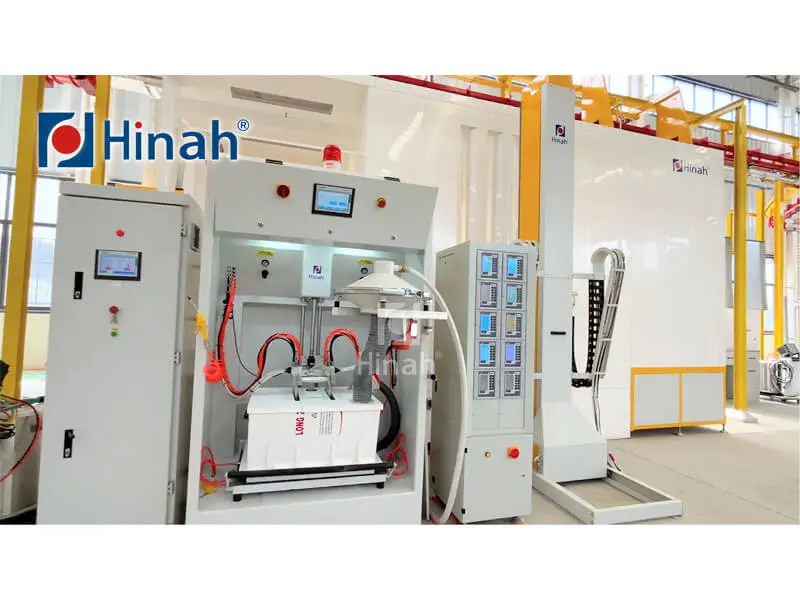
Addressing Pain Points in Automated Powder Coating Lines
Pain Point 1: Faraday Cage Effect in Recessed Areas
Automated guns can struggle with deep recesses where electrostatic fields collapse. Solution: tribo charging (frictional charging) combined with robotic angles that direct powder mechanically. Some systems use a secondary robot with a small‑diameter extension gun to reach into cavities.
Pain Point 2: Film Build Variation on Complex Shapes
Even with robots, leading edges may receive excess powder. Solution: adaptive trigger delays based on part geometry. The PLC adjusts gun on/off timing so that edges are coated only when the gun is perpendicular to the surface. Laser profilometers mounted before the booth can map each part and feed data to the control.
Pain Point 3: Maintenance and Calibration Drift
Automated systems require periodic verification. Recommended practices:
Daily checks of gun tip wear and high‑voltage contact.
Weekly verification of powder flow meters against gravimetric standards.
Monthly robot calibration using laser tracker to maintain positional accuracy within ±0.5 mm.
Quality Assurance and In‑Process Monitoring
Modern automated powder coating systems often incorporate inline inspection:
Infrared thermography: Immediately after curing, cameras detect cold spots indicating insufficient coating or cure.
Vision systems: Detect surface defects like orange peel, dirt, or thin coverage.
Statistical process control (SPC): Data from every part is fed into a central database; trends trigger preventive maintenance before rejects occur.
This level of monitoring aligns with Industry 4.0 principles and is a standard offering from HANNA in their turnkey finishing systems.
Future‑Proofing Your Automated Powder Coating Line
As powder coating materials evolve—low‑cure powders, antimicrobial coatings, super‑durable textures—the automation platform must adapt. Considerations for long‑term flexibility:
Modular booth design: Allows addition of more robots or guns as production grows.
Open control architecture: OPC UA or MQTT communication enables integration with future MES or ERP systems.
Energy monitoring: Submeters on each robot and conveyor help identify efficiency improvements.
Frequently Asked Questions
Q1: What is the typical return on investment (ROI) for an automated powder coating system?
A1: Based on HANNA project data, most manufacturers see payback within 18–30 months. Factors include labor reduction (typically 2–3 operators per shift), powder savings (15–20% less overspray), and increased throughput (25–40%). Higher first‑pass yield also reduces rework and scrap.
Q2: Can automated powder coating handle frequent color changes?
A2: Yes, with modern quick‑change systems. Automated booths equipped with self‑cleaning guns and multiple powder feed lines can change colors in under three minutes. For maximum flexibility, some lines use a “cluster” booth design where robots move to different feed centers.
Q3: How does automation affect powder reclaim efficiency?
A3: Automated systems typically improve reclaim because consistent gun positioning produces a more uniform overspray pattern, making it easier for the cyclone and cartridge filters to separate powder. Reclaim rates of 95–98% are common, though careful color management is needed to avoid cross‑contamination.
Q4: What is the learning curve for operators and maintenance staff?
A4: Modern HMIs are intuitive; operators can be trained in 1–2 weeks. Maintenance staff require deeper training on robot programming and PLC troubleshooting—usually a 2‑week course from the integrator. HANNA provides on‑site training and remote support during ramp‑up.
Q5: Can existing manual lines be retrofitted with automation?
A5: Yes, in many cases. Retrofitting involves adding robots, conveyors, and controls while keeping the existing booth and oven if they are in good condition. A feasibility study assesses part mix, space constraints, and required line speed. HANNA has successfully retrofitted dozens of lines, often reusing pretreatment and curing equipment.
Q6: How do I ensure consistent film thickness on complex 3D parts?
A6: Use a combination of offline programming (OLP) to simulate coating distribution and in‑process sensors. Robots can be programmed with varying gun angles and speeds for different part zones. Some systems incorporate real‑time film gauges that adjust gun outputs on the fly.
Q7: What safety certifications are required for automated powder coating equipment?
A7: In North America, compliance with NFPA 33 (Standard for Spray Application Using Flammable or Combustible Materials) is mandatory. In Europe, ATEX directives apply. Automation components inside the booth must be rated for hazardous locations, and safety PLCs with emergency stop circuits are required. HANNA ensures all systems meet regional codes and are third‑party certified.
Adopting automated powder coating is a strategic investment that transforms finishing from a manual craft into a precision manufacturing process. By leveraging robotics, advanced control software, and inline monitoring, manufacturers can achieve consistent quality, lower operating costs, and the agility to respond to changing product mixes. With decades of integration experience, HANNA remains a trusted partner in engineering automated solutions that deliver measurable operational improvements.