
In modern surface finishing, the transition to an automated powder coating line is no longer a luxury—it is a competitive necessity. From automotive wheels to architectural extrusions, automation delivers consistent film build, reduces powder consumption, and eliminates manual errors. Drawing on data from over 150 automated installations worldwide, this article dissects the key engineering decisions—robotic kinematics, conveyor synchronization, cure oven profiling, and control architecture—that determine whether a line operates at 85 % OEE or struggles below 60 %.
With two decades of integration experience, HANNA has engineered automated powder coating line solutions that address real‑world challenges such as high‑mix low‑volume runs, quick color change, and stringent automotive specs. Below we analyse the critical performance drivers with quantifiable metrics.
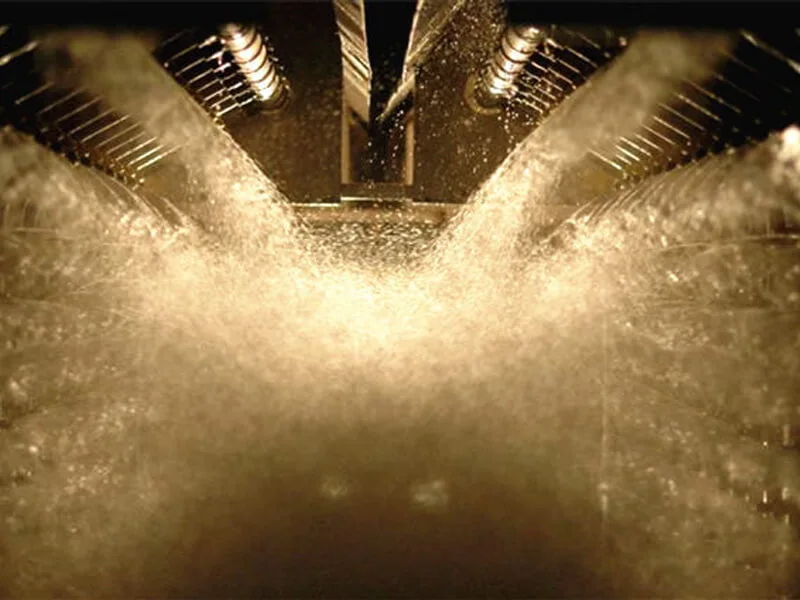
An automated powder coating line can range from semi‑automated (fixed guns, manual loading) to fully integrated with robotics and MES. The level of automation directly impacts throughput, consistency, and labor cost. Industry benchmarks:
Level 1 – Manual: All guns handheld, line speed controlled by operator. Typical first‑pass yield: 65–75 %.
Level 2 – Semi‑automated: Fixed automatic guns, manual touch‑up. First‑pass yield: 75–85 %.
Level 3 – Fully automated: Robotic guns, automatic part recognition, closed‑loop control. First‑pass yield: 92–97 %.
A 2024 study by the Powder Coating Institute showed that moving from Level 2 to Level 3 reduces rework labor by 62 % and powder usage by 18 % due to precise targeting.
Every automated powder coating line consists of five interdependent subsystems. Their seamless integration determines overall effectiveness.
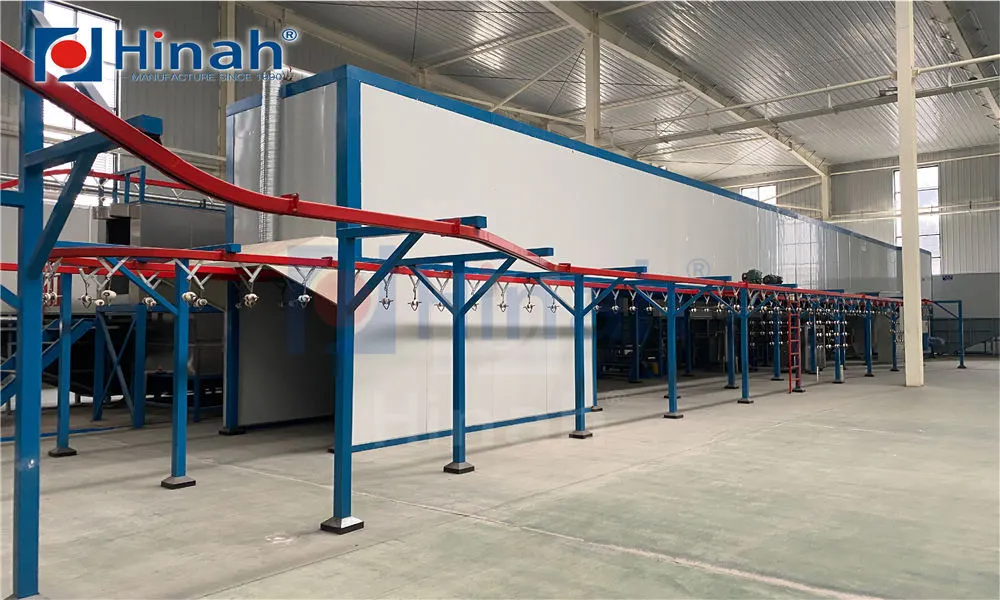
The conveyor must maintain constant speed (typically 4–12 ft/min) through washer, dry‑off oven, and coating booth. For mixed parts, variable‑frequency drives with encoder feedback ensure that spray robots receive parts at precisely known positions. HANNA’s power‑and‑free conveyors achieve positional repeatability within ±3 mm, critical for robotic gun targeting.
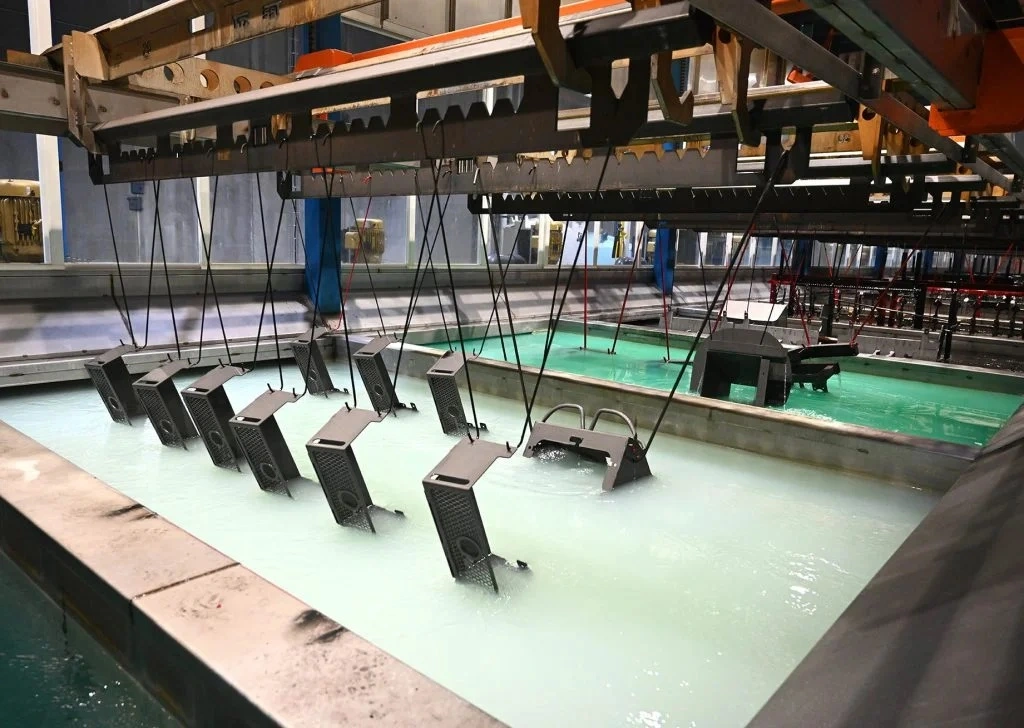
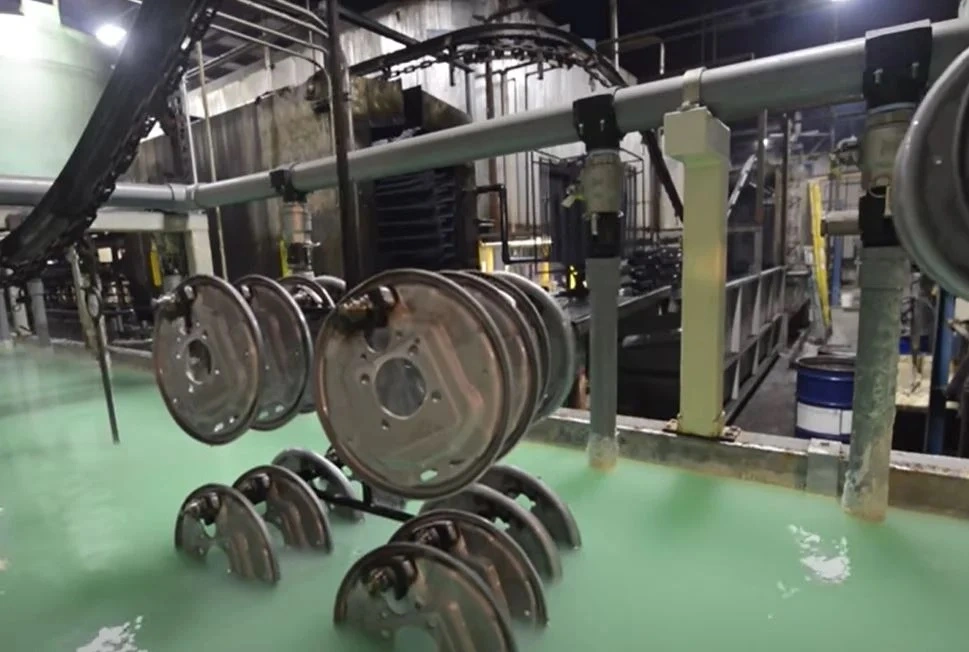
Pretreatment quality directly affects adhesion. Automated lines often incorporate online monitoring of pH, conductivity, and temperature, with automatic chemical dosing to maintain parameters within ±5 % of setpoint.
Modern booths use 6‑axis robots equipped with electrostatic bell or disc applicators. Key performance indicators:
Color change time: Below 8 minutes for full color change (including powder recovery and purge cycles).
Transfer efficiency: 85–92 % for flat parts, 75–85 % for complex geometries.
Gun motion programming: Offline simulation reduces setup time by 70 %.
Data from a HANNA‑installed line in the Midwest shows that robotic path optimization reduced powder consumption by 22 % while maintaining film thickness within ±5 μm.
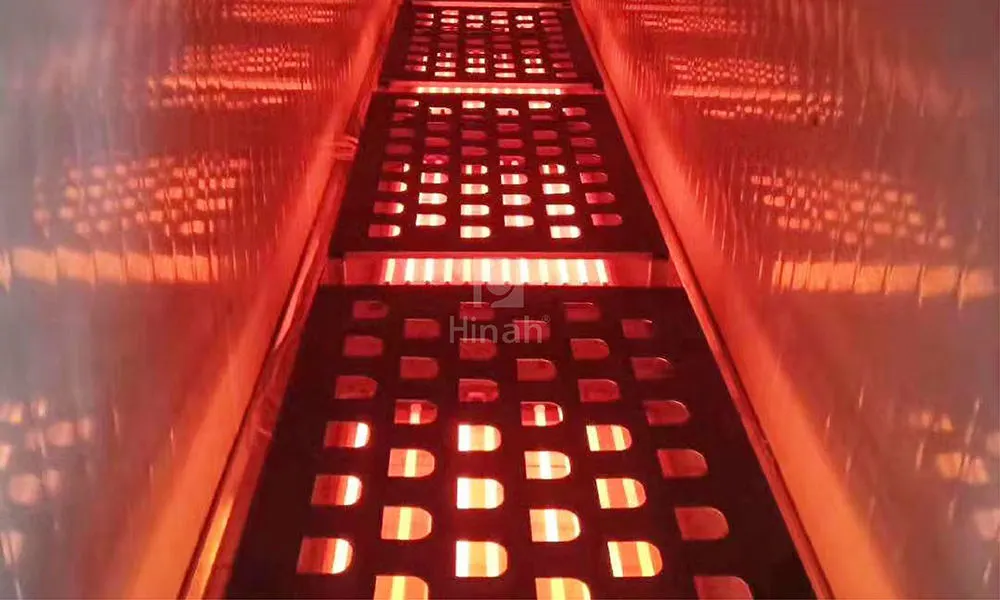
The automated powder coating line relies on a curing oven that maintains peak metal temperature (PMT) within a tight window (±5 °C). Adaptive control algorithms adjust burner output based on real‑time part temperature measured by infrared sensors. This prevents undercure on heavy parts and overbake on thin ones.
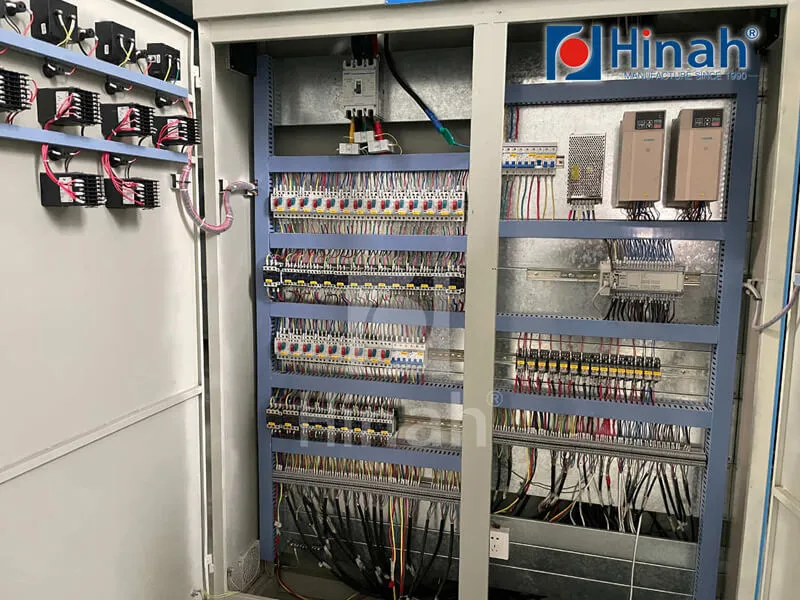
A SCADA system collects data from every module: conveyor speed, gun current, oven temperature, powder usage, and reject rates. This data feeds predictive maintenance models and provides traceability for quality audits. In HANNA’s latest installations, the control system automatically adjusts line speed to maintain cure schedule when part mix changes.
To justify an automated powder coating line, plant managers need hard numbers. Consider a job shop coating 500,000 parts/year with a manual line operating at 75 % first‑pass yield. Rework requires stripping and recoating 125,000 parts at $3.50/part. Switching to an automated line with 95 % yield reduces rework to 25,000 parts—saving $350,000 annually.
Additional savings come from labor: a manual line needs 4 operators per shift; automated needs 1 operator and 1 supervisor. At $25/hour, labor savings exceed $200,000/year. Powder savings (15 % less overspray) add another $60,000. Total annual benefit ≈ $610,000, yielding payback on a $1.8M investment in under 3 years.
Such calculations are part of every HANNA proposal, backed by real process data.
HANNA also offers a proprietary ROI calculator that factors in local labor rates, energy costs, and production mix to provide a custom payback analysis.
Even well‑designed automated powder coating line can suffer from issues if not properly implemented. Field data from 80 troubleshooting visits reveal top failure modes:
Sensor drift in pretreatment: pH probes lose calibration. Solution: automatic two‑point calibration weekly and redundant sensors.
Robot program errors for new parts: Offline simulation must be validated with actual part profiles. Use 3D laser scanning to generate robot paths automatically.
Oven temperature stratification: Caused by poor airflow. CFD analysis during design prevents hot/cold spots. Retrofit with adjustable air nozzles.
Color change contamination: Incomplete purge of powder feed hoses. Install dedicated purge valves and compressed air knives at the gun tip.
The next generation of automated powder coating line will leverage machine learning to optimize parameters in real time. For example, cameras can detect surface defects and immediately adjust gun angles or voltage. Predictive maintenance uses vibration and current signatures to forecast bearing failures or pump wear weeks in advance.
Digital twin technology allows operators to simulate new part programs offline, reducing changeover downtime by 50 %. HANNA is currently piloting an AI‑based system that correlates oven temperature profiles with final gloss and adhesion, enabling self‑optimizing cure schedules.
A1: For a mid‑volume line (1–2 million ft²/year), investment typically ranges from $1.5M to $3.5M depending on level of robotics, oven length, and pretreatment complexity. HANNA provides modular designs that can be scaled as production grows.
A2: With a well‑designed booth and powder recovery system, color change can be completed in 8–12 minutes. Fast‑change systems using cyclone recovery and dedicated feed lines can achieve under 5 minutes for frequent colors.
A3: Yes, modern lines use part recognition (vision or barcode) to automatically select the appropriate robot program and gun settings. Quick‑change tooling on the conveyor and fast color change make HMLV economically viable.
A4: Most facilities see an increase from 70–80 % manual to 90–95 % automated. The exact improvement depends on part complexity and operator skill. Consistent gun positioning and automatic voltage control eliminate human variability.
A5: A typical line includes pretreatment (40–60 ft), dry‑off oven (30 ft), coating booth (30 ft), and curing oven (60–100 ft). Total length often exceeds 200 ft. Compact designs with vertical ovens or multi‑pass configurations can reduce footprint by 30 %.
A6: Daily: clean gun tips and check powder feed. Weekly: verify ground continuity on conveyor, inspect oven seals, and calibrate temperature sensors. Monthly: analyze robot gearbox oil, clean booth filters, and update backup parameters. Following these steps can extend line life beyond 15 years.
Selecting and implementing the right automated powder coating line is a strategic decision that directly impacts quality, cost, and market responsiveness. Whether you are upgrading an existing facility or building a greenfield plant, relying on data‑driven engineering—like the solutions provided by HANNA—ensures that your automated line delivers consistent, profitable performance for decades.