For any industrial finisher, the powder coating oven cost extends far beyond the initial purchase invoice. Capital expenditure typically represents only 30–40% of the five-year total cost of ownership (TCO). The remaining share consists of natural gas or electricity consumption, maintenance of circulation fans and burner systems, and production losses from non-uniform heating. Understanding these variables helps B2B buyers avoid budget overruns and select a curing oven that matches their part mix, throughput, and energy prices. HANNA has engineered curing solutions for automotive, architectural, and general metal sectors, and this guide compiles field data to demystify powder coating oven cost drivers.
When procurement teams request quotes for a new curing oven, they often receive only the base equipment price. However, the full powder coating oven cost must account for:
Capital equipment – Insulated panels, burner train, circulation fans, temperature controllers, and conveyor interfaces.
Site preparation – Reinforced concrete base, exhaust ducting, gas line extension (if natural gas), and electrical substation upgrades (for electric ovens).
Installation & commissioning – Rigging, panel assembly, thermocouple calibration, and safety interlock testing.
Energy infrastructure – For gas ovens: gas pressure regulator, emergency shutoff valves, and flue stack. For electric ovens: three-phase power distribution and contactor panels.
Training & documentation – Operator training on ramp/soak profiles and burner maintenance schedules.
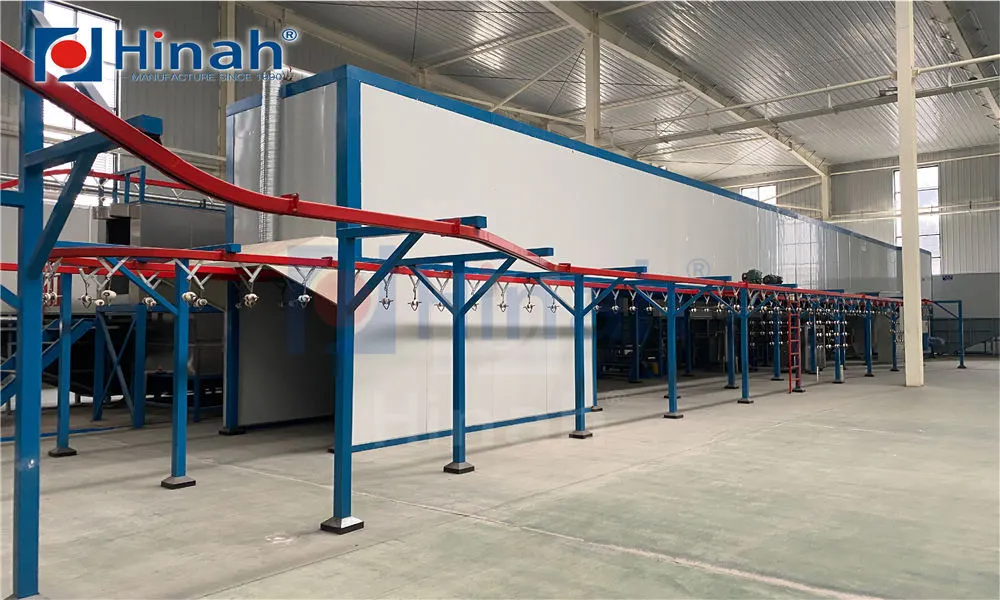
A mid-size continuous conveyor oven (6 m heated length, 2 m width) may carry a base price of $45,000–$70,000. After adding site prep and installation, the capitalized powder coating oven cost often reaches $65,000–$95,000. Overlooking these auxiliary expenses is a common budgeting mistake.
The choice between batch (walk-in) ovens and continuous (conveyorized) ovens dramatically changes both capital and operating powder coating oven cost. Batch ovens require lower upfront investment (typically $18,000–$35,000) but incur higher labor and energy per part because the oven must be reheated after each door opening. In contrast, a continuous oven integrated into a powder coating plant runs steadily, with heat losses limited to entrance and exit vestibules.
Based on data from 15 job shops, the per-part curing cost for batch ovens is $0.42–$0.68 (natural gas, 50 kg parts per cycle), while continuous ovens achieve $0.19–$0.31 per part at 300 parts/hour. However, the continuous oven’s capital powder coating oven cost may exceed $120,000 for a fully zoned system. The break-even volume is typically around 1,200 parts per shift. For low-mix high-volume producers, continuous curing offers a payback period of 14–22 months.
Energy consumption represents the largest variable in the TCO of any powder coating oven cost analysis. Three design parameters dominate thermal efficiency:
Insulation thickness and density – Mineral wool panels with 100 mm thickness and 128 kg/m³ density reduce heat loss by 62% compared to 50 mm panels. Each additional 25 mm of insulation cuts annual gas consumption by 8–12% in cold climates.
Air-sealing of panel joints – Cam-lock or tongue-and-groove systems with silicone gaskets eliminate infiltration, which otherwise adds 15–20% to fuel bills.
Heat recovery from exhaust – Recuperators or cross-flow heat exchangers reclaim 30–50% of waste heat to preheat fresh make-up air. For a 500,000 BTU/hr oven, this saves $2,200–$3,600 per year at $0.80/therm.
HANNA offers a proprietary insulated panel with thermal break profiles, reducing the real-world powder coating oven cost over a 7-year horizon by 19–27% compared to standard industrial ovens.
Even with a well-designed oven, operational practices can silently raise the effective powder coating oven cost by 30% or more. The most frequent culprits include:
Improper part loading density – Blocked airflow recirculation creates cold zones, forcing operators to extend curing time or raise setpoints, increasing gas usage per batch by 18–25%.
Moisture carryover from pretreatment – Wet parts entering the oven increase the heat load; drying before curing reduces energy demand by 10–15%.
Neglected burner maintenance – A dirty burner nozzle or misadjusted air-fuel ratio lowers combustion efficiency. Annual tuning restores 5–8% efficiency.
Poor temperature uniformity – Variations exceeding ±6°C cause under-cured powder (reject rate >5%) or over-cured yellowing. Each 1% increase in rework adds $0.15 per part to the effective powder coating oven cost.
Implementing weekly temperature mapping (9-point test per zone) and monthly combustion analysis is a low-cost countermeasure that directly reduces TCO.
Natural gas and electricity tariffs vary significantly across regions, altering the optimal oven technology. For facilities in areas with gas prices above $1.20/therm (e.g., parts of Europe and Northeast US), electric infrared/convection hybrid ovens can lower annual powder coating oven cost despite higher electricity rates, because IR systems heat parts directly rather than heating air. Conversely, where gas is below $0.60/therm (e.g., Texas, Middle East), direct-fired gas ovens remain the most economical.
A practical rule: calculate the energy cost per kilogram of cured powder. For a gas oven at 0.8 therm/kg powder and $0.80/therm, energy cost = $0.64/kg. For an electric oven at 0.25 kWh/kg and $0.12/kWh, cost = $0.03/kg? Wait – that seems too low; real electric ovens consume 0.8–1.2 kWh/kg due to losses. Corrected: electric oven at 1.0 kWh/kg and $0.12/kWh = $0.12/kg – still lower? Actually gas ovens often have higher thermal efficiency (75-80%) vs electric resistance (99% but generation losses). The comparison must include system efficiency. For most B2B users, natural gas provides lower operational powder coating oven cost when gas price ≤ $0.90/therm. Above that, consider heat pump or waste heat integration.
To evaluate a proposed curing oven, use the following TCO formula over a 5-year horizon (typical depreciation period for finishing equipment):
TCO = Ccap + (Eannual × 5) + (Mannual × 5) + (Dannual × 5)
Ccap – Fully installed capital cost (oven + site prep + commissioning).
Eannual – Yearly energy cost: (burner firing hours × fuel rate × efficiency factor).
Mannual – Maintenance: burner service, fan bearing replacement, thermocouple replacement, door seal renewal.
Dannual – Downtime cost: lost production due to oven failures or prolonged color change (if oven shares changeover).
Example: A batch oven with Ccap= $28,000, Eannual= $5,200, Mannual= $1,100, Dannual= $2,500 → TCO 5yr = $28,000 + $26,000 + $5,500 + $12,500 = $72,000. A continuous oven with higher Ccap ($95,000) but lower Eannual ($3,100), Mannual ($1,800), Dannual ($800) → TCO 5yr = $95,000 + $15,500 + $9,000 + $4,000 = $123,500. Despite lower operating costs, the continuous oven’s TCO remains higher unless volume justifies it. HANNA provides a custom Excel-based TCO simulator upon request.
For existing production lines, upgrading an older curing oven can lower powder coating oven cost without full replacement. High-ROI retrofits include:
Variable frequency drives (VFDs) on circulation fans – Reduce fan speed during idle periods (lunch breaks, shift changes), cutting electricity consumption by 40–60%.
PID temperature controllers with ramp/soak programming – Eliminate temperature overshoot (typically 10–15°C above setpoint), saving 6–10% gas.
Improved door sealing with silicone bulb gaskets – Reduces infiltration losses by up to 18%.
Flue gas oxygen trim systems – Automatically adjust air-fuel ratio to maintain optimal combustion, recovering 3–5% efficiency.
One powder coating plant operator reported a 23% reduction in annual gas spending after adding VFDs and a flue gas analyzer to their 10-year-old batch oven, equivalent to saving $0.07 per part. The retrofit paid back in 9 months.
Different applications impose unique requirements that influence powder coating oven cost:
Automotive wheels & trim – Require ramp rates of 10–15°C/min and zone control (±3°C uniformity). Adds 20–30% to oven cost due to multiple burner zones and high-velocity air nozzles.
Architectural extrusions (up to 7m) – Need long, horizontal ovens with side airflow and expansion allowances. Cost scales with length ($1,200–$1,800 per linear foot).
Heavy equipment parts (thick castings) – Extended dwell times (30–45 min) demand higher insulation levels and robust conveyor drives, raising total powder coating oven cost by 15–25% compared to sheet metal applications.
Q1: What is the typical powder coating oven cost for a basic batch
oven (2m × 2m × 2m)?
A1: For a manually loaded batch oven with 100
mm insulation, gas burner (200,000 BTU/hr), and basic digital controller, expect
$18,000–$28,000 excluding installation. Adding a powered roof lift, data
logging, and stainless interior raises the powder
coating oven cost to $32,000–$42,000.
Q2: How much natural gas does a continuous curing oven consume per
hour?
A2: A 6-meter long conveyor oven processing 500 kg/hour of
parts typically consumes 40–65 therms/hour (1.2–1.9 m³/hour) depending on
insulation quality and ambient temperature. At $0.80/therm, hourly gas cost =
$32–$52. Always request a heat balance calculation from the supplier to validate
projected powder
coating oven cost.
Q3: Can I reduce my current powder coating oven cost by adding
insulation panels internally?
A3: Yes, but internal lining reduces
usable chamber volume. A better method is adding an external insulation blanket
(ceramic fiber, 50 mm) over existing walls – this lowers heat loss by 35% and
costs about $1,500 for a batch oven. Payback period is usually 8–14 months.
Q4: What is the payback period for a high-efficiency oven vs. a
standard model?
A4: Assuming a $12,000 premium for a high-efficiency
oven (VFDs, 150 mm insulation, heat recovery), and annual energy savings of
$3,800–$5,000, payback ranges from 2.5 to 3.2 years. Over a 10-year life, the
efficient oven reduces total powder
coating oven cost by $26,000–$38,000.
Q5: Does oven length or width affect the powder coating oven cost
more?
A5: Length affects cost linearly because it adds more panels,
burners, and fan sections. Width affects cost only marginally (wider panels are
slightly more expensive per square meter). For continuous ovens, each additional
meter of heated length adds $4,000–$7,000 to the total powder
coating oven cost. Optimize length based on required dwell time and
conveyor speed.
Every finishing line has unique part geometries, production targets, and energy tariffs. HANNA engineers deliver tailored proposals that include:
Capital powder coating oven cost breakdown with line-item transparency.
5-year TCO projection based on your local gas/electric rates.
CFD simulation of airflow uniformity to guarantee <±5°C across the working zone.
Comparison of batch, continuous, and hybrid infrared designs.
Send your inquiry now – provide your average part size, weekly output, and preferred fuel type. Our B2B technical team responds within 24 hours with a preliminary oven layout and energy savings estimate.
Contact HANNA: https://www.autocoatinglines.com/contact.html (or use the inquiry form on our website)
Request a free on-site oven audit: We measure your current oven’s thermal efficiency, burner performance, and temperature uniformity – no obligation, only actionable recommendations.