Investing in a powder coating production line represents a seven-figure decision that directly impacts throughput, finish quality, and operating costs for the next decade. Unlike standalone equipment, an integrated line combines pretreatment, application, curing, and material handling into a synchronized system. Based on commissioning data from over 400 industrial lines worldwide, this guide examines eight engineering decisions that separate profitable operations from chronic bottleneck sources. HANNA has engineered modular powder coating production lines for automotive, architectural, agricultural, and general metal finishing sectors, achieving first-pass yield improvements of 15–25% documented across customer sites.

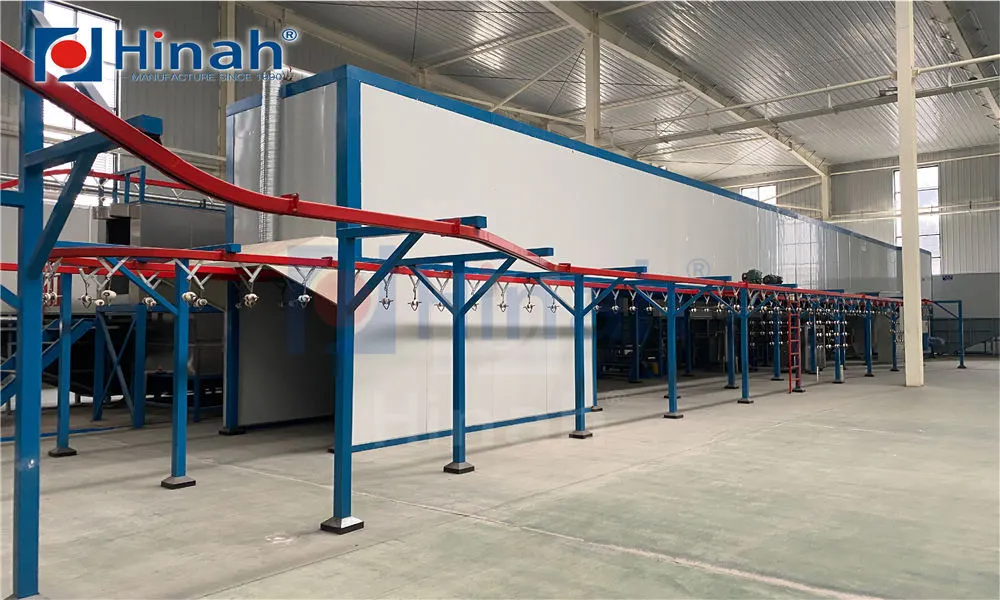
A complete powder coating production line consists of six mandatory stations: loading zone, pretreatment system, dry-off oven, powder application booth (manual or automatic), curing oven, and unload/inspection area. Optional modules include cooling tunnels, primer application, and robotic demasking. The conveyor system ties all stations together. Each component's performance affects the others — a mismatch in line speed between the booth and curing oven creates pile-ups or empty hooks. Integrated system design must account for part geometry, production volume (parts per hour), and powder chemistry. Below we break down the eight high-impact decisions.
The conveyor is the backbone of any powder coating production line. Two dominant types exist:
Overhead monorail (IMS) – Best for heavy parts up to 500 kg per hook. Allows 180° rotation for uniform coating. Requires regular chain lubrication and wear inspection.
Power-and-free (P&F) – Enables accumulation and independent carrier routing. Higher initial cost but essential for lines with multiple coating colors or batch processing.
Line speed is calculated by: (hook spacing × desired parts per hour) / 60. A typical automotive line runs 3–6 m/min. VFD-controlled drives allow speed changes without mechanical adjustments. Mistake: undersized take-up units cause chain sag and erratic part positioning. Specify automatic chain oilers with proximity sensors to reduce maintenance intervals by 300%.
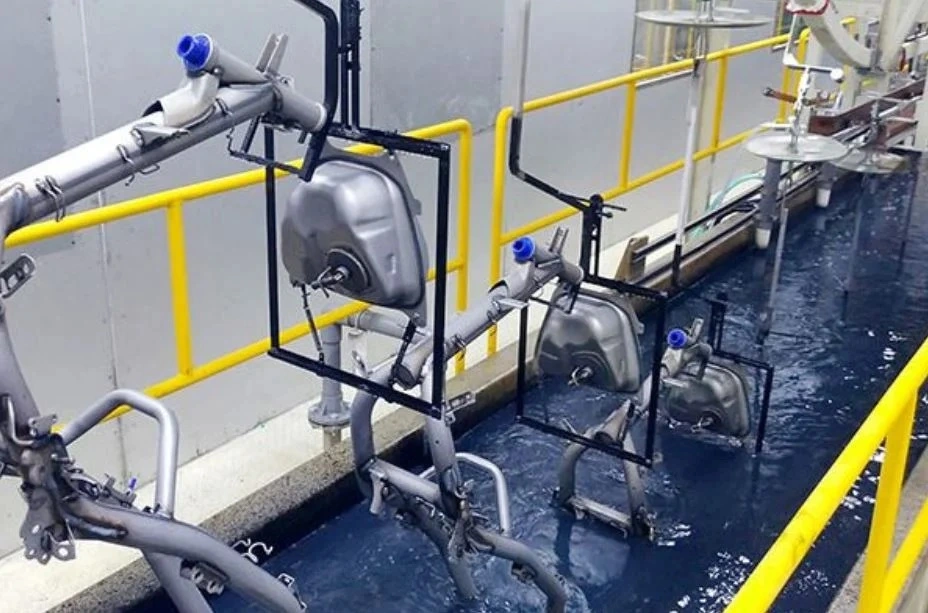
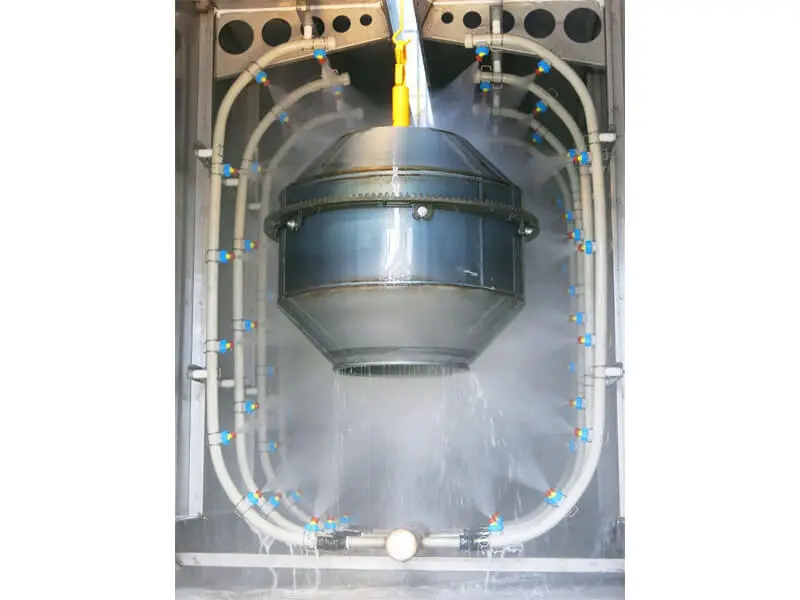
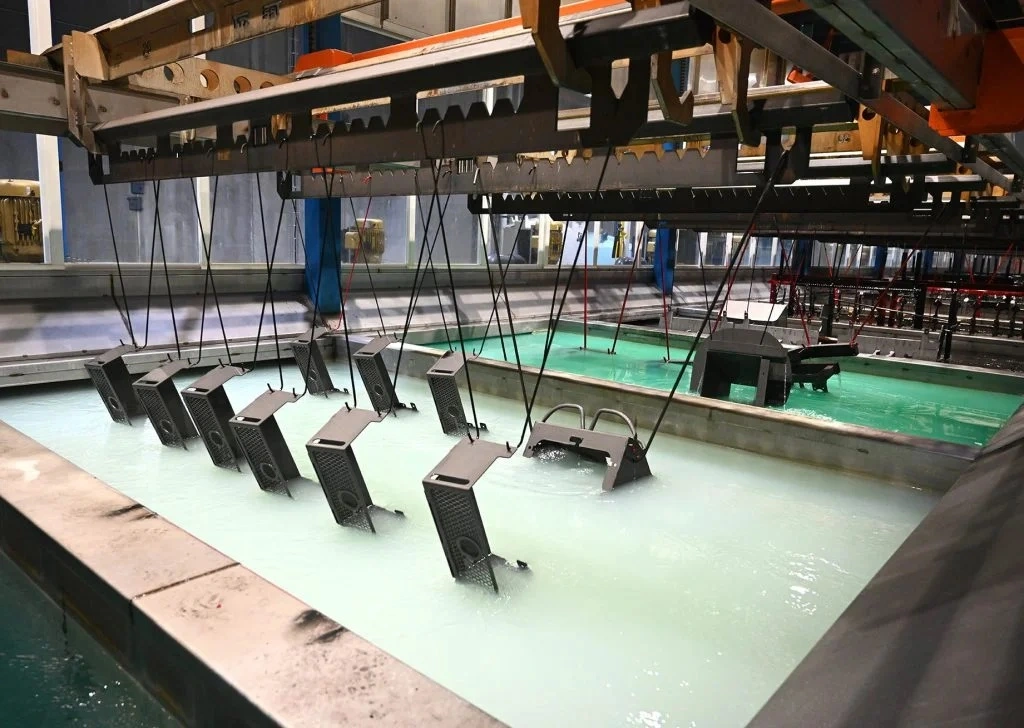
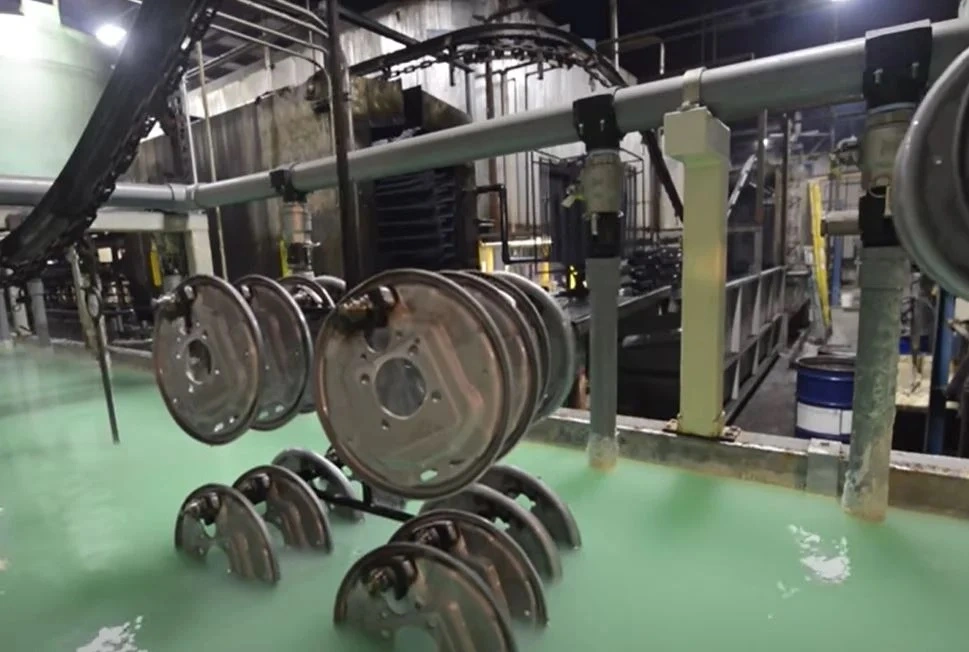
Substrate contamination causes 70% of coating failures. A proper pretreatment section for a metal pretreatment system includes:
Stage 1: Alkaline clean (55–65°C) – removes oils and shop dirt.
Stage 2: Fresh water rinse – ambient or heated.
Stage 3: Conversion coating (zinc phosphate or zirconium) – improves adhesion and corrosion resistance.
Stage 4: Deionized water rinse – prevents water spots.
Zirconium-based pretreatments operate at ambient temperature, saving 40% energy compared to zinc phosphate (55°C). However, phosphate offers better salt spray performance (1,000+ hours) for outdoor architectural applications. Specify stainless steel tank construction (304 grade) and automated chemical dosing with pH/conductivity probes. A weekly tank dump schedule reduces sludge buildup. For high-volume powder coating production lines, a 5-stage system with two rinse stages after conversion is recommended.
After pretreatment, parts enter a dry-off oven to evaporate surface moisture before powder application. Typical specifications: 120–140°C for 8–12 minutes. Undersized dry-off ovens force residual moisture into the powder booth, causing pinholes and poor adhesion. Calculate required airflow using: CFM = (parts surface area × moisture load × 1.2) / (temperature rise × 0.075). A heat recovery heat exchanger between dry-off and curing oven exhaust can reclaim 40% of energy. Direct gas-fired dry-off ovens are common, but indirect firing prevents combustion products from contacting cleaned parts.
The powder application booth determines transfer efficiency and color change speed. Three configurations:
Manual booth – For low-volume, high-mix lines (≤ 500 parts/day). Operator uses hand-held guns. Requires proper grounding and air makeup.
Automatic booth with fixed guns – 6–12 guns mounted on vertical oscillators. Transfer efficiency 60–75%. Suitable for high-volume, same-color runs.
Fast-color-change booth – Cyclone or cartridge filter design with quick-release hoppers. Color change under 15 minutes. Powder coating production lines serving job shops prioritize this option.
Booth air velocity must be maintained at 0.5–0.8 m/s to contain overspray. Higher velocities pull powder from the part; lower velocities allow fugitive emissions. Install differential pressure gauges across filters to signal cleaning cycles. HANNA's HANNA booth designs incorporate anti-static liners to reduce powder adhesion to walls.
The curing oven completes the thermosetting reaction. Temperature uniformity of ±3°C across the work zone is mandatory. Common pitfalls:
Cold spots near door ends – install recirculation fans with adjustable dampers.
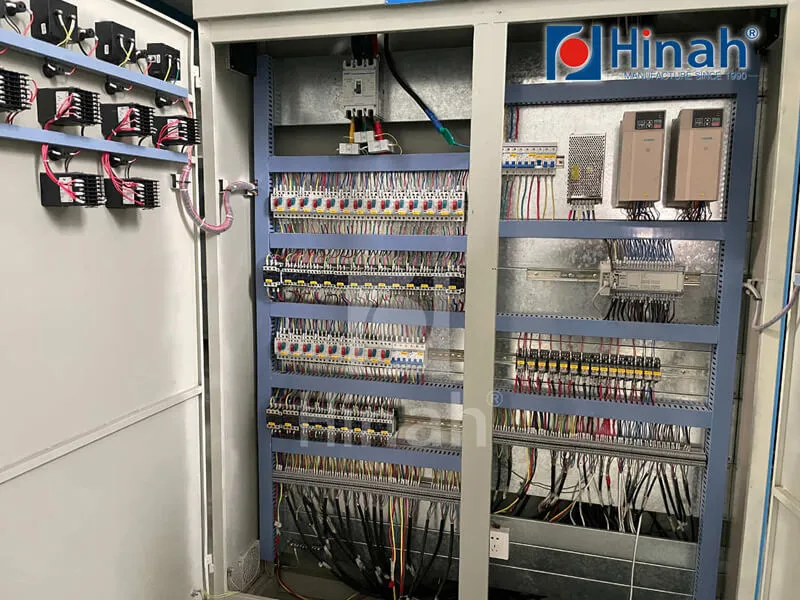
Over-curing thin edges – use multi-zone PID control with independent burner modulation.
Inadequate dwell for heavy parts – measure part temperature with trailing thermocouples, not oven air temperature.
For a curing oven design, specify insulated panels with 100 mm mineral wool (density 128 kg/m³) and tongue-and-groove joints to prevent thermal bridging. Gas-fired convection remains the industry standard, but infrared boosters at the entrance can shorten total oven length by 30%. HANNA provides CFD simulation reports to validate uniformity before fabrication.
Overspray powder represents 30–50% of total material consumption. Recovery systems fall into two categories:
Cyclone + cartridge filter – Recovers up to 98% of overspray. Powder is sieved and returned to the feed hopper. Ideal for single-color lines.
Single-stage cartridge filter – Simpler but lower recovery rate (85-90%). Suitable for lines that change color frequently because the entire system can be cleaned faster.
Closed-loop recovery with automatic sieving reduces waste disposal costs. Monitor pressure drop across filters; a rise of 200 Pa indicates cleaning needed. Powder coating production lines processing expensive TGIC polyester powders recover capital investment in recovery systems within 8–12 months.
Color change is the largest source of unplanned downtime. Efficient lines implement:
Dedicated powder feed hoses per color (quick-disconnect fittings).
Vacuum-assisted booth cleaning – reduces manual wipe-down time by 70%.
Spare hoppers and gun tips pre-configured for the next color.
Measure color change time as the interval between last good part of color A and first good part of color B. Top-performing fast-change systems achieve under 10 minutes. Avoid common mistake: insufficient air purge in feed lines, leaving residual powder that contaminates the next color. Install purge valves at each gun manifold.
Freshly cured parts exit the oven at 80–100°C. Forced air cooling tunnels reduce temperature to 40°C before handling, preventing burns and distortion. Design cooling tunnel length based on: L = (conveyor speed × cooling time). Cooling time = (part mass × specific heat × temperature drop) / (heat transfer coefficient × surface area). A typical tunnel uses high-velocity ambient air (15–20 m/s). After cooling, install inspection lighting (500 lux minimum) and thickness gauges (eddy current or magnetic). Statistical process control (SPC) software logs readings per part.
Real-world powder coating production line problems and fixes:
Pain point: Faraday cage areas uncoated – Solution: Use electrostatic guns with adjustable kV (60–100 kV) and ion collection nozzles. Reduce gun distance to 150–200 mm.
Pain point: Orange peel texture – Solution: Increase powder flow rate or reduce oven temperature ramp rate. Check powder particle size distribution (D50 should be 35–45 microns).
Pain point: Back ionization (cratering) – Solution: Lower kV setting (40–60 kV) or use anti-back-ionization electrodes. Ensure part grounding resistance below 1 MΩ.
Pain point: High compressed air consumption – Solution: Install air saver nozzles and monitor leak rate monthly. A 3 mm hole at 6 bar wastes $2,500/year.
HANNA provides root cause analysis for each issue, using high-speed video of powder cloud dynamics to optimize gun positioning.
Q1: What is the typical footprint required for a powder coating
production line handling 500 parts per day?
A1: A manual line with 6
m conveyor length, pretreatment tunnel (8 m), dry-off oven (4 m), booth (3 m),
curing oven (12 m), and cooling (4 m) totals about 37 m linear length. Width:
3–4 m including walkways. Allow 20% extra for maintenance access. HANNA provides
2D layout drawings before purchase.
Q2: How do I calculate return on investment for automating a manual
powder coating line?
A2: Compare current labor cost (operators ×
hourly rate × shifts) vs. automated line (one operator for monitoring). Typical
manual line: 4 operators, $20/hour, 2 shifts = $320,000/year labor. Automated
line: 1 operator = $80,000/year. Equipment amortization over 5 years: $500,000
line cost = $100,000/year. Net savings: $140,000/year. Plus reduced rework
(manual lines average 8% reject rate; automated < 2%). ROI period: 3–4
years.
Q3: What are the critical spare parts to keep in stock for a powder
coating production line?
A3: Keep: two complete powder guns
(including nozzles and electrodes), set of cartridge filters, conveyor chain
links (10 pieces), three thermocouples (type K), drive belt for fan, and a spare
VFD for the curing oven. For pretreatment: spare pH probe, chemical dosing pump
seals. Stock value typically $8,000–$12,000.
Q4: How does part geometry affect line speed and
curing?
A4: Parts with deep recesses (Faraday cage areas) require
slower conveyor speed (1–2 m/min) to allow powder penetration. Heavy castings
need longer cure dwell (up to 25 minutes) because metal temperature lags oven
air temperature. Use part profiling with data loggers to set zone speeds.
Variable
conveyor speed control allows different recipes for mixed
loads.
Q5: What environmental permits are required for a powder coating
production line?
A5: Most regions require: air permit for
particulate emissions (powder overspry below 50 mg/m³), wastewater permit for
pretreatment chemical discharge (or zero-discharge system with evaporator), and
fire safety approval (NFPA 33 compliance). Powder coating is generally low-VOC
(< 0.1 lb/gal), avoiding volatile organic compound regulations. Consult local
authorities; HANNA provides compliance documentation.
Q6: Can I retrofit an existing curing oven with a faster cooling
system?
A6: Yes – add a forced air cooling tunnel after the oven
exit. Use 450 mm diameter fans with directional louvers. Typical cooling length:
3–6 m depending on part mass. Retrofits reduce handling time by 30% and prevent
glove sticking. Ensure conveyor extension is feasible. HANNA offers modular
cooling sections that bolt onto existing ovens.
Q7: How do I maintain consistent powder film thickness across varying
part sizes?
A7: Install closed-loop feedback: a thickness gauge at
booth exit signals the powder feeder to adjust output. For automatic guns, use
distance sensors (ultrasonic or laser) to modulate voltage and powder flow based
on part profile. Standard deviation of thickness can be reduced from ±15 µm to
±5 µm. Powder coating
production lines with adaptive controls achieve Cpk > 1.33.
Designing a powder coating production line requires balancing pretreatment chemistry, conveyor dynamics, booth design, and oven uniformity. HANNA offers free line audits, simulation-based design, and turnkey installation. Send your part drawings, target daily output, and available floor space to receive a detailed proposal including layout drawings, energy consumption estimates, and 5-year cost projection. All inquiries receive a response within 48 hours.
Request your inquiry now → Visit https://www.autocoatinglines.com/ or email neil@autocoatinglines.com. Include your part dimensions, material (steel/aluminum), and required coating standard (e.g., ASTM D7803, AAMA 2604).