
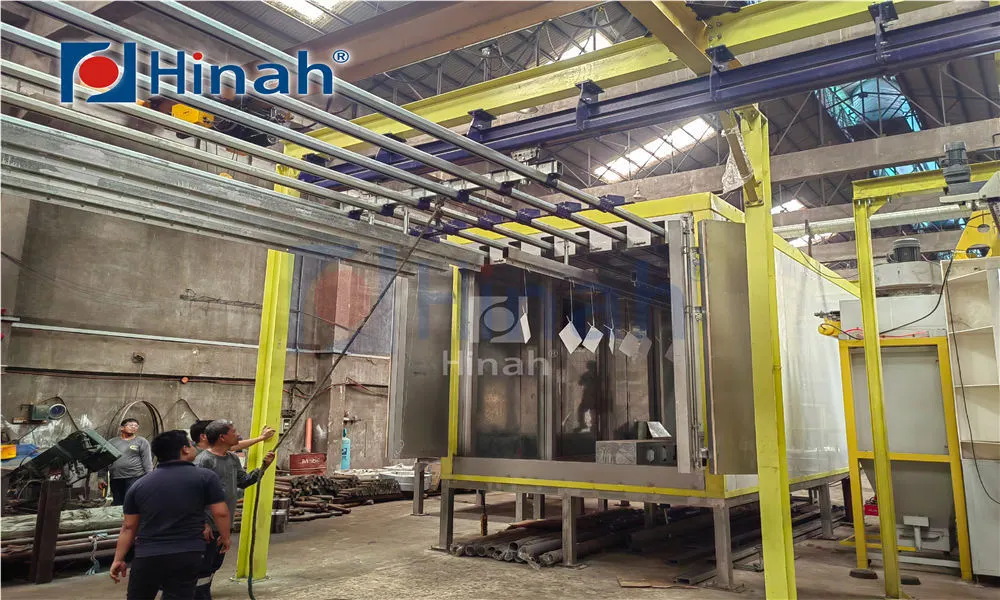
In modern powder coating operations, the Powder coating spray booth is not merely an enclosure—it is the core process module determining first-pass transfer efficiency, reclaimable overspray quality, and color change downtime. For B2B finishers processing thousands of parts daily, booth design directly impacts powder consumption, labor costs, and compliance with NFPA/ATEX regulations. This guide provides engineering-level insights into airflow schemes, filtration technologies, explosion venting, and integrated recovery systems, supported by data from industrial deployments and HANNA’s field experience across automotive, architectural, and general metal finishing sectors.
Selecting a Powder coating spray booth begins with understanding three non-negotiable parameters: cross-draft or downdraft air velocity uniformity, filter media efficiency (H12/H13 or pleated cartridge), and structural grounding to prevent electrostatic discharge. Industrial booths must maintain 0.4–0.7 m/s face velocity to capture airborne powder without disturbing the spray plume. Downdraft configurations, preferred for high-value parts, reduce turbulent eddies and improve powder cloud stability. Below are the critical subsystems:
Air distribution plenum: Perforated back walls or ceiling diffusers ensure laminar airflow, minimizing dead zones where powder settles.
Cartridge filter arrays: Nanofiber or cellulose/polyester blends with pulse-jet cleaning; recommended air-to-cloth ratio ≤1.5:1 for extended campaign life.
Recovery cyclones (optional): When paired with a powder coating plant, cyclones separate coarse particles (≥10 µm) before final filtration, reducing cartridge load by 40–60%.
Explosion venting & suppression: NFPA 33-compliant burst panels or flameless venting devices are mandatory when processing fine powders with a Kst value >200 bar·m/s.
From a B2B perspective, the total cost of ownership (TCO) of a Powder coating spray booth includes filter replacement cycles (typically 800–1200 operating hours), compressed air consumption for pulse cleaning (6–8 bar, 2–4 CFM per filter), and color change time. HANNA has documented that switching from a conventional open-face booth to a closed-loop cartridge booth reduces annual powder waste by 18–25% for medium-volume job shops.
One of the most misunderstood aspects of powder coating spray booth engineering is the air pattern’s effect on transfer efficiency. In cross-draft booths (air moving horizontally from back to front), operators often experience “powder bounce-back” due to interaction with the part geometry. Downdraft booths, where air flows vertically through a grated floor into underground ducts, eliminate this issue. However, downdraft requires deeper pit construction and higher fan static pressure. A hybrid solution—semi-downdraft with rear extraction—offers 85% of the performance at 60% of the capital cost.
Industrial data indicate that poor booth aerodynamics can reduce first-pass transfer efficiency from 65% to below 45%, directly increasing reclaim system load and reject rates. To quantify performance, use an anemometer grid test (16 points per square meter) to ensure velocity variation ≤±15%. For automated lines, install pressure transducers across the filter bank to trigger pulse cleaning at ΔP = 1.2 kPa.
The majority of modern Powder coating spray booth configurations use cartridge collectors due to their compact footprint and >99.5% collection efficiency on particles >0.5 µm. Key selection parameters for cartridge filters include:
Media treatment: Oleophobic coatings for powder types prone to moisture absorption (e.g., epoxy-polyester hybrids).
Pulse-jet timing: Sequential cleaning with 80 ms bursts, 10–15 second intervals; improper timing leads to re-entrainment.
Gasketing & sealing: FDA-grade silicone or EPDM to prevent bypass leakage, which degrades reclaim purity.
For large-scale operations, integrating a cyclone upstream of the cartridge filters reduces maintenance intervals by 40%, as documented by HANNA in automotive wheel coating plants. The cyclone removes oversized agglomerates and contaminants, sending clean fines to the cartridge collector. Sieving (150–200 µm mesh) of reclaimed powder is mandatory before reintroduction to the spray gun to eliminate “angel hair” or cured particles.
Color change downtime remains the #1 bottleneck in job shop environments. Conventional Powder coating spray booth cleaning requires manual blow-down of walls, floors, and ducting—often 60–90 minutes per change. Advanced modular booths incorporate:
Floors with fold-down sections and integrated vacuum ports for rapid powder removal.
Anti-static wall panels (PVC or stainless steel) that minimize powder adhesion; surface resistivity < 10^6 Ω/sq.
Automatic purge cycles using programmable nozzles that sweep interior surfaces in <10 minutes.
Quick-change filter cassettes with swing-away access doors.
Data from a tier-1 agricultural equipment supplier show that switching to a quick-color-change powder coating plant with a movable cart booth reduced average changeover from 75 minutes to 19 minutes, enabling three additional color runs per shift. HANNA has engineered a proprietary booth floor vacuum system that captures 98% of residual powder within 4 minutes, directly validated by laser particle counters.
Powder coating processes generate combustible dust atmospheres. A compliant Powder coating spray booth must address ignition sources: electrostatic discharge from ungrounded operators, friction sparks from conveyor belts, and hot surfaces. Mandatory engineering controls include:
Continuous grounding monitoring: Resistance to true ground ≤ 1 MΩ for all conductive booth components.
Explosion relief panels: Sizing based on booth volume (EN 14491: 0.1 m² per 1 m³).
Spark detection and extinguishing systems in ductwork (infrared sensors + water mist nozzles).
ATEX-certified fans and motors (Category 2 or 3 depending on zone classification).
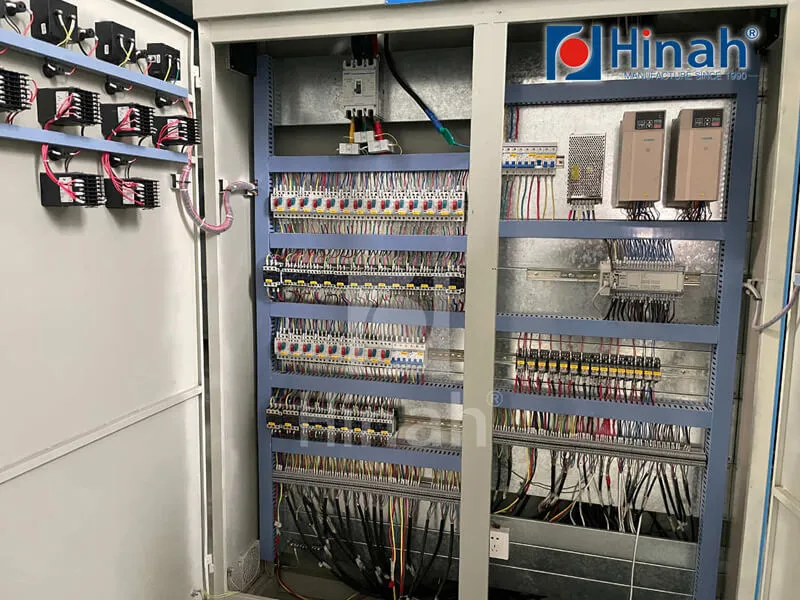
Regular audits must verify that the powder coating spray booth’s bonding resistance remains below 10 Ω. HANNA recommends quarterly thermographic inspection of electrical cabinets and grounding lugs, as loose connections are a frequent hidden risk in high-vibration finishing lines.
Different end-markets impose distinct requirements on powder coating spray booth specifications:
Automotive wheels & trim: Require ultra-low particle fallout (ISO 14644-8 Class 100,000) and integrated parts cooling zones. Downdraft booths with H13 secondary filters mandatory.
Architectural aluminum extrusions: Long parts (up to 7 m) need tunnel booths with side-draft airflow and variable-speed fans to maintain velocity uniformity across length.
Heavy equipment (agricultural/construction): High film builds (80–150 µm) generate more overspray; cyclones followed by secondary baghouses reduce filter loading.
For each segment, HANNA provides modular booth platforms with customizable filter bank sizing, from 12-cartridge units for small job shops to 96-cartridge arrays for high-volume automated lines.
To justify capital investment in a new Powder coating spray booth, B2B buyers must model 5-year TCO. Key operational metrics include:
Powder usage per shift (kg): Baseline vs. post-installation; expect 15–30% reduction with high-efficiency booths due to reduced overspray loss.
Filter replacement cost: Average $80–150 per cartridge; budget for 2 annual replacements for 2-shift operations.
Compressed air cost for pulse cleaning: 2–4 SCFM per filter at 6 bar; annual cost = (SCFM × 0.00015 $/SCF × operating hours).
Labor for color changes: Calculate hourly burden rate × frequency. Modular booths often pay back within 8 months purely through labor reduction.
Data from a HANNA customer in the lighting fixture industry: After retrofitting their old open booth with a closed-loop cartridge spray booth, powder consumption dropped from 42 kg/shift to 29 kg/shift, while color change time decreased from 55 min to 14 min, resulting in annual savings of $87,000.
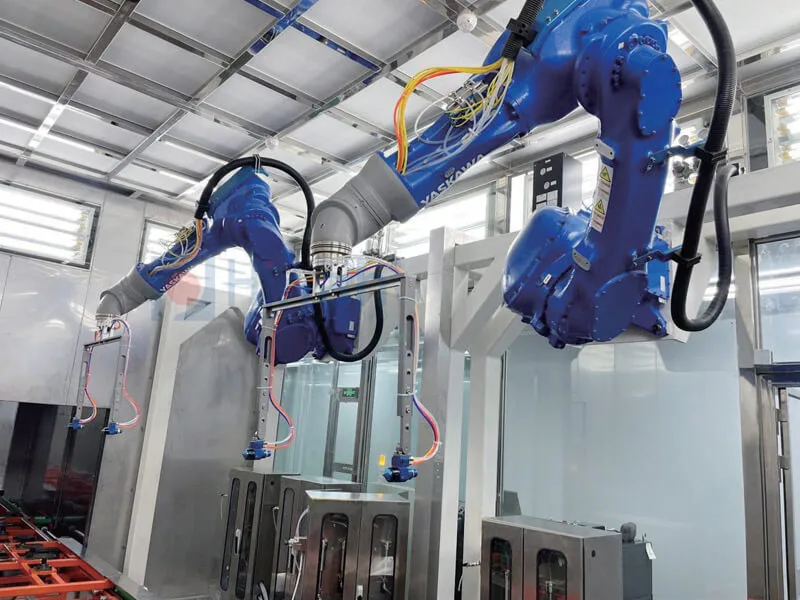
Modern Powder coating spray booth systems are increasingly connected to MES/SCADA platforms. Sensors track filter differential pressure, hopper level, and ambient humidity. Real-time dashboards alert operators to pulse cleaning failures or abnormal pressure drops. For fully automated powder coating plant integration, booth controllers communicate with reciprocators or robots to adjust spray parameters based on part geometry and reclaim powder ratio (fresh/reclaim blend up to 30% reclaim for most chemistries). This closed-loop optimization improves material utilization by 12–18% beyond standalone booth benefits.
Q1: What is the ideal air velocity inside a powder coating spray
booth for manual vs. automatic operation?
A1: For manual booths,
0.5–0.7 m/s cross-draft is recommended to contain overspray without operator
discomfort. For automatic booths with reciprocators or robots, 0.4–0.6 m/s
downdraft ensures powder cloud stability. Velocities above 0.8 m/s can cause
Faraday cage penetration issues on complex parts.
Q2: How often should cartridge filters be replaced in a high-volume
powder coating spray booth?
A2: Typical service life ranges from 800
to 1,500 operating hours, depending on powder type (epoxy-rich powders load
faster) and pulse-jet efficiency. Monitor differential pressure: replace when ΔP
exceeds 1.5 kPa after pulse cleaning. HANNA offers filter life
prediction algorithms based on real-time pressure data.
Q3: Can I retrofit my existing spray booth with a cartridge collector
instead of a cyclone?
A3: Yes, provided the booth’s air volume (CFM)
matches the collector’s rated capacity and the ductwork design prevents powder
settling. Many retrofits require replacing the fan to overcome higher static
pressure of cartridge filters (typically 1.2–1.8 kPa vs. 0.6–0.9 kPa for
cyclones).
Q4: What NFPA/ATEX requirements apply to a powder coating spray booth
handling hybrid powders?
A4: NFPA 33 (US) and EN 12981 (EU) mandate
explosion venting, bonding/grounding, and dust accumulation limits (<1/32
inch). For hybrid powders with a Kst >200 bar·m/s (St2 class), deflagration
venting must be directed to a safe outdoor area or use flameless venting.
Regular dust layer thickness inspections are required.
Q5: How do I calculate the correct booth size for my parts
mix?
A5: The booth opening width should be at least 300 mm larger
than the widest part on each side. Depth must accommodate the spray gun distance
(250–350 mm) plus operator/robot travel. For a powder coating
plant processing multiple SKUs, use a statistical envelope: 95th
percentile part dimensions + 400 mm clearance. HANNA provides free layout
simulation using 3D CAD models.
Every finishing line has unique constraints—floor space, part geometry, production volume, and powder types. HANNA engineers deliver custom-designed Powder coating spray booth solutions, from compact single-cartridge units to fully automated downdraft systems with integrated reclaim and color-change automation. Our proposals include ROI calculations, airflow CFD simulations, and ATEX compliance documentation.
Send your inquiry today — provide your part size range, desired output (parts/hour), and existing powder chemistry. Our B2B technical team responds within 24 hours with a preliminary layout and savings estimate.
Inquiry contact: https://www.autocoatinglines.com/contact.html (or use the live chat on our website)
Request a free on-site audit: Our specialists measure your current booth’s transfer efficiency, air velocity uniformity, and recovery losses. No obligation — just data-driven recommendations.