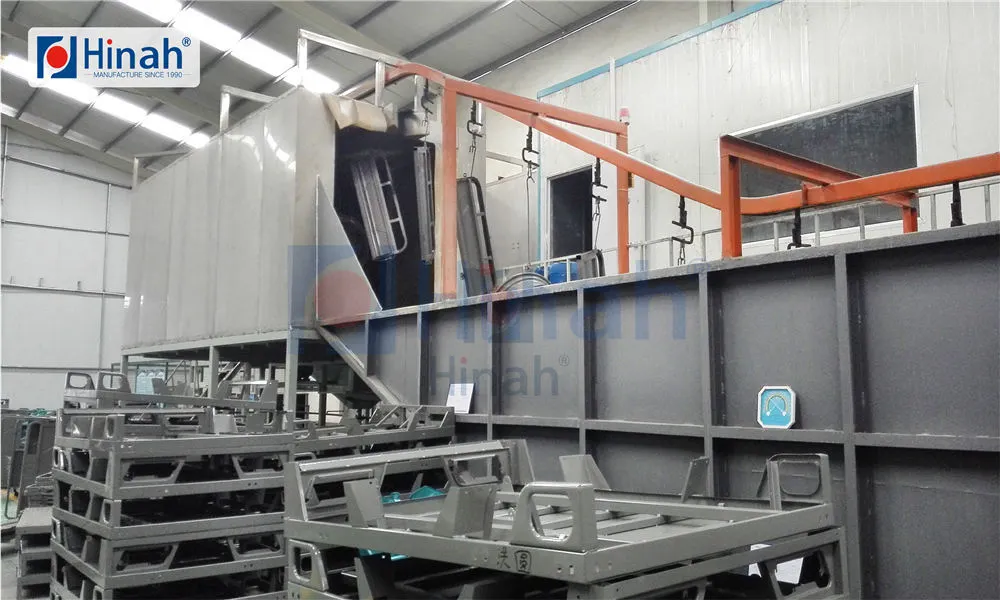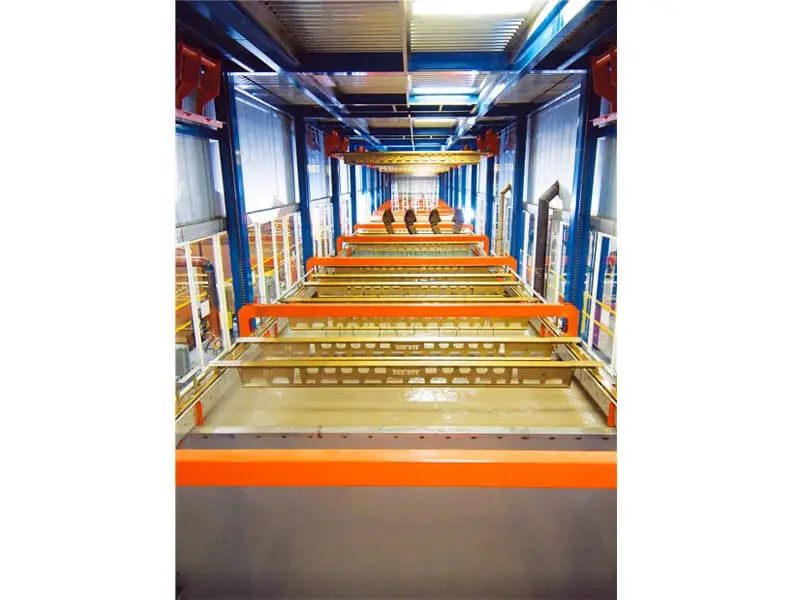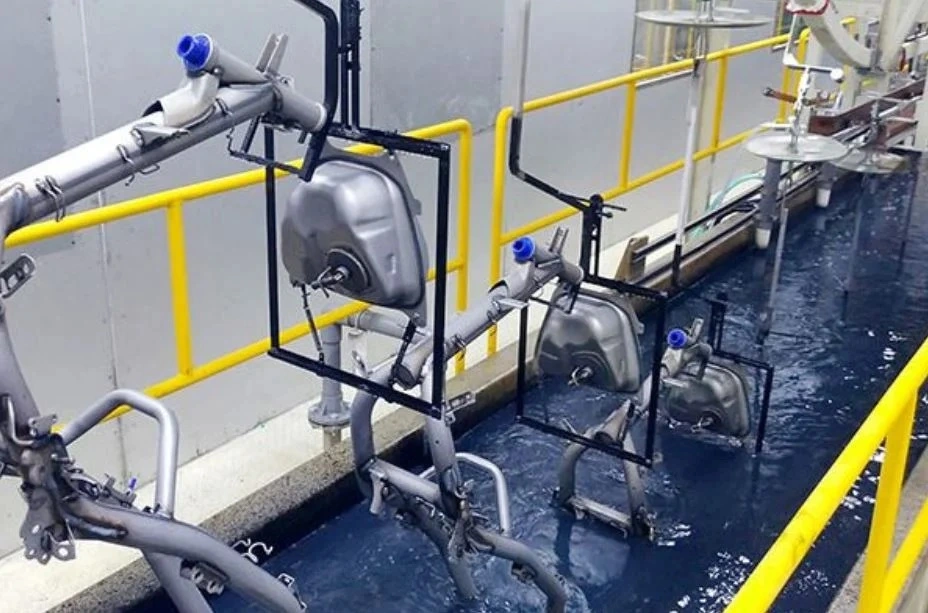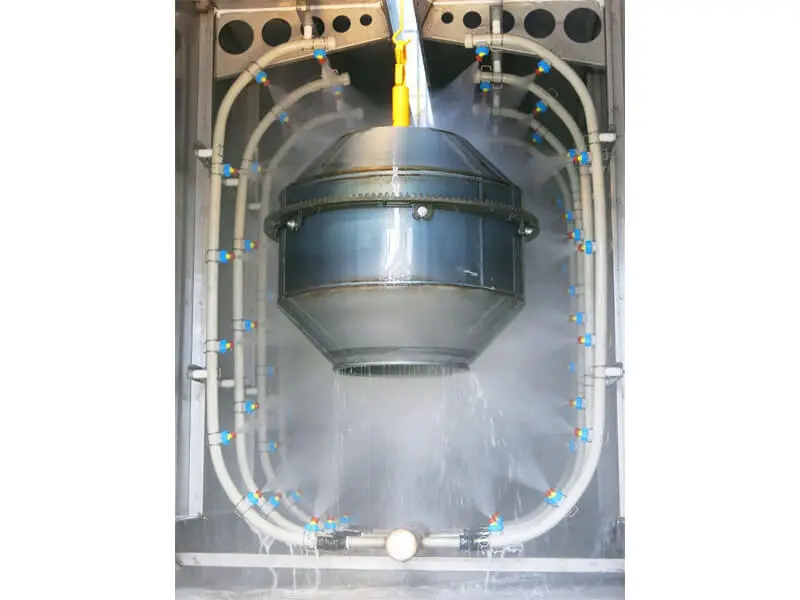
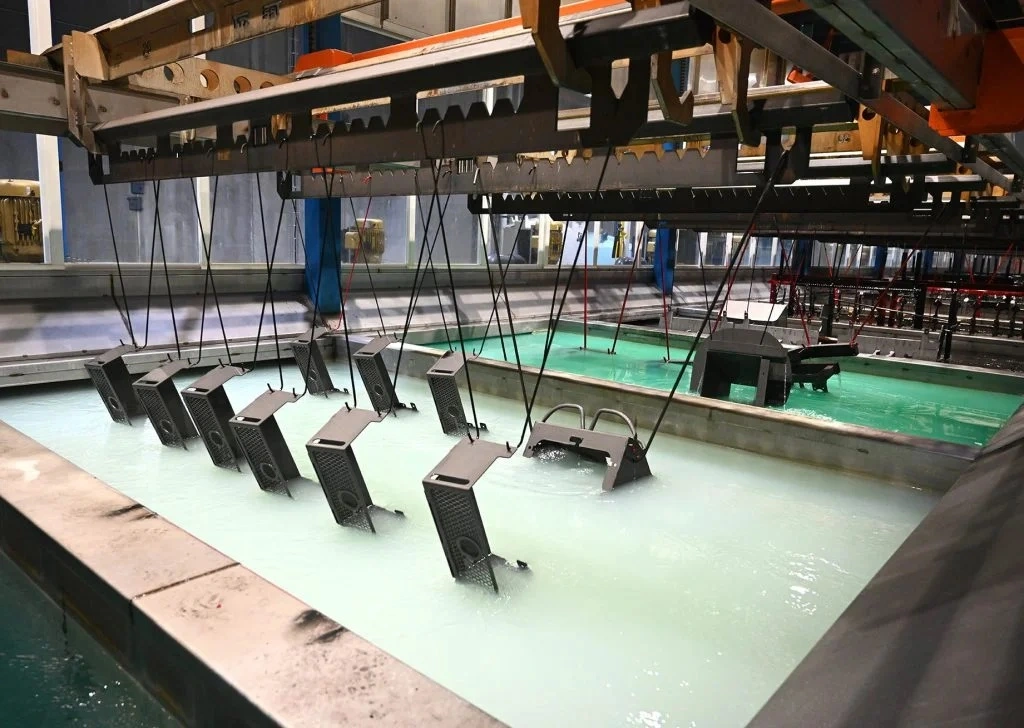
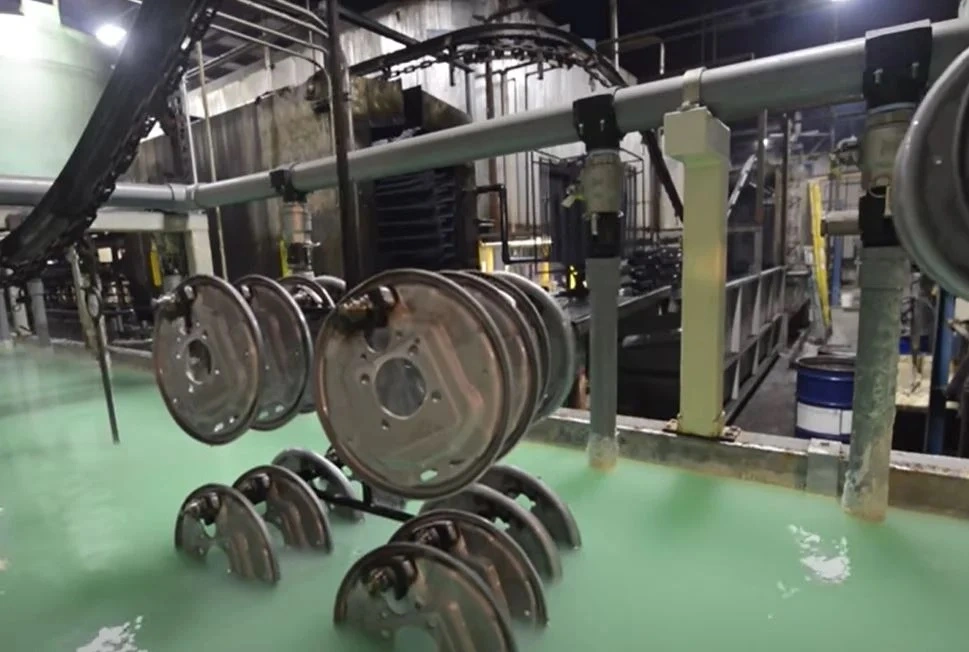
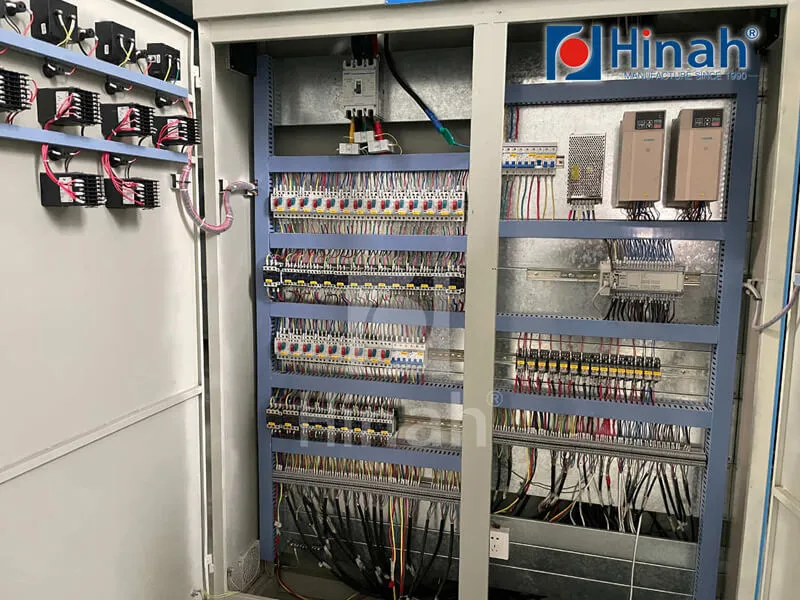
Processing oversized components — such as wind tower sections, railway car bodies, or mining equipment frames — requires a big powder coating oven that surpasses standard thermal design. Unlike small batch units, a big powder coating oven must resolve temperature gradients across lengths exceeding 12 meters, manage high thermal inertia of heavy-gauge steel, and maintain consistent dwell times for powder cross-linking. This article examines heat transfer physics, aerodynamic zoning, and energy recovery methods, supported by field data from HANNA installations across North America and Europe.
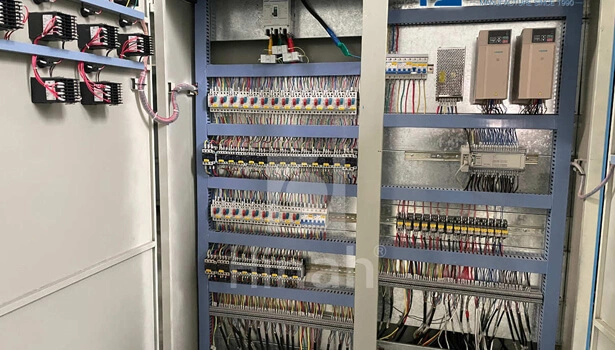
Industry standards classify a big powder coating oven based on three criteria:
Internal volume > 200 m³ for batch designs, or heated length >15 m for continuous tunnels.
Clear width > 3 meters to accommodate wide fabrications (e.g., truck chassis).
Mass throughput > 3,000 kg/hour, demanding rapid heat recovery after cold load entry.
Heavy fabrications impose unique thermal loads: a 10-ton steel beam entering at 10°C requires approximately 2.7 GJ (2.5 MMBtu) just to reach 200°C. A properly engineered big powder coating oven must deliver that energy within the required dwell window without creating hot spots. Integration with a complete powder coating plant ensures upstream pretreatment and downstream cooling match oven throughput.
In a 4m-wide, 20m-long oven, side-wall and end losses create temperature drops of 15–20°C from center to perimeter. This results in under-cured powder on outer flanges and over-cured zones near recirculation outlets. Mitigation strategies:
Multi-zone longitudinal control: Independent PID loops for each 3–4m segment along the tunnel.
Adjustable side-wall nozzles with 45° deflection toward the load.
CFD validation before fabrication — a standard step in powder coating plant design from HANNA.
Heavy-duty monorails (e.g., I-beam 200×200 mm) or skids act as parasitic heat sinks. A 100m conveyor chain absorbs energy continuously, increasing gas consumption by 18–25%. Solutions:
Ceramic fiber thermal breaks at conveyor penetrations.
VFDs on recirculation fans to reduce airflow during idle periods.
Slat conveyors with hollow steel sections to lower mass.
When curing 2mm sheet metal alongside 50mm steel plates, thin parts reach temperature three times faster. Over-curing degrades impact resistance. Advanced big powder coating ovens use:
Traversing thermocouples on the conveyor to adjust speed dynamically.
Zoned heating with independent ramp profiles.
Perforated shields for thin parts placed near oven ends.
Natural gas is the preferred energy source for big powder coating oven due to lower operating cost (≈0.03 USD/kWh-equivalent vs. 0.12 USD for electric). Two gas configurations dominate:
Combustion products mix directly into recirculating air. Efficiency up to 93%, rapid heat-up, lower capital cost. However, moisture from combustion (≈10g water/kg dry air) can degrade TGIC-free polyester powders, causing micro-blistering. Use only after verifying powder manufacturer's humidity tolerance.
Stainless steel or ceramic tubes separate combustion gases from process air. Zero contamination, ideal for high-gloss architectural coatings or moisture-sensitive powders. Efficiency typically 78–84%, but HANNA offers condensing heat exchangers that recover latent heat, reaching 91% efficiency. For facilities in regions with strict NOx limits (e.g., California’s SCAQMD), indirect firing is mandatory.
Electric resistance or infrared panels are alternatives for low-throughput or high-value parts, but operating expenses are 3–4 times higher per BTU delivered.
A big powder coating oven requires forced convection with convective heat transfer coefficient (h) > 25 W/m²K. Achieving this across wide spans demands:
Dual plenum chambers on both side walls with perforated baffles to equalize static pressure.
High-static-pressure plug fans (≥1,500 Pa) with VFDs, rated for continuous 230°C operation.
Crossflow pattern: air enters left wall, travels horizontally, and exits right wall — minimizing stratification compared to end-to-end flow.
Turning vanes at all 90° corners to prevent short-circuiting.
Case example: A wind tower manufacturer experienced 18% rework due to uncured powder on internal flanges of 20m sections. After CFD analysis, HANNA installed four high-static-pressure fans with adjustable nozzles oriented upward at 30°, plus an additional recirculation loop for the central zone. Uniformity improved from ±22°C to ±4°C, and rework dropped below 2%.
Surface heat loss from a big powder coating oven can exceed 120 kW without proper insulation. Recommended specifications:
Mineral wool panels density 128–160 kg/m³, thickness 200 mm for roof and sidewalls, 150 mm for floor (if above grade).
Thermal break floor design using aerated concrete blocks (conductivity <0.2 W/mK) to prevent heat sink into foundation.
Air-to-air plate heat exchangers on exhaust ducts: recover 55–70% of waste heat to pre-heat fresh makeup air. Payback period 9–14 months for two-shift operation.
High-speed roll-up doors at oven ends (1.5 m/s opening speed) reduce infiltration losses by 40% compared to curtain strips.
A real-world retrofit: A heavy equipment manufacturer added a condensing heat exchanger and VFDs to their existing big powder coating oven. Gas consumption fell by 33%, and annual CO₂ emissions decreased by 112 metric tons. The upgrade was supplied by HANNA with a 16-month ROI.
Material handling inside a big powder coating oven must withstand 200–230°C without lubrication failure. Proven solutions:
Overhead power-and-free chain with high-temperature grease (e.g., Mobil SHC 100 series).
Slat conveyors on ceramic bearings (zirconia or silicon nitride) for floor-mounted systems.
Monorail expansion joints every 12 m to accommodate thermal expansion (ΔL = α × L × ΔT; α for steel = 12×10⁻⁶/°C).
Load spacing of at least 500 mm between parts and 300 mm from walls to allow airflow penetration.
Loading density directly affects cure consistency. CFD studies show that random packing creates recirculation zones; use standardized racking patterns as defined in the powder coating plant layout from HANNA.
For large components, destructive testing (mandrel bend, impact) is impractical per batch. Non-destructive methods include:
Data-logged thermocouples attached to three mass zones (thin, medium, thick) per ASTM D5423.
Infrared thermal imaging of parts exiting the oven — any area >5°C below setpoint triggers manual inspection.
Dielectric cure monitoring: a small electrode measures capacitance change as polymer cross-links.
Conveyor-mounted witness coupons (same material and coating) tested daily for gloss, adhesion (ASTM D3359), and pencil hardness.
For big powder coating oven operations in automotive or aerospace supply chains, IATF 16949 requires documented evidence that each batch meets time-temperature parameters. Thermal profiling at least once per shift is standard practice.
Field audits across 56 heavy industrial sites identified these frequent issues:
Orange peel on vertical surfaces → air velocity too high (>8 m/s) blowing powder off before gelation; reduce fan speed or reposition nozzles.
Pinholes on flat horizontal areas → moisture contamination of powder; check compressed air dryer or oven humidity (keep <10g/kg).
Edge corrosion after 6 months → under-cured powder in recesses; increase dwell time by 10–15% and verify airflow reaches pockets.
Higher gas bills without load change → slipping VFD belts or dirty burner nozzles; clean quarterly and tighten belts.
Conveyor stops during peak hours → thermal expansion misalignment; install spring-loaded take-up units or expansion joints.
Each fault has a documented correction procedure. HANNA provides remote diagnostic services using live PLC data to identify these issues without a site visit.
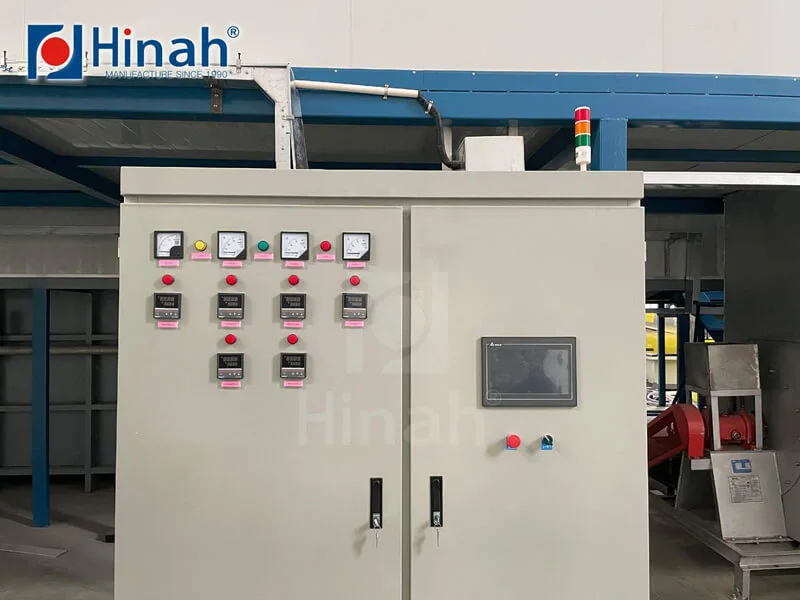
Different industries demand specialized big powder coating oven configurations:
Wind tower sections (20m long, 4m diameter): Segmented oven with retractable end doors and internal IR panels for flange curing. Conveyor speed 0.8 m/min, dwell 45 minutes at 200°C.
Railway wagons (18m length): Walk-in oven width 5m, height 4.5m. Downdraft airflow to remove outgassing from rubber suspension components. Maximum temperature 180°C for hybrid powder-paint systems.
Aluminum extrusions (12m): Horizontal airflow from side walls prevents distortion (temperature gradient ≤±3°C). Gas-fired indirect with ceramic recuperators.
Heavy truck chassis (10,000 kg): Floor-type chain conveyor with ceramic rollers. 6-zone heating profile to slowly ramp thick sections (max rate 5°C/min).
For each, integration with a complete powder coating plant ensures upstream chemical pretreatment and downstream cool-down match oven throughput.
A1: Custom-built ovens can accommodate parts up to 25 meters in length, 5 meters in width, and 4.5 meters in height — typical for mining trucks or marine containers. For longer components (e.g., wind blades up to 60m), modular ovens are built in sections and moved along rails. Big powder coating oven designs from HANNA start at 8m length and scale in 2m increments with walk-in access.
A2: Use the thickest part's time-to-temp as the minimum dwell. Attach a surface thermocouple to the heaviest section and record the time to reach 200°C. Multiply that measured time by 1.15 (safety factor for polyester powders). For example, a 40mm plate reaches 200°C in 18 minutes; set dwell to 20.7 minutes. To protect thin parts, shield them with perforated metal sheets or place them near the oven door (coolest zone).
A3: Yes, but three modifications are mandatory: (a) bake at 250°C for 24 hours to remove all solvent residue, (b) install HEPA filters to capture airborne powder before recirculation, (c) reduce maximum temperature to ≤200°C for standard polyesters. Gas-fired direct ovens may need an indirect heat exchanger to prevent moisture absorption. Conversion typically costs $20,000–$40,000 and is a standard service from powder coating plant retrofits by HANNA.
A4: For a 200 m³ oven operating at 200°C with 150mm insulation, gas consumption ranges 150–250 therms/hour (4.4–7.3 kW/m³). Actual depends on load density, conveyor opening size, and number of air changes. With heat recovery (plate exchanger), consumption drops 25–35%. Request a thermal simulation from HANNA for your specific dimensions and throughput.
A5: Overspray powder enters the oven on parts. To prevent accumulation: (a) ensure upstream spray booth captures >98% of powder, (b) schedule weekly oven cleaning using dry ice blasting or high-temperature vacuum, (c) maintain minimum air velocity of 2 m/s over walls to reduce residence time. For heavy buildup, apply a PTFE-based release coating on interior surfaces. HANNA ovens include clean-out access doors at 3m intervals.
Selecting or retrofitting a big powder coating oven requires more than off-the-shelf sizing — it demands thermal simulation, load-specific airflow design, and energy recovery tailored to your production mix. HANNA provides CFD-validated designs, modular construction for rapid installation, and global commissioning support. Whether you need a 250 m³ batch oven for 5-ton castings or a 30m continuous tunnel for railcar sidings, our engineering team delivers guaranteed temperature uniformity (±4°C) and gas consumption below 0.85 kWh per kg of processed steel.
Request your customized solution now → Send inquiry to HANNA specialists for a free thermal audit, ROI projection, and NFPA 86 compliance checklist.