In any coating application — from powder to wet paint — the final cross-linking process determines mechanical resistance, corrosion protection, and aesthetic quality. Curing ovens are the thermal reactors where polymer chains form permanent networks. Unlike simple drying chambers, professional curing ovens must maintain precise temperature-time profiles, uniform airflow, and controlled ramp rates. This article examines heat source selection, aerodynamic design, and validation methods, drawing from field data across automotive, aerospace, and heavy equipment sectors — including installations by HANNA.
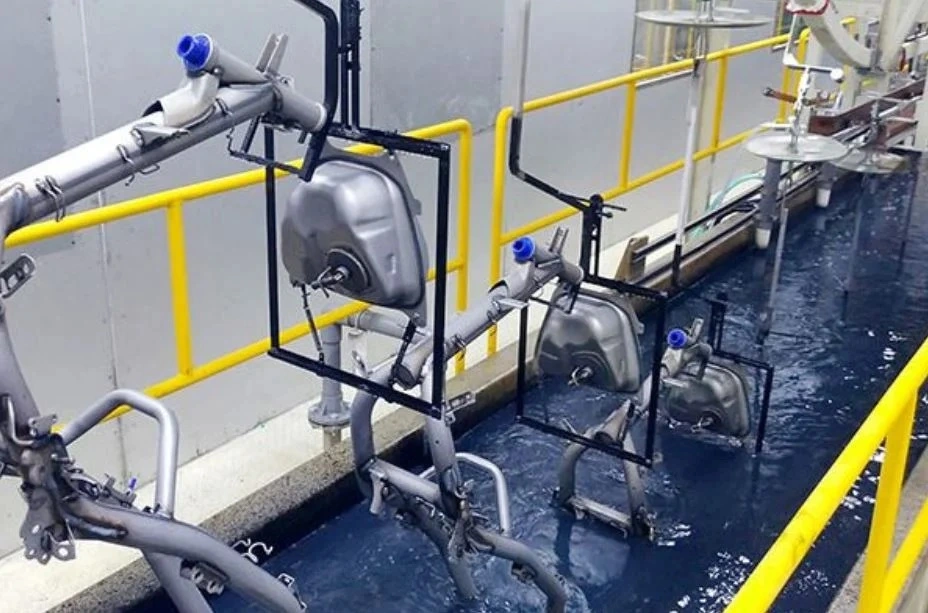
An industrial curing oven must satisfy four quantifiable criteria:
Temperature uniformity: ≤ ±5°C across all loaded parts (ASTM D5423).
Ramp-up rate: Adjustable from 2°C/min to 15°C/min to avoid solvent popping or thermal shock.
Dwell time accuracy: ±2% of set value, synchronized with conveyor speed.
Air change rate: 6–12 volumes/hour for VOC exhaust and oxygen replenishment.
Batch and continuous curing ovens share these requirements, but continuous tunnels demand multi-zone independent control to handle variable load density. A well-engineered powder coating plant integrates the oven with upstream spray booths and downstream coolers, ensuring that gelation and full cure happen without contamination.
Natural gas remains the dominant energy source for large industrial curing ovens due to lower operating cost (0.02–0.04 USD per kWh-equivalent vs. 0.12–0.15 USD for electric). Two gas configurations exist:
Combustion products mix directly into recirculating air. Advantages: thermal efficiency up to 93%, rapid heat-up, lower capital cost. However, for moisture-sensitive powder coatings (e.g., TGIC-free polyesters) or two-component liquid paints, the added humidity (≈10 g water per kg dry air) can cause micro-blistering or reduced gloss. Use only after confirming coating manufacturer's tolerance.
A stainless steel or ceramic tube separates combustion gases from process air. Zero contamination, ideal for aerospace primers, medical device coatings, and high-gloss automotive clearcoats. Efficiency typically 78–84%, but HANNA offers condensing heat exchangers on indirect units that recover latent heat, pushing efficiency to 91%. For curing ovens located in jurisdictions with strict NOx limits (e.g., California's SCAQMD), indirect firing is often mandatory.
Surface coating cure depends on convective heat transfer coefficient (h), which should exceed 25 W/m²K. Achieving this across large or complex parts requires:
Plenum chambers with perforated baffles to equalize static pressure.
Adjustable louvers directing air at 30–60° angles toward blind cavities.
High-static-pressure fans (≥1,500 Pa) with VFDs for velocity control.
CFD validation before fabrication — a standard step in powder coating plant design by HANNA.
A common failure in field-erected curing ovens is short-circuiting airflow: heated air travels directly from supply to exhaust without contacting parts. This can be prevented by installing turning vanes at corners and using a crossflow pattern (air enters one side, exits opposite) rather than end-to-end.
Heat loss through walls, roof, and conveyor openings can exceed 30% of input energy in poorly insulated curing ovens. Mitigation measures:
Mineral wool panels with density 128–160 kg/m³, thickness 150–200 mm. External skin temperature ≤ ambient +15°C.
Thermal break floors using aerated concrete or ceramic fiber boards.
Air-to-air plate heat exchangers on exhaust ducts: recover 55–70% of waste heat to preheat fresh makeup air. Payback period 9–14 months for two-shift operation.
High-speed roll-up doors at oven ends, reducing infiltration losses by 40% compared to curtain strips.
Case example: A heavy equipment manufacturer retrofitted their aging curing oven with a condensing heat exchanger and variable-frequency drives on recirculation fans. Gas consumption fell by 33%, and annual CO₂ emissions decreased by 84 metric tons. The retrofit was supplied by HANNA with a 16-month ROI.
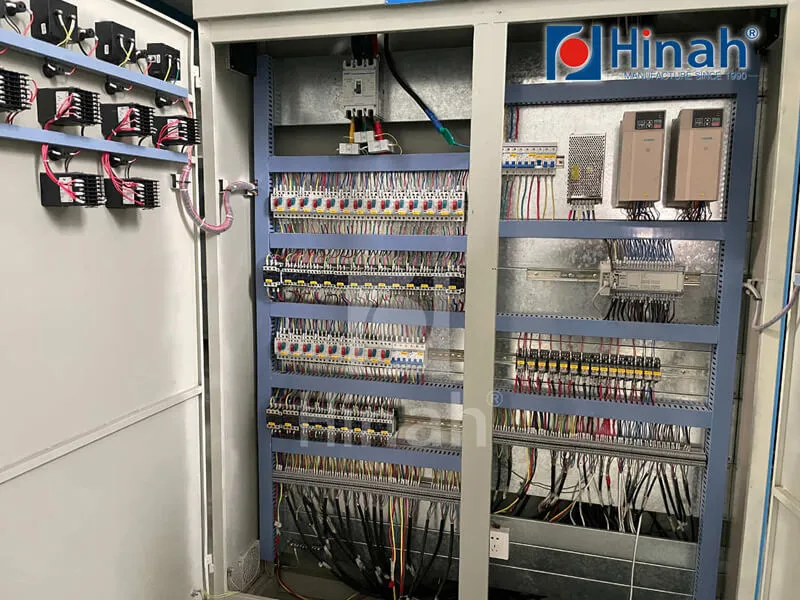
Modern industrial curing ovens are not standalone; they must integrate with MES and quality management systems. Required control features:
Multi-zone PID control with auto-tuning, communicating via Profinet, EtherNet/IP, or Modbus TCP.
Real-time temperature mapping using 6–12 thermocouples placed on fixtures or representative parts.
Batch traceability logs: record temperature vs. time for each product SKU, retrievable for 10 years (ISO 9001:2022).
Predictive maintenance alerts for fan bearing vibration, burner flame instability, or filter clogging.
For powder coating plant operators, an integrated controller can automatically adjust oven dwell time based on real-time load weight detected by a scale at the entrance. This prevents over-curing of lightweight parts and under-curing of heavy ones.
Extensive field audits across 120 finishing lines have identified these frequent issues:
Orange peel or solvent popping → excessive radiant flux or low air velocity; reduce burner modulation or increase fan speed.
Edge corrosion after 6 months → under-cured coating in recesses; extend dwell time by 10-15% and verify airflow reaches pockets.
Irregular gloss across batch → non-uniform temperature distribution; recalibrate dampers and check for insulation sagging.
Condensation inside oven during warm-up → insufficient air change before production; implement a pre-heat purge cycle (5 minutes).
High gas consumption without load change → slipping fan belts or dirty burner nozzles; perform quarterly maintenance.
Each fault has a documented correction procedure. HANNA provides remote diagnostics using live PLC data to identify these issues without site visits.
For high-value products, destructive testing (mandrel bend, impact, solvent rub) is impractical for every batch. Non-destructive validation techniques include:
Data-logged thermocouples attached to three critical mass points (thin, medium, thick) per ASTM D5423.
Infrared thermal imaging of parts exiting the oven; any area >5°C below setpoint is flagged.
Dielectric cure monitoring: a small electrode measures capacitance change as polymer cross-links; provides real-time cure degree.
Conveyor-mounted witness coupons (same material and coating) that are tested daily for gloss, adhesion, and pencil hardness.
For curing ovens used in automotive supply chains, IATF 16949 requires documented evidence that each batch meets time-temperature parameters. Thermal profiling at least once per shift is standard practice.
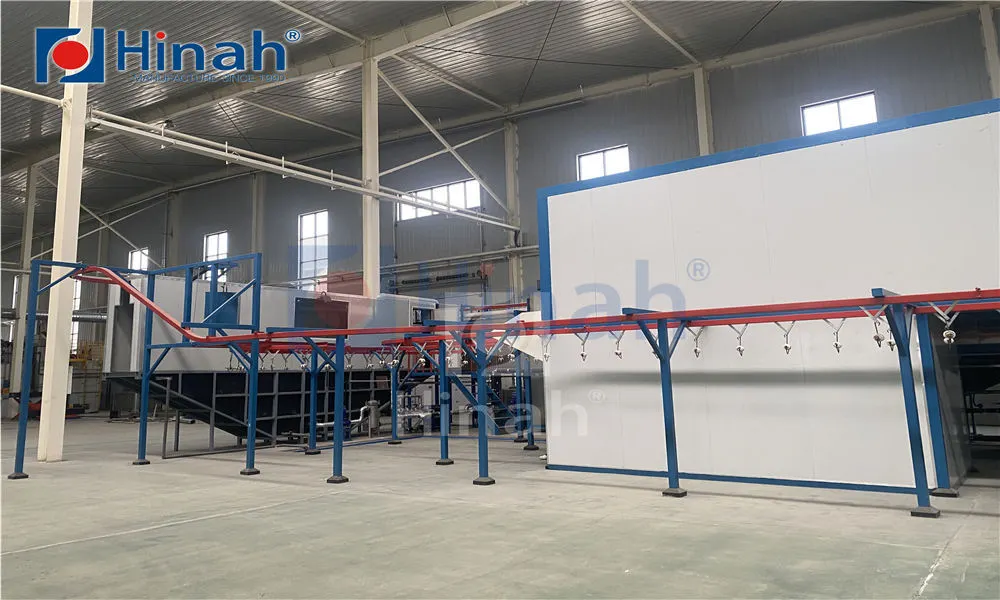
Different industries demand specialized curing ovens:
Automotive wheels (aluminum alloy): 3-zone convection oven with ramp (30–80°C), hold (80–180°C), and cool-down (180–60°C) to prevent metallurgical changes. Length 24 m for 600 wheels/hour.
Aerospace fasteners (small steel): Infrared + convection hybrid to avoid overheating edges while core reaches 190°C. Nitrogen purging prevents oxidation.
Agricultural machinery (heavy fabrications): High air velocity (3 m/s) at 210°C to penetrate joints; floor-type chain conveyor with ceramic bearings.
MDF powder coating (wood panels): Low-temperature cure (max 130°C) and humidity control (<10 g water/kg dry air) to prevent outgassing.
For each, integration with a complete powder coating plant ensures chemical pretreatment and cool-down zones match the oven's thermal profile.
When an existing curing oven no longer meets quality or throughput goals, evaluate using this matrix:
Age < 5 years, structural sound: Retrofit with VFD fans, high-efficiency burner, and insulation top-up. Payback 12-18 months.
Age 5-10 years, moderate corrosion: Replace burner and heat exchanger, add energy recovery, upgrade controls. Payback 24-30 months.
Age >10 years or rusted panels: New oven construction yields better long-term ROI due to modern aerodynamics and lower emissions.
HANNA offers modular replacement systems that can be installed within 2-3 weeks of downtime, using pre-assembled wall sections and plug-and-play controllers — 60% faster than traditional field-built ovens.
A1: For most powder coatings (polyester, epoxy-polyester), the curing temperature is 180–200°C (356–392°F). Liquid paints (urethanes, acrylics) cure at 120–160°C. Specialty coatings like PTFE require 380–400°C, which demands ceramic insulation and high-temperature alloys. Always follow the coating manufacturer's technical data sheet and validate with a thermocouple on the part.
A2: At least annually for general industrial use, or every 6 months for automotive or aerospace lines (per IATF 16949). Use 9 to 12 thermocouples distributed across the load zone, following ASTM D5423. If uniformity exceeds ±5°C, rebalance airflow or repair insulation. HANNA provides on-site thermal mapping services with 24-channel data loggers and a same-day report.
A3: Not without significant modification. Powder requires clean atmosphere and may absorb moisture from direct-fired gas ovens. Liquid paints release VOCs that can contaminate powder. A practical solution is a dedicated oven for each process, or an indirect-fired oven with HEPA filters and separate exhaust settings. Conversion from liquid to powder typically costs $15,000–$25,000 for cleaning and filter upgrades.
A4: A plate-type air-to-air heat exchanger installed on the exhaust stack, recovering heat to preheat fresh combustion air or oven makeup air. Typical gas savings: 20–35%, with payback 9–14 months for a two-shift operation. The second-best investment is variable-frequency drives on recirculation fans, reducing electricity consumption by up to 40% during ramp-up and idle periods.
A5: Use perforated metal shields or "thermal shadow" racks to reduce convective heat transfer to thin sections. Alternatively, place thin parts near the oven door (coolest zone) and heavy parts near the recirculation outlet (hottest zone). For continuous ovens, implement a zoning strategy: the first zone ramps slowly, and thin parts exit earlier via a side door. Advanced systems use traversing thermocouples and variable-speed fans to modulate heat load in real time.
Selecting or retrofitting curing ovens requires more than off-the-shelf sizing — it demands thermal simulation, load-specific airflow design, and energy recovery tailored to your production mix. HANNA provides CFD-validated designs, modular construction for rapid installation, and global commissioning support. Whether you need a 30 m³ batch oven for job-shop flexibility or a 200 ft continuous tunnel for automotive volumes, our engineering team delivers guaranteed temperature uniformity (±4°C) and gas consumption below 0.9 kWh per kg of processed substrate.
Request your customized solution now → Send inquiry to HANNA specialists for a free thermal audit, ROI projection, and NFPA 86 compliance checklist.