An industrial curing oven is a fundamental component in many manufacturing processes. It provides the controlled heat necessary to dry, bake, or cure coatings, finishes, and adhesives. The performance of your industrial curing oven directly impacts product quality, production speed, and energy consumption.
Selecting the right oven requires understanding the different types, heating methods, and key performance features. This guide provides the essential information needed to make a sound investment for your finishing line.
Industrial curing oven designs are primarily categorized by how parts move through them. The choice between batch and continuous ovens depends on your production volume and workflow.
Batch ovens process loads of parts in discrete cycles. Parts are loaded into the oven, the door is closed, and a timed curing cycle begins.
Parts move continuously through the oven on a conveyor system at a set speed. This creates a constant flow of production.
The method of heat transfer within an industrial curing oven is a critical design choice. It affects cure quality, energy use, and suitability for different products.
Many advanced ovens from HANNA use a hybrid approach. They combine focused infrared heating for rapid initial warm-up with convection for holding a precise, uniform temperature throughout the cure cycle.
The choice of energy source and the sophistication of controls are major factors in operational cost and product consistency.
Most industrial curing oven systems use one of two primary energy sources.
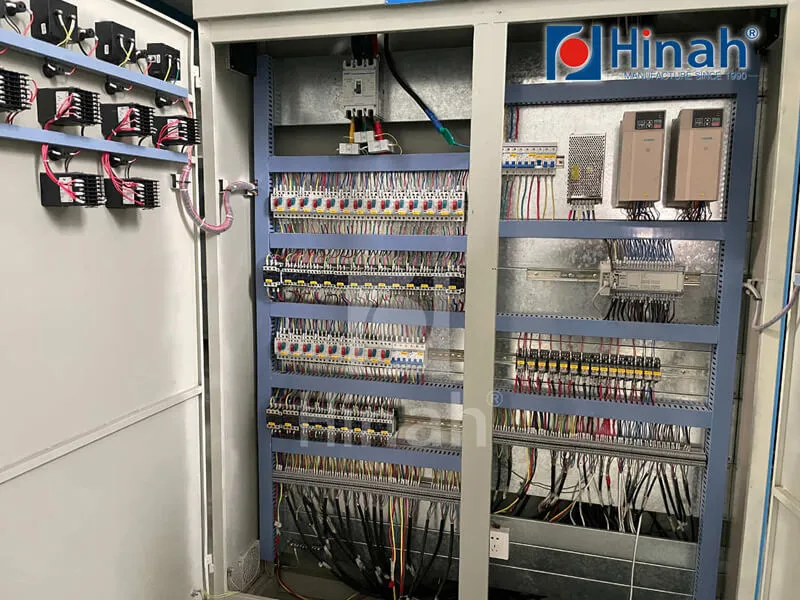
Modern digital controls are essential for repeatable results and efficiency.
HANNA ovens are equipped with intuitive, robust control panels. These systems ensure your cure profile is executed precisely every time, batch after batch.
An industrial curing oven rarely operates in isolation. Its design must be synchronized with the rest of your production system.
Working with a single supplier like HANNA for the entire line ensures seamless integration. Our engineers design the industrial curing oven to work perfectly with your pretreatment, application, and material handling systems.
Making the correct choice involves a detailed analysis of your specific requirements. Ask these key questions:
Partnering with an experienced manufacturer is crucial. HANNA provides application analysis and oven sizing to recommend a system that balances performance with your budget. We focus on durability, efficiency, and ease of maintenance.
Investing in a well-designed industrial curing oven is an investment in final product quality and manufacturing reliability. By understanding the technology and carefully defining your needs, you can select a system that delivers consistent results for years to come.
Q1: What is the difference between drying, baking, and curing in an industrial oven?
A1: Drying typically removes moisture or solvents. Baking causes a physical change, like powder flowing into a smooth film. Curing creates a chemical crosslinking reaction, forming a durable, high-performance finish. An industrial curing oven is designed for the precise time-temperature control needed for curing.
Q2: How do I determine the correct size and capacity for a batch oven?
A2: You must calculate the internal dimensions needed for your largest expected load, including the rack or cart. Then, consider the oven's heat capacity (BTU/hr or kW) to ensure it can bring that mass of metal and parts up to temperature within your required cycle time.
Q3: Why is air flow so important in a convection curing oven?
A3: Proper, directed air flow ensures uniform temperature throughout the oven chamber. This prevents hot and cold spots that can lead to under-cured or over-cured parts. HANNA designs airflow patterns (vertical downflow, horizontal, etc.) to suit specific load characteristics.
Q4: Can an existing oven be retrofitted with new controls or energy-saving features?
A4: Often, yes. Older ovens can frequently be upgraded with modern digital controls, high-efficiency burners, or improved insulation. A HANNA service technician can assess your current industrial curing oven and recommend cost-effective retrofit options.
Q5: What safety features are standard on a HANNA industrial curing oven?
A5: Standard safety features include independent over-temperature protection switches, proper ventilation for fumes, emergency stop buttons, safety interlocks on doors, and audible/visual alarms. Options like combustion safeguards (for gas ovens) and fire suppression systems are also available.