
Automated surface finishing requires exact mechanical precision, fluid stability, and synchronized kinematic paths. Modern production environments demand consistent film thickness across intricate geometries, zero cross-contamination during color switches, and minimal particulate dispersion in the spray zone. Integrating a specialized Robotic paint sprayer transforms standard conveyorized lines into high-yield, repeatable production centers capable of operating non-stop with tight tolerance control.
Achieving ideal coating uniformity depends on matching the mechanical axes of motion with fluid dynamics and electrostatic field behaviors. As components grow more complex in automotive, architectural, and heavy machinery manufacturing, conventional manual application and static reciprocators fail to deliver even deposition. Robotic automation resolves these geometric limitations by maintaining a constant standoff distance, an invariant gun orientation relative to surface normals, and tightly governed tool center point (TCP) speeds.
Industrial spray booths present severe physical constraints, including airborne particulate concentrations and volatile carrier solvents. Articulated arm manipulators must maintain structural stiffness while executing sweeping, rapid trajectories around complex workpieces.
Six-axis articulated robots provide the foundational agility for modern surface finishing. By combining three base axes (waist rotation, shoulder pitch, and elbow pitch) with three spherical wrist axes (roll, pitch, and yaw), the manipulator positions the spray nozzle at any target coordinate within its operational envelope. In applications with elongated structural extrusions or oversized chassis, engineers often mount the arm on a synchronized linear seventh axis (traverse track). This linear rail extends reach while the arm maintains a 90-degree impingement angle against dynamic parts moving on continuous overhead conveyors.
Internal routing of powder hoses, high-voltage cascades, air supply lines, and fluid conduits through a hollow cast wrist prevents external hose whipping. When hoses hang externally, continuous wrist articulation causes torsional fatigue, irregular powder pulsing, and paint overspray accumulation on the cabling. Hollow-wrist kinematics preserve cleanroom integrity, eliminate snagging hazards near fixtures, and provide smooth continuous wrist revolutions during cornering and pocket coating.
Operating inside solvent or high-density organic powder environments requires strict compliance with explosion-proof standards, including ATEX Directive 2014/34/EU and NFPA 33 Class I / Class II, Division 1 classifications. Finishing manipulators utilize positive-pressure internal purge systems. Clean, dry air or inert nitrogen continuously pressurizes the internal casting voids to prevent hazardous vapors and combustible powders from reaching internal servomotors, harmonic drives, and feedback resolvers.
The core function of an automated spray system is controlling the fluid or powder cloud from delivery pump to substrate impact. Irregularities in powder fluidization or liquid atomization directly degrade mechanical finish quality.
Engineers specifying production line hardware through engineering leaders like HANNA integrate digital fluid delivery skids directly with robot control cabinets. This synchronized loop ensures that fluid flow rates instantly adjust based on real-time TCP acceleration and deceleration.
Precise powder metering determines film build consistency across long shifts:
Venturi Ejector Systems: Utilize compressed air to create a low-pressure zone that draws powder into the flow path. While cost-effective, venturi throat wear gradually shifts the air-to-powder ratio, demanding frequent recalibration to prevent film thickness drift.
Dense-Phase Pneumatic Pumps: Employ double-chamber pinch valves and positive displacement to convey high concentrations of powder using minimal transport air. This creates a low-velocity, stable powder cloud that significantly reduces overspray, avoids bounce-back from deep recesses, and extends nozzle operating life.
A reliable Robotic paint sprayer uses integrated electrostatic cascade generators capable of outputting up to 100 kV directly at the gun tip. In negative corona charging, strong electric fields ionize passing air molecules, transferring negative charges to powder particles via ionic collision. These charged particles follow electrostatic flux lines toward the grounded metal workpiece.
To coat complex structures without defects, the robotic controller must dynamically adjust current (microamperes) and voltage (kilovolts). When coating broad flat panels, high voltage maximizes transfer efficiency and creates an electrostatic "wrap" around rear edges. When coating tight inner corners subject to Faraday cage resistance, the system shifts to a low-voltage, current-limited profile to prevent back-ionization and surface orange peel.
Consistent finish quality relies on how the robot interprets workpiece location and calculates motion vectors.
Modern production cannot tolerate lengthy teaching sessions inside the spray booth. Offline programming software environments allow automation engineers to import 3D CAD files of parts, generate spray trajectories normal to surfaces, and simulate coat overlaps. The simulation engine calculates overlap percentages, nozzle standoff distances (typically held between 150 mm and 250 mm), and deposition patterns using numeric models of atomized spray plumes.
Workpieces suspended from power-and-free or continuous monorail conveyors rarely travel at a perfectly constant speed. Rotary optical encoders connected directly to the conveyor drive send high-frequency pulse trains to the robot controller. The trajectory processor continuously shifts its Cartesian coordinate frame in real time, synchronizing the spray gun's path with the physical conveyor movement without pausing the production line.
Mixed-model finishing facilities process varying part geometries on the same conveyor line. Upstream 3D laser profiling cameras or structured-light optical scanners detect incoming part models, spatial orientation, and hook swing. The industrial vision controller identifies the part recipe and transmits the corresponding program index to the robot before the part reaches the active spray station.
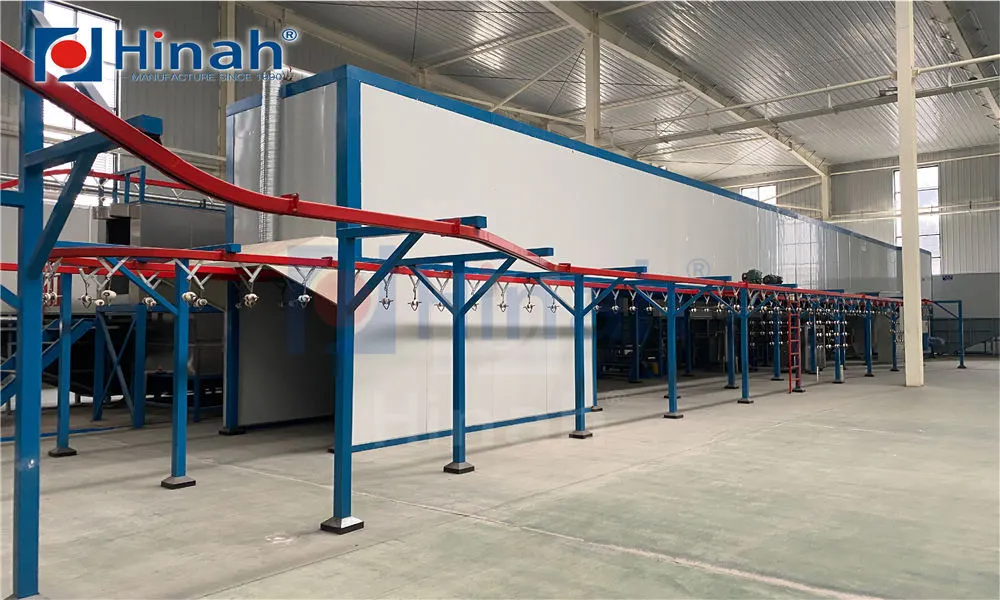
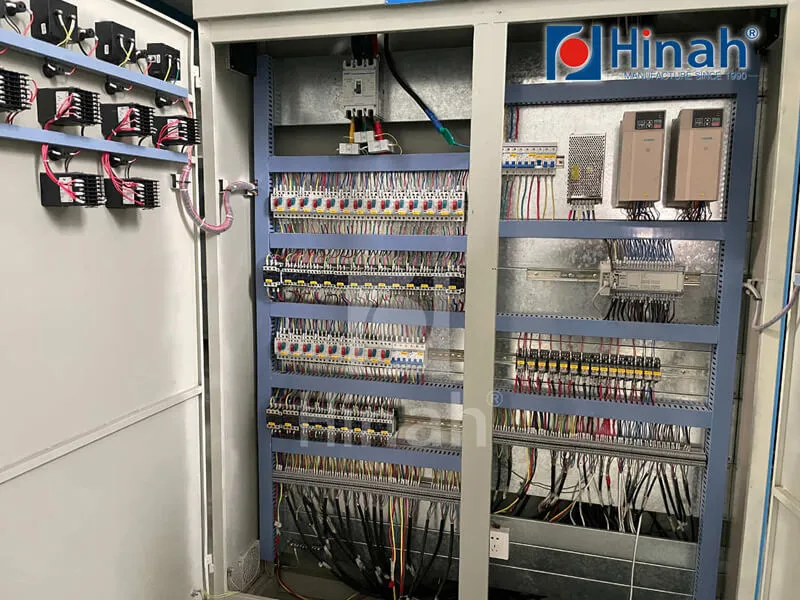
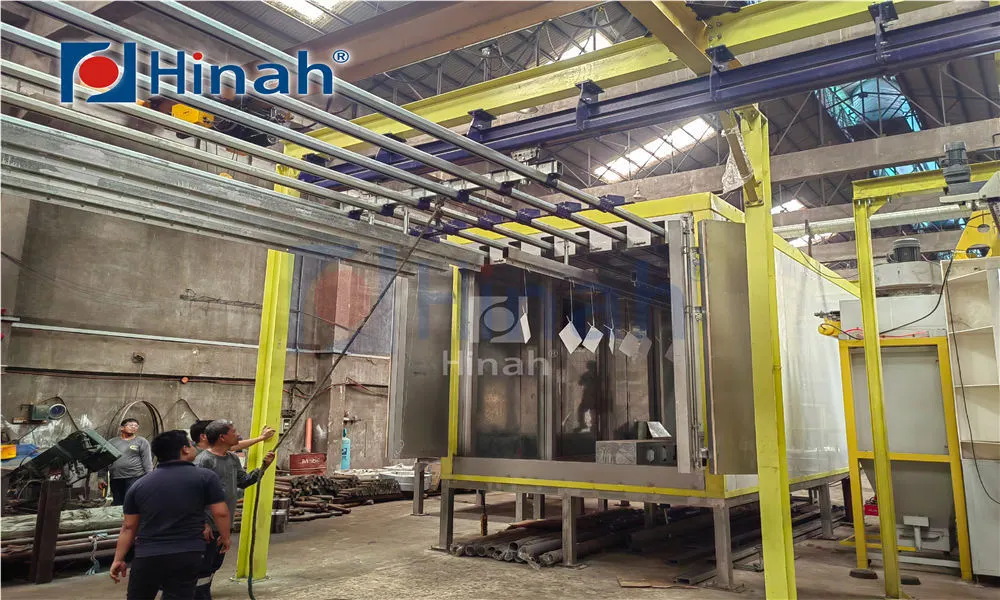
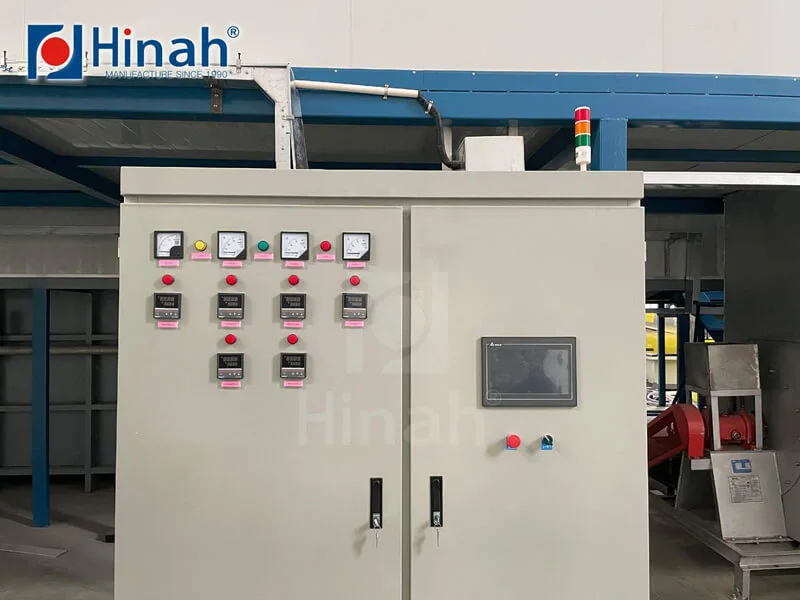
A robotic manipulator functions as one component of a broader finishing ecosystem. Full process stability requires seamless interaction among the spray booth, reclaim cyclone, cure oven, and automated control interface.
System designers at HANNA structure automated cells to combine advanced physical containment with clean airflow engineering. Downdraft booth velocities must stay balanced between 0.4 m/s and 0.6 m/s. If the booth exhaust velocity is too high, it distorts the atomized spray pattern; if it is too low, airborne powder settles on robot arm joints and surrounding production equipment.
High-efficiency color-change booths utilize non-conductive composite sandwich walls (such as PVC or Apaspor) that repel powder particles. During automatic color transitions, the Robotic paint sprayer maneuvers toward an integrated purging station. High-pressure air blasts clear the internal fluid channels, while the booth base sweeps loose powder toward a central cyclone recoverer, enabling fast color turnarounds without manual intervention.
Maintaining high first-pass yield rates across multiple shifts requires continuous process monitoring rather than post-cure inspection alone.
Back-Pressure Flow Monitoring: Flow transducers measure air and fluid line impedance to instantly identify nozzle clogging or hose wear.
High-Voltage Feedback Loops: Closed-loop monitoring of the high-voltage cascade confirms that target microampere setpoints match actual ground currents, flagging part-grounding failures instantly.
Tool Center Point Calibration: Optical calibration sensors inside the booth routinely check the physical alignment of the spray nozzle tip to correct for mechanical drift or collision-induced offsets.
Post-cure quality audits assess the real performance of the automated application process. Production managers measure dried or cured film thickness using magnetic induction or eddy-current thickness gauges according to ISO 2808. Controlled robot paths eliminate typical manual application defects, such as runs, sags, pinholing, and thin edge builds, maintaining standard deviation of film thickness within +/- 2.5 microns across complex three-dimensional geometries.
Q1: What are the main differences between a standard 6-axis
industrial robot and a dedicated robotic paint sprayer?
A1: A
dedicated spray robot features specialized mechanical engineering, including
explosion-proof structural housings (ATEX/NFPA certified), internal purge
pressurization, hollow-wrist conduit pathways to protect fluid lines, and
materials designed to withstand aggressive cleaning solvents and fine
powders.
Q2: How does a robotic system overcome the Faraday cage effect during
powder coating?
A2: Robotic systems manage the Faraday cage effect
through precise trajectory control and dynamic electrostatic regulation. The
manipulator maintains a perpendicular spray angle to recessed pockets while the
controller reduces voltage (kV) and caps current (µA), allowing low-velocity
powder clouds to penetrate deep channels without back-ionization.
Q3: Can robotic paint sprayers accommodate mixed-production lines
with random part sequencing?
A3: Yes. Integrated 3D vision systems
or barcode/RFID readers at the booth entrance identify the geometry and
orientation of incoming parts. The vision system transmits the correct recipe to
the robot controller, which instantly switches trajectories and spray parameters
on the fly.
Q4: Why is conveyor tracking accuracy important for automated spray
systems?
A4: Overhead conveyors experience micro-surges, chain
stretch, and speed variations. High-resolution optical encoders track the
conveyor drive in real time, enabling the robot control software to adjust its
spatial coordinates continuously and apply uniform coat thickness without
stopping the line.
Q5: What routine maintenance ensures long-term process reliability in
robotic finishing booths?
A5: Key maintenance routines include
checking purge-air pressure seals, inspecting the hollow wrist for hose wear,
verifying tool center point (TCP) alignment against optical references, cleaning
electrostatic cascade contacts, and replacing venturi inserts or dense-phase
pinch valves before mechanical wear impacts fluid delivery rates.
Integrating advanced automation into complex industrial finishing lines requires custom engineering analysis, from fluid delivery dynamics to multi-axis kinematic planning. For detailed production evaluations, line layout configurations, and technical specifications for custom robotic spray systems, submit your project parameters directly to HANNA to connect with our process engineering team.