If your powder coating operation struggles with consistency, high labor costs, or complex part geometries, manual spraying might be holding you back. The transition to automation can feel like a significant step. Yet, for a growing number of finishing shops, integrating a robotic paint sprayer is becoming the decisive factor for staying competitive.
These automated arms do far more than just replace a human operator. They bring a level of precision, repeatability, and data control that fundamentally upgrades your entire coating process. The result isn't just faster application; it's a dramatic reduction in waste, rework, and variability.
At HANNA, we integrate robotic painting solutions into powder coating lines worldwide. We've seen how this technology solves persistent production challenges. Let's explore the tangible benefits and practical considerations of adding a robot to your shop floor.
A human operator, no matter how skilled, has good days and off days. Fatigue, subtle variations in movement, and environmental factors can all influence the final finish. This variability leads to inconsistent film build, potential defects, and color match issues across batches.
A robotic paint sprayer eliminates this variability. Once programmed, it repeats the exact same motion path, speed, and trigger points for every part, every hour of the day. This guarantees a uniform coating thickness across even the most complex part geometry.
For industries with stringent specifications—like automotive, aerospace, or architectural fittings—this repeatability is non-negotiable. It ensures every single component meets the quality standard, reducing inspection time and customer rejections.
Powder coating material is a major operational expense. Overspray, where powder misses the target part, represents pure waste. Manual spraying, due to its inherent variability, often has a lower "first-pass transfer efficiency."
A robotic system optimizes the spray path and gun angles for maximum powder adhesion. The robot can maintain the ideal distance and orientation to the part surface throughout the entire motion. This precise control significantly boosts transfer efficiency.
By putting more powder on the part and less in the filters, you achieve substantial material savings. For high-volume lines or expensive specialty powders, a robotic paint sprayer can pay for itself through material conservation alone.
Some parts are simply difficult or unsafe for a person to coat effectively. Deep recesses, intricate angles, or very heavy components pose challenges. An operator might need to contort into awkward positions or make multiple passes, increasing the risk of errors.
A robotic arm has no such limitations. With the right tooling and programming, it can seamlessly navigate complex 3D paths, ensuring complete coverage in cavities and on edges that are hard to reach manually. This improves overall finish quality and corrosion protection.
It also removes operators from repetitive motions and the powder cloud environment, enhancing workplace ergonomics and safety. They can be redeployed to higher-value tasks like racking, quality control, and system supervision.
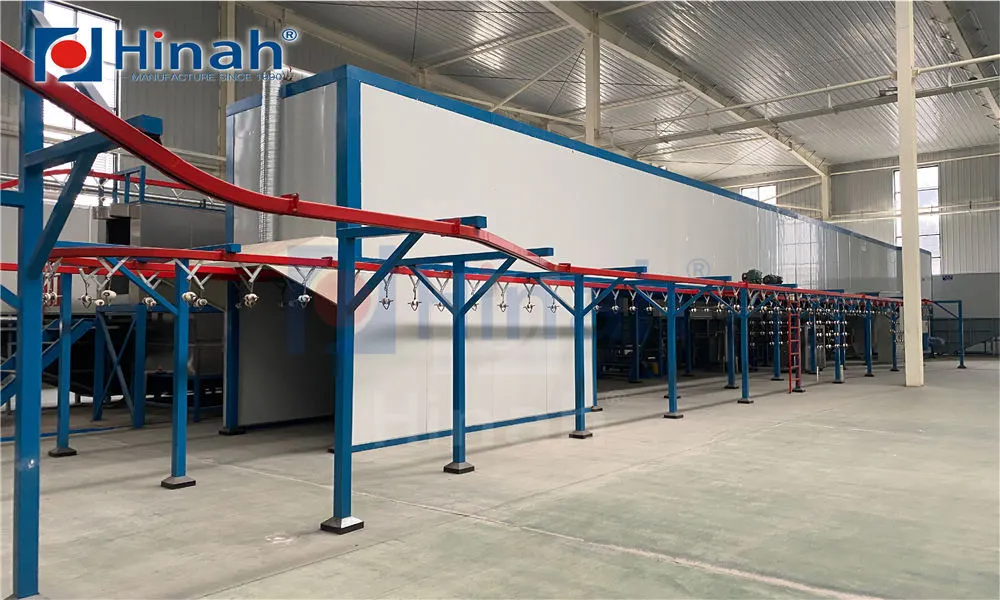
A common misconception is that robots require a "greenfield" factory rebuild. In reality, modern robots are designed for integration. They can be added to an existing conveyor paint line to automate a specific application cell.
The Hardware: More Than Just an Arm
The robot arm itself is one component. A complete HANNA robotic cell includes the arm, a precision powder application gun, a robust mounting structure (pedestal or gantry), and sophisticated fluidized feed systems. Safety fencing and interlocks are also mandatory to protect workers.
The choice between a six-axis articulated arm and a simpler gantry system depends on your part size and range of motion required. Our engineers assess your needs to recommend the most effective and cost-efficient configuration.
The Critical Role of Programming and Vision
Programming is what brings the robot to life. Modern "teach pendants" make this more intuitive than ever. For complex batches, offline programming software allows paths to be created on a computer using a 3D model of the part, minimizing production downtime.
Advanced systems may include machine vision. Cameras scan each part as it enters the booth, identifying its exact position and orientation. The robot then adjusts its programmed path in real-time to compensate for any variations in how the part is hanging. This is crucial for maintaining precision with inconsistent racking.
The upfront investment is a primary consideration. However, the total cost must be viewed through the lens of Return on Investment (ROI). Factor in the annual savings from reduced powder usage, lower labor costs per part, and the virtual elimination of rework due to coating defects. For many shops, the payback period is surprisingly short.
Flexibility for High-Mix Production
People often worry robots are only for high-volume, low-mix runs. This is outdated. Modern robots excel at flexibility. Program recipes can be stored and recalled with a button press. When combined with quick-change powder cartridges and booth cleaning protocols, a robotic paint sprayer can handle frequent color and part changes efficiently.
Maintenance and Support
Robots are industrial tools built for continuous operation. Routine maintenance involves cleaning, checking calibration, and lubricating joints as specified. The key is partnering with a supplier like HANNA that provides comprehensive training and reliable local service support, ensuring your system stays productive.
Consider automation if you face any of these challenges: inconsistent quality, high material waste, difficulty coating complex parts, labor shortages, or the need to increase throughput without expanding your physical footprint.
Start with a professional audit of your line. HANNA can analyze your parts, volumes, and pain points to model the potential ROI. A pilot project or cell-based integration can be a lower-risk way to prove the technology's value.
The next evolution of the robotic paint sprayer is connectivity. These systems are becoming rich data sources. Information on powder consumption per part, gun performance, and cycle times can be fed into plant management software.
This data enables predictive maintenance, deeper process optimization, and unparalleled traceability for quality reporting. It turns your coating process from a manual art into a controlled, digital science.
Adopting a robotic paint sprayer is a strategic decision that moves your powder coating operation from a cost center to a competitive advantage. It’s an investment in precision, efficiency, and quality that pays dividends for years.
The technology is proven, accessible, and more flexible than ever. By automating the application process, you free your team to focus on what humans do best: oversight, problem-solving, and growth. For forward-thinking finishers, the question is no longer if to automate, but when.
Q1: How much does a basic robotic paint sprayer system cost?
A1: A complete, integrated cell for powder coating typically starts in the range of $75,000 to $150,000+. The final cost depends heavily on the robot's reach and payload, the complexity of the part recognition system (simple vs. advanced vision), and the level of safety fencing required. HANNA provides detailed quotes based on a specific application analysis.
Q2: Can a robot handle all the different parts we coat?
A2: In most cases, yes, if it is properly programmed. The key is the part's "envelope" (size and range of motion needed) and the fixturing. A well-designed system can store dozens or hundreds of programs. For widely varying part sizes, a robot with a larger reach or a track-mounted system may be recommended to maintain efficiency.
Q3: Is the programming difficult to learn?
A3: Modern robot interfaces are designed for technicians, not PhDs. While there is a learning curve, HANNA includes comprehensive operator training. For complex parts, offline programming (using a 3D model on a PC) is often handled by our engineers or your programmer, creating a file that is simply loaded onto the robot controller.
Q4: How does a robot manage variations in how parts are hung on the conveyor?
A4: There are two main methods. For consistent racking, precise programming is sufficient. For natural variation, a 2D or 3D machine vision system is used. A camera "sees" the part, calculates its offset, and sends correction data to the robot in real-time, ensuring the spray path stays accurate regardless of hang point drift.
Q5: What is the typical maintenance required?
A5: Daily: Light cleaning of the arm and gun. Weekly: Check for powder buildup in joints and verify gun tip wear. Periodic: Re-lubricate gears as per the manufacturer's schedule (often every 6-12 months of operation). The robot itself is very reliable; most maintenance is focused on the application gun and powder delivery system, similar to a manual setup.