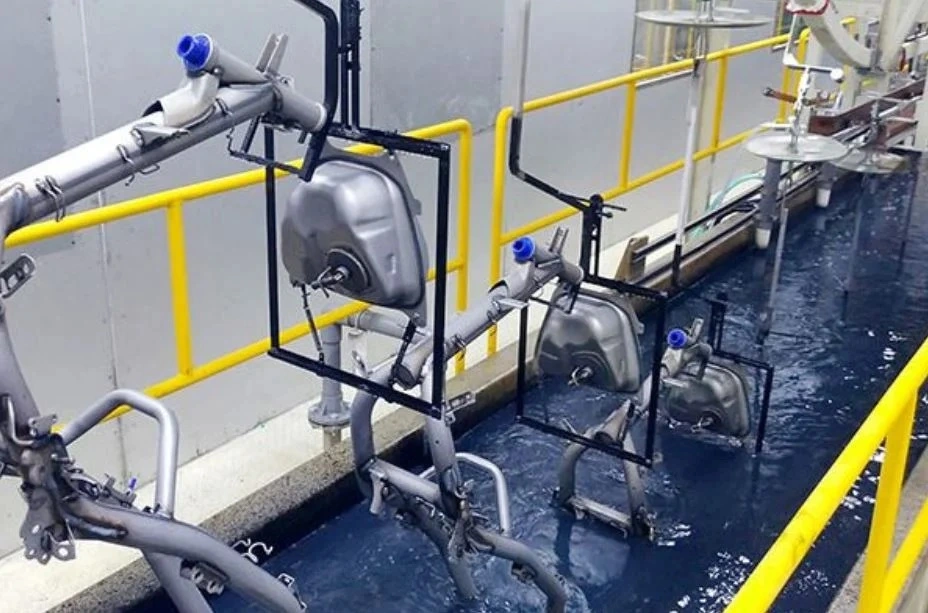
The finishing industry is undergoing a fundamental shift. With skilled labor becoming scarcer and quality expectations tightening, manufacturers are turning to automated powder coating systems not just for throughput, but for consistency. These systems integrate programmable logic controllers (PLCs), part recognition software, and precision applicators to deliver repeatable film builds at line speeds unattainable by manual operators. This article provides a deep technical analysis of the core components, integration challenges, and financial metrics driving the adoption of robotics in powder coating, featuring case data from HANNA installations across North America and Europe.
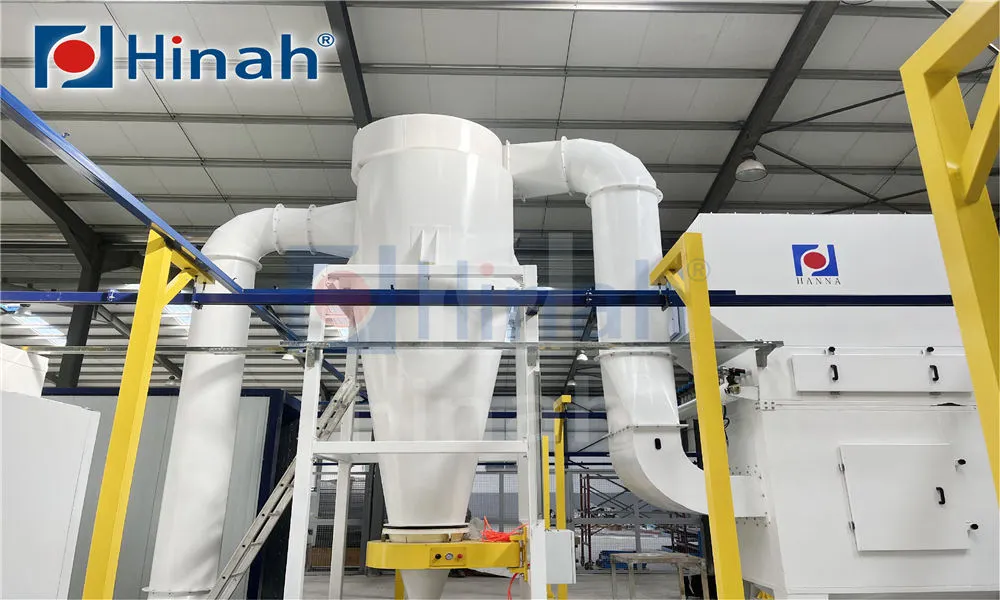
Understanding the hardware and software stack is critical for procurement teams. An automated system is a symphony of moving parts, sensors, and logic controllers.
The backbone of any automated powder coating systems is the reciprocating machine. Modern units are servo-driven, offering variable stroke lengths and speeds independent of the chain speed. Unlike pneumatic predecessors, servo control allows for "spot coating"—programming the guns to paint only when a part is present. This reduces powder consumption by 20-35% compared to continuous spraying. HANNA's reciprocators utilize absolute encoders that maintain position accuracy within ±1 mm, ensuring consistent gun-to-part distance even after thousands of cycles.
To automate effectively, the system must "see" the part. Infrared photo-eyes and through-beam sensors are being replaced by 3D laser scanners. These scanners create a real-time profile of the incoming part, feeding dimensional data to the PLC. The controller then adjusts gun triggers, reciprocator stroke, and even voltage setpoints on the fly. This dynamic adjustment is essential for mixed-model production, where a flat panel might be followed by a complex tubular frame. Without this, automated powder coating systems would simply paint empty space or miss recessed areas.
The central nervous system is the PLC, typically from vendors like Siemens or Allen-Bradley. The HMI must provide operators with the ability to store "recipes." For example, a recipe for 5-inch I-beams might specify stroke length of 72 inches, four guns active, and flow rate of 80 grams per minute. When the scanner identifies that part, the system switches recipes in milliseconds. Advanced HMIs now offer remote diagnostics, allowing HANNA technicians to troubleshoot programming errors from remote locations, reducing downtime.
While the benefits are clear, the path to full automation is fraught with engineering challenges that must be addressed during system design.
Faraday Cage Effect in Complex Geometries: Automated guns, if not positioned correctly, struggle to coat inside corners and recesses. Electrostatic lines of force concentrate on the outside edges, leaving the interior bare. This requires strategic placement of tribo or corona guns with optimized air angles.
Color Change Logistics: In automated lines serving job shops, the speed of color change is the bottleneck. Automated systems require purge cycles that can take 5-15 minutes. If not managed, this negates the speed advantage gained by automation.
Conveyor Synchronization: If the conveyor indexing is inconsistent, the part detection system will misfire. Mechanical friction and thermal expansion of conveyor chains can throw off timing. Closed-loop feedback between the conveyor drive and the powder application system is mandatory for precision.
Overcoming these pain points requires more than just buying robots; it requires system integration expertise. The following solutions are currently deployed in high-efficiency facilities using automated powder coating systems.
Standard systems maintain a constant powder flow. Advanced automation varies the flow based on part geometry. As a part enters the booth, the PLC calculates the surface area. High-surface-area parts receive higher flow rates; low-area parts receive reduced flow. Data from a recent HANNA installation in a lighting fixture manufacturer showed that predictive flow control reduced powder usage by 18% while maintaining a 2.5 mil thickness specification.
A common issue with indexing lines is "double-coating" the leading and trailing edges of parts. If the gun turns off 100 milliseconds too late, the edge gets a thick, orange-peeled finish. Modern automated powder coating systems use predictive algorithms based on encoder counts to trim the on/off delays. This ensures that the powder cloud starts and stops precisely at the part's edge. The result is a reduction in rework rates from an industry average of 8-10% down to less than 2%.
Automation does not exist in a vacuum. The performance of the spray system is directly tied to the booth's airflow and the recovery system's efficiency. If the booth airflow is turbulent (above 120 feet per minute), it can pull the charged powder away from the part. HANNA integrates its automation controls with the booth's variable frequency drives (VFDs). When the automated guns are firing at high volume, the exhaust fans ramp up to contain the cloud. When the guns are idling, fans ramp down, saving energy and reducing filter loading.
Different industries require different automation architectures. The one-size-fits-all approach fails in this sector.
Aluminum Extrusion (Architectural): These lines require long-stroke reciprocators (up to 30 feet) with multiple gun rings to coat complex profiles. Automation here focuses on penetrating deep fins and channels.
Automotive Wheels: High-volume wheel lines utilize rotary guns on dedicated spindles. The automation must handle rapid indexing (30 seconds per part) and flawless clear-coat application.
General Fabrication (Job Shops): These facilities benefit most from 3D scanning and quick-color-change automated powder coating systems that can handle 50 different part numbers per shift without manual reprogramming.
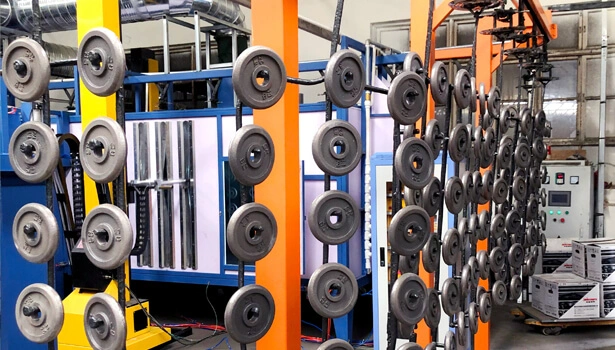
The decision to automate is ultimately a financial one. The initial capital expenditure for a multi-gun automated booth is significant, often ranging from $250,000 to over $1 million. However, the operational expenditure reductions are quantifiable.
Labor Reduction: A two-booth operation running two shifts can typically reduce manual coaters from 6 to 2. At a fully loaded labor cost of $25/hour, this saves approximately $200,000 annually.
Material Efficiency: Manual operators achieve transfer efficiency of 40-60%. Automated systems with part sensing consistently achieve 70-85% efficiency. On a line consuming 50,000 lbs of powder annually at $5/lb, a 20% efficiency gain saves $50,000 per year.
Rework Reduction: By eliminating human variability, reject rates drop. A 5% reduction in rework on a $5 million finishing operation saves $250,000 in labor and materials.
A mid-sized fabricator investing in automated powder coating systems from HANNA typically sees a payback period of 18 to 30 months based on these metrics, not including the softer savings from reduced worker compensation claims due to less repetitive motion strain.
Q1: What is the difference between automatic and robotic powder
coating?
A1: While often used interchangeably, "automatic" typically
refers to fixed reciprocators with multiple guns moving up and down. "Robotic"
usually implies an articulated arm (6-axis) that can move the gun in complex
paths around the part. High-end automated powder coating
systems often combine both: reciprocators for broad coverage and robots
for tricky corners.
Q2: How long does it take to program an automated system for a new
part?
A2: For modern systems with 3D part scanning, it is nearly
instantaneous. The scanner detects the part and loads a pre-set recipe. For
manual teaching of a new, complex part on a robotic arm, initial programming
might take 2-4 hours. Once saved, recall takes seconds. HANNA's HMI systems are
designed for drag-and-drop recipe management.
Q3: Can automated powder coating systems handle small batch sizes
economically?
A3: Yes, if they are equipped with fast color change
and part recognition. The economic danger zone for automation is when changeover
time exceeds 10 minutes for batches of fewer than 50 parts. High-end systems
minimize this with self-cleaning gun components and quick-disconnect hoppers,
making small batches viable.
Q4: What maintenance is required for automated gun
movers?
A4: Servo-driven reciprocators require less maintenance than
pneumatic systems but are not maintenance-free. Key tasks include quarterly
lubrication of linear bearings, annual checking of belt tension, and calibration
of position encoders. Regular inspection of high-voltage cables and gun tips for
wear is also critical to prevent arcing.
Q5: How do I ensure consistent film thickness with
automation?
A5: Consistency is achieved through closed-loop control.
Modern systems monitor the milliamperage draw at the gun tip. As film builds,
the electrical resistance changes. The controller can reduce voltage or gun
speed to prevent the coating from getting too thick. Combined with upstream part
sensing, this maintains tolerance within ±0.2 mils.
Q6: What is the typical lifespan of automated powder coating
equipment?
A6: With proper maintenance, the mechanical structure of
a powder booth and reciprocators can last 15-20 years. Electronics (PLCs, HMIs,
sensors) may become obsolete sooner, typically 7-10 years, but components can be
upgraded. HANNA designs its systems with modular components to
allow for technology refreshes without replacing the entire line.
For a detailed automation audit and ROI projection for your specific product mix, contact the integration specialists at HANNA.