For finishing lines processing oversized parts, heavy fabrications, or high-mix production, the curing oven is the bottleneck or the quality gatekeeper. A large powder coating oven must deliver consistent temperature profiles across significant dimensions — lengths exceeding 10 meters, heights over 3 meters — while maintaining energy efficiency and throughput. This article provides a technical deep dive into the design, thermal dynamics, zoning strategies, and practical engineering solutions for large powder coating oven systems, written for plant engineers, finishing managers, and industrial buyers.
A large powder coating oven typically refers to units with internal chamber height exceeding 2.5 meters, width beyond 2 meters, or length (for continuous tunnels) exceeding 15 meters. Common configurations include:
Batch walk-in ovens: Suitable for oversized parts like engine blocks, transmission housings, agricultural implements, and structural steel. Sizes range from 3m×3m×3m up to 12m×6m×5m.
Continuous conveyor ovens: For high-volume production of medium-to-large parts (e.g., aluminum extrusions, automotive wheels, fence posts). Belt widths up to 2.5 meters, heated lengths up to 40 meters.
Indexing or shuttle ovens: Hybrid solution for heavy workpieces handled by overhead monorail. The oven moves over the part or the part moves into a stationary chamber with vertical lift doors.
Choosing the right configuration depends on production volume, part size envelope, changeover frequency, and available floor space. HANNA specializes in custom-engineered large-scale curing systems with integrated material handling.
Unlike smaller ovens, a large powder coating oven faces three major engineering hurdles:
Standard industrial ovens often specify ±5°C uniformity. For powder coating, wider variation leads to under-cured patches (poor adhesion, low gloss, poor chemical resistance) or over-cured areas (discoloration, loss of mechanical properties). In large ovens, stratification of hot air and dead zones near corners are common. Solutions include:
Multi-zone recirculation: Independent heating and blower units for each zone (e.g., bottom zone, side zones, top zone). Each zone has its own PID temperature controller and thermocouple feedback.
High-velocity air nozzles: Placed strategically to disrupt laminar flow and increase convective heat transfer coefficient. For heavy parts, nozzle velocities of 10–15 m/s reduce boundary layer resistance.
Adjustable baffles and dampers: Allow fine-tuning of air distribution during commissioning. Field balancing with a thermal mapping test (using at least 12-15 datalogger points) is mandatory for large ovens.
Large oven structures (insulated panels, steel framework, conveyor rails) absorb significant energy during startup. To minimize idle energy waste, modern large powder coating oven designs incorporate high-density mineral wool insulation (150–200mm thickness, 0.035 W/m·K) and low-mass liner panels. For intermittent production, a standby temperature (e.g., 80°C) reduces recovery time to under 20 minutes versus over 90 minutes from cold.
Leakage through access doors, conveyor slots, and exhaust stacks can account for 20–35% of total heat loss in poorly designed ovens. Critical mitigation measures:
Double-gasket door seals with pneumatic clamping – ensures positive pressure seal during curing.
Slot seals with labyrinth or magnetic curtains for continuous belt openings.
Counter-flow heat recovery on exhaust – preheats incoming fresh air using a plate heat exchanger, recovering up to 65% of exhaust heat.
The choice between indirect gas-fired and electric infrared (medium-wave or short-wave) affects operating cost, temperature ramp rate, and part compatibility.
Indirect gas-fired recirculating ovens are the most common for large powder coating oven applications above 150°C. They use a heat exchanger to keep combustion products separate from oven atmosphere, preventing contamination of powder coating. Typical burner capacities range from 250,000 BTU/hr to 2.5 million BTU/hr per zone. Efficiency: 75–82% LHV. Best for heavy steel parts and continuous production.
Electric medium-wave infrared (MWIR) panels offer precise zone control and instant response. They heat the part surface directly without heating the air, making them ideal for thin-gauge aluminum or complex geometries where air recirculation is inefficient. However, for parts with large thermal mass, infrared alone may not achieve uniform core temperature. Hybrid systems (IR boost zone followed by convection hold zone) are gaining traction.
Waste heat recovery: Some integrators, including HANNA, offer heat recovery from curing oven exhaust to preheat the powder coating booth make-up air, reducing overall plant energy consumption by 12–18%.
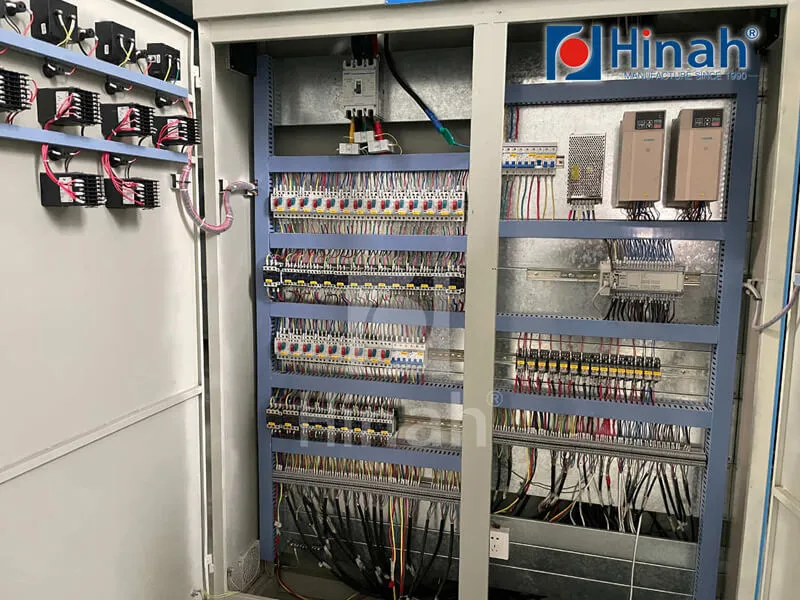
A large powder coating oven requires sophisticated control systems to manage thermal uniformity and track part curing history. Core components:
Multi-point thermocouple arrays – at least six fixed sensors (top, middle, bottom, left, right, center) and two portable probes for periodic profiling.
Part temperature tracking system – wireless dataloggers attached to workpieces transmit real-time part metal temperature, not just air temperature. Manufacturers specify "metal temperature at cross-section" for full cure (e.g., 190°C for 10 minutes for TGIC polyester).
SCR-controlled heating elements or proportional gas valves – smooth modulation eliminates overshoot and undershoot cycles common with on/off control.
PLC with HMI and recipe management – stores curing profiles for different part families, including ramp rates, setpoints, and dwell times. Alarms for temperature deviations beyond ±5°C trigger automatic hold or reject.
Below are three typical scenarios where a large powder coating oven is deployed, along with engineering specifications and results.
Parts: Truck chassis rails, suspension arms, axle housings. Material thickness: 4–12 mm steel. Requirement: Uniform cure to meet ASTM D3451 adhesion and 1,000-hour salt spray resistance. A 6m (L) × 2.5m (W) × 2.2m (H) batch oven with two independent heating zones (bottom + sides) and a 1.2 million BTU/hr gas burner achieved temperature uniformity of ±3°C at 200°C setpoint. Cycle time: 35 minutes including ramp-up, 20 minutes hold, and 10 minutes forced cooling. Throughput: 8 racks per hour, 2 parts per rack.
Parts: Window frames, curtain wall profiles up to 7 meters long. Challenge: Thin walls (1.5–3 mm) are sensitive to overheating, but need full polymerization of polyester powder. A continuous 25-meter long convection oven with three temperature zones (zone 1: 160°C, zone 2: 190°C, zone 3: 180°C) and belt speed 1.2 m/min produced consistent cure with less than 1.5% rejects. Infrared preheat reduced gel time and improved flow.
Parts: Tractor transmission housings, combine harvester components. Mass: 300–800 kg. Requirement: Uniform heating despite thick sections (up to 40mm). A walk-in oven with powered roller conveyor and both forced convection and low-density infrared boosters reduced curing time from 90 minutes to 55 minutes, and eliminated rework due to under-cured bosses.
Large powder coating ovens must comply with NFPA 86 (Standard for Ovens and Furnaces) and local electrical/gas codes. Key safety features:
Combustion safeguards with flame supervision, purge timers, and high-limit temperature cutoffs.
Explosion relief panels (for gas-fired systems) – 1 ft² per 300 ft³ of oven volume, venting to safe area.
Interlocked access doors that shut down heating and recirculation fans when opened.
Automatic fire suppression system (dry chemical or CO₂) with manual pull stations and thermal detectors.
Regular maintenance includes quarterly inspection of blower bearings, belt condition, gas pressure switches, and thermocouple calibration. HANNA provides annual safety audits and performance verification for all installed systems.
If you already operate a large powder coating oven with high energy bills, consider these retrofit measures:
Insulation overlay: Adding 50mm of ceramic fiber blanket on existing panels reduces heat loss through shell by 30–40%.
Variable frequency drives (VFDs) on recirculation fans – reduce air velocity during dwell times, saving fan energy and minimizing dust entrainment.
Automatic door closers and strip curtains – limit infiltration when doors open for loading/unloading.
Oven exhaust heat recovery to preheat wash water or plant space heating.
Typical payback for these retrofits ranges from 8 to 24 months, depending on local energy costs and oven utilization (> 4000 hours/year).
Q1: What is the typical temperature uniformity specification for a
large powder coating oven?
A1: For industrial powder curing, you
should require ±5°C or better. High-performance ovens achieve ±3°C across the
entire usable workspace. Always request a thermal map report (9 to 16 points) as
part of Factory Acceptance Testing. The curing temperature for most polyester
powders is 180–200°C, reaching part metal temperature, not just air
temperature.
Q2: How do I calculate the heating power needed for a large powder
coating oven?
A2: Use this formula: Power (kW) = [ (m × cp × ΔT) /
(t × 3600) ] + (A × U × ΔT_avg), where m = mass of parts + conveyor + racks
(kg), cp = specific heat (0.5 kJ/kg·K for steel), ΔT = temperature rise (e.g.,
20°C to 200°C), t = ramp-up time (hours), A = oven surface area (m²), U =
overall heat transfer coefficient (0.6–1.2 W/m²·K for insulated panels). A
simplified rule-of-thumb for ovens up to 200°C: 1.5–2.5 kW/m³ of oven volume.
HANNA's engineering team provides free
heat load calculations using your part dimensions and production schedule.
Q3: Can I use a large powder coating oven for both batch and
continuous processing?
A3: Not simultaneously. However, some ovens
are designed with removable trolleys and a rear door that can be converted from
a batch end-load configuration to a pass-through continuous configuration by
adding a second door and external conveyor. This hybrid approach requires
modular heating zones and adjustable recirculation. Consult your oven
manufacturer for feasibility, as redesigning air distribution is complex.
Q4: How often should I replace thermocouples in a large powder
coating oven?
A4: Type K thermocouples exposed to 200–250°C cycles
should be replaced every 12–18 months, or sooner if readings drift by more than
±2°C compared to a reference probe. Use heavy-gauge (3mm) inconel-sheathed
probes with high-temperature leads. Annual calibration of all sensors and
controllers is strongly recommended for ISO-certified finishing lines.
Q5: What is the maximum part weight a large powder coating oven
conveyor can handle?
A5: It depends on the conveyor type. For
continuous chain-on-edge or belt conveyors, typical load ratings are 30–50 kg
per linear meter. For shuttle or monorail systems with rotating hooks,
single-point loads up to 1,500 kg are possible. When specifying a large powder coating oven, provide
maximum part weight and hanger spacing so structural supports and rail gauges
can be properly sized. Overloading leads to chain stretching and uneven part
spacing, causing non-uniform cure.
Q6: How do I remove uncured powder overspray from oven recirculation
ducts?
A6: Install easily removable access panels in ductwork and
schedule quarterly cleaning using non-abrasive dry ice blasting. For ovens with
high powder carryover, add a high-efficiency particulate filter (MERV
15) on the recirculation air return. Pyrolytic self-cleaning cycles (heating
oven to 400°C without parts) can burn off organic deposits but require special
high-temperature insulation and limit switch overrides.
Every finishing line has unique constraints: available floor space, part mix, shift patterns, and utility capacities. A standard catalog oven rarely meets the demands of large-scale production. Large powder coating oven systems from HANNA are built to your specifications, with thermal simulation, 3D CAD layout, and on-site commissioning support.
Provide the following details to receive a detailed quote and energy consumption simulation:
Maximum part dimensions (length × width × height) and weight
Throughput: number of racks/hr or parts/hr
Desired curing schedule (temperature and time at metal temperature)
Heating energy type available (natural gas, propane, electric)
Preferred configuration: batch walk-in, continuous belt, or overhead monorail
Submit your inquiry using the contact form below. A project engineer will respond within 24 hours with preliminary specifications, a budgetary quote, and references from similar installations.
Send your inquiry to HANNA finishing systems – include your part photos or CAD models for a precise layout proposal.