Selecting the right finishing system is a capital decision that directly impacts production throughput, finish quality, and operational costs. For fabricators, job coaters, and OEMs, the market offers various options, but only precision-engineered machinery ensures consistent results. When you evaluate powder coating equipment for sale, it is critical to look beyond the initial price tag and analyze the technology behind the booth, the recovery efficiency, and the curing uniformity. HANNA has established itself as a reliable partner in this sector, providing systems that integrate seamlessly into high-mix or high-volume environments. This article dissects the core components, addresses common operational pain points, and provides data-backed insights to guide your purchasing decision.
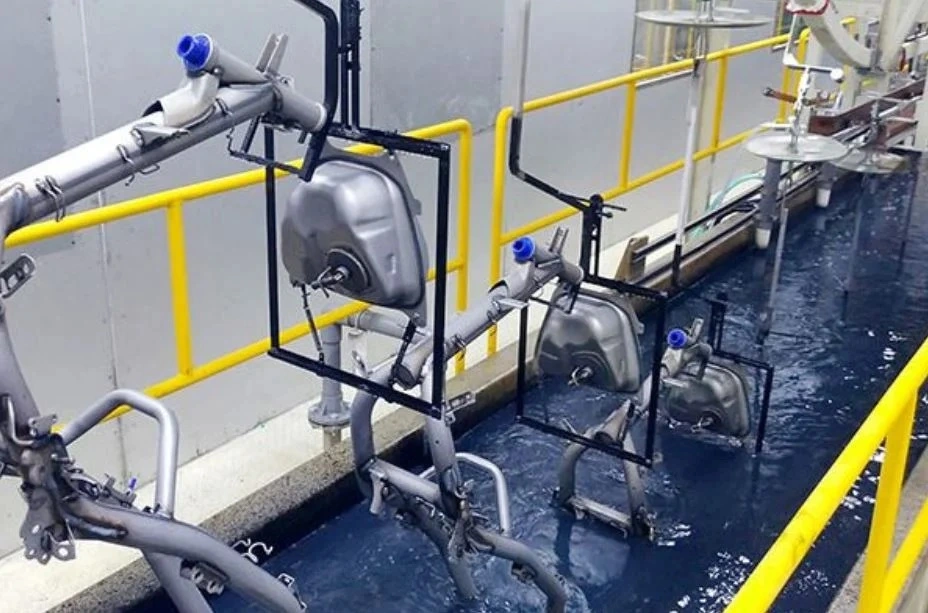
A complete powder coating line is a symphony of interdependent parts. Investing in powder coating equipment for sale requires understanding how each module contributes to the overall efficiency. Below are the critical subsystems, with technical details that separate entry-level machinery from industrial-grade solutions.
The booth is the heart of the application area. Two primary technologies dominate the market:
Cartridge Booth Systems: These utilize high-efficiency filter cartridges to capture overspray and return clean air to the plant (or exhaust it). Modern cartridge systems from HANNA feature automatic pulse-jet cleaning, which maintains consistent airflow and extends filter life. Typical filtration efficiency exceeds 99.9% at 0.5 microns. For operations prioritizing a compact footprint and minimal maintenance, cartridge booths are ideal.
Cyclone Booth Systems: These employ a cyclonic separator to reclaim a high percentage of uncontaminated powder, which is then sieved and reused. The remaining fines are captured in a secondary filter. Cyclone technology is indispensable for facilities running frequent color changes, as the cleanout time is significantly reduced—often under 15 minutes for a complete color switch. The initial investment is higher, but the material savings on high-cost powders can yield an ROI in less than 18 months.
Application efficiency hinges on the gun technology. When you procure powder coating equipment for sale, ensure the gun package matches your part geometry.
Corona Charging Guns: The industry standard, using a high-voltage electrode to ionize the air and charge the powder particles. Modern corona guns feature integrated cascade technology that provides stable voltage even in humid conditions. Adjustable current and voltage settings allow operators to fine-tune the wrap-around effect for Faraday cage areas.
Tribo Charging Guns: These rely on frictional charging, where powder particles collide against a PTFE lining to gain a positive charge. Tribo guns are superior for re-coating applications and for applying metallic or blended finishes, as they avoid the "orange peel" effect sometimes caused by free ions in corona systems.
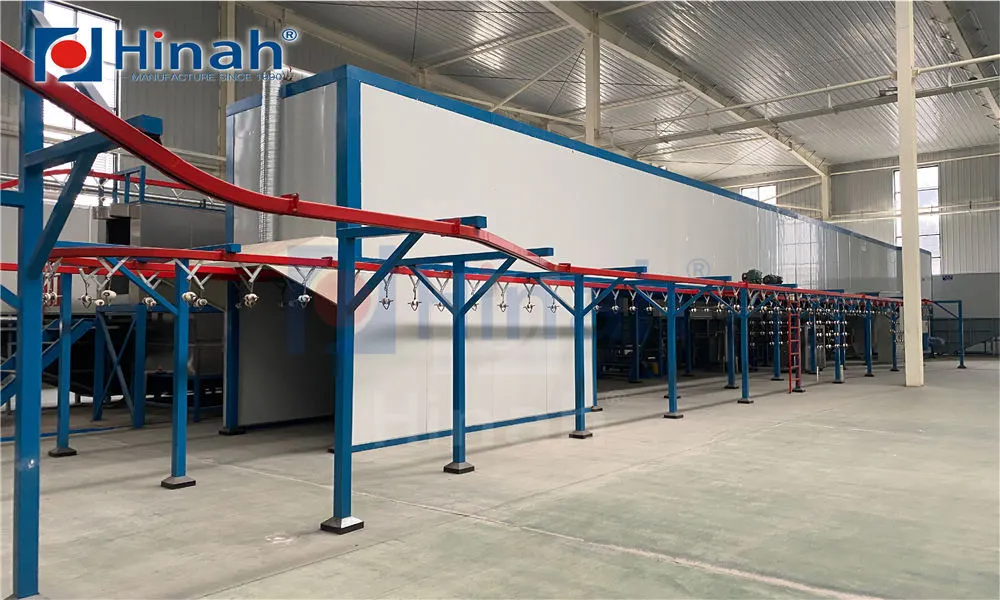
Curing uniformity directly impacts film adhesion and mechanical properties. Industrial ovens are typically gas-fired or electric. HANNA engineers ovens with:
High-Velocity Airflow: To ensure temperature uniformity of ±5°C across the load.
Insulation Panels: Typically 100 mm rock wool with an aluminum casing, reducing energy loss.
IRT (Infrared) Boosters: For high-mass parts or quick gel, IR modules can be integrated at the oven entrance to accelerate the curing process and increase line speed without lengthening the oven footprint.
Procuring new powder coating equipment for sale should solve specific operational challenges. Here is how modern design addresses common frustrations:
In job shop environments, downtime for color change is lost revenue. Traditional systems can take hours. Modern solutions from HANNA incorporate:
Self-cleaning slide seals between the booth and the recovery unit.
Smooth interior walls with radiused corners to prevent powder accumulation.
Integrated purge lances for quick cleaning of feed hoses.
These features collectively reduce color changeover time to less than 10-15 minutes, directly increasing productive spray time by 15-20%.
Wasted powder is wasted profit. Data indicates that outdated equipment operates at 50-60% transfer efficiency, while modern systems achieve 75-85% on most geometries. Factors contributing to this leap include:
Advanced gun control: Closed-loop current control prevents back-ionization.
Optimized powder flow: Dense-phase or Venturi pumps deliver consistent cloud patterns.
Part sensing: Automatic guns trigger only when a part is present, reducing overspray during gaps.
When comparing powder coating equipment for sale, evaluate vendors based on verifiable performance data. Request documentation on:
Airflow capacity (CFM) at the booth face: Minimum face velocity should be 100-120 ft/min to contain overspray, per OSHA and NFPA standards.
Recovery efficiency: Cyclone systems should reclaim 95-98% of virgin powder in ideal conditions.
Heat-up time and recovery: An oven should reach setpoint from cold start within 20-30 minutes and recover temperature within 2 minutes after loading a rack.
HANNA provides thermal imaging reports and airflow validation during commissioning, ensuring the line performs to these specifications.
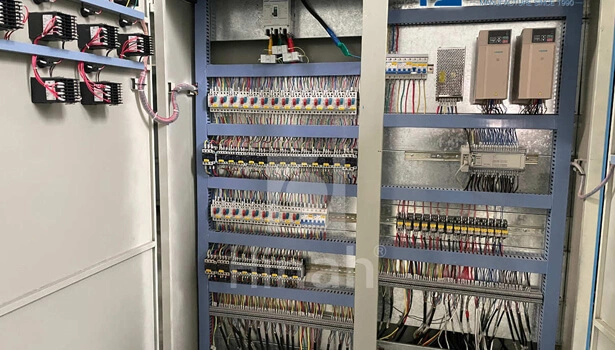
There is no one-size-fits-all solution. The selection of powder coating equipment for sale must align with your throughput, part mix, and budget.
For automotive suppliers or appliance manufacturers running the same part for weeks, a dedicated line with:
Fixed gun arrays (6-12 guns) controlled by PLC.
Walk-in gas-fired oven with multi-zone temperature control.
Overhead power-and-free conveyor allowing for accumulation.
Throughput can exceed 50 racks per hour.
Job shops require flexibility. The optimal configuration includes:
A cyclone booth with quick-change sieve.
Manual gun stations with advanced controls for operator adjustment.
A combination convection/IR oven to handle varying part masses and cure schedules without bottlenecks.
Q1: What is the typical transfer efficiency of modern powder coating equipment, and how is it measured?
A1: Modern systems achieve 75-85% first-pass transfer efficiency on most parts. This is measured by comparing the weight of powder deposited on the part versus the weight of powder sprayed. High-efficiency guns, proper part grounding, and optimized airflow are the primary contributors. With reclaim systems, overall material utilization can exceed 98%.
Q2: How do I choose between corona and tribo charging guns for my application?
A2: Corona guns are versatile and handle most powder types well, making them the standard for general coating. Choose tribo guns specifically for re-coating, complex Faraday cage areas, or when applying metallic and blended powders where a consistent finish without pattern interruption is critical. Many modern lines include both types on the same booth for maximum flexibility.
Q3: What maintenance is required to keep a powder coating system operating at peak efficiency?
A3: Daily tasks include inspecting gun tips for wear, cleaning booth walls to prevent buildup, and checking differential pressure across filters. Weekly, inspect seals and gaskets, and clean the sieves in the reclaim system. Quarterly, perform a deep clean of the recovery unit and calibrate oven sensors. Adhering to a preventive maintenance schedule extends equipment life by 30%.
Q4: Can HANNA equipment handle custom colors and quick changeovers efficiently?
A4: Yes. HANNA cyclone booth designs prioritize quick color change. Features like smooth interior surfaces, self-cleaning slide seals, and dedicated purge stations allow a two-person team to complete a color change in under 15 minutes, minimizing downtime for job shops.
Q5: What are the energy-saving features in modern curing ovens?
A5: Modern ovens incorporate several energy-saving technologies: variable-frequency drives (VFDs) on recirculation fans to match airflow to load, high-efficiency ribbon burners with 90+% combustion efficiency, and insulated panels that reduce skin temperature and heat loss. Additionally, IR boosters can quickly bring parts to gel temperature without heating the entire oven volume, saving up to 20% on gas consumption.
Q6: What safety certifications should I look for when buying powder coating equipment?
A6: Equipment should comply with NFPA 33 (Standard for Spray Application Using Flammable or Combustible Materials) and OSHA standards. Look for components with UL or CE marks. Explosion venting on the booth and recovery units, along with proper grounding and interlock systems, are non-negotiable safety features.