In the industrial finishing sector, the choice of powder coating equipment suppliers directly impacts line efficiency, coating quality, and total cost of ownership. As manufacturing demands shift toward higher flexibility and sustainability, procurement decisions must be based on technical merit and long-term partnership value rather than upfront cost alone. This analysis outlines a framework for evaluating suppliers, grounded in engineering parameters and real-world operational data.
When assessing potential powder coating equipment suppliers, engineering teams must scrutinize the core technologies that dictate transfer efficiency (TE) and first-pass yield. Modern systems are not just about spraying powder; they are integrated solutions for surface finishing.
A technically proficient supplier offers both corona and tribo charging guns with proven performance data. For corona systems, evaluate the power supply's voltage consistency and the gun's ability to handle complex Faraday cage areas. Suppliers should provide data on the current (µA) and voltage (kV) output stability, which affects powder adhesion. For tribo systems, the materials of construction and gun design must maximize charge generation for specific powder chemistries, such as those used in functional coatings.
The efficiency of the powder recovery system is a key differentiator. Suppliers offering cyclone + post-filter combinations with documented separation efficiency (e.g., 95-98% for specific particle sizes) provide significant material savings. Inquire about the air-to-cloth ratio in cartridge filters and the design of the cyclone to minimize degradation of powder particles, which can cause surface defects like orange peel.
For instance, an evaluation of a system from experienced suppliers like HANNA would involve analyzing their cyclone geometry and how it minimizes particle degradation, a common issue in high-throughput recovery loops. Understanding these nuances separates high-performance lines from standard installations.
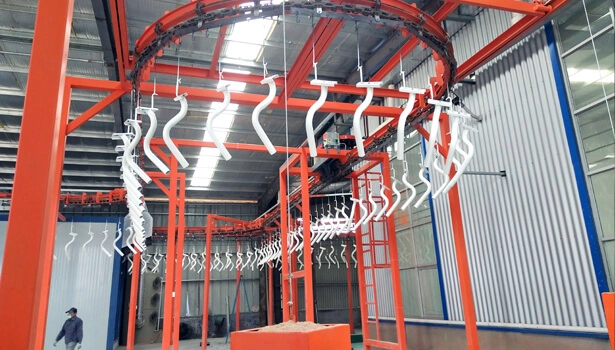
A coating line is a sequence of interdependent processes. The chosen powder coating equipment suppliers must demonstrate the capability to integrate their application equipment seamlessly with pretreatment systems, curing ovens, and conveyor controls.
Poorly specified equipment will not compensate for inadequate pretreatment, but the application equipment must be compatible with the line speed and part temperature. Suppliers should specify required part temperature at the application booth (often 40-50°C for optimal grounding and flow) and the necessary air quality (ISO 8573-1 Class 1.2.1 or better) to prevent nozzle clogging and contamination. Specify your pretreatment capabilities—whether it's iron phosphate, zinc phosphate, or chromate-free conversion coatings—and ensure the supplier's gun and nozzle selection can handle any residual moisture or specific part conductivity.
While not directly part of the application equipment, a reputable supplier will analyze your oven's temperature profile and airflow patterns. They should advise on how their equipment's powder chemistry (from partnered material suppliers) correlates with your oven's dwell time and heat-up rate to ensure complete cross-linking and optimal film formation. Requesting references with similar oven setups is a prudent step.
Procurement decisions based solely on capital expenditure (CAPEX) are short-sighted. A robust evaluation model includes operational expenditure (OPEX) over a 5-10 year horizon. Leading powder coating equipment suppliers provide data to build this model.
Powder Savings: High-efficiency components (guns, pumps, booths) can increase first-pass transfer efficiency from 50-60% to over 85%, directly reducing material costs, which constitute 30-50% of total coating costs.
Color Change Time: In a JIT environment, downtime for color change is a major cost. Evaluate suppliers on the design of their booth and recovery systems—compact recovery cyclones, self-cleaning filters, and purge routines that can reduce color change from hours to under 15 minutes.
Energy Consumption: Assess the power requirements of the application equipment, particularly the recovery fans and reclaim systems. Variable frequency drives (VFDs) and energy-efficient motors are now standard in best-in-class systems.
Maintenance Schedules: Request recommended maintenance intervals and costs for wear parts like nozzles, electrodes, pump venturi, and filter cartridges. A supplier with a local distribution center for spares, like HANNA's established network for their powder coating systems, minimizes downtime risk.
Different industries have unique coating challenges. General industry suppliers may not have the specific process expertise required for complex geometries or high-specification markets.
Automotive & Architectural: Require exceptional finish appearance (DOI - Distinctness of Image), weatherability, and corrosion resistance. Suppliers must provide precise control over film build and application consistency, often requiring multi-gun arrays and robotic integration.
Functional Coatings (e.g., pipe, rebar): Demand high film builds (e.g., >250 microns) and 100% coverage. This requires high-output guns, specialized nozzles, and often, pre-heating of parts. Equipment from top-tier powder coating equipment suppliers is engineered for these demanding conditions.
Heat-Sensitive Substrates (e.g., MDF, plastics): Require low-cure or UV-curable powder systems and precise temperature control. The equipment must be capable of low-temperature application and integration with IR or UV curing systems.
The relationship with the supplier extends well beyond installation. Critical questions include:
Commissioning and Training: Does the supplier provide on-site start-up assistance and certified operator training? This is essential for achieving design performance metrics quickly.
Process Optimization: Will they conduct regular audits of your line to optimize gun positioning, powder flow rates, and recovery efficiency?
Remote Diagnostics: Do modern systems include IoT connectivity for remote monitoring and troubleshooting by the supplier's engineers?
Regulatory pressures and corporate sustainability goals are reshaping equipment selection. Suppliers must provide solutions that help manufacturers meet stringent environmental standards. Powder coating is inherently more sustainable than liquid painting, but equipment choices matter.
VOC/HAP Elimination: Ensure the equipment is optimized for 100% solids powder, eliminating volatile organic compounds (VOCs) and hazardous air pollutants (HAPs) entirely.
Waste Reduction: High-efficiency recovery and recycling systems minimize landfilled powder waste. Suppliers should provide data on the recyclability rate of overspray—top-tier systems can reclaim and reuse 95-98% of powder.
Energy Efficiency: As mentioned in TCO, equipment with lower energy consumption contributes directly to Scope 2 emission reductions. Look for suppliers investing in energy-efficient component design.
The selection of powder coating equipment suppliers is a strategic decision that affects production agility, cost structure, and environmental footprint. By focusing on technical performance, integration capabilities, and long-term support, manufacturers can build a partnership that delivers competitive advantage. Conducting thorough site visits to reference installations and demanding detailed performance data are essential steps in this critical procurement process.
A1: Lead times vary significantly based on system complexity and current order backlogs. For a standard, manual batch booth, lead times can be 4-8 weeks. However, for a fully automated, multi-stage powder coating line with pretreatment and curing ovens, lead times typically range from 16 to 30 weeks. This includes engineering design, fabrication, factory acceptance testing (FAT), shipping, and installation. Reputable suppliers like HANNA provide a detailed project timeline during the quotation phase, which is critical for your production planning.
A2: Filter replacement frequency depends on system usage, the type of powder used, and the efficiency of the pre-separation (cyclone) stage. As a general guideline, final filters (after-filters or safety filters) should be checked weekly and typically replaced every 6 to 12 months. Cyclone filter cartridges, which handle higher loads, may need replacement every 1-2 years, but regular monitoring of the differential pressure across the filters is the most reliable indicator. Operating with clogged filters reduces airflow, decreasing transfer efficiency and potentially causing powder to blow back into the work environment.
A3: Yes, retrofitting is often a cost-effective way to improve line performance without a complete system overhaul. Common retrofits include upgrading to high-efficiency corona or tribo guns, installing a new control system for better precision, or adding a compact recovery cyclone to an existing booth to improve color change speed. However, compatibility must be carefully evaluated. You should consult with powder coating equipment suppliers who offer a range of components and can engineer the integration with your existing booth, conveyor, and controls.
A4: The fundamental difference lies in the charging mechanism. A corona gun uses a high-voltage electrode at the gun tip to create an electrostatic field that ionizes the air, charging the powder particles as they pass through. It's versatile, works well for most powder types, and is excellent for general coating. A tribo gun charges powder through friction—the powder particles rub against the interior wall of the gun (typically made of a specific material like PTFE), creating a positive charge. Tribo charging is preferred for re-coating and for penetrating complex Faraday cage areas because it creates a more uniform, field-free powder cloud. The choice depends on your specific part geometries and coating requirements.
A5: To validate the performance of new equipment from your chosen powder coating equipment suppliers, track these essential KPIs from the start: First-Pass Yield (FPY) - the percentage of parts meeting quality specs on the first run. Transfer Efficiency (TE) - the ratio of powder deposited on the part versus total powder used. Color Change Time - the total downtime from the last good part of one color to the first good part of the next. Film Build Consistency - measured across different part geometries. Overall Equipment Effectiveness (OEE) - combining availability, performance, and quality. Benchmark these against the supplier's guaranteed performance metrics established during the purchase contract.
A6: It is very important for longevity, safety, and cleanability. Most modern booths are constructed from modular, heavy-gauge steel or aluminum panels with a smooth, powder-coated finish. Stainless steel is often used in high-humidity environments or cleanrooms due to its corrosion resistance. The panels must be grounded effectively to prevent static charge buildup, which is a safety hazard. The design should also be free of sharp edges and crevices where powder can accumulate, as this simplifies cleaning and reduces the risk of contamination during color changes.
For manufacturers seeking to upgrade their finishing capabilities, a thorough technical dialogue with established powder coating equipment suppliers is the first step toward a higher-performance, more sustainable operation. Companies like HANNA bring decades of application engineering to the table, helping clients navigate these complex decisions to achieve their specific production and quality objectives.