Powder coating operations demand absolute precision in material handling. The paint line conveyor systems form the central nervous system of any high-output finishing plant. Unlike wet paint lines, powder coating requires strict control over grounding, contamination, and thermal stability. A poorly designed conveyor introduces defects such as Faraday cage resistance, back-ionization marks, or uneven film build — all of which lead to costly rework. This guide provides engineering-level insights into paint line conveyor systems for coaters, plant managers, and process engineers. Drawing from decades of field data, we examine topologies, pain points, maintenance protocols, and Industry 4.0 integration, with practical references to installations by HANNA.
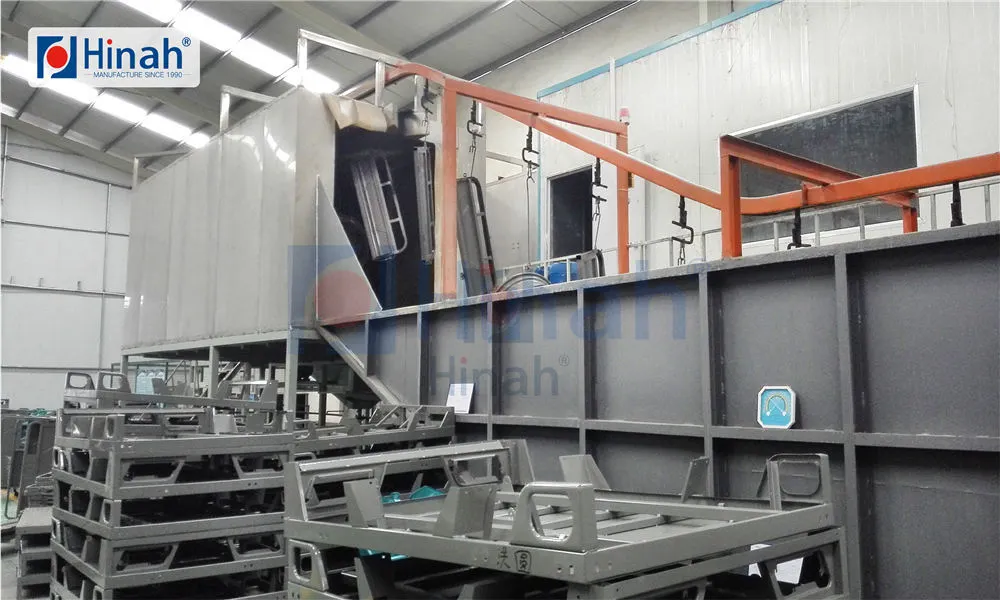
Any paint line conveyor systems architecture comprises five non-negotiable elements: the chain or belt, drive unit, track/rail, trolleys or carriers, and control logic. For powder coating lines, additional demands emerge:
Chain pitch & tensile strength: Typical pitches range from 3" to 6" (80-150 mm) with ultimate strengths above 10,000 lbs to handle high-density hanging patterns.
Ground continuity: Powder particles rely on electrostatic attraction. Conveyor grounding must maintain ≤1 ohm resistance from hook to earth ground. Sliding contacts or carbon brushes are mandatory.
Thermal tolerance: Conveyor components passing through curing ovens (180-220°C) require high-temperature lubricants (e.g., PTFE-based greases) and alloy steel wheels.
Cleanability: Powder overspray accumulates on rails and chains. Open-link designs allow easier blow-off compared to enclosed tracks.
Leading integrators like HANNA use finite element analysis to match conveyor stiffness with maximum load deflection — critical to maintain consistent gun-to-target distance (usually 150-250 mm) across the entire line.
Choosing the wrong conveyor topology directly impacts color-change flexibility and uptime. Below are the dominant configurations used in modern powder coating plants.
The simplest and most cost-effective paint line conveyor systems use a single I-beam track with pendular trolleys. Monorail excels in continuous, high-volume production of identical parts (e.g., fence panels, shelving). However, monorails cannot accumulate carriers — a bottleneck during color change or booth maintenance. Typical speeds range from 2 to 8 m/min.
For lines requiring zone isolation and carrier accumulation, P&F systems feature two tracks: a power chain pulling free trolleys via pusher dogs. This allows individual carriers to stop inside a spray booth or oven while the main chain keeps moving. Powder coating plants handling multiple colors benefit from P&F: carriers with dark color powder residue can be diverted to a cleaning station without stopping production. P&F also enables “banking” of parts for batch curing.
Heavy or odd-shaped components (engine blocks, agricultural implements) require inverted conveyors where the chain runs below floor level, or slat conveyors with steel belts. These designs prevent pendulum sway, ensuring consistent coating on recessed areas. The downside: higher capital cost and limited accessibility for manual touch-up.
Even the most expensive paint line conveyor systems fail if they ignore three recurring operational pains:
Cross-contamination & cratering defects: Residual powder from previous colors (especially dark pigments) contaminates the booth air and falls onto light-colored parts. Solution: Install modular chain covers and quick-detach hangers. HANNA offers automated hanger cleaning systems that use pyrolysis to burn off cured powder without conveyor downtime.
Poor grounding leading to Faraday cage issues: Rotating or greasy bearings increase electrical resistance. Solution: Regularly monitor grounding continuity via wireless sensors on each trolley; use copper grounding straps at load/unload stations.
Uneven coating from inconsistent line speed: VFD-controlled drives with encoder feedback are mandatory. For P&F systems, synchronize the power chain speed with the booth’s reciprocator stroke to avoid thickness variations >±10µm.
Field data from powder coating plant retrofits show that implementing a contamination-control conveyor strategy reduces rework rates from 8-12% down to under 2% within three months.
Line speed and part spacing are not arbitrary — they directly determine curing window and powder transfer efficiency (PTE). For a typical hybrid or polyester powder cured at 190°C for 10 minutes (metal temperature), the conveyor must balance three constraints:
Curing zone length: If the oven is 30 meters long, required speed = 30m / (10min * 60sec) = 0.05 m/s (3 m/min). Too slow? Production drops. Too fast? Undercured powder.
Hanging density: Spacing between parts should be at least 1.5x the part’s largest dimension to prevent powder shadowing. For complex geometries, computational fluid dynamics (CFD) can simulate powder cloud trajectories around carriers.
Booster drives: When using paint line conveyor systems with multiple accumulation zones, auxiliary drives prevent chain slip during heavy loads.
Advanced lines employ speed profiling: slow down (0.8 m/min) inside the electrostatic spray booth to maximize wrap, then accelerate to 4 m/min through the cool-down tunnel. HANNA control platforms integrate with powder dosing systems to automatically adjust conveyor speed based on real-time film thickness measurement.
Powder coating environments are abrasive and thermally aggressive. Without a rigorous maintenance schedule, paint line conveyor systems suffer from chain elongation, wheel seizing, and track wear. Implement the following:
Weekly: Blow off powder deposits from chain and rails using compressed air (dry, oil-free). Inspect hanger tips for cured buildup; replace as needed.
Monthly: Measure chain pitch elongation. Replace chain segments when elongation exceeds 2%. Lubricate trolley wheels with high-temperature grease (drop point >260°C).
Quarterly: Perform thermal imaging of drive units and bearings. Check alignment of tracks with laser alignment tools — misalignment of even 1 mm accelerates wear exponentially.
Annually: Replace all grounding contacts. Conduct load test of the entire system at 125% of maximum design weight.
Many plants overlook the conveyor until a catastrophic failure occurs, leading to 3-5 days of downtime. Powder coating plant operators who adopt predictive maintenance (vibration sensors on drive sprockets) reduce unplanned stops by 70%.
The versatility of modern paint line conveyor systems is best illustrated through sector-specific deployments:
Aluminum wheels require clear coat over a base silver powder. A P&F conveyor allows wheels to pass through the clear booth while a separate carrier bank holds wheels for the base coat — zero cross-color contamination. HANNA engineered a 1.2 km long P&F system for a tier-1 supplier, achieving 850 wheels/hour with <0.5% rejects.
Extrusions up to 7 meters long demand inverted monorail conveyors with adjustable hangers every 1.5 m to prevent sagging. The conveyor speed is set at 2.5 m/min to allow complete curing of AAMA 2604-compliant powders.
Heavy fabricated steel parts (e.g., chassis brackets) use slat conveyors with integrated rotation spindles. The rotation (5-10 rpm) ensures powder reaches all sides, eliminating manual touch-up.
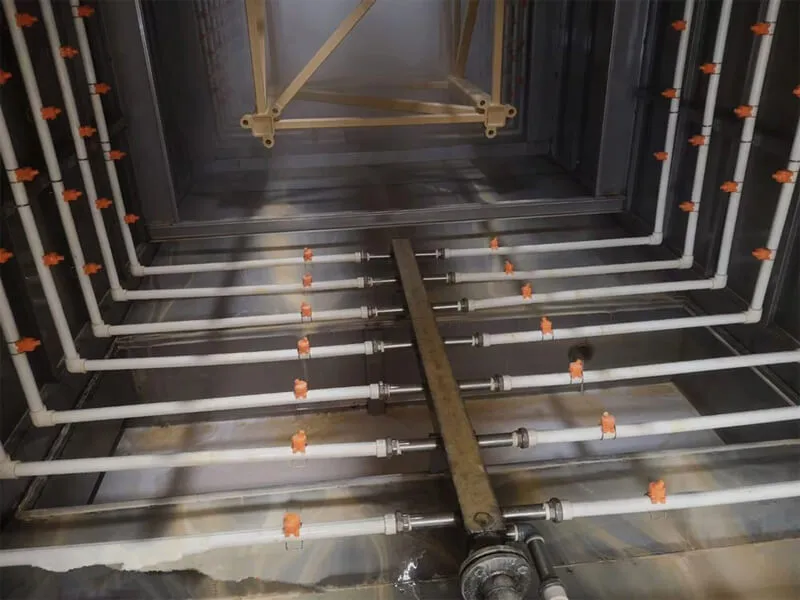
The next generation of paint line conveyor systems will merge mechanical robustness with digital intelligence. Key developments include:
IoT-enabled trolleys: Each carrier equipped with RFID tags storing part ID, required powder recipe, and cure history. The conveyor communicates with the booth controller to adjust gun voltage and powder flow automatically.
Digital twin simulation: Before installing a new line, engineers simulate part movement, spray patterns, and oven heat distribution — reducing commissioning time by 40%.
Energy recovery: Regenerative drives capture braking energy from declining conveyor sections and feed it back to the plant grid.
HANNA has already deployed a fully connected paint line for a European farm equipment manufacturer where the conveyor system self-adjusts speed based on real-time oven load and powder reclaim efficiency. This closed-loop optimization increased overall equipment effectiveness (OEE) from 67% to 89%.
A1: Speed depends on cure schedule and part geometry. For conventional hybrid powders (10 min @ 190°C metal temp) with a 25 m curing oven, line speed is 2.5 m/min. For fast-cure powders (5 min @ 180°C), speeds can reach 5 m/min. Always validate with oven profiling studies.
A2: Implement three layers: (1) daily blow-off of overhead chain using static-neutralizing nozzles; (2) weekly hanger stripping via thermal cleaning (400°C for 2 hours); (3) install disposable paper or silicone mats on conveyor return sections to capture falling powder flakes. Regular measurement of particle fallout using adhesive slides is recommended.
A3: Yes, but modifications are essential. You must add grounding contacts (copper brushes riding on the rail), replace standard lubricants with high-temperature, powder-compatible versions, and install quick-release hanger systems. Powder coating plant retrofits often include a dedicated chain cleaning station before the spray booth.
A4: Power-and-free (P&F) allows individual carrier accumulation and zone isolation. For multi-color operations, P&F lets you store powder-contaminated carriers in a holding loop while the main line continues with a different color. Monorails cannot accumulate — a jam anywhere stops the entire line. P&F also enables offline load/unload without stopping production.
A5: HANNA provides full turnkey engineering: from conveyor load calculation and track layout to PLC integration with powder booths and curing ovens. Their team performs on-site thermal mapping, chain tension validation, and operator training. All systems are backed by a 2-year warranty on drive components and 24/7 remote diagnostics. For complex projects, HANNA offers digital twin simulation prior to fabrication.
A6: Unlike wet paint lines, powder lines require minimal lubrication to avoid attracting powder dust. Use a dry-film lubricant (graphite or MoS₂ based) applied via automatic lubricators every 8-12 operating hours. Over-lubrication leads to caking and increased wear. Conventional oil-based lubricants should never be used above 150°C.
Selecting the right paint line conveyor systems directly impacts your first-pass yield, energy consumption, and maintenance costs. Whether you are building a greenfield powder coating plant or retrofitting an existing line, precise engineering of chain type, grounding, and speed control is non-negotiable. HANNA combines 30+ years of conveyor metallurgy and powder application expertise to deliver systems that achieve >95% transfer efficiency and less than 1% field rejects.
Contact our technical sales team today for a detailed proposal, load analysis, and virtual walkthrough of your future paint line. Send your inquiry with part drawings and desired output rates to receive a customized conveyor design within 5 business days.
Request your quotation now — email: neil@autocoatinglines.com or use the inquiry form on our website.