The industrial curing oven is the final, decisive stage in any powder coating line. Even a perfect spray application fails if the curing process does not achieve full cross-linking of the polymer matrix. Unlike simple drying ovens, an industrial curing oven must maintain precise metal temperature profiles across complex geometries, often for sustained periods. Poor oven design leads to under-cure (poor adhesion, reduced chemical resistance), over-cure (yellowing, brittleness), or uneven gloss. This guide provides engineering-level insights into industrial curing oven selection, thermal profiling, energy optimization, and common failure modes — drawing from real powder coating plant retrofits and new installations by HANNA.
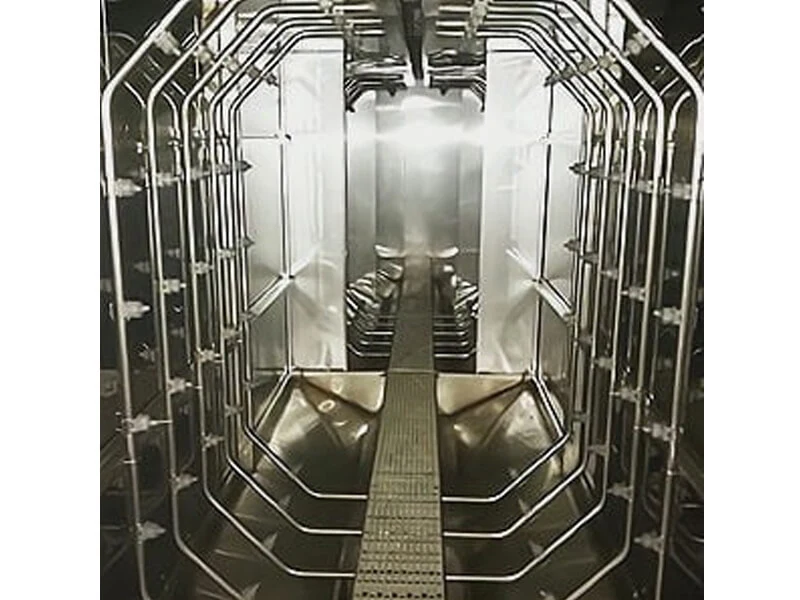
The most critical specification for any industrial curing oven is temperature uniformity across the working zone. Powder coatings from major suppliers (e.g., polyester, epoxy, hybrid) require metal temperature to be held within ±5°C of the target (typically 180-210°C) for the specified dwell time (5-15 minutes). Achieving this demands:
Air circulation design: High-volume, low-pressure (HVLP) fans with adjustable louvers to eliminate dead zones. A well-designed oven recirculates 80-90% of heated air, with fresh air intake only to control volatile emissions.
Heater placement: For gas-fired ovens, indirect heat exchangers prevent combustion byproducts from contacting powder films. Electric infrared (IR) boosters can be added at the entrance to rapidly raise part temperature, but IR alone rarely provides uniform cure for complex shapes.
Zone control: Multi-zone industrial curing ovens use separate PID controllers for entrance, middle, and exit zones. This compensates for heat loss at the oven ends and accommodates varying part masses.
Field testing from HANNA installations shows that a properly tuned oven achieves temperature uniformity of ±3°C across 90% of the tunnel cross-section, reducing rejects from thermal causes to below 0.5%.2. Conveyor Integration and Curing Window Calculation
The industrial curing oven must be synchronized with the paint line conveyor system. The key relationship is: Oven length (m) = Line speed (m/min) × Required dwell time (min). For a typical hybrid powder requiring 10 minutes at 190°C metal temperature and a line speed of 3 m/min, the oven must be 30 meters long. However, engineers must account for:
Thermal mass effects: Heavy steel parts take longer to reach metal temperature than thin aluminum. Use computational fluid dynamics (CFD) or physical thermal profiling to determine the “ramp-up” time.
Carrier spacing: Overcrowded hangers create shadow zones that reduce airflow. Maintain at least 150 mm between parts and 200 mm from oven walls.
Inertia zone: Add 2-3 meters of unheated tunnel at the exit to allow gradual cooling, preventing thermal shock.
Modern powder coating plant designs use variable frequency drives (VFDs) on both conveyor and oven fans to adjust speed based on real-time part temperature measured by infrared sensors.
When an industrial curing oven drifts out of specification, three distinct defect families emerge:
Under-cure (low gloss, poor MEK rub resistance): Caused by insufficient metal temperature or shortened dwell time. Solution: Install recording thermocouples on product carriers; verify oven controller calibration quarterly.
Over-cure (yellowing, loss of impact resistance): Typically from excessive temperature or extended dwell due to line stoppage. Solution: Implement a “dump zone” — if conveyor stops, automatically lift heating elements or divert air to a bypass stack.
Color shift or mottling: Non-uniform airflow causes local hot spots. Solution: Perform a 9-point temperature map across the oven width at product level; adjust louvers or add perforated baffles.
One HANNA client reduced rework from 11% to 1.8% simply by replacing an aged single-zone oven with a three-zone recirculating industrial curing oven equipped with high-efficiency particulate air (HEPA) filtered recirculation.
An industrial curing oven is typically the largest energy consumer in a powder coating line, accounting for 40-60% of total utility costs. Cutting consumption without compromising cure requires a multi-pronged approach:
Insulation upgrade: Mineral wool panels with 150 mm thickness and aluminum-silicate face reduce heat loss through walls to below 50 W/m². Avoid exposed steel structures that act as thermal bridges.
Heat recovery from exhaust: Install a cross-flow plate heat exchanger to preheat fresh make-up air using the hot exhaust stream (typically 120-150°C). Recovery efficiencies of 50-65% are achievable.
Modulating burners or SCR-controlled electric heaters: On/off cycling wastes energy; continuous modulation maintains setpoint within ±1°C.
Curtains and vestibules: Flexible strip curtains at the oven entrance reduce infiltration of cold plant air by 70%.
After implementing these measures, a powder coating plant can reduce gas consumption by 25-35% with payback periods under 18 months. HANNA offers energy audits that include thermographic imaging and computational modeling to identify specific savings.
Smart industrial curing ovens are now equipped with IoT sensors that transmit data to cloud-based analytics platforms. Key parameters monitored include:
Bearing vibration on recirculation fans (predicts failure 2-4 weeks in advance)
Differential pressure across filters (indicates clogging)
Exhaust gas composition (CO, NOx for combustion efficiency)
Product temperature trace from multiple thermocouples
When a deviation occurs (e.g., temperature drop >2°C for 60 seconds), the system sends an SMS to maintenance staff and automatically adjusts fan speed or burner output. This closed-loop control prevents defective batches. HANNA integrates these systems with existing plant SCADA, providing full traceability per carrier — essential for automotive or aerospace certifications.
Different industries require tailored industrial curing oven features:
Clear coat over base metallic powder needs very tight temperature control (±2°C) to avoid color shift. Use a direct gas-fired oven with modulating burners and a 3-zone design. Oven length typically 40-50 meters for a 12-minute cure.
Long, thin profiles require horizontal airflow from both sides to prevent bending. Use a side-flow oven with vertical baffles. Cure schedule: 10 minutes at 200°C for AAMA 2604 compliance.
High thermal mass parts need an IR booster zone (5-8 kW/m²) at the entrance to rapidly raise surface temperature, followed by a convection holding zone. Without IR, internal temperature lags by 4-5 minutes, leading to under-cure on thick sections.
A1: A powder industrial curing oven must achieve and hold precise metal temperatures (typically 180-220°C) to initiate cross-linking reactions in thermoset polymers. Standard paint drying ovens operate at lower temperatures (60-80°C) to evaporate solvents. Additionally, powder curing ovens require much better temperature uniformity (±5°C vs ±15°C) and often incorporate heat recovery systems due to higher energy consumption.
A2: At minimum, perform a full 21-point temperature profile (using a data logger with thermocouples attached to product) every six months. After any maintenance affecting airflow or heating (e.g., fan replacement, burner service), re-profile immediately. High-volume automotive lines often profile monthly. HANNA provides portable profiling kits and analysis software.
A3: Yes, but ensure the combustion system uses indirect heat exchange (flue gases do not contact the oven atmosphere). Direct-fired ovens introduce water vapor and trace combustion byproducts that can cause pinholing in epoxy powders. For epoxy-rich formulations, electric or infrared ovens are safer choices.
A4: With proper maintenance (insulation checks, fan bearing replacement, filter changes), a well-built industrial curing oven lasts 20-25 years. However, energy efficiency deteriorates after 15 years due to insulation settling and fan wear. Retrofitting controls and heat recovery can extend economic life to 30 years.
A5: Use the formula: Oven length (m) = Line speed (m/min) × Required dwell time (min) + 3 meters (for entrance and exit thermal buffer zones). For example, at 3.5 m/min and a 10-minute cure, length = 3.5 × 10 + 3 = 38 meters. Always add 15% margin for future speed increases. Powder coating plant designers from HANNA can perform precise simulations.
A6: Red flags include: (a) product exiting with tacky surface or smearing when rubbed; (b) discolored patches on light-colored coatings; (c) MEK rub resistance failing below 50 double rubs; (d) oven cycling on/off more than 8 times per hour; (e) hot spots visible via thermal camera near door seals. If any appear, stop production and run a full thermal profile.
Selecting and maintaining the right industrial curing oven is not a commodity purchase — it directly determines your coating's mechanical properties, appearance, and warranty compliance. Whether you need a new high-efficiency oven for a greenfield powder coating plant or a retrofit to add zoning and heat recovery to an existing line, HANNA provides engineered solutions backed by thermal simulation, on-site commissioning, and long-term support.
Send your inquiry with current oven specifications (or planned production rates) to our engineering team. We will provide a free preliminary thermal analysis and a fixed-price quotation within 5 business days. Include part drawings, desired powder type, and line speed for an optimized design.
Request your consultation now — email: neil@autocoatinglines.com or use the inquiry form below.