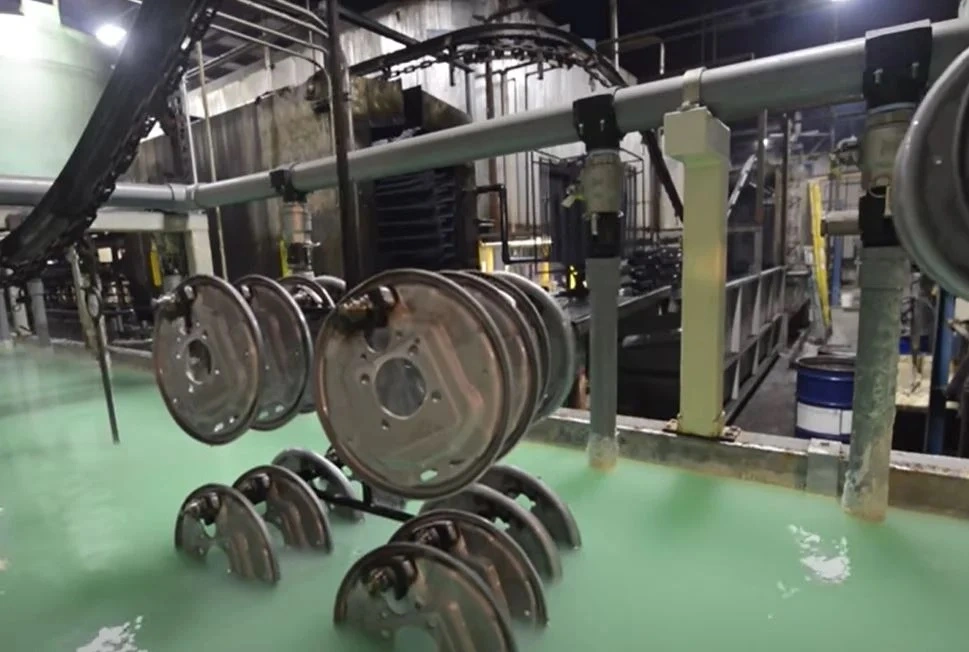
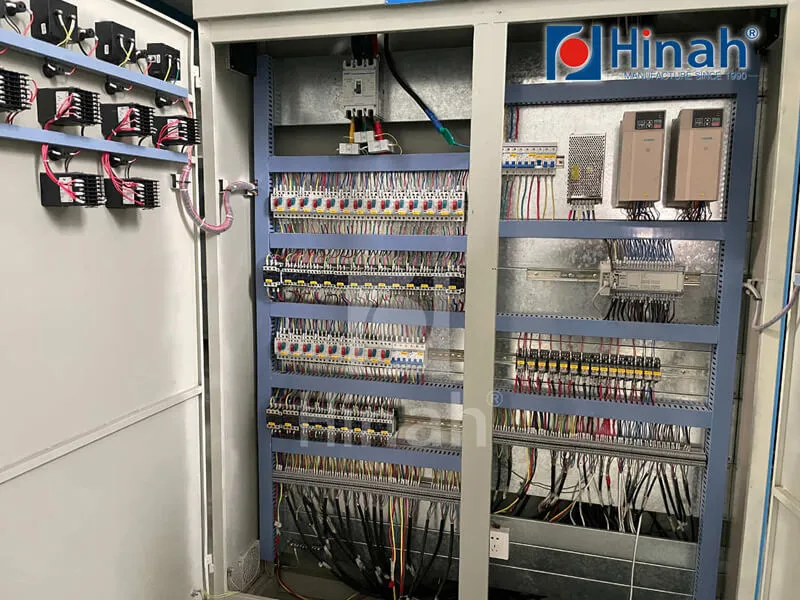
In any automated powder coating operation, the powder coating conveyor is more than a material transport device—it dictates oven dwell time, spray booth loading, and overall line OEE. A poorly specified conveyor leads to part sway (causing uneven film thickness), hanger contamination (powder back-transfer), and premature bearing failures. HANNA has engineered over 500 finishing lines globally, and the single biggest differentiator between a 95% first-pass yield line and a 75% line is the conveyor system's design and maintenance accessibility. This guide details the critical parameters engineers must evaluate when selecting or retrofitting a conveyor for powder coating.
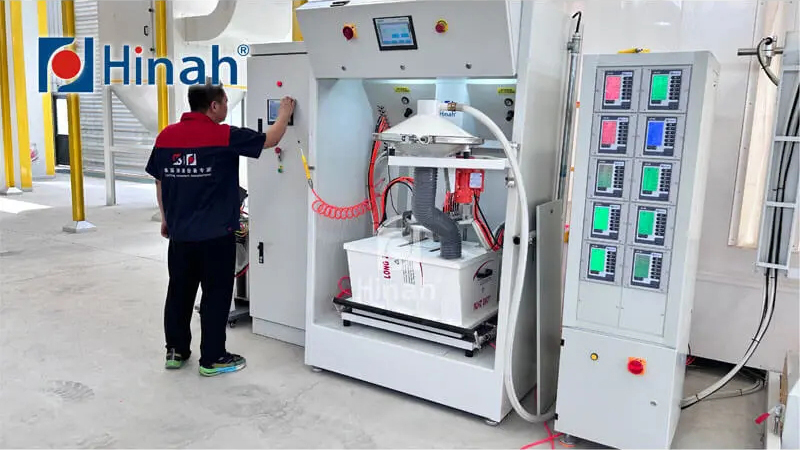
The choice of powder coating conveyor architecture directly affects flexibility, accumulation capability, and part orientation.
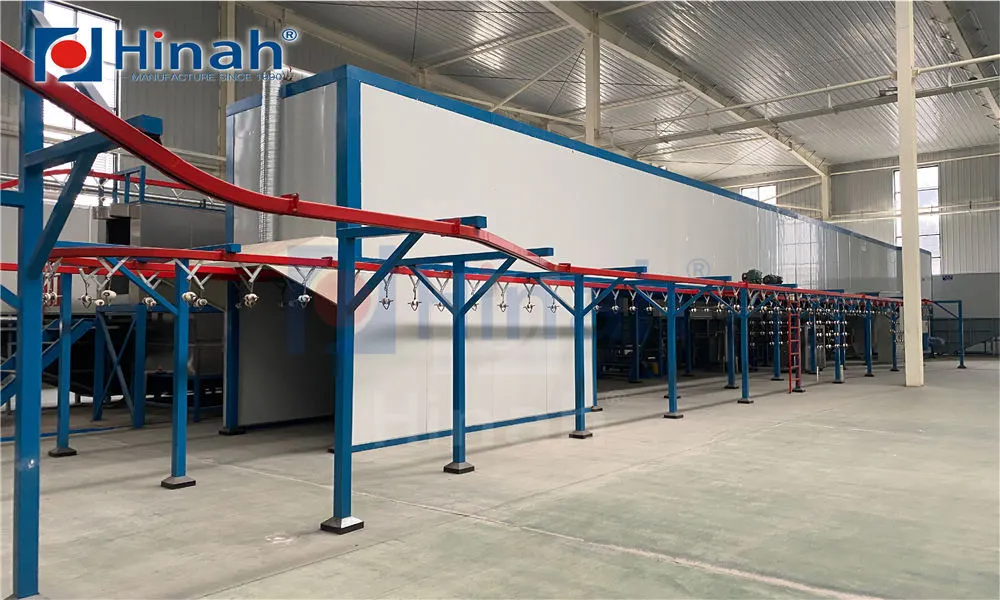
Overhead monorail (continuous): Simplest and most common. Parts hang on trolleys attached to a single chain. Low initial cost, but cannot accumulate parts independently. Best for fixed-sequence lines with uniform part spacing (e.g., fence posts, beams).
Power-and-free (P&F): Dual-track system with separate drive chain and free trolleys. Allows carriers to stop, accumulate, or transfer to spurs without stopping the main line. Essential for lines with inspection stations, offline loading/unloading, or color change buffers. HANNA uses P&F conveyors for job shops coating 50+ SKUs per shift.
Floor-mounted (inverted or skid): Parts sit on pallets or skids, often rotated by spindles. Provides stable grounding for electrostatic application. Ideal for heavy parts (engine blocks, castings) where overhead hanging is unsafe.
For a typical powder coating plant handling mixed part sizes, a power-and-free system with variable-speed drive offers the best ROI. HANNA's P&F conveyors include automatic lubrication systems that reduce chain wear by 50% compared to manual greasing.
The conveyor chain is subjected to tensile loads, oven temperatures (up to 220°C), and powder contamination. Key specifications:
Chain pitch (e.g., 3”, 4”, 6”): Larger pitch allows higher load per foot but reduces curve flexibility. For light parts (<10 kg per hanger), 3” pitch is adequate. For heavy dies or castings (>50 kg), use 6” pitch with double-pin construction.
Material: Standard carbon steel (C45) is cost-effective but requires regular lubrication. For high-temperature ovens (above 180°C), HANNA recommends alloy steel (42CrMo4) with black oxide coating to prevent scaling. Stainless steel chains are only needed for food-contact powder coating.
Breaking strength: Calculate the total live load (sum of part + hanger weight on the line) and multiply by a safety factor of 8 for overhead conveyors. A 4” pitch chain with 10 mm diameter pins typically offers 25–35 kN breaking load.
During a powder coating conveyor selection, HANNA provides a chain pull calculation including friction, elevation changes, and start-up torque. Many buyers overlook start-up torque, which can be 2.5x running torque, leading to motor stalls.
Inconsistent conveyor speed creates variations in film thickness and curing. Modern lines require closed-loop speed control with feedback from the paint robot or reciprocators.
VFD-driven AC motors (with encoder feedback) maintain speed within ±0.5% regardless of load changes. HANNA uses Siemens or ABB drives with programmable acceleration/deceleration ramps (0.5–2 m/s²).
Master-slave synchronization: The conveyor encoder sends a pulse train to the spray gun controller. When the conveyor slows (e.g., due to a jam), the guns reduce powder output proportionally to prevent over-coating. This requires a PLC with high-speed counter inputs.
Zone speed control: In a long line, the conveyor may run at 4 m/min in the spray booth but 2 m/min in the oven to achieve proper dwell without increasing oven length. Power-and-free systems allow independent speed zones via separate drive stations.
A common failure point is using a simple potentiometer for speed adjustment. HANNA insists on digital speed presets (stored in the HMI) with password protection to prevent unauthorized changes.
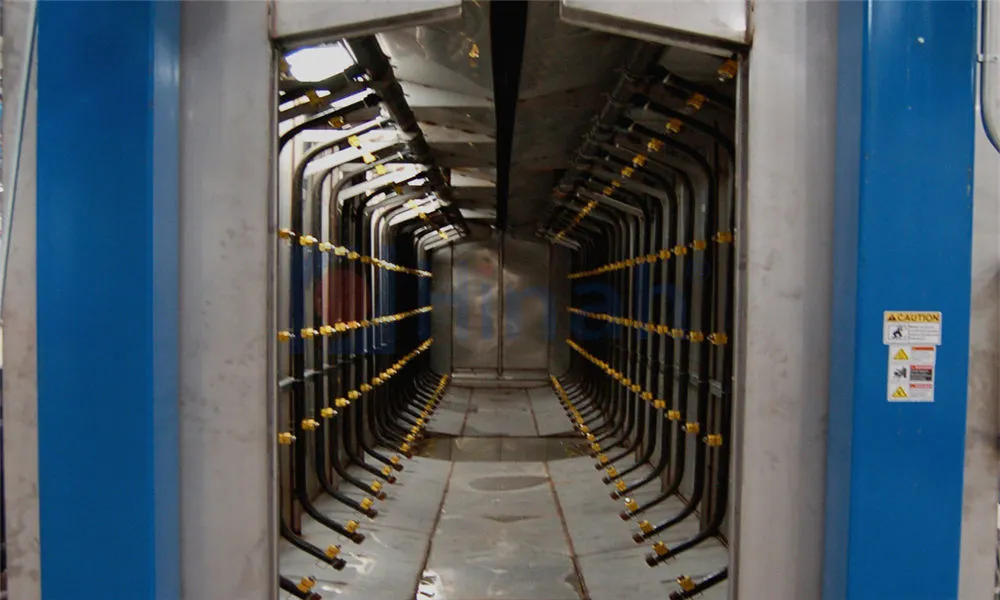
Conveyor chains elongate when heated. A 30-meter oven section at 200°C causes a carbon steel chain to expand by approximately 24 mm (coefficient 12×10⁻⁶ /°C). Without proper design, this expansion leads to chain binding, sprocket misalignment, or even derailment.
Expansion take-up units: Every oven zone must have a spring-loaded or counterweighted take-up that absorbs elongation. HANNA uses heavy-duty coil springs with 50 mm travel and position indicators to warn when chain stretch exceeds safe limits.
High-temperature bearings: Conveyor wheels and trolleys inside the oven must use graphite-impregnated or ceramic bearings. Standard sealed ball bearings fail within 200 hours at 200°C. HANNA specifies SKF Explorer series with PTFE-lined raceways for oven sections.
Expansion joints in rail system: The I-beam or enclosed track must have sliding splices every 12–15 meters. These splices allow rail elongation while maintaining alignment. Missing expansion joints cause the rail to bow, leading to carrier jams.
During a recent powder coating plant upgrade, HANNA replaced a competitor's conveyor that had no oven take-ups. The chain had stretched 45 mm, causing the drive sprocket to skip teeth every 3 hours. After retrofitting expansion modules, line downtime dropped from 12 hours/week to zero.
Overspray powder settles on conveyor rails, chains, and hangers. If not removed, this powder hardens (especially on hot oven sections) and can flake onto freshly coated parts, causing defects.
Automatic hanger burn-off ovens: A separate oven that heats hangers to 400–450°C, turning cured powder to ash. HANNA integrates a burn-off station with a timed conveyor spur. The cycle: load hangers → burn for 60 minutes → cool → return to line.
Rail wipers and brushes: Install stationary nylon brushes at the exit of the spray booth to wipe powder off the rail bottom. For heavy accumulation, use a rotating brush driven by a small motor.
Chain cleaning baths: A small tank with a heated solvent (or water-based degreaser) where the chain passes through. The chain is submerged for 2–3 meters, then air-knife dried. This is essential for lines running epoxy powders, which stick aggressively.
For a powder coating conveyor operating 24/7, HANNA recommends a weekly inspection of the burn-off oven and monthly chain bath cleaning. Preventive maintenance schedules are provided with every line.
Underpowered drive stations cause motor overheating and conveyor stalls. Oversized drives waste energy and increase maintenance costs. The correct sizing requires:
Chain pull calculation: Sum of friction forces (0.03–0.05×total weight for well-lubricated chains), elevation forces (vertical lifts require additional 9.8 N per kg of load), and acceleration forces (mass × acceleration).
Motor power (kW): (Chain pull in N × conveyor speed in m/s) / (efficiency, typically 0.85). Add a 20% safety margin for unknown friction spikes. For example, a line with 5,000 N pull at 0.1 m/s requires 0.59 kW → select 0.75 kW motor.
Safety devices: A slip clutch on the drive sprocket prevents damage if the conveyor jams. Also mandatory: broken chain sensors (limit switches on take-up units) and emergency pull-cords every 15 meters along the line.
HANNA’s conveyors include a torque limiter that disengages at 120% of nominal torque, protecting the chain from catastrophic overload. This has saved multiple clients from weeks of downtime due to jams caused by fallen parts.
Client: Agricultural equipment coater
(Brazil)
Problem: Existing 6” pitch monorail conveyor ran at
1.2 m/min maximum due to chain wear. Oven dwell time was 25 minutes, but
required only 15 minutes for the part’s metal temperature. The line was
oven-bound, limiting output to 400 parts/shift.
Solution: HANNA replaced the drive station with a 3 kW motor (previously 1.5 kW),
installed a new 4” pitch chain with sealed trolley bearings, and added a
variable-frequency drive. The conveyor speed increased to 2.8 m/min while
maintaining smooth operation.
Result: Output rose to 950
parts/shift with the same oven. The new powder
coating conveyor paid for itself in 5 months through increased
throughput. Additionally, chain lubrication frequency reduced from daily to
weekly.
Q1: What is the maximum operating temperature for a standard powder
coating conveyor chain?
A1: For carbon steel chains with standard
lubrication, the maximum continuous temperature is 160°C. Above that, lubricants
carbonize and chain pins seize. For curing ovens at 200–220°C, you must use
high-temperature chains with solid lubricants (graphite or MoS₂) and expansion
take-ups. HANNA supplies chains rated for 250°C intermittent.
Q2: How often should I lubricate the conveyor chain?
A2:
In a clean environment (no powder overspray), every 200 operating hours. In a
powder coating line where overspray accumulates, lubricate every 40–60 hours.
HANNA recommends an automatic lubrication system that applies 0.1–0.2 ml of
high-temp oil per trolley per pass. This reduces manual labor and ensures
consistent lubrication.
Q3: Can I use a standard roller chain for a powder coating
conveyor?
A3: No. Standard roller chains (ANSI) lack the lateral
flexibility required for overhead curves and cannot support hanging loads. You
need a drop-forged chain with extended pins and trolley wheels. These are
specifically designed for overhead conveyors. HANNA uses chains manufactured to
ISO 6971 or ANSI B29.1 standards.
Q4: What causes chain elongation, and when should I replace the
chain?
A4: Chain elongation is caused by pin and bushing wear (not
stretching of links). Measure the chain length over 10 pitches; if the total
length has increased by more than 3% of original, replace the chain. For a 6”
pitch chain, 10 pitches = 60” nominal; if measured length exceeds 61.8”,
replacement is due. HANNA provides a chain wear gauge with every conveyor.
Q5: How do I prevent parts from swaying on the conveyor inside the
spray booth?
A5: Swaying occurs when the hanger is too long or the
conveyor speed changes abruptly. Solutions: (1) Use a twin-track (anti-sway)
rail that guides the trolley vertically; (2) Install a magnetic or pneumatic
stabilizer that gently grips the hanger inside the booth; (3) Reduce conveyor
acceleration ramps to 0.2 m/s². HANNA’s booths include side guides that limit
part swing to ±10 mm.
Q6: Can I integrate a used conveyor with a new powder coating
line?
A6: Yes, but you must verify the chain pitch matches the new
drive sprockets, and the rail system has no twists or sags. HANNA offers a
retrofit service: we inspect the existing conveyor for wear (chain, bearings,
take-ups) and provide a compatibility report. If the chain has more than 2%
elongation, we recommend replacement to avoid uneven coating.
Q7: What safety certifications do your conveyors
carry?
A7: HANNA conveyors are CE marked (EN 619:2018 for continuous
handling equipment) and comply with OSHA 1910.219 for mechanical power
transmission guards. For explosive dust environments (powder coating booths), we
provide ATEX-certified trolleys and grounding brushes to prevent static
discharge.
The powder coating conveyor is a long-term investment that directly affects your finishing line’s reliability and product quality. HANNA provides engineered conveyor solutions including chain pull calculations, thermal expansion modeling, and integration with spray booths and ovens. Our proposals include a 3D layout, spare parts list for 2 years, and on-site commissioning supervision.
Request your conveyor specification review today: Send your part weight range, line layout sketch, and desired throughput. We will respond within 48 hours with a chain selection recommendation, drive sizing, and a fixed-price quotation.
Submit an Inquiry for HANNA Conveyor Systems