


Selecting, Sizing & Maintaining the Powder Coating Conveyor for Maximum OEE
In any powder coating operation, the powder coating conveyor is more than a material transport mechanism—it is the central nervous system that dictates line speed, part spacing, and thermal uniformity. Having commissioned over 90 finishing lines across automotive, architectural, and industrial sectors, I have observed that conveyor mis-specification is the leading cause of throughput bottlenecks and quality defects. A system that cannot maintain consistent part spacing will cause uneven film build; a conveyor that introduces vibration will produce orange peel; an oven that experiences chain drag will result in temperature fluctuations that compromise cure.
This analysis provides a technical framework for evaluating a powder coating conveyor as part of an integrated finishing line. We will examine the engineering trade-offs between monorail, power-and-free, and inverted chain-on-edge designs; discuss the impact of conveyor speed variability on oven profiling; and outline predictive maintenance protocols that prevent unscheduled downtime. For organizations seeking to upgrade existing lines or deploy new installations, HANNA offers simulation-driven conveyor design that aligns material handling with process chemistry.
1. The Conveyor as Process Regulator
Many facility managers treat the powder coating conveyor as a commodity—a simple means to move parts from pretreatment to booth to oven. In reality, the conveyor’s mechanical characteristics directly influence four critical process parameters:
Part-to-part spacing consistency: Variation in spacing alters the time each part spends in the spray zone, causing film build variance. Acceptable spacing deviation should be under ±50 mm for automatic guns with fixed reciprocators.
Vibration amplitude: Excessive chain slop or rail misalignment transfers vibration to hanging parts. In the spray booth, vibration can cause powder to shake off before curing; in the oven, it can create flow marks. Permissible vibration at the hook point should not exceed 0.2 mm/s in the booth zone.
Oven residence time uniformity: If the conveyor stops or jams in the oven, parts will over-cure (yellowing, brittleness). Conversely, if the conveyor surges, parts may under-cure (poor adhesion). Speed variation should be maintained within ±2% across the entire line.
Thermal mass impact: The conveyor chain and carriers absorb heat in the oven and release it in the cool-down zone. Heavy chain designs increase thermal load, requiring longer oven dwell times or higher burner output.
2. Conveyor Types: Engineering Trade-offs
Selecting the appropriate powder coating conveyor begins with matching the mechanical architecture to production volume, part geometry, and process requirements.
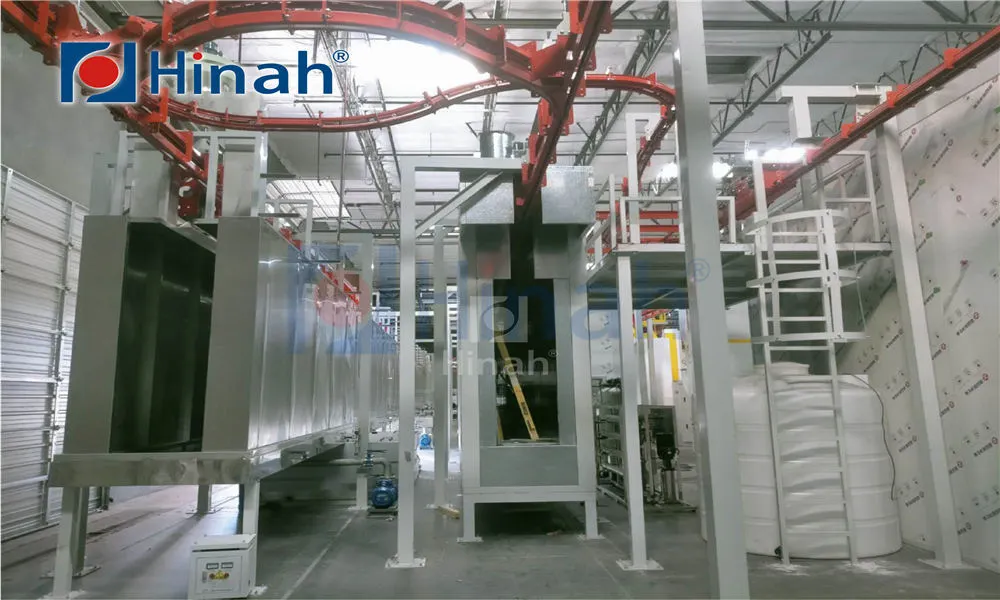
2.1. Overhead Monorail Conveyor
This is the most common configuration for continuous powder coating lines. A single chain travels in a fixed track, with carriers attached at fixed intervals.
Advantages: Low initial cost (typically $300–$500 per foot), simple design, and ease of maintenance. Suitable for high-volume, consistent parts where spacing does not require adjustment.
Limitations: No accumulation capability—if one part jams, the entire line stops. Fixed spacing limits flexibility for mixed-part production. Chain expansion in the oven (thermal elongation) requires take-up units to maintain tension.
Design considerations: Trolley wheels must be rated for oven temperatures (up to 230°C). High-temperature grease with a dropping point above 260°C is required to prevent wheel seizure. Chain speed is typically 8–15 ft/min for powder coating lines.
2.2. Power-and-Free Conveyor
This system uses two tracks: a power chain that moves continuously, and a free track where carriers can be disengaged, accumulated, or routed to different spurs. Each carrier has its own independent movement capability.
Advantages: Accumulation zones allow the line to continue running during manual loading/unloading. Carriers can be automatically routed to different booths or ovens based on color or coating type. This flexibility reduces changeover time in high-mix environments.
Limitations: Higher capital cost (typically 60–80% more than monorail). More complex controls require PLC integration. Maintenance demands are higher due to additional moving parts (pusher dogs, switches, stops).
Application fit: Ideal for job shops running 10+ part families per shift, or for facilities with robotic load/unload stations requiring precise carrier positioning.
2.3. Inverted (Floor-Mounted) Chain-on-Edge
In this configuration, the conveyor runs at floor level, with parts mounted vertically on fixtures that rotate through the line. Commonly used for small-to-medium parts requiring 360-degree coating access.
Advantages: Excellent for high-volume small parts (automotive brackets, fasteners). The rotating fixtures eliminate the need for reciprocators—coverage is achieved through part rotation rather than gun movement. Floor mounting simplifies overhead accessibility for maintenance.
Limitations: Limited to parts that can be mounted on a rotating fixture. Fixture cleaning is required regularly to prevent coating buildup, which can unbalance rotation.
Design considerations: Fixture rotation speed must be synchronized with gun cycle time to ensure uniform film build. Typical rotation speeds range from 10–30 RPM depending on part geometry.
2.4. Belt or Slat Conveyor
Used primarily for large, heavy parts that cannot be hung from overhead carriers. Parts are placed directly on a heat-resistant belt or slat bed.
Advantages: Supports parts up to several tons without overhead structure. Simple loading with forklifts or overhead cranes.
Limitations: One-sided coating only—parts must be flipped for full coverage, which adds handling complexity. Belt materials must withstand oven temperatures; steel slats are common but add thermal mass.
3. Conveyor Impact on Coating Quality
The relationship between the powder coating conveyor and final finish quality is often underestimated. Three specific failure modes originate in the conveyor system:
Back-ionization from Chain Lubricant: Lubricants vaporized in the oven can condense on parts, creating surface contamination that appears as pinholes or fisheyes. Use of high-temperature synthetic lubricants (food-grade silicone-free) and proper lubrication intervals (typically 100–150 operating hours) prevents this.
Spacing-Induced Coating Variance: If carriers are spaced irregularly due to manual loading, automatic guns cannot optimize their stroke pattern. The result is thin coating on parts that pass too quickly and heavy coating (sagging) on parts that move slowly. Fixed indexing with photo-eyes that trigger guns only when a part is present mitigates this issue.
Oven Temperature Uniformity Disruption: A conveyor that introduces cold carriers into the oven in irregular patterns creates temperature fluctuations. Data loggers placed on carriers often show temperature drops of 5–10°C when a large, cold carrier enters the oven. Pre-heating carriers in a vestibule or using insulated carriers reduces this effect.
4. Maintenance Strategy: Predictive vs. Reactive
Conveyor downtime is among the most costly failures in a finishing line. For a powder coating conveyor, a predictive maintenance program based on condition monitoring significantly reduces unplanned stoppages.
Key indicators to track:
Drive motor amperage: A 10–15% increase over baseline indicates increased friction, often from seized trolley wheels or chain tension issues.
Chain elongation: Overhead chains stretch over time. Measure elongation every 6 months; replacement is typically required when elongation exceeds 3% of original length to prevent sprocket misalignment and chain jump.
Track wear: Use ultrasonic thickness gauges on wear strips and curves. Worn tracks cause carrier tilting, which can result in parts striking booth walls or oven openings.
Lubrication intervals: Automated lubrication systems with programmable cycles (e.g., 0.5 cc per trolley every 4 hours) ensure consistent lubrication without over-application that could contaminate parts.
5. Integration with Pretreatment, Booth, and Oven
The powder coating conveyor must be designed in concert with upstream and downstream equipment. Common integration failures include:
Conveyor speed mismatch with oven dwell time: If the conveyor speed is set for optimal coating but the oven length cannot provide the required 10–20 minute dwell time, the line will either under-cure parts or be forced to run slower than optimal coating speed.
Pretreatment carryover: Conveyor returns that pass over pretreatment zones can drip chemicals onto parts in the booth. Proper drip pans and conveyor routing that separates wet and dry zones are necessary.
Booth clearance: Reciprocators and automated guns require precise clearance. Carriers with varying hook lengths can cause parts to collide with gun mounts. Standardizing hook length to within ±20 mm eliminates this risk.
Single-source integrators like HANNA use 3D simulation to validate conveyor clearances, speed profiles, and thermal loading before fabrication, reducing field modifications and commissioning delays.
6. Total Cost of Ownership Considerations
When evaluating a powder coating conveyor, the initial capital cost typically accounts for 30–40% of the 10-year TCO. The remainder is split between:
Energy consumption: Conveyors with high thermal mass (heavy chains, steel slats) increase oven energy consumption by 15–25% compared to low-mass designs. Aluminum carriers and lightweight chain sections reduce thermal load.
Maintenance labor: Power-and-free systems require 2–3 times more maintenance hours per year than monorail systems due to additional moving parts. This labor cost should be factored into the selection decision.
Downtime cost: A conveyor failure in a high-volume line can exceed $5,000 per hour in lost production. Investing in redundant drives, wear-resistant tracks, and predictive monitoring reduces this risk.
The Conveyor as Strategic Asset
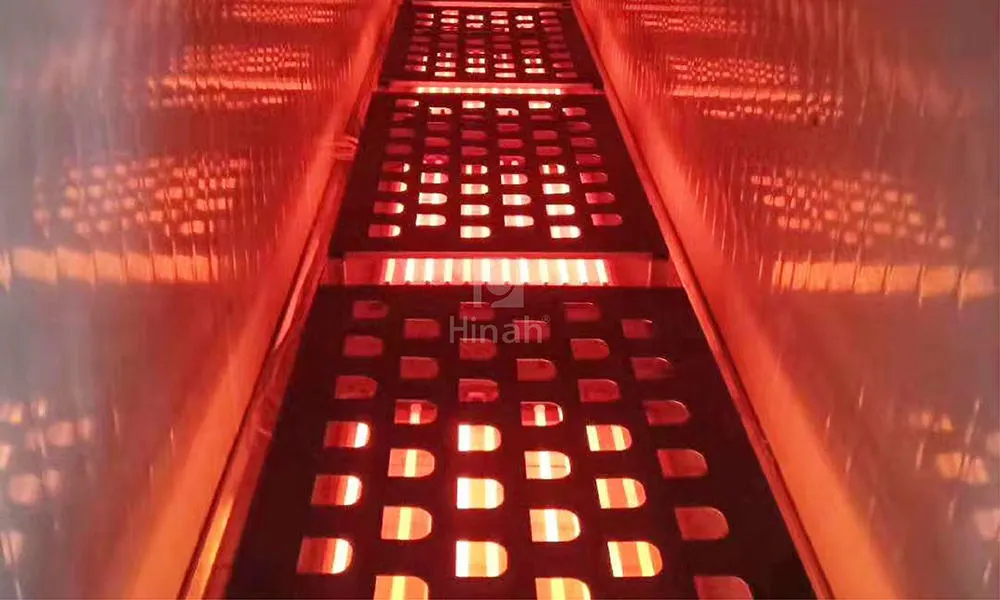
The selection of a powder coating conveyor should be treated with the same rigor as the selection of the powder booth or curing oven. A well-specified conveyor ensures consistent part spacing, minimizes vibration, supports oven temperature uniformity, and provides the flexibility to adapt to changing production requirements. Facilities that approach conveyor specification with a system-level perspective—integrating mechanical design, process chemistry, and predictive maintenance—achieve higher OEE and lower defect rates. With the increasing complexity of customer orders and tightening quality standards, the conveyor is no longer a passive transport system; it is an active enabler of finishing line performance.
For a detailed conveyor specification and integration plan tailored to your part mix and facility layout, consult the engineering team at HANNA. Their simulation-based approach ensures that your conveyor system aligns with throughput targets and quality requirements from day one.
Frequently Asked Questions (FAQs)
Q1: How do I determine the required conveyor speed for my powder
coating line?
A1: Conveyor speed is determined by
three factors: oven dwell time (the time required to fully cure the powder at
the specified temperature), part hanging density (number of parts per foot of
conveyor), and desired throughput (parts per hour). The formula is: Speed
(ft/min) = (Oven Length in ft) / (Required Dwell Time in min). For example, a
40-ft oven with a 15-minute cure requires 2.7 ft/min. If throughput targets
require a faster speed, the oven must be extended or a low-cure powder
specified.
Q2: What are the most common causes of conveyor chain failure in
powder coating lines?
A2: The three primary failure
modes are: (1) Lubrication failure—grease breakdown at oven
temperatures causes trolley wheels to seize, leading to chain drag and drive
overload. (2) Chain elongation—wear in chain pins and bushings
increases pitch, causing sprocket misalignment and eventual chain jump. (3)
Track wear—curves and switches experience accelerated wear from
carrier weight, leading to misalignment and carrier tipping.
Q3: Can I use a standard industrial conveyor for a powder coating
line, or does it require special
specifications?
A3: Standard conveyors are not
suitable without modification. Powder coating conveyors require: (a)
high-temperature lubricants rated for 200–230°C, (b) trolley wheels made from
materials that withstand thermal cycling (cast steel or specialized polymers),
(c) expansion take-ups to accommodate chain growth from heat, and (d)
corrosion-resistant finishes to withstand pretreatment chemicals if the conveyor
passes over wash zones.
Q4: How does conveyor design affect color change
time?
A4: In monorail systems, all carriers pass
through the booth, so color change requires clearing the entire line of parts
(typically 10–30 minutes of conveyor travel). Power-and-free systems allow
carriers to be accumulated in storage spurs, so the booth can be cleared in 2–3
minutes by diverting carriers. For facilities running 6+ color changes per
shift, the productivity gain from a power-and-free conveyor often justifies the
higher capital cost.
Q5: What maintenance interval is recommended for a powder coating
conveyor?
A5: A comprehensive maintenance schedule
includes: daily visual inspection of chain tension and drive alignment; weekly
lubrication (or automated system checks); monthly measurement of chain
elongation and wear strip thickness; quarterly inspection of all sprockets,
bearings, and take-up units; annual replacement of high-temperature lubricant in
oven-section trolleys. Facilities with predictive monitoring systems extend
intervals based on condition data.
Q6: Can I retrofit an existing conveyor with new controls or
accumulation zones?
A6: Yes, retrofits are common.
Adding variable frequency drives (VFDs) to existing conveyors improves speed
control and reduces energy consumption. Power-and-free zones can be added to
portions of a monorail line by installing additional tracks, switches, and PLC
controls. However, the existing conveyor structure must be assessed for load
capacity and wear before modification. A structural audit is recommended to
determine if the existing track and supports can accommodate the additional
components.
Related News
Learn More + -
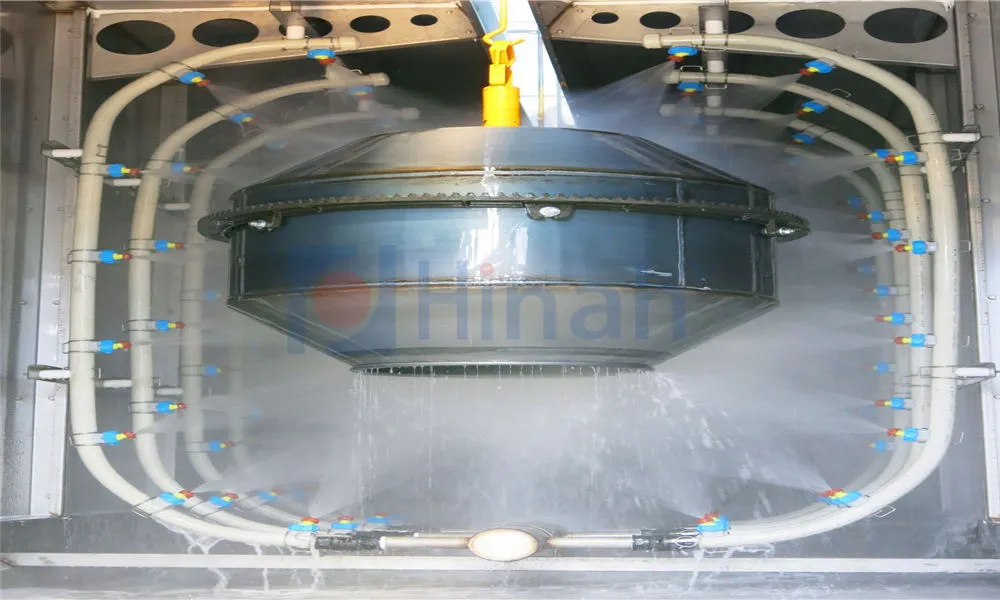
7 Must-Know Facts About Powder Coating Conveyor Systems: Customization, Integrators, and Cost
Powder coating conveyor systems are the backbone of modern industrial finishing processes, providing efficient, consistent, and eco-friendly solutions ...View Details2026-11-06 -
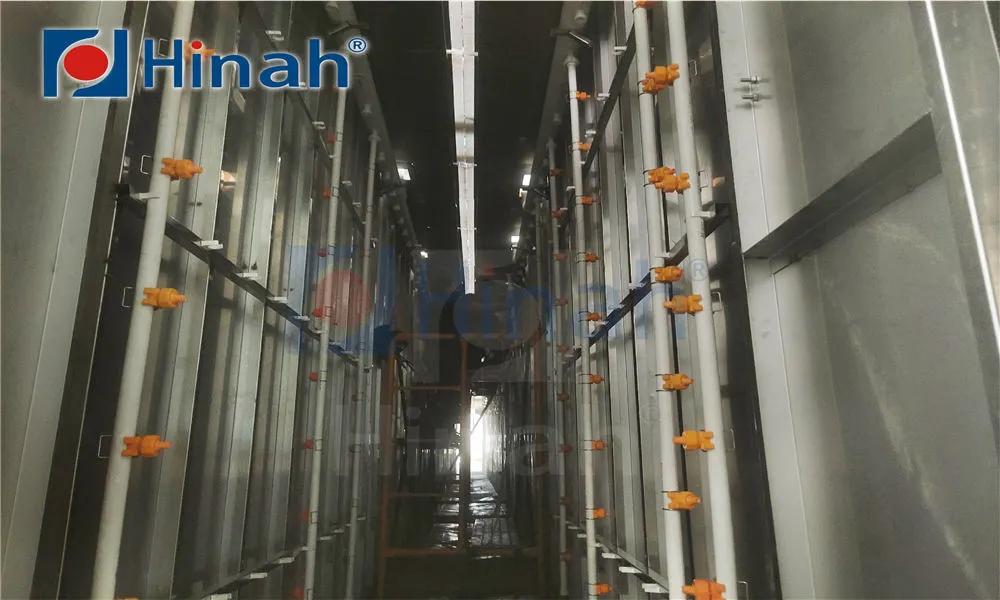
How a Powder Coating Conveyor Transforms Your Production Line
In the world of manufacturing and finishing, efficiency is king. The process of applying a durable, high-quality finish to products relies heavily on ...View Details2026-11-06 -
Powder Coating Conveyor Systems: Boosting Efficiency in Industrial Finishing
Powder coating conveyor systems are essential components in modern manufacturing and finishing processes, providing a streamlined way to apply durable ...View Details2026-11-06 -
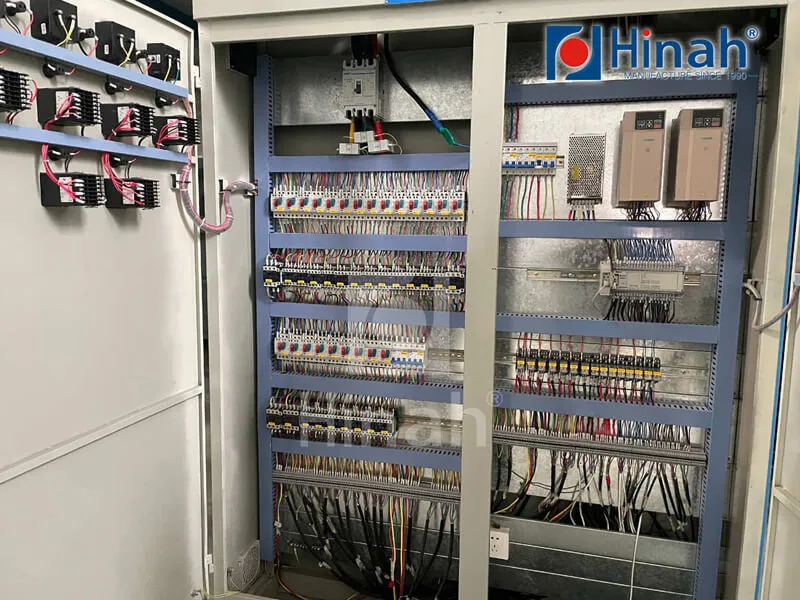
Optimizing Industrial Coating Processes with Advanced Powder Coating Conveyor Systems by HANNA
In today's competitive manufacturing landscape, efficiency and quality are paramount. One critical component that drives success in surface finishing ...View Details2026-11-06 -
Powder Coating Conveyor Systems: Boost Efficiency & Cut Costs
Every powder coating operation hinges on one critical backbone: the conveyor system. It’s the unseen engine that dictates your line’s speed, flexibili ...View Details2026-11-06 -
Conveyor Dynamics in Finishing: How Powder Coating Conveyor Systems Define Line Capacity and Cure Consistency
In any automated finishing operation, the conveyor is the central nervous system—determining throughput, dictating dwell times, and directly influenc ...View Details2026-11-06