
For operations managers and facility owners, a powder coating equipment sale represents one of the most capital-intensive decisions in the finishing industry. Having evaluated over 150 equipment configurations across automotive suppliers, architectural extruders, and custom coaters, I have observed that purchase price often accounts for less than 30% of the five-year cost structure. The critical factors—transfer efficiency, color-change downtime, energy consumption, and maintenance intervals—are frequently underestimated during procurement.
This analysis provides a technical framework for navigating a powder coating equipment sale. We will examine the engineering trade-offs between compact integration (CI) booths versus cartridge-filter systems, the thermodynamic efficiency of infrared/convection ovens, and the return-on-investment models that justify higher initial capital outlay. For organizations seeking to modernize their finishing line, HANNA offers a data-driven approach that aligns equipment specifications with production volume, part geometry, and color-change frequency.
Not all powder coating equipment is engineered for the same operational reality. The first step in any powder coating equipment sale is to classify the production environment into one of three profiles. Misalignment here leads to either underperformance (bottlenecks) or overcapitalization (unused features).
Profile A: High-Volume, Low-Mix (Automotive, Appliance)
Demands maximum transfer efficiency and minimal intervention. Preferred configurations include multi-gun automatic booths with cyclone reclaim systems achieving 95–98% overspray recovery. Ovens are typically multi-zone convection with data-logging to maintain ±3°C uniformity across the chamber. Payback on higher upfront cost is achieved through material savings—typically 10–15 tons of powder annually.
Profile B: High-Mix, Low-Volume (Job Shops, Contract Coaters)
Requires rapid color change and flexibility. Compact integration (CI) booths with cartridge filter modules allow color change in under 8 minutes without dedicated clean rooms. Quick-change gun mounts and modular conveyor sections reduce reconfiguration time between batch runs.
Profile C: Heavy-Duty, Large Parts (Agricultural, Construction)
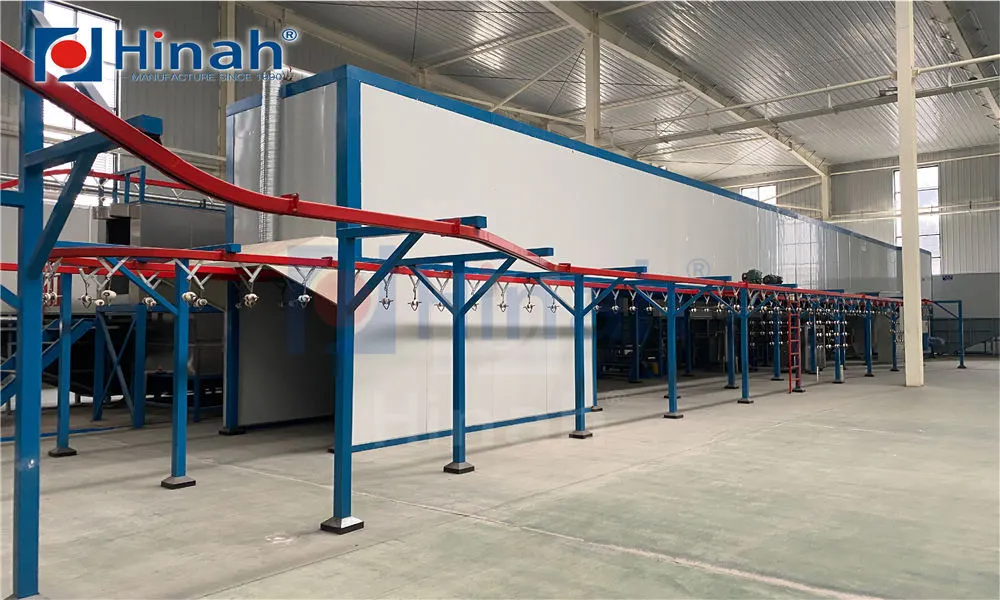
Focuses on accessibility and durability. Walk-in booths with floor-level recovery, heavy-duty reciprocators, and extended oven dwell times (30–45 minutes) to accommodate high thermal mass parts. Conveyor systems are typically power-and-free to allow accumulation and independent carrier movement.
When evaluating a powder coating equipment sale, the specification of four interdependent subsystems determines overall line effectiveness.
Transfer efficiency begins at the gun tip. Modern systems offer two primary technologies:
Corona Charging: Uses high voltage (60–100 kV) to ionize air. Best for high-speed, flat surfaces. Requires regular electrode cleaning. Look for closed-loop current control that adjusts KV based on gun-to-part distance to prevent back-ionization (a defect causing pinholes).
Tribo Charging: Uses friction to charge powder particles. Preferred for complex geometries, recessed areas, and recoating applications because it eliminates the Faraday cage effect. No high voltage means reduced fire risk in explosive environments.
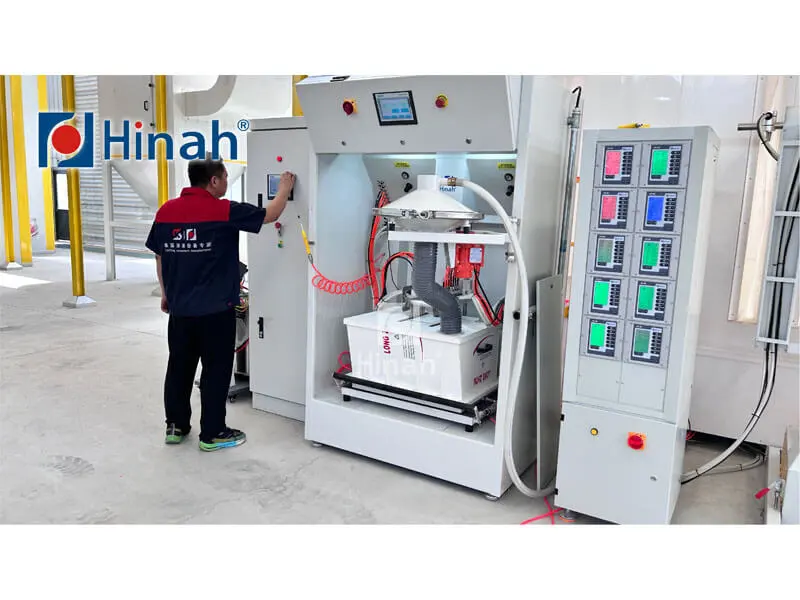
Controllers should offer programmable recipes storing parameters (voltage, amperage, flow rate, atomizing air) for each part family. Systems with Ethernet/IP or Profinet integration allow central monitoring of applicator performance.
Overspray recovery directly impacts material cost and color-change efficiency.
Cyclone + Sieve: Achieves 98% recovery efficiency with minimal powder degradation. Best for high-volume single-color operations. Color change requires thorough cleaning (20–45 minutes), but new “rapid clean” cyclone designs with swing-away ducts have reduced this to under 12 minutes.
Cartridge Filter Modules: Integrated directly into the booth. Offer color change in 5–8 minutes by exchanging filter cartridges. Recovery efficiency is slightly lower (94–96%), but the flexibility suits job shops running 6+ colors per shift.
Energy costs represent 20–25% of operating expenses in a powder coating line. Oven selection must balance capital cost with long-term energy consumption.
Infrared (IR) Ovens: Cure from the outside-in; ideal for thin-gauge parts (
<3mm) 30="" and="" high-speed="" lines.="" typical="" gas="" consumption="" is="">Convection Ovens: Provide uniform temperature distribution for thick parts and complex assemblies. Multi-zone designs with modulating burners reduce energy waste during idle periods. A well-insulated convection oven with 6-inch mineral wool panels can reduce heat loss by 25% compared to standard 4-inch insulation.
Combination IR + Convection: Preferred for mixed production. IR zones bring parts to flow temperature quickly, while convection ensures full cross-linking of the powder.
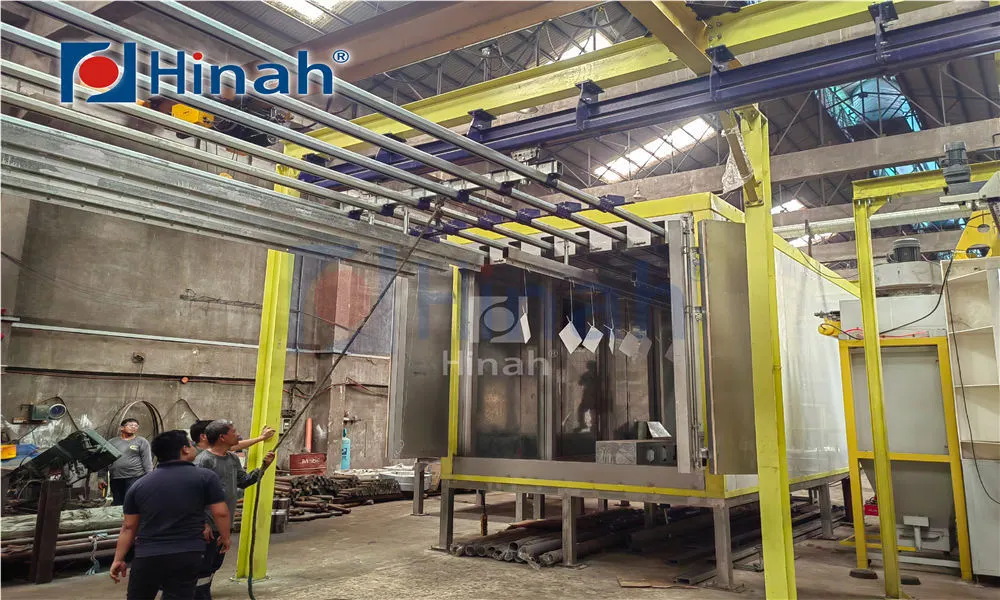
The conveyor dictates line speed and ergonomics. For a powder coating equipment sale, the conveyor specification must match part weight, hanging density, and oven dwell time. Overhead monorail systems are cost-effective for consistent parts, while power-and-free conveyors allow accumulation zones and independent carrier speed control—critical when integrating with robotic load/unload stations.
A purchase decision based solely on initial capital expenditure ignores the operational costs that accumulate over the equipment’s 10–15 year lifespan. A rigorous TCO model includes:
Material Consumption: A system with 95% transfer efficiency vs. 85% will save 50–70 tons of powder annually for a medium-volume coater. At an average powder cost of $4.50/kg, the difference exceeds $200,000 per year.
Energy Costs: Convection ovens with variable frequency drives (VFDs) on exhaust fans reduce electricity consumption by 15–20%. IR ovens with zoned controls further cut gas usage by up to 40%.
Maintenance & Consumables: Cartridge filters require replacement every 2,000–3,000 operating hours; cyclone systems have no consumable filters but require periodic balancing of rotating assemblies. Gun wear parts (electrodes, venturi blocks) typically cost $1,500–$2,500 per year per booth.
When evaluating a powder coating equipment sale, requesting a 5-year TCO projection from vendors provides comparability that purchase price alone obscures.
Based on post-installation audits, four recurring errors undermine the success of capital acquisitions:
Undersizing the Oven: Selecting an oven based on part dimensions without accounting for thermal mass. A cast iron housing requires 40–60% longer dwell time than aluminum of the same thickness. The result is undercured powder (poor adhesion) and production bottlenecks.
Neglecting Air Compressor Capacity: Powder coating systems consume 15–40 CFM per gun at 80–100 PSI. Facilities often overlook that existing compressors may be insufficient, leading to pressure drops that cause surging (uneven film build).
Inadequate Pretreatment Integration: Advanced coating equipment cannot compensate for poor adhesion from inadequate cleaning. A new booth combined with an outdated washer yields the same defect rates as before.
Ignoring Future Flexibility: Locking into a fixed-gun configuration without provisions for adding reciprocators or robotics limits the ability to handle new part geometries when customer requirements evolve.
The final consideration in any powder coating equipment sale is the supplier’s ability to support integration and commissioning. A modular booth from one vendor, an oven from another, and a conveyor from a third often result in interface issues that delay production startup by 8–12 weeks. Single-source integrators like HANNA provide:
Pre-installation simulation to validate throughput and film build before fabrication begins.
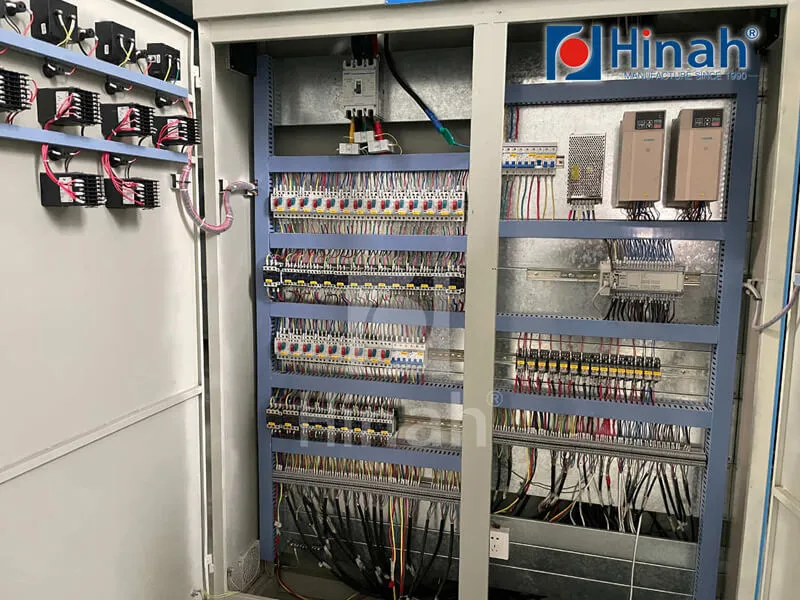
Unified controls architecture (HMI/SCADA) that monitors all subsystems from a central panel.
Operator training programs that reduce learning curves and ensure first-pass yield targets are met within 30 days of commissioning.
Navigating a powder coating equipment sale requires more than comparing specifications; it demands a thorough understanding of how subsystem choices interact to affect material usage, energy consumption, and production flexibility. Facilities that approach the acquisition with a clear production profile, a TCO model, and an integration-focused supplier achieve payback periods typically between 18 and 30 months. With tightening quality requirements from OEMs and increasing pressure to reduce lead times, modern powder coating equipment is not merely a capital expense—it is a strategic investment in operational capacity and market competitiveness.
For a detailed equipment specification and TCO analysis tailored to your production volume and part mix, consult the engineering team at HANNA. Their approach integrates process simulation with modular equipment design to ensure the selected configuration delivers projected financial returns.
Q1: What is the typical lifespan of powder coating equipment, and what components require replacement most frequently?
A1: With proper maintenance, booth structures and ovens last 15–20 years. Wear components have shorter lifespans: gun electrodes and venturi blocks (1–2 years), cartridge filters (2–3 years), reciprocator belts and bearings (3–5 years), and oven burner controls (8–10 years). A well-documented preventive maintenance schedule extends equipment life and prevents unplanned downtime.
Q2: Is it more cost-effective to purchase a complete new line or to retrofit existing equipment?
A2: The decision depends on the condition of the existing infrastructure. If the oven, conveyor, and booth structure are in sound condition (less than 10 years old, no corrosion), retrofitting with new application equipment, recovery systems, and controls typically costs 40–60% of a new line and yields similar improvements in transfer efficiency and color-change speed. However, if the conveyor or oven is undersized or energy-inefficient, a full replacement offers better long-term TCO.
Q3: What floor space is required for a compact automatic powder coating line?
A3: Compact integration (CI) systems are designed for space-constrained facilities. A complete automatic line including a 6-foot CI booth, cyclone recovery, sieve, and control panel can fit within a 15 ft × 20 ft footprint. Including a 30-foot curing oven, the total line length typically ranges from 80 to 120 feet, depending on conveyor layout and cooling zone requirements.
Q4: How does the choice of powder coating equipment affect color-change time?
A4: Equipment configuration is the primary determinant of color-change efficiency. A cartridge-filter booth with quick-release filter modules achieves color change in 5–8 minutes. A cyclone system with rapid-clean ducting and a separate sieve for each color reduces changeover to 10–15 minutes. Fixed-gun systems without quick-disconnect features may require 30–45 minutes. For facilities running 6+ color changes per shift, the labor savings from faster changeover alone can justify higher initial equipment cost.
Q5: What certifications or compliance standards should powder coating equipment meet?
A5: Key certifications include NFPA 33 (fire safety standards for spray application), FM or UL approval for electrical controls, and compliance with local air permit requirements for particulate emissions. For equipment sold in European markets, CE marking is required. Many specifications also require conformance to ISO 9001 for manufacturing quality. Reputable suppliers provide documentation confirming these certifications as part of the equipment package.
Q6: Can powder coating equipment be financed, and what are typical lease versus purchase considerations?
A6: Yes, capital equipment financing is common through equipment lenders or vendor financing programs. Lease options (operating leases) preserve working capital and may offer tax advantages, but total cost over the term is typically 10–15% higher than outright purchase. For organizations with available capital and stable production forecasts, outright purchase offers the lowest TCO. Many suppliers offer tiered payment schedules tied to commissioning milestones, reducing upfront cash requirements while ensuring equipment performance is validated before final payment.