
In any automated finishing operation, the conveyor is the central nervous system—determining throughput, dictating dwell times, and directly influencing the thermal uniformity achieved in the curing oven. Powder coating conveyor systems are often selected based on initial cost or generic load ratings, yet their engineering specifications ultimately govern first-pass yield, energy efficiency, and maintenance intervals. A mismatch between conveyor design and process requirements leads to erratic part spacing, inconsistent oven temperature profiles, and excessive wear that manifests as unplanned downtime. This article examines the technical criteria for specifying conveying solutions—from monorail configurations to inverted power-and-free designs—and provides data-driven insights into how conveyor behavior impacts the entire coating line. Drawing on field experience from HANNA installations across automotive, agricultural, and architectural sectors, we detail the engineering principles that separate reliable systems from chronic sources of process variation.
The selection of a conveyor topology must align with part geometry, production volume, and the required level of process control. Each design carries distinct implications for load capacity, accumulation capability, and compatibility with spray booths and curing ovens.
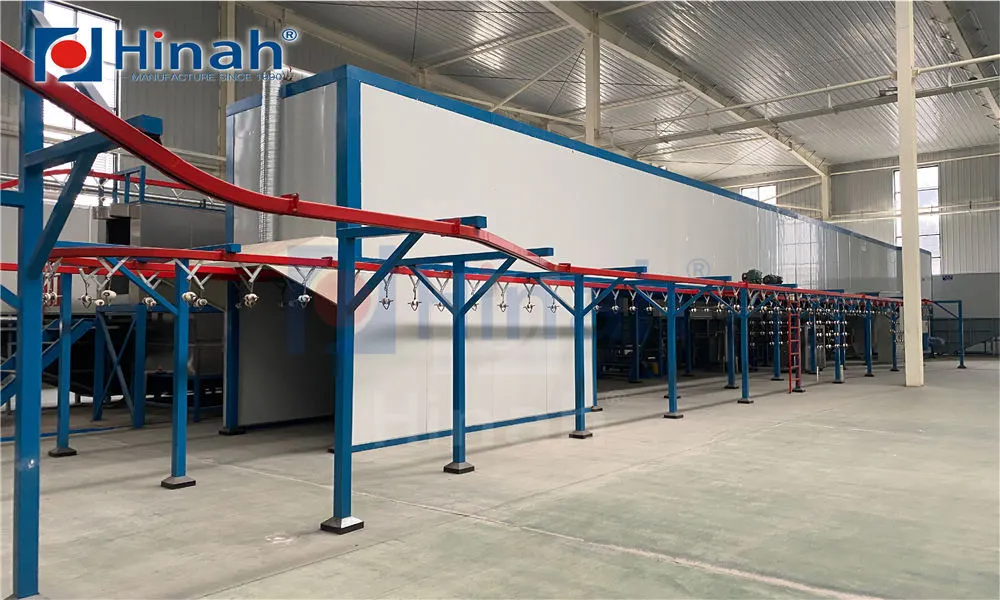
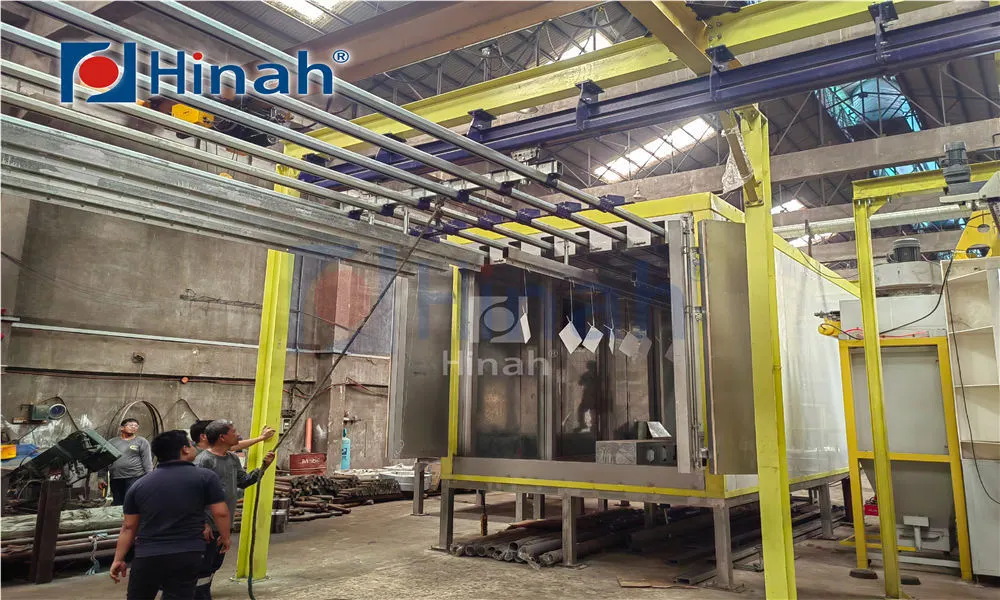
Monorail systems remain the most widely deployed due to their simplicity and low initial investment. Parts hang from trolleys that travel along a single I-beam track, powered by continuous chains. These systems excel in applications with consistent part spacing and minimal need for accumulation. However, they present limitations:
Thermal bridge effects: The continuous chain passes through the curing oven, conducting heat outward and increasing energy loss. In ovens operating at 200°C, chain temperatures can degrade lubricants if not specified with high-temperature grease.
Limited buffering: Without accumulation zones, any stoppage upstream forces the entire line to halt, creating temperature dwell issues inside the oven.
For lines where production volumes exceed 10,000 parts per shift or where multiple color changes occur, monorail systems often become a bottleneck.
Power-and-free configurations introduce a secondary track that allows carriers to accumulate independently of the main drive chain. This design provides critical advantages for powder coating conveyor systems in high-mix environments:
Zone buffering: Carriers can be stopped before the spray booth or after the oven without halting the entire line, enabling batch processing and quality inspection holds.
Independent speed control: Different sections—pretreatment, spray, cure—can operate at optimal speeds. For example, the oven section can run slower to accommodate heavy castings while the booth section maintains higher throughput for lighter parts.
Maintenance isolation: Sections can be taken offline for service while production continues elsewhere.
The trade-off is higher capital cost and increased complexity in controls, requiring sophisticated PLC programming to manage carrier routing and collision avoidance.
For heavy fabrications, agricultural implements, or parts with unstable hanging geometries, inverted conveyors provide a stable base. The chain and carriers run in floor channels, with fixtures rising vertically to present parts at ergonomic heights. Key engineering considerations include:
Contamination exposure: Floor-mounted chains are more susceptible to powder overspray and pretreatment chemicals, requiring robust sealing and frequent cleaning.
Oven floor integration: The conveyor must withstand the same oven temperatures as the parts, often necessitating special heat-resistant rollers and expansion joints to prevent buckling.
A poorly designed conveyor can negate the most advanced oven controls. The thermal mass of carriers, their spacing, and their entry pattern into the oven create localized temperature disturbances. Critical parameters include:
Each carrier absorbs energy from the oven, acting as a heat sink. If carriers are heavy and closely spaced, the oven’s heating system must compensate for this additional load. Using finite element analysis (FEA), engineers calculate the specific heat absorption of carrier trains. In lines where powder coating conveyor systems utilize lightweight aluminum or stainless steel carriers with open designs, the oven’s energy consumption can be reduced by 12–18% compared to heavy carbon steel carriers with solid plates.
Irregular part spacing creates turbulence and temperature gradients inside the oven. When a large gap occurs, the oven’s PID controllers may overshoot, then undershoot as the next part enters. Automated conveyor systems with photo-eye spacing control maintain consistent pitch, allowing the oven’s airflow and heating to stabilize. Data from HANNA-engineered lines show that maintaining spacing variation below ±150 mm reduces oven temperature deviation by up to 40%.
The spray booth environment imposes unique demands on conveying equipment. Electrostatic powder application requires a reliable electrical ground path from the part through the carrier to the conveyor rail. Any interruption—caused by paint build-up on hangers, worn trolley wheels, or grease contamination—leads to poor transfer efficiency and Faraday cage defects.
Advanced lines incorporate ground verification systems that measure resistance between the part and the conveyor earth. If resistance exceeds a preset threshold (typically 1 megohm), the system triggers an alarm or stops the line to prevent rejects. Conveyor manufacturers offering integrated grounding contacts and self-cleaning trolley wheels significantly reduce this failure mode.
Automated spray applications rely on precise positioning. When the conveyor stops for reciprocator operation or moves at a controlled speed through a robot cell, any slippage or backlash in the drive system results in inconsistent film build. Servo-driven indexing conveyors with encoder feedback achieve positioning repeatability of ±1 mm, essential for automotive and aerospace coatings where film thickness tolerances are ±10 microns.
The total cost of ownership for conveying equipment extends far beyond the purchase price. Three areas dominate operational expenditure:
Lubrication programs: Overhead conveyors require precise lubrication intervals. Automatic lubricators that apply high-temperature grease (rated for 250°C) to chain pins and trolley wheels extend chain life by 3-5 years compared to manual greasing, which often leads to over- or under-lubrication.
Wear components: Chain links, wear strips, and sprockets must be replaced periodically. Conveyors with modular chain designs reduce downtime by allowing section replacements without disassembling the entire system.
Drive energy consumption: Friction losses dominate energy use. Using low-friction polymer wear strips instead of steel-on-steel contact reduces drive motor load by 15–20%, a significant saving in lines operating 16+ hours per day.
In a recent facility upgrade managed by HANNA, replacing a worn monorail system with a modern power-and-free conveyor featuring high-efficiency drives and automatic lubrication reduced annual maintenance costs by 32% and energy consumption by 11%, with a payback period of 18 months.
Automotive finishing demands high throughput and traceability. Conveyor specifications include:
Load capacities up to 500 kg per carrier for chassis components.
Integration with RFID tags for part tracking and recipe management.
Clean room compatibility for primer and topcoat applications, requiring stainless steel components and sealed bearings.
Agricultural and construction equipment parts often exceed 2 meters in length and weigh over 1,000 kg. Engineering priorities include:
Wide carrier spacing to prevent part-to-part contact.
Rotating hooks or turntables within the spray booth to allow full coverage without manual repositioning.
Reinforced overhead structures capable of supporting live loads during oven transit without deflection.
Aluminum extrusions up to 7 meters require horizontal or vertical conveying solutions. Horizontal monorails with extended carriers and sway bars prevent twisting during transport, while vertical systems demand precise lift mechanisms and uniform air velocity in the oven to avoid warping.
Modern powder coating conveyor systems serve as data collection platforms. Sensors embedded in the conveyor provide:
Real-time position tracking to synchronize oven burners and spray gun triggers.
Carrier load monitoring to detect jams or overload conditions before they cause mechanical failure.
Predictive maintenance alerts based on vibration analysis and motor current signatures.
When integrated with a central SCADA system, this data enables statistical process control (SPC) that correlates conveyor performance with final coating quality. For instance, a sudden increase in chain tension might indicate binding, which could lead to erratic spacing and subsequent temperature variation in the oven. By flagging this early, maintenance can intervene during shift changes rather than during production.
A1: The decision hinges on three factors: accumulation needs, speed variation requirements, and maintenance flexibility. If your line processes a single product at constant speed and you can tolerate a total shutdown during maintenance, monorail suffices. If you run multiple products requiring different oven dwell times, or if you need to perform quality holds or color changes without stopping the entire line, power-and-free is necessary. Calculate the cost of downtime per hour; for high-volume operations exceeding $5,000/hour in lost revenue, the added investment in power-and-free typically pays back within two years.
A2: The primary defects are grounding failures (leading to poor powder adhesion), inconsistent spacing causing thermal variation (resulting in under- or over-cured spots), and contamination from worn carrier components (flaking metal or grease deposited on parts). Regular audits of ground continuity, spacing sensors, and carrier cleanliness reduce these risks. Implementing a scheduled hanger stripping process—thermal or chemical removal of built-up coating—prevents grounding issues before they affect production.
A3: Ovens are designed around a target line speed and thermal mass profile. Speed variation alters the dwell time inside each oven zone. If the conveyor slows unexpectedly, parts may over-cure; if it speeds up, they may under-cure. High-quality systems use closed-loop speed control with encoder feedback to maintain setpoint within ±2%. Additionally, oven controllers should receive conveyor speed signals to dynamically adjust zone temperatures—a feature known as speed-compensated temperature control.
A4: Intervals depend on operating hours and environment. For a two-shift operation (16 hours/day), standard intervals are: weekly inspection of chain tension and lubrication levels; monthly verification of ground continuity on carriers; quarterly cleaning of photo-eyes and proximity sensors; semi-annual replacement of wear strips; and annual chain elongation measurement (replacement recommended when elongation exceeds 3%). Using automatic lubricators with programmable cycles extends chain life and reduces manual intervention.
A5: Yes, retrofitting is feasible and often cost-effective. Install vibration sensors on drive units and major sprockets, add current transducers to drive motors, and integrate photo-eyes for spacing verification. These sensors feed data into a PLC or edge gateway, providing real-time alerts. Retrofits typically cost 15–25% of a new conveyor system and deliver similar predictive maintenance benefits. HANNA has completed such retrofits in over 20 facilities, with average payback periods of 14 months due to reduced unplanned downtime.
Selecting and maintaining powder coating conveyor systems with engineering rigor transforms the conveying infrastructure from a passive transport mechanism into an active contributor to quality and efficiency. By aligning conveyor architecture with production demands, integrating thermal and grounding requirements, and leveraging data-driven maintenance strategies, finishing lines achieve higher first-pass yields and lower operating costs. HANNA continues to partner with manufacturers to design and optimize these critical systems, ensuring that the conveyor becomes a competitive asset rather than a process constraint.