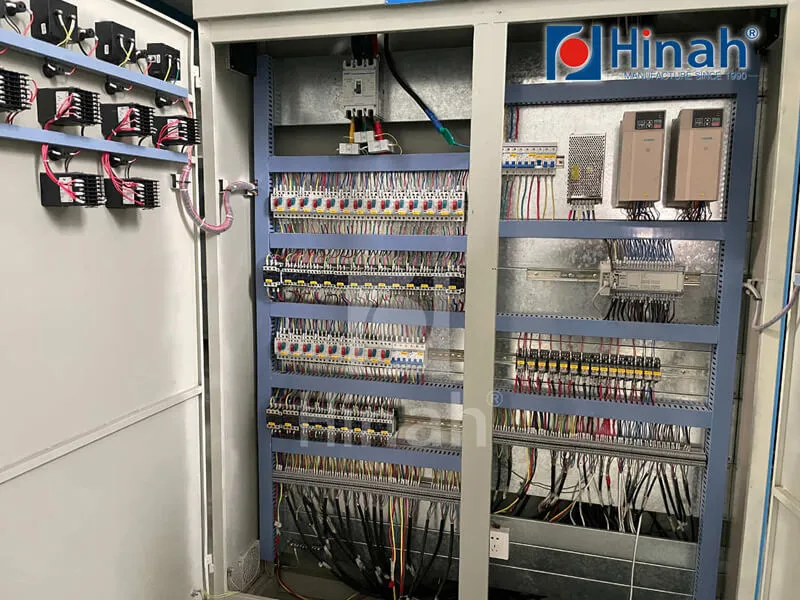

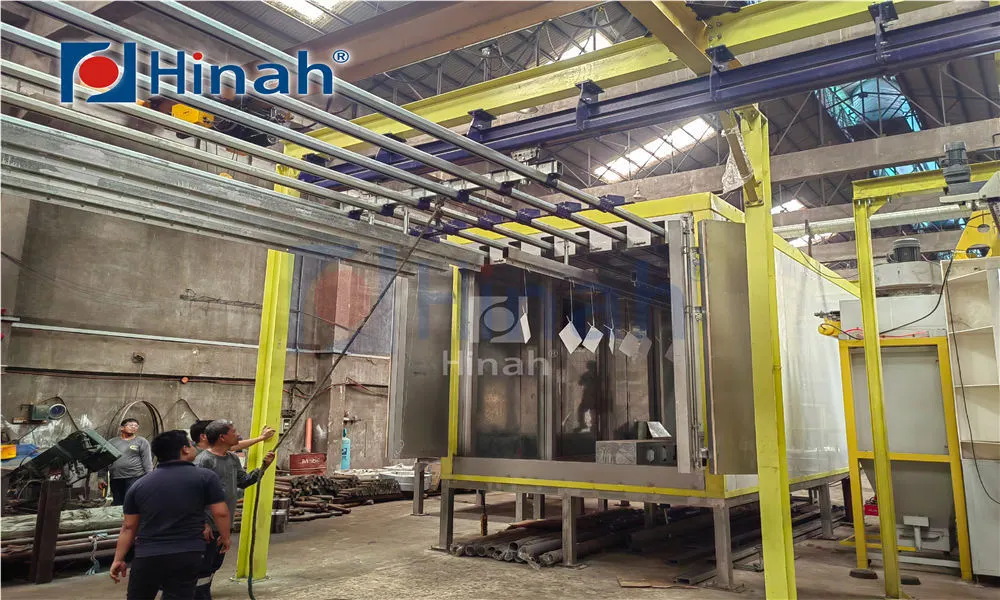
The powder coating paint booth is far more than an enclosure for spraying. It serves as the central process control node where electrostatic application, overspray recovery, and environmental safety intersect. In high-volume manufacturing—from automotive wheels to architectural extrusions—booth design directly dictates first-pass transfer efficiency (TE), powder consumption, changeover downtime, and operator exposure to respirable dust. A poorly engineered booth can waste 15–25% of annual powder spend, while an optimized system reduces reclaim handling costs and consistently achieves TE above 70%.
Drawing from 15 years of powder coating line integration and ISO 1461/Qualicoat compliance projects, this guide examines the critical engineering parameters that separate high-performance booths from those that cause recurring rejects and productivity bottlenecks. We will analyze filtration technologies, airflow dynamics, color-change strategies, and safety systems. Throughout, HANNA’s modular booth platforms will serve as references for how integrated design reduces total cost of ownership (TCO) while maintaining strict NFPA 33 compliance.
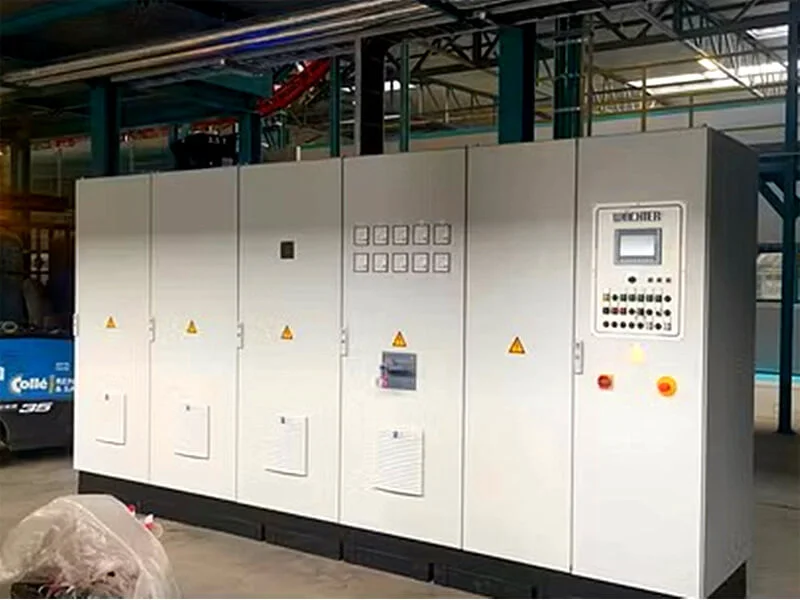
Industrial powder coating paint booth selection begins with determining the optimal airflow configuration. Two primary architectures dominate:
Closed-Loop (Cartridge Recovery) Booths: These systems recirculate conditioned air after filtering overspray through cartridge filters. They offer superior energy efficiency (no constant exhaust of heated/cooled plant air) and are mandatory for applications requiring powder reclaim. Typical air recirculation rates range from 80–95%, reducing HVAC loads by up to 40% compared to open-face designs.
Open-Face (Single-Pass) Booths: Used primarily for low-volume, high-color-change operations where cross-contamination risk is prohibitive. These exhaust air directly outdoors (through baghouse or after-filter), eliminating reclaim but simplifying color changes. However, they consume 3–5 times more conditioned air, significantly raising operating costs in climate-controlled facilities.
Modern hybrid booths—such as those in HANNA’s portfolio—allow operators to switch between closed-loop reclaim mode and full-exhaust mode within minutes, providing flexibility for mixed production environments.
Cartridge filters are the heart of any reclaim booth. Key technical specifications that impact performance:
High-end booths use nanofiber-coated cellulose/polyester blends with MERV 15 ratings (99.9% efficiency at 0.5–1.0 µm). These capture fine powder particles that would otherwise settle on booth surfaces or escape into the plant. Standard cellulose cartridges degrade after 500–800 hours of operation; nanofiber cartridges extend service life to over 2,000 hours in high-throughput settings.
Computer-controlled pulse cleaning systems use compressed air bursts to dislodge accumulated powder from filter surfaces. Critical parameters include:
Pulse pressure: 80–100 psi optimizes cleaning without damaging filter pleats.
Differential pressure (dP) setpoints: Cartridge cleaning initiates at 1.2–1.5 inches water column. If dP exceeds 2.0 inches, TE drops due to reduced booth airflow, causing powder cloud turbulence.
Sequential valve control: Individual cartridge pulsing (vs. simultaneous) prevents transient pressure spikes that can blow powder off parts.
Data from 200+ installations shows that properly tuned pulse cleaning reduces compressed air consumption by 25–30% while maintaining consistent booth static pressure.
Airflow uniformity across the booth opening determines powder containment and operator safety. Three configurations dominate:
Crossdraft Booths: Air flows horizontally from rear plenum to front opening. Simpler and lower cost, but vulnerable to turbulence when operators move across the face. Best for smaller parts (under 1 meter) and lower production speeds.
Downdraft Booths: Air enters through ceiling diffusers and exits through floor grates. Provides superior containment for complex geometries and large parts, as overspray is drawn downward away from the operator. Typical face velocities are 80–100 ft/min, ensuring minimal powder escape. However, downdraft designs require raised floors or pit construction, increasing initial capital expense.
Side-Draft (Hybrid): Combines rear and side air intake with multiple exhaust points. Ideal for long parts (extrusions up to 20 feet) where traditional crossdraft would create end-to-end velocity gradients. HANNA offers side-draft booths with adjustable airfoil vanes to maintain ±10% velocity uniformity across the booth length.
Regardless of configuration, NFPA 33 requires maintaining face velocity between 60–100 ft/min to prevent combustible dust accumulation. Annual airflow visualization tests (using smoke tubes) should verify laminar flow without dead zones.
A powder coating paint booth must be constructed with conductive materials (typically 14-gauge steel) and connected to a verified grounding system. Resistivity to ground must measure below 1 megohm (MΩ) per NFPA 77. Common failure points include:
Powder buildup on non-conductive booth windows (acrylic/polycarbonate) – solved by anti-static coatings or conductive panels.
Conveyor hangers with poor contact – automatic hanger cleaners (brush or blast systems) maintain consistent part grounding.
Isolated recovery bins – grounding cables with continuous monitoring sensors prevent electrostatic discharge (ESD) ignition sources.
When TE exceeds 70%, approximately 30% of sprayed powder becomes reclaim. That reclaim must be blended with fresh powder at ratios not exceeding 30:70 (reclaim:fresh) to maintain chargeability and flow characteristics. Integrated booths from HANNA include automated sieving and rationing systems that maintain consistent reclaim particle size distribution (PSD).
For contract coaters and job shops, color-change time directly impacts profitability. Three design strategies reduce changeover from 45 minutes to under 10 minutes:
Modular Cartridge Banks: Quick-release cartridge modules allow operators to swap entire filter sets rather than cleaning in place. Pre-cleaned spare cartridges reduce downtime by 60%.
Powder Sweep Floors: Stainless steel floor panels with pneumatic vibrators or brush systems accelerate powder removal from booth surfaces. Sloped floors (1/4 inch per foot) direct powder to central collection hoppers.
Automated Wash-Down Systems: High-pressure air lances or water-soluble coating on booth walls (sacrificial layers) enable rapid cleaning without disassembly.
Facilities performing more than two color changes per shift should also consider split-filter booths, where independent filter sections isolate colors, allowing one side to remain operational while the other is cleaned.
Powder coating booths are classified as Class II, Division 2 hazardous locations (or Zone 22 under ATEX). Critical safety elements include:
Explosion Venting: Booth walls must incorporate explosion relief panels with a burst pressure ≤ 1 psi, venting to a safe external area. Vent area calculations follow NFPA 68 (1 ft² per 15 ft³ of booth volume).
Fire Suppression: Automatic sprinkler systems or dry chemical systems with thermal detection (200°F) are mandatory. Water flow switches and tamper-proof valves ensure activation.
Interlock Systems: Booth exhaust fan must interlock with spray guns; powder application ceases if airflow drops below 60 ft/min. Control panels should include visual and audible alarms.
Bonding and Grounding: All conductive components (including drum dollies, powder feed hoses, and operator carts) must be bonded to the booth grounding system. Continuous monitoring systems with LED status indicators are now common.
Compliance documentation—including annual electrical continuity tests, airflow verification, and sprinkler system inspections—is essential for insurance approvals and OSHA/EPA audits.
Booth design must account for part geometry and conveyor configuration. Key parameters:
Opening dimensions: Minimum 12 inches of clearance around the largest part prevents airflow disruption. For continuous conveyors, curtain seals (brush or inflatable) maintain face velocity while accommodating varying part widths.
Conveyor type: Inverted monorail conveyors (with chain below the booth floor) eliminate powder accumulation on moving components. Overhead conveyors require protective covers and regular cleaning to prevent powder shedding onto parts.
Automated reciprocators vs. manual booths: Reciprocators with stroke length control (up to 8 ft) provide consistent gun-to-part distance (±2 inches) and improve TE by 8–12% compared to manual spraying.
Advanced powder coating paint booth systems from HANNA include photo-eye part detection that automatically adjusts gun positioning and booth airflow to match part length, reducing overspray by up to 20%.
To sustain peak performance, preventive maintenance schedules should address:
Daily: Clean booth walls, floors, and windows; inspect grounding continuity; check pulse collector blow-down tanks.
Weekly: Measure cartridge dP and inspect for tears; verify conveyor hanger contact; test interlock functions.
Monthly: Calibrate air velocity sensors; inspect explosion vent fasteners; test fire suppression system.
Quarterly: Replace or rotate cartridge filters; check fan belt tension and bearing vibration; clean compressed air lines.
Lifecycle cost analysis shows that investing in a premium booth with advanced controls reduces 5-year TCO by 18–25%, primarily through lower powder consumption (reduced overspray), less downtime, and extended filter life. Facilities that track cost per square foot coated typically see payback periods under 18 months when upgrading from entry-level booths.
Q1: What face velocity should I maintain in my powder coating booth,
and how often should it be verified?
A1: NFPA 33 mandates face
velocity between 60 and 100 ft/min (0.3–0.5 m/s) for combustible dust control.
The optimal setpoint depends on powder density and part geometry: heavy metallic
powders require higher velocities (90–100 ft/min) to prevent settling; standard
polyester operates well at 70–80 ft/min. Use an anemometer to verify velocity at
four points across the booth opening weekly, and perform full airflow balancing
after any filter change or conveyor adjustment.
Q2: How do I calculate the reclaim ratio, and what is the maximum
reclaim percentage I can use?
A2: Reclaim ratio = (weight of
collected powder / total powder sprayed) × 100. Most powder manufacturers
recommend limiting reclaim to 30% of the total powder mix to maintain consistent
chargeability and film properties. However, with precise sieving (200–270 mesh)
and controlled particle size distribution, some operations successfully use up
to 50% reclaim for non-critical parts. Always conduct gloss, impact, and
adhesion tests when changing reclaim ratios.
Q3: What are the signs that my booth’s cartridge filters need
replacement?
A3: Key indicators include: (1) differential pressure
exceeding 2.2 inches water column after pulse cleaning; (2) visible powder
escaping from booth openings; (3) increased frequency of pulse cleaning cycles
(more than every 10–15 seconds); (4) uneven coating appearance due to airflow
turbulence; (5) annual inspection showing media delamination or pleat collapse.
Nanofiber cartridges typically last 2,000–3,000 operating hours under normal
conditions.
Q4: Can I use a single powder coating booth for both batch and
continuous conveyor operations?
A4: Yes, with modular design. Batch
booths typically have manual spray stations with a roll-on/roll-off cart for
part loading, while continuous booths integrate with overhead or inverted
conveyors. Convertible booths feature removable floor sections and adjustable
pass-through openings. HANNA offers hybrid platforms that transition between modes in under two hours,
allowing facilities to handle both job-shop and high-volume production.
Q5: What is the most cost-effective way to reduce powder consumption
in an existing booth?
A5: Start with a three-phase approach: (1)
Optimize electrostatic parameters—reduce kV from 100 to 70–80 for standard parts
to minimize repulsion; (2) Install a dense-phase powder pump to improve
powder-to-air ratio, reducing overspray by 10–15%; (3) Add automatic gun movers
or reciprocators to maintain consistent gun-to-part distance. These upgrades
typically cost 15–20% of a new booth and deliver payback within 9–14 months
based on powder savings alone.
Q6: How does humidity affect booth performance and powder
reclaim?
A6: Relative humidity (RH) directly influences powder
flowability and electrostatic charging. At RH above 60%, powder tends to clump
in feed hoses and filters, reducing reclaim efficiency and increasing pulse
cleaning frequency. At RH below 30%, static buildup on booth walls and
non-conductive components creates safety risks and inconsistent powder cloud
deposition. Maintain booth environment between 40–55% RH using HVAC systems with
dehumidification capabilities. Install RH sensors with interlock alarms to alert
operators when conditions drift outside acceptable ranges.