
When evaluating a powder coating line for sale, the purchase decision extends far beyond initial capital cost. Industrial finishing systems represent a 10- to 15-year infrastructure investment where productivity, energy efficiency, and first-pass yield directly impact profit margins. In my two decades of commissioning coating lines across automotive, architectural, and heavy equipment sectors, I have observed that buyers who conduct structured technical assessments achieve 23–35% lower operating costs compared to those who focus solely on price.
This guide provides a systematic framework for evaluating complete finishing systems—from pre-treatment to curing. We will analyze mechanical integration, thermal performance, powder recovery economics, and automation compatibility. Drawing from real-world commissioning data and HANNA’s 30-year engineering heritage, we establish measurable criteria to ensure that your next powder coating line for sale delivers consistent quality while minimizing downtime and consumable costs.
Every coating line must be sized to specific operational parameters. Begin by quantifying:
Daily throughput: Number of parts or square meters coated per shift. A line designed for 10,000 parts/day will have different conveyor speeds (typically 3–8 m/min) and oven lengths (20–40 m) than a job-shop line processing 500 mixed parts/day.
Part envelope dimensions: Maximum part length, width, and height determine conveyor hanger spacing, booth opening size, and oven tunnel clearance. For parts exceeding 2 meters, side-draft booths and convection ovens with zone control become essential.
Color change frequency: Operations performing more than 2 color changes per shift require quick-color-change (QCC) booths with modular cartridge banks and automated sweep floors, reducing changeover from 45 minutes to under 12 minutes.
Leading manufacturers, including HANNA, offer modular platforms where booth width, oven length, and conveyor type are configured to these specific parameters, avoiding over-engineering or capacity constraints.
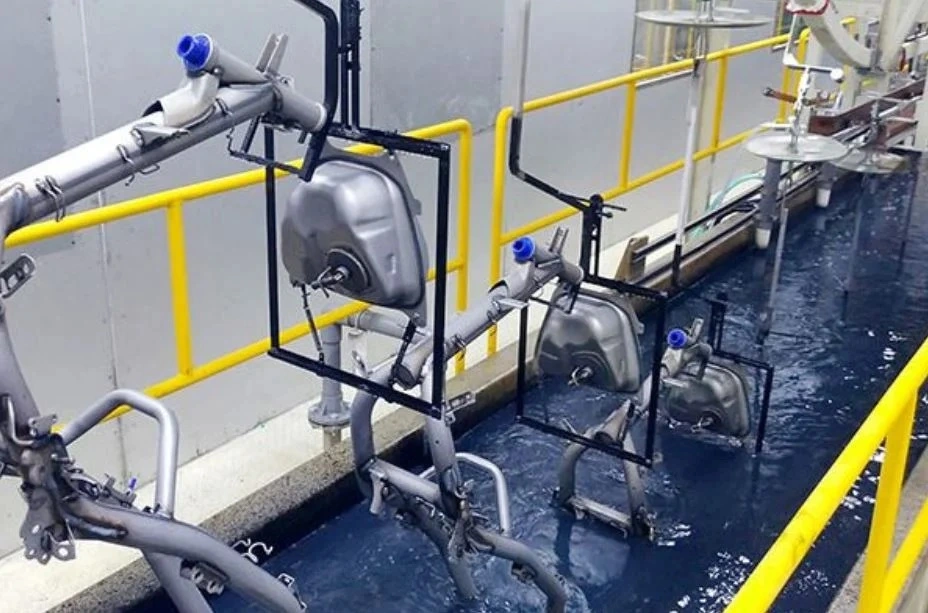
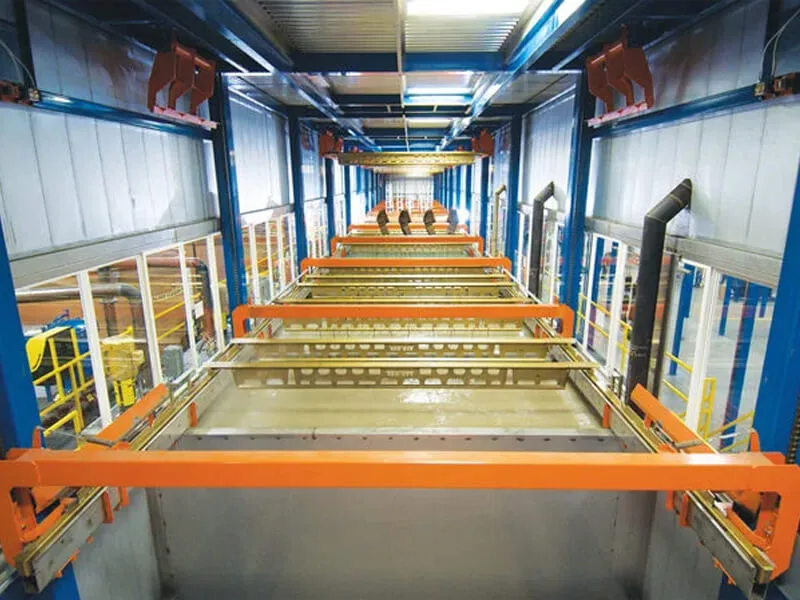
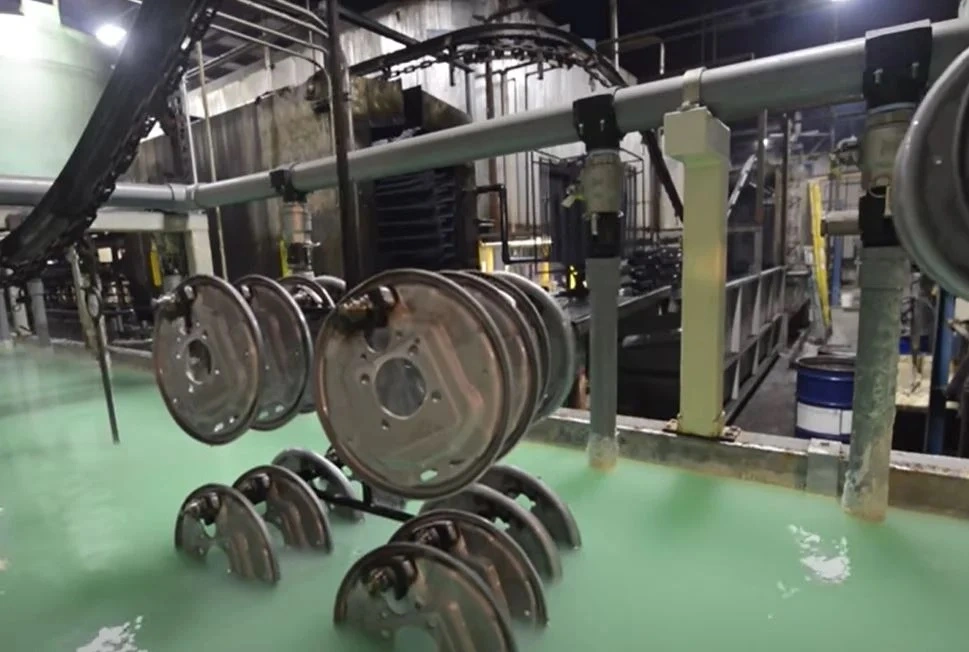
Coating adhesion and corrosion resistance begin with substrate preparation. A powder coating line for sale must include or interface with a pre-treatment system suited to the base material:
Iron phosphate: For indoor applications on steel; requires 3–5 stage spray washers with dwell times of 60–90 seconds.
Zinc phosphate or nano-ceramic: For high-corrosion resistance (automotive, agricultural equipment); 5–7 stage systems with stricter temperature control (40–60°C) and deionized water rinses.
Chromate-free conversion coatings: Increasingly specified for aluminum architectural components; require precise pH and conductivity monitoring.
Verify that the line includes integrated drying ovens (typically 120–140°C for 10–15 minutes) to ensure moisture is removed before coating. Inadequate drying is a leading cause of outgassing defects in powder coating.
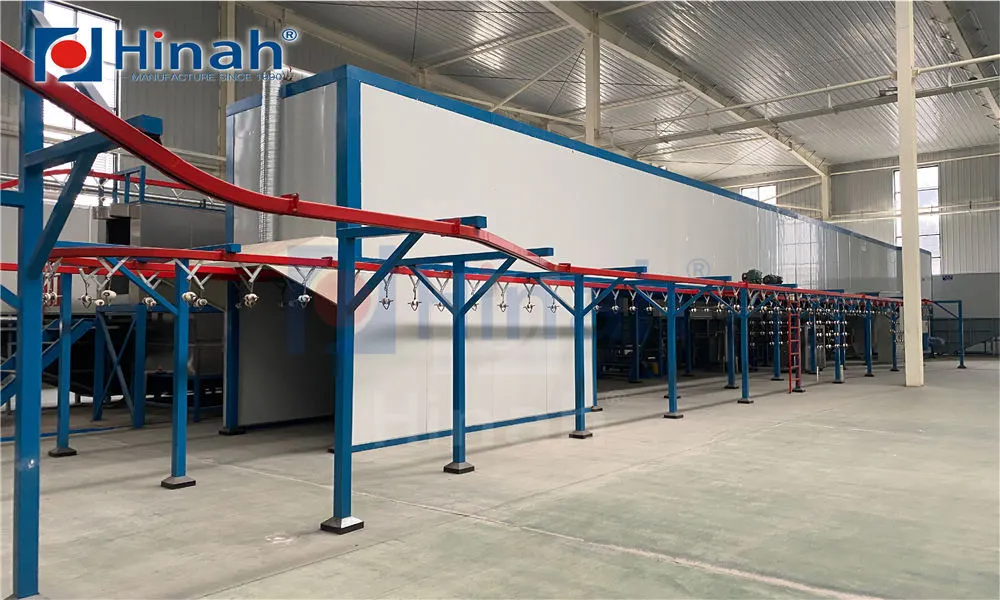
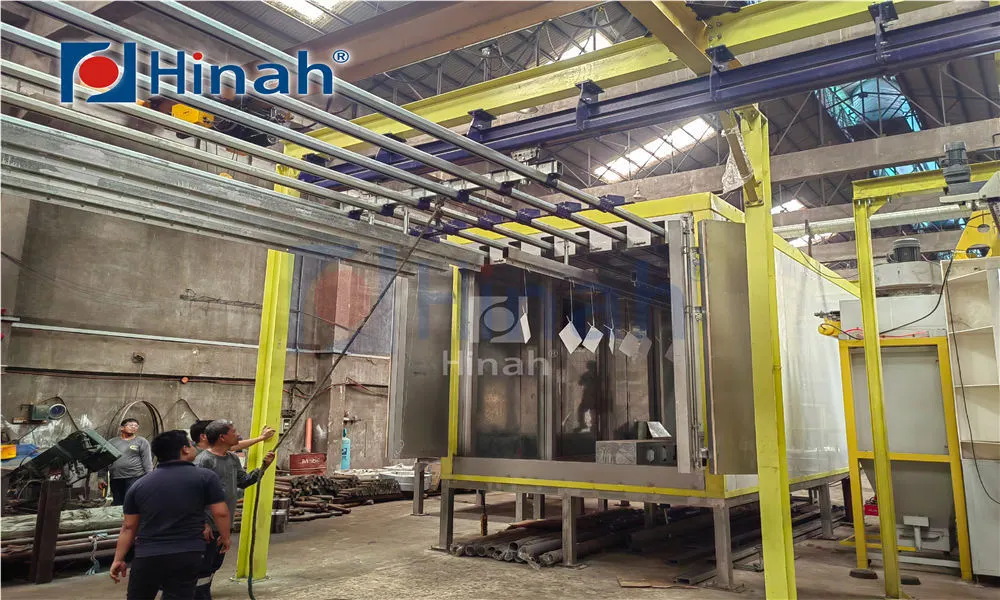
The conveyor determines system reliability and ergonomics. Three configurations dominate industrial lines:
Overhead monorail: Lowest initial cost; suitable for parts up to 1.5 m. Requires regular track cleaning to prevent powder buildup and chain lubrication systems to reduce wear.
Inverted (power-and-free) conveyor: Preferred for high-volume automotive and heavy equipment. Chain runs below floor level, eliminating contamination on moving parts. Allows accumulation zones for buffer storage between process stages.
Walking beam or belt: Used for flat, heavy parts (e.g., panels, chassis frames) where hanging is impractical. Requires dedicated loading/unloading robotics for efficient operation.
When evaluating a powder coating line for sale, inspect conveyor for chain elongation (acceptable limit <3% over original length), drive sprocket wear, and track alignment. Request maintenance logs showing lubrication frequency and any past jamming incidents.
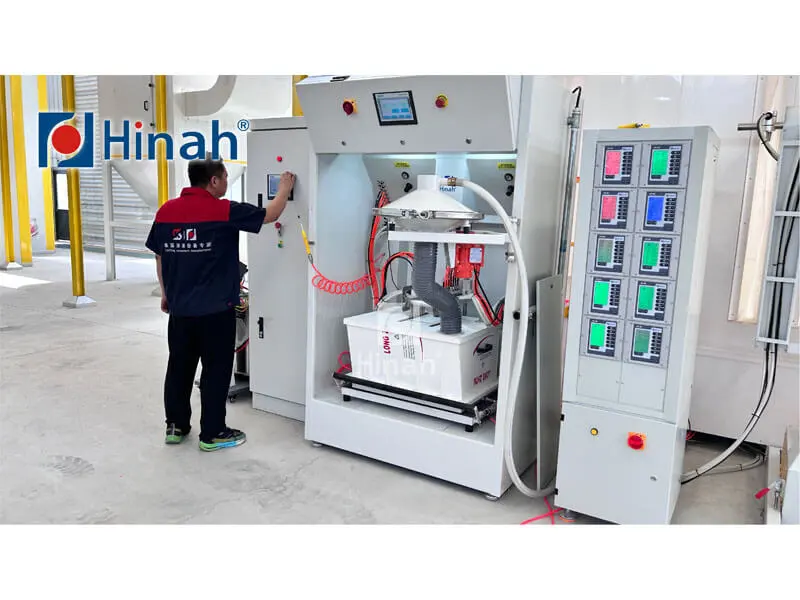
The booth is where transfer efficiency (TE) and material utilization are determined. Critical specifications include:
Crossdraft booths: Economical but limited to parts under 1 meter; face velocity must be maintained at 80–100 ft/min (NFPA 33).
Downdraft booths: Superior for complex geometries and large parts; require pit construction or raised floor; provide 95%+ containment efficiency.
Side-draft designs: Ideal for long extrusions (up to 8 m); utilize adjustable airfoils to maintain ±10% velocity uniformity.
Cartridge filters with nanofiber coating (MERV 15) achieve 99.9% efficiency on sub-micron particles. Pulse cleaning systems should maintain differential pressure below 1.5 inches water column.
Closed-loop recirculation reduces HVAC costs by 30–40% compared to single-pass systems.
For reclaim booths, verify that sieving systems (200–270 mesh) and automated rationing are included to maintain consistent reclaim-to-fresh ratios (typically max 30% reclaim).
Booths from HANNA are engineered with quick-release cartridge modules and sweep-floor systems, enabling color changes under 10 minutes—a critical factor for high-mix operations.
The oven is the largest energy consumer in any coating line (typically 40–60% of utility costs). Evaluate based on:
Temperature uniformity: Request thermal profiles demonstrating ±5°F (±2.8°C) across all zones. Poor uniformity causes under-cure (poor adhesion, low impact resistance) or over-cure (color shift, brittleness).
Insulation thickness: High-density mineral wool (6-inch minimum) reduces heat loss by 35% compared to 4-inch panels. Look for thermal break construction on conveyor openings.
Burner technology: Low-NOx, modulating burners with 10:1 turndown ratios maintain precise temperature control while reducing gas consumption by 15–20% compared to on/off burners.
Heat recovery: Systems with exhaust-to-fresh-air heat exchangers or heat wheels reclaim up to 50% of waste energy, achieving payback periods under 2 years in continuous operation.
For hybrid lines, infrared (IR) boost zones at the oven entrance can reduce overall length by 25% and cut energy use by 20% by accelerating powder gelation.
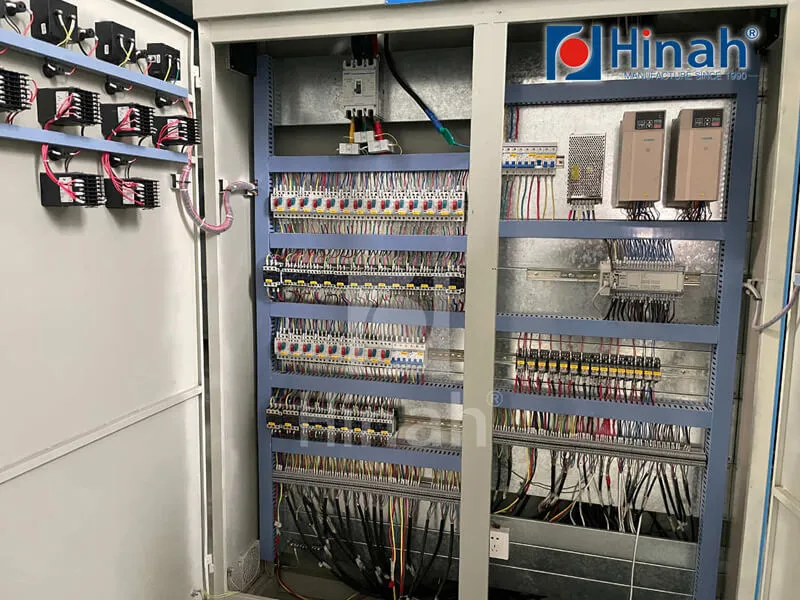
Modern coating lines integrate PLC-based automation with SCADA systems. Key capabilities to verify:
Recipe management: Digital storage of gun parameters (kV, µA, flow rate), booth airflow, oven zone temperatures, and conveyor speed for each part number. Reduces setup errors by over 90%.
Real-time monitoring: Sensors for booth static pressure, oven temperature profile, and conveyor speed with historical data logging. Enables root cause analysis of defects.
Predictive maintenance: Vibration sensors on fan motors, pressure transducers on filter systems, and thermocouples on oven zones feeding into maintenance scheduling software.
Remote diagnostics: Ethernet/IP or Profinet connectivity allows equipment suppliers to troubleshoot issues without on-site visits, reducing mean time to repair (MTTR) by 40–60%.
Ensure that control panels are UL 508A or CE certified and include safety interlocks per NFPA 79 and NFPA 33 requirements.
When comparing a powder coating line for sale, calculate total cost of ownership (TCO) over 5 and 10 years. Include:
Energy consumption: Request vendor energy audits showing kWh per square meter coated. Best-in-class lines achieve <1.2 kWh/m² for application and curing combined.
Powder utilization: Higher transfer efficiency (70% vs. 55%) reduces annual powder spend by $25,000–$50,000 for medium-volume operations (200 tons/year).
Maintenance costs: Premium systems with sealed bearings, modular components, and accessible service points reduce annual maintenance labor by 30%.
Downtime cost: Every hour of unplanned downtime costs an estimated $500–$2,000 in lost production. Systems with redundant fans, dual filter banks, and quick-change components minimize this risk.
Financial modeling should also account for environmental compliance—lines with waste heat recovery and high-efficiency filtration may qualify for energy credits or accelerated depreciation (Section 179 in the US).
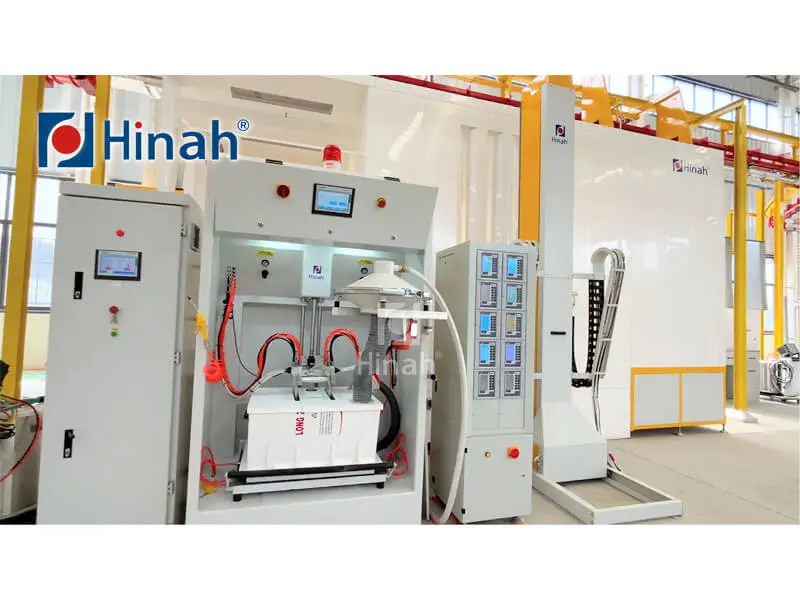
Equipment performance ultimately depends on proper installation and operator training. Essential vendor capabilities:
Project management: Single-point responsibility for civil works (foundations, pits), utilities (compressed air, gas, electrical), and equipment integration.
Commissioning protocol: Formal FAT (Factory Acceptance Test) and SAT (Site Acceptance Test) with documented performance metrics—transfer efficiency, temperature uniformity, and production throughput.
Training programs: Operator training on gun setup, booth cleaning, and preventive maintenance; technician training on PLC programming and oven calibration.
Spare parts availability: Guaranteed availability of critical spares (cartridge filters, gun nozzles, burner components) with lead times under 48 hours.
Vendors like HANNA provide comprehensive documentation, including P&IDs, electrical schematics, and thermal profiles, ensuring maintainability long after commissioning.
Q1: What is the typical lead time for a custom-engineered powder
coating line?
A1: Standard lines with proven designs require 8–16
weeks from order to shipment. Fully customized systems with specialized
automation, pits, or unusual part geometries can extend to 20–24 weeks. Always
verify that vendors provide a detailed project timeline with milestones for
design approval, FAT, shipping, installation, and commissioning. Expedited
delivery often compromises quality control and FAT procedures.
Q2: How do I determine the correct oven length and conveyor speed for
my production volume?
A2: Calculate required oven dwell time based
on powder manufacturer’s cure schedule (typically 10–15 minutes at metal
temperature). Then oven length (meters) = conveyor speed (m/min) × dwell time
(min). For continuous production, add 20% to calculated length to accommodate
part spacing and thermal recovery zones. Use thermal profilers during trial runs
to validate that the heaviest parts reach full cure temperature within the
specified zone.
Q3: What are the most critical safety certifications for a powder
coating line?
A3: For North America, NFPA 33 (Spray Application
Using Flammable or Combustible Materials) and NFPA 70 (National Electrical Code)
are mandatory. OSHA 1910.107 covers spray booth requirements. For European
markets, ATEX 137 (Directive 1999/92/EC) and EN 12981 (Coating plants—Spray
booths for organic powder) apply. Ensure that the control panel has UL 508A or
CE certification, and that explosion venting is calculated per NFPA 68 or EN
14491.
Q4: Can I integrate a used or refurbished powder coating line with my
existing pre-treatment and oven?
A4: Yes, but a compatibility audit
is essential. Verify that the booth’s face velocity matches the oven’s airflow
balance to avoid pressure imbalances that draw contamination into the oven.
Conveyor speed must be synchronized—use VFDs on all drives to allow fine-tuning.
Most importantly, ensure that control systems (PLCs) can communicate via common
protocols (Modbus TCP/IP, Profibus) to enable centralized monitoring. HANNA offers integration engineering services to retrofit existing components with new
control architecture.
Q5: What is the expected lifespan of a powder coating line, and how
can I extend it?
A5: With proper maintenance, a well-engineered line
operates effectively for 15–20 years. Key longevity factors: (1) using stainless
steel in wet sections (pre-treatment) to prevent corrosion; (2) maintaining oven
insulation and burner calibration; (3) replacing conveyor chains before
elongation exceeds 3%; (4) upgrading controls every 8–10 years to maintain parts
availability. Preventive maintenance costs typically run 2–4% of initial
equipment cost annually—a critical investment to avoid unplanned outages.
Q6: How do I calculate return on investment (ROI) for a new powder
coating line?
A6: Standard ROI calculation = (Annual net savings) /
(Total installed cost). Net savings include: reduced outsourced coating costs,
lower consumable usage (powder, pretreatment chemicals), energy savings compared
to old equipment, and decreased reject rates. For example, a line costing
$500,000 that saves $150,000/year yields a 3.3-year payback. Include tax
incentives for energy efficiency and potential resale value of existing
equipment. Most industrial coating lines achieve ROI in 2–4 years when properly
sized for production needs.