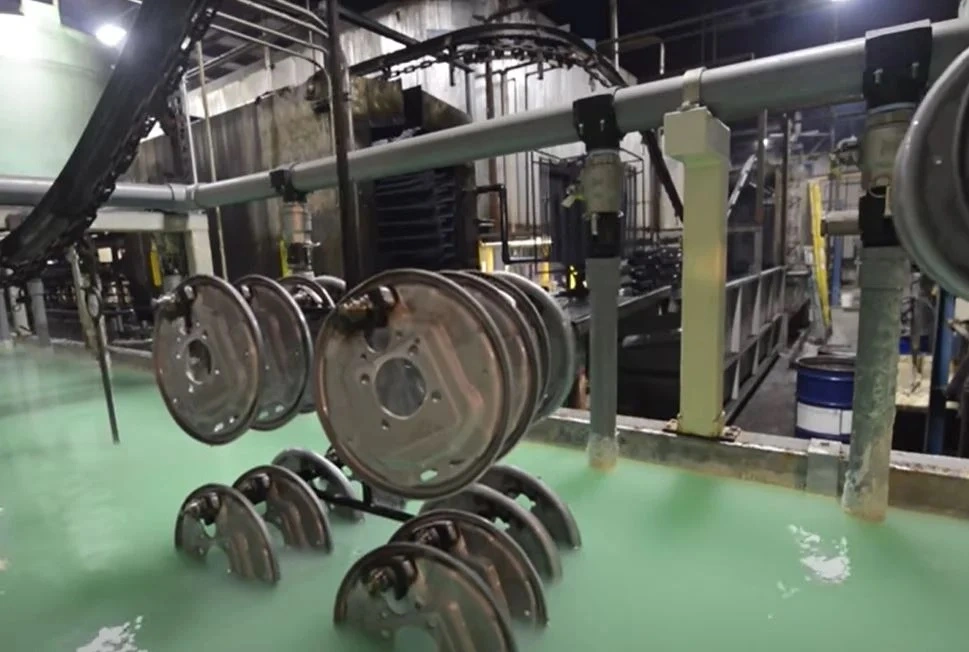
In high-volume industrial coating, the pairing of curing ovens with application booths defines first-pass yield, operational cost, and coating consistency. A poorly balanced Powder coating oven and spray booth leads to orange peel, under-cure, or excessive overspray—directly hitting profit margins. This article provides an evidence-based analysis of thermodynamic design, air management, material recovery, and system integration, drawing from field data and process engineering principles.
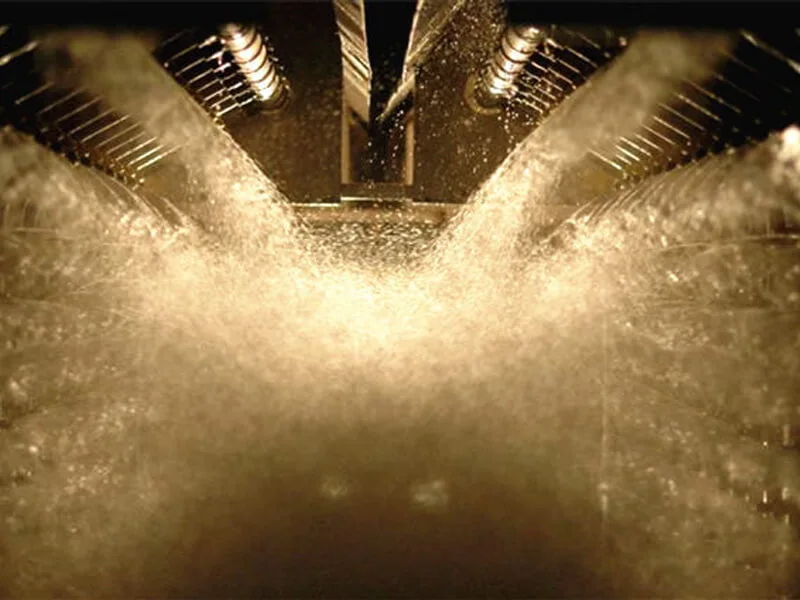
Every high-efficiency line relies on two interdependent zones: the spray booth for electrostatic application and the curing oven for cross-linking. Their interaction dictates coating morphology and adhesion. Below we dissect each subsystem with quantitative metrics.
The booth must achieve three conflicting goals: high overspray capture, minimal air turbulence, and rapid color transitions. Modern cartridge-style booths operate with down-draft or cross-draft airflow.
Air velocity: Typical recommended face velocity: 0.5–0.7 m/s (100–140 ft/min) for thermoset powder coating plant environments. Below 0.4 m/s risks powder escape; above 0.9 m/s pulls particles away from the substrate (Faraday cage issues).
Filter media: Nanofiber-coated cartridges (1–2 μm retention) achieve 99.6% efficiency on reclaimable powder. Pulse-jet cleaning with dew-point controlled compressed air prevents caking.
Color-change protocols: In less than 10 minutes for a 12-booth system? Automated sweep augers, blow-off nozzles, and quick-release cartridge racks reduce downtime by 40% compared to manual cleaning.
A critical parameter often overlooked is relative humidity inside the booth (maintain 40–55% RH) to prevent powder clumping and ensure consistent tribo or corona charging.
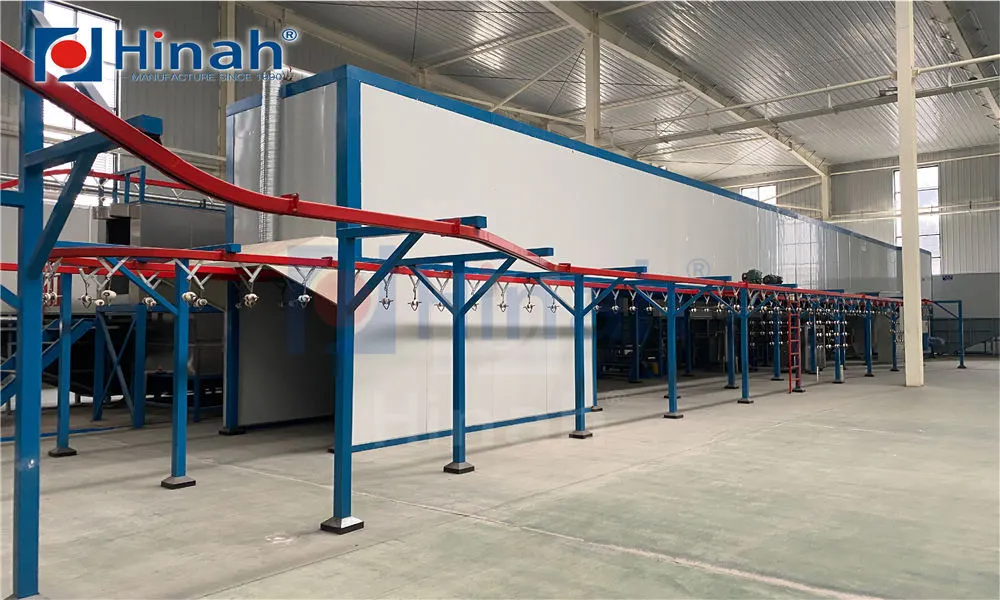
The Powder coating oven and spray booth must be thermally synchronized. Ovens are classified by heat transfer mechanism:
Convection ovens: Best for complex geometries, but require longer dwell times. Temperature uniformity ≤ ±3°C across the load zone per ASTM D3451. Recirculation rates of 15–20 air changes per minute prevent stratification.
Infrared (IR) ovens: Medium-wave IR (2.5–4 μm) penetrates powder films faster—cure cycles reduced by 60%. However, shadow areas risk under-cure without air-assist reflectors.
Hybrid systems: IR booster at oven entrance + convection hold zone. This combination eliminates pinholes while achieving full cross-linking at lower peak metal temperature.
For high-output lines, insulation thickness of 150 mm mineral wool (density 128 kg/m³) reduces skin temperature below 45°C, cutting energy loss by 30%.
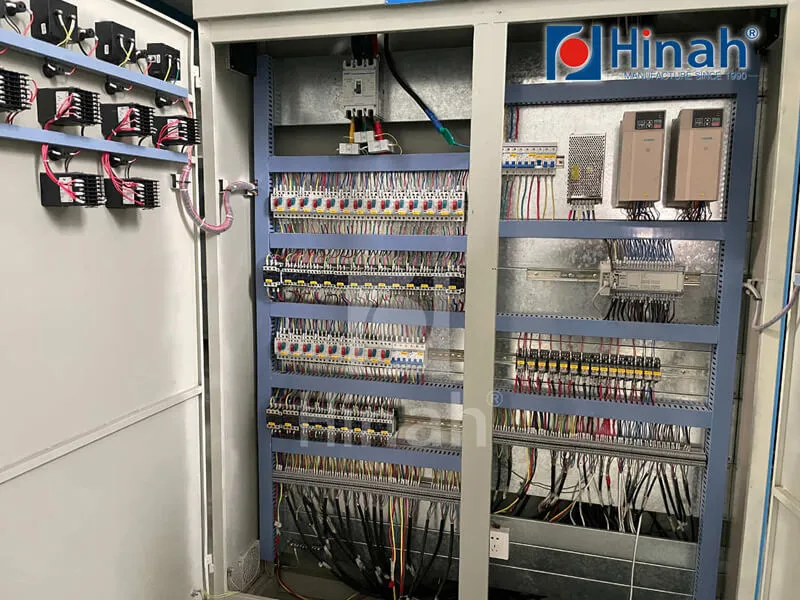
Symptom: Varied gloss levels or poor impact resistance across racked parts. Root cause: Burner modulation lag or poor baffle design. Solution: Install a four-zone PID controller with high-limit thermocouples at 12 positions (top, mid, bottom). Data logging over 24 hours identifies cold streaks. Retrofitting with variable frequency drives (VFDs) on recirculation fans stabilizes airflow.
When switching from a dark to light color, even 0.1% residual pigment creates visible defects. Advanced solution: Implement a dual-booth system with movable partitions. For single booths, use laminar flow purge cycles: 90 seconds at 1.2 m/s air velocity without powder feed. HANNA has engineered quick-release cyclone clusters that reduce color-change residue to below 50 ppm.
Typical transfer efficiency (TE) for manual guns is 40–60%; automatic guns reach 70–85%. Every 5% increase in TE saves €0.12 per kg of powder. To improve TE:
Optimize gun-to-part distance (150–250 mm) and voltage (70–90 kV for corona).
Use booth back-sheet extraction with cyclonic separators before filters.
Install a powder management unit that sieves reclaim (mesh 140) and blends with virgin powder at ratios up to 30/70 without affecting orange peel.
Energy typically accounts for 25% of coating line operating costs. Below are data-backed measures:
Exhaust heat recovery: The spray booth exhaust (22–28°C) carries latent heat. A cross-flow plate heat exchanger can pre-heat fresh make-up air, saving 12–18% oven gas consumption.
Oven flue gas recirculation (FGR): Recirculate 15-20% of flue gases back into the combustion chamber to lower NOx and recover enthalpy.
Insulation audits: Thermal imaging of oven panels and ductwork. Even a 5 mm gap in insulation increases heat loss by 40%. Use ceramic fiber gaskets on access doors.
Booth lighting: Replace fluorescent tubes with IP65 LED luminaires (5000K, 1200 lm). Reduced heat load into booth → less HVAC demand.
A properly tuned Powder coating oven and spray booth can reduce kWh per square meter by 35% compared to non-integrated controls.
For continuous production, the indexer speed must match both booth cycle time and oven dwell curve. Consider a 500 mm/s variable-speed chain conveyor. Industry 4.0 integration includes:
IoT sensors on booth differential pressure (setpoint 750–1250 Pa) and oven oxygen trim (3–5% O₂).
Edge computing for predictive filter clogging: algorithms detect rising pulse frequency and schedule maintenance before downtime.
Central SCADA with batch traceability: records part ID, oven zone temperatures, and booth humidity for each rack.
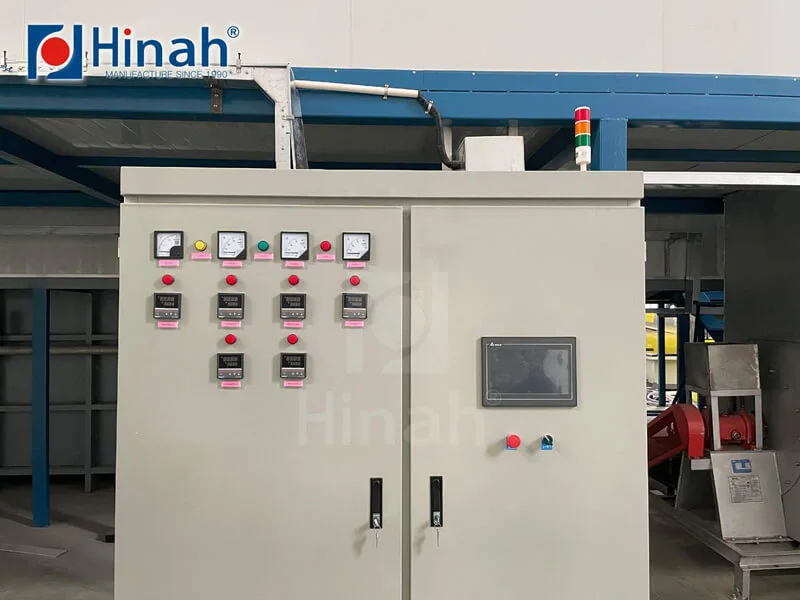
HANNA provides fully modular systems where the Powder coating oven and spray booth share a common PLC backbone, reducing integration errors and commissioning time by 30%.
Booth preventive maintenance (PM):
Weekly: Clean booth walls with non-silicone wipes; inspect cartridge pulsing solenoids.
Monthly: Measure air velocity profile across the face (anemometer at 9 grid points).
Quarterly: Extract and weigh powder hopper residue – if >2 kg, adjust cyclone separation efficiency.
Oven PM:
Bi-weekly: Check belt tracking and bearing temperatures (max 65°C).
Annually: Calibrate thermocouples against a NIST-traceable probe; inspect burner flame rods.
Following these schedules increases equipment lifespan beyond 15 years, as validated by HANNA field service records from 150+ installations.
A1: For 60/40 epoxy-polyester, cure at 180°C (356°F) for 10 minutes metal temperature. Use a ramp rate of 10–15°C/min to avoid outgassing. The Powder coating oven and spray booth combination must maintain ±2°C uniformity across the load. Always validate with a datalogger on heavy parts (e.g., 6 mm thick steel).
A2: Use the formula: Q (m³/h) = booth face area (m²) × air velocity (m/s) × 3600. For a 2.5 m wide × 2 m high opening, velocity 0.6 m/s → Q = 5 m² × 0.6 × 3600 = 10,800 m³/h. Ensure the dust collector has at least 15% reserve capacity. Always cross-check with ISO 14644-3 for cleanroom-grade booths.
A3: Yes, provided the conveyor speed matches the IR dwell window (typically 30–90 seconds). Install medium-wave IR emitters above the line with zone control. However, you must recalculate the booth extraction to avoid IR-induced airflow turbulence. HANNA offers retrofit kits with integrated airflow diffusers to prevent powder drift.
A4: For pleated nanofiber cartridges, initial ΔP is 350–450 Pa. Pulse cleaning should trigger at 850–1000 Pa. Above 1200 Pa, airflow drops below 0.5 m/s, risking powder escape. Install a differential pressure transmitter with an alarm at 1100 Pa to schedule off-shift deep cleaning.
A5: High humidity (>65% RH) causes powder agglomeration in the booth feed hopper and reduces electrostatic charge retention, leading to poor wrap. Low humidity (<30% RH) increases static discharge risk and powder cloud instability. Maintain 45–55% RH using desiccant dryers. The oven’s curing quality also suffers when wet parts enter—moisture flashes into steam, creating pinholes.
Designing or upgrading a Powder coating oven and spray booth requires precise load analysis, thermal modeling, and airflow simulation. Standardized off-the-shelf units rarely meet high-mix, high-volume demands.
For a custom-engineered system that reduces energy costs by 20–35% and increases first-pass yield above 92%, consult our application engineers. HANNA provides turnkey solutions with full documentation, FAT, and onsite commissioning.
Ready to discuss your project specifications? Send your part dimensions, desired output (parts/hour), and powder type to our technical sales team. We will deliver a detailed ROI analysis and layout proposal within 5 business days.
For inquiries, please contact our B2B engineering desk: Submit your requirements here 。Get a free initial process audit.