
Industrial finishing lines rely on Powder coating systems to apply durable, solvent-free films on metal substrates. Unlike liquid paints, powder coatings require electrostatic application followed by thermal fusion. The performance of a complete line — consisting of a spray booth, recovery module, curing oven, and conveyor — dictates film thickness consistency, edge coverage, and material usage. This article examines the engineering parameters that separate high-efficiency Powder coating systems from outdated designs, with focus on Faraday cage penetration, powder reclaim ratios, and oven zoning.
Modern fabricators of aluminum profiles, automotive wheels, agricultural equipment, and electrical enclosures all require systems that can handle varying part shapes without sacrificing first-pass transfer efficiency (typically 60-85%). HANNA designs modular Powder coating systems with integrated booth airflow management and fast-color-change features. Below we break down the core subsystems and the science behind each.
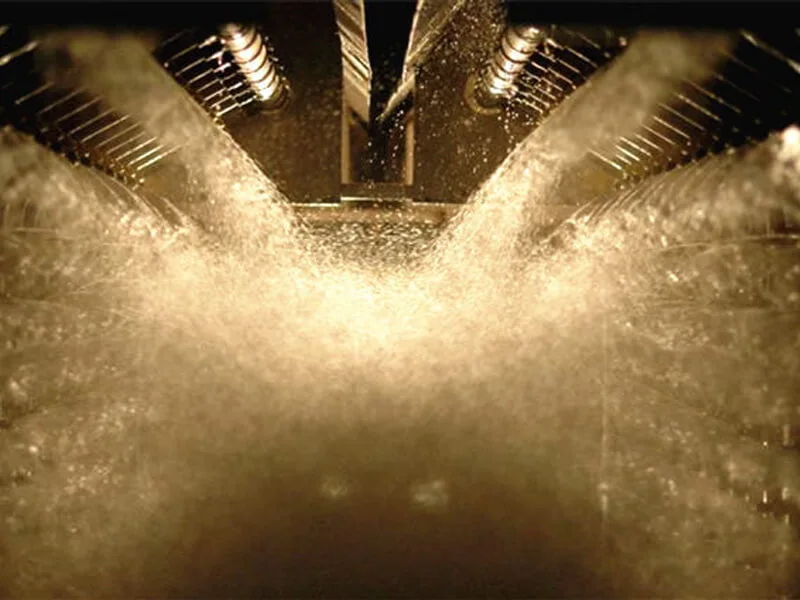
The spray gun is the heart of any powder coating line. Two charging methods dominate the market:
Corona charging – High voltage (60-100 kV) applied to a needle electrode creates an ion cloud that charges powder particles passing through. Suitable for most powders but can produce back-ionization if the film becomes too thick, resulting in orange peel or pinholes.
Tribo charging – Friction between the powder and a PTFE or nylon tube generates positive charges. No external voltage; avoids back-ionization, ideal for recoating or metallic powders. Requires powders with specific tribo additives.
Advanced Powder coating systems offer interchangeable gun barrels and automatic voltage feedback (kV and µA regulation) to maintain constant charge regardless of distance. A sensor in the gun detects current flow to the part and adjusts voltage downward as coating builds, preventing dielectric breakdown.
The booth contains overspray and directs it to recovery cyclones or cartridge filters. Key parameters:
Air velocity at the booth opening – 0.6 to 1.2 m/s (typical). Higher velocities pull powder out of the booth; lower velocities allow powder escape into the working area.
Booth wall material – polypropylene or stainless steel with smooth surfaces to minimize powder adhesion. Anti-static properties prevent explosive dust accumulation.
Open-face versus closed-loop booths – closed-loop systems recirculate conditioned air, reducing heating/cooling costs and maintaining humidity (45-55% RH recommended for consistent charging).
For frequent color changes (e.g., contract coaters), HANNA offers cartridge filter booths with quick-release cassettes. Changeover time under 10 minutes is achievable with cyclonic separation and purge sequences.
Overspray typically accounts for 40-60% of powder usage. Reclaiming this material is economically necessary. Recovery paths include:
Cyclone separators – centrifugal action deposits heavier powder particles in a collection hopper. Fine particles (<10 µm) are exhausted to secondary filters. Cyclones recover 90-95% of overspray but change powder particle size distribution (fines removed).
Cartridge filters – used in batch booths. Pulse-jet cleaning periodically blows compressed air backward, dropping powder into the reclaim hopper. Recovery efficiency >98% but requires careful humidity control to prevent caking.
Post-sieving – reclaimed powder must pass through a 120-200 mesh screen to remove agglomerates and contamination. In-line vibratory sieves mounted directly under the hopper.
A well-designed Powder coating system blends fresh powder with reclaim at a ratio of 30% to 50% reclaim, maintaining consistent fluidization properties. If reclaim percentage exceeds 60%, the reduced fines may impact surface smoothness.
After application, parts enter a curing oven where powder particles melt, flow, and crosslink. The oven temperature profile determines mechanical properties (adhesion, flexibility, impact resistance).
Gas-fired or electric air heaters circulate hot air (180-220°C) across parts. Typical dwell time 10-20 minutes, depending on part thermal mass. Air velocity 1-3 m/s ensures uniform heat transfer. For thick parts (e.g., engine blocks), thermocouples must be attached to confirm that metal temperature reaches the required value (e.g., 190°C for 10 minutes) rather than air temperature.
Medium-wave or short-wave IR lamps directly heat the powder film. Advantages include rapid ramp-up (seconds vs. minutes) and lower floor space. However, complex shapes create shadow areas that do not cure. Therefore, many Powder coating systems combine IR boosters at the entrance to gel the powder (prevent sagging) followed by convection hold zones.
Oven validation requires a 4- or 6-channel data logger with thermocouples mounted on the product. Acceptable temperature variance across the part is ±5°C. Undercured powder fails solvent rub tests (MEK double rubs < 100); over-cured powder becomes brittle and discolors (ΔE > 2.0).
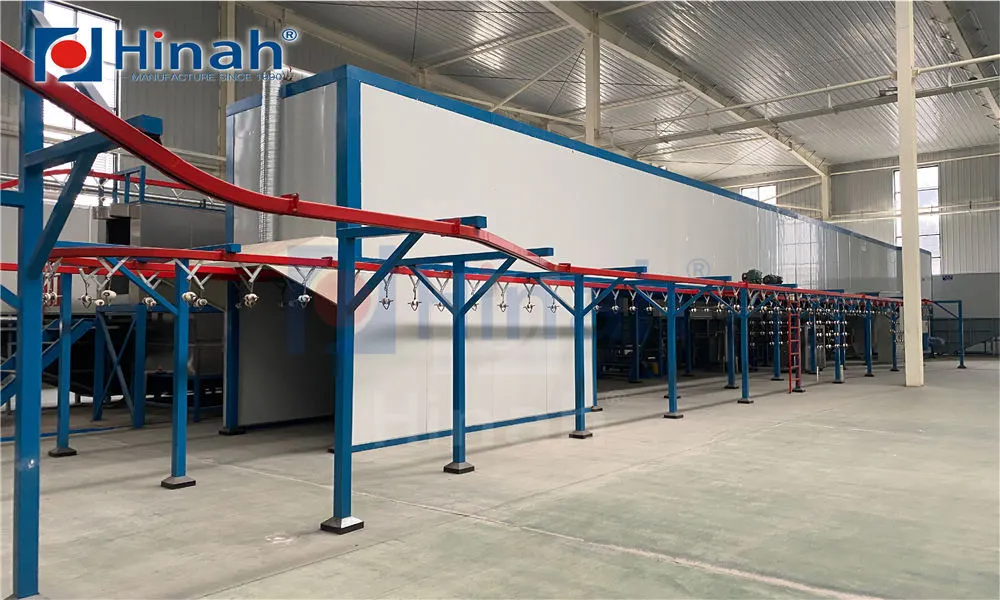
The conveyor moves parts through the pretreatment (if any), spray booth, and oven. Choice depends on part weight and line speed.
Monorail (continuous overhead) – simplest, lowest cost. Parts hang on hooks at fixed pitch. Cannot stop individual carriers. Suitable for parts with consistent line speed (3-5 m/min).
Power-and-free (accumulating) – each carrier can stop independently at the spray booth for manual touch-up or at the oven load zone. Allows buffer zones between process steps. Required for complex parts requiring multiple coating passes.
Grounding is a frequent failure point in Powder coating systems – hooks and carriers must be cleaned regularly (burn-off ovens or shot blasting) to maintain electrical continuity. A poorly grounded part creates a charged insulator that repels powder (Faraday cage effect).
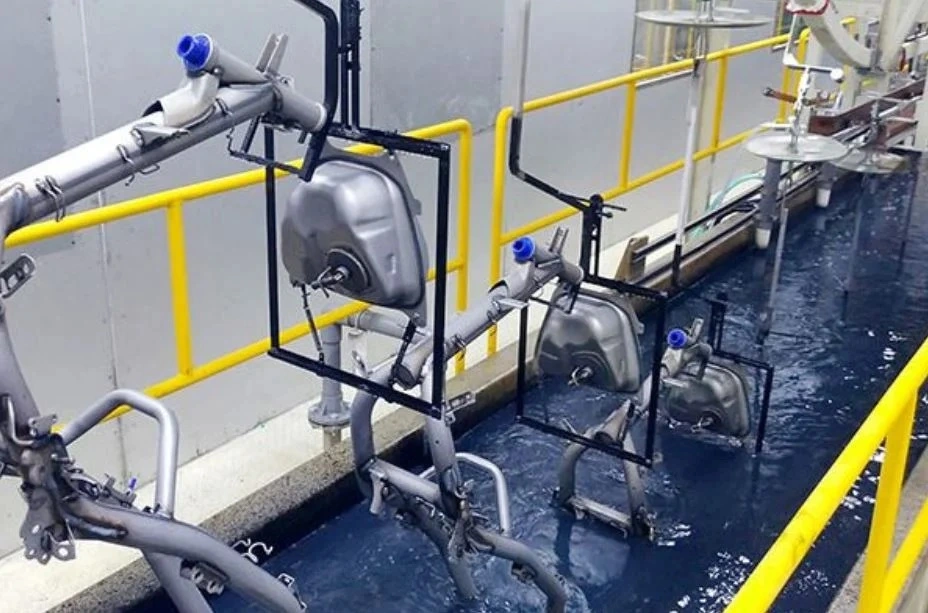
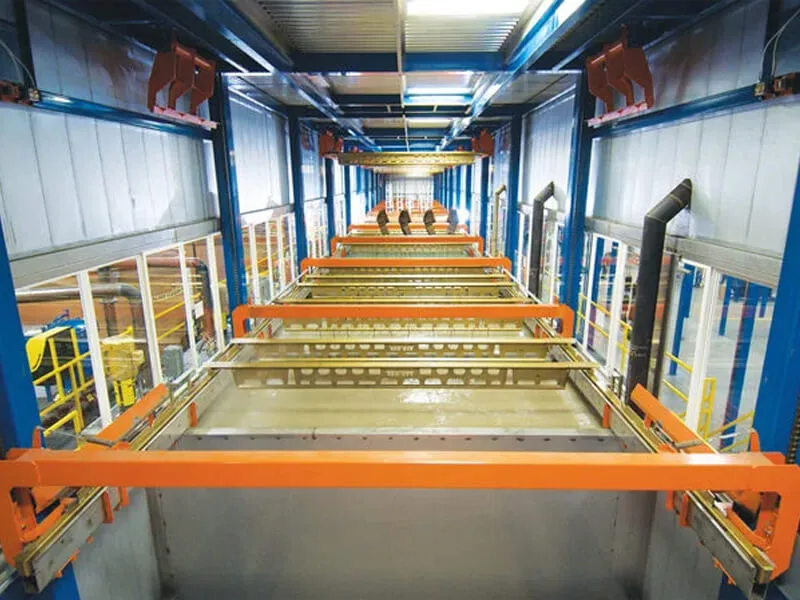
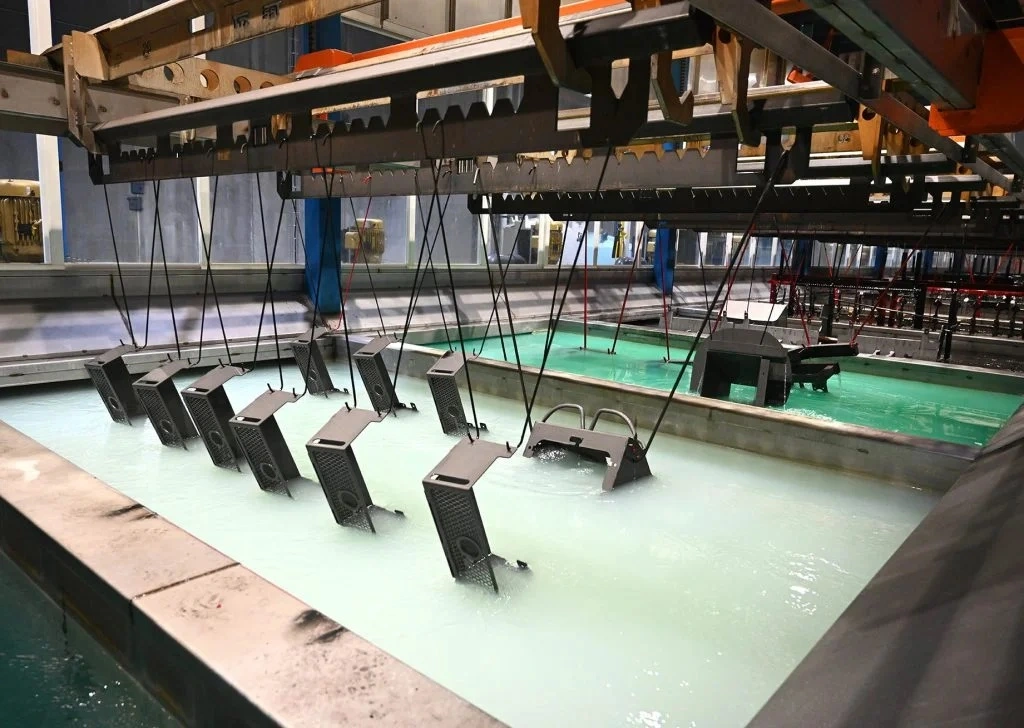
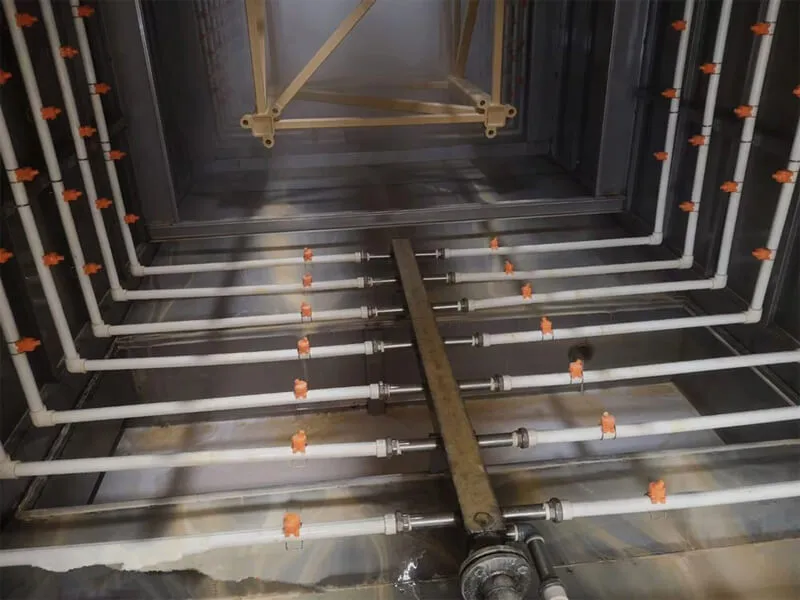
While powder coating does not require a primer, conversion coatings improve corrosion resistance and adhesion. In-line Powder coating systems often include a multi-stage washer:
Stage 1: Alkaline cleaning (remove oils, 55-65°C)
Stage 2: Rinse (tap water)
Stage 3: Iron phosphate or zirconium treatment (2-5 minutes)
Stage 4: Sealed DI water rinse
Stage 5: Drying oven (100-120°C) to remove moisture before powder application
Zirconium-based pretreatments have become common for their low sludge generation and room temperature operation, reducing energy costs.
Through site audits of over 50 finishing lines, six recurring problems appear. Each is solved by specific upgrades to Powder coating systems.
Inside corners and recessed areas receive little to no powder because the electric field lines curve away. Solution: Use tribo guns (no external field) or corona guns with a "Faraday optimizer" – a multipurpose nozzle that reduces voltage and increases powder flow velocity. Another method: preheating parts to 70-80°C reduces resistivity and improves wrap.
Excessive film thickness (>120 µm) or incorrect oven ramp causes outgassing. Solution: Calibrate gun traversing speed and powder output to achieve 60-80 µm per pass. For degassing, hold parts at 120°C for 2 minutes before full cure to allow volatiles to escape without bubbling the already-gelled surface.
Gloss levels shift when oven temperature drifts or line speed changes. Solution: Install an automatic gloss monitoring system (offline) and implement PID-controlled oven zones. Also, check powder lot: different production batches may have different resin flow coefficients.
Open-face booths without recovery recirculate powder to waste. Solution: Retrofit a cyclone + cartridge filter module. Typical payback on recovery equipment is 6-18 months depending on powder usage. Also, adjust gun positioning to minimize spray beyond part edges.
Residual powder in hoses and booth walls ruins subsequent runs. Solution: HANNA offers "rapid color change" Powder coating systems with internal hose purging, removable floor plates, and cartridge filters that can be swapped in 5 minutes. A purge sequence of compressed air + virgin powder cleans the entire feed system.
Parts longer than 3 meters experience gradient coating from one gun. Solution: Use multiple stationary guns with oscillating drives, or reciprocating vertical guns that travel up and down while the part moves horizontally. Ensure the spray pattern overlaps by 30% at the edges.
Powder coatings are combustible dusts. A professional Powder coating system must include:
Grounding of all conductive components (booth, hoppers, ductwork) with resistance < 1 MΩ.
Explosion venting panels on filter collectors (venting to outside).
Fire suppression (CO₂ or water mist) interlocks with air flow sensors.
Regular cleaning of powder accumulations on booth ledges and inside ducts.
Filter cartridges should be inspected every 500 operating hours for tears or blinding. A pressure differential gauge across the filter (start < 500 Pa, change > 1500 Pa) indicates saturation.
When specifying Powder coating systems, three numbers are required: lineal loading (parts per meter of conveyor), desired line speed (m/min), and part envelope dimensions. For example, a line coating 2,000 aluminum extrusions per shift (8 hours) with 2-meter parts spaced 0.5m apart requires line speed = (2000 * 2) / (8*60) = 8.3 m/min. The oven length then becomes dwell time (15 min) × speed = 125 meters. This influences building layout.
Batch systems (non-conveyorized) are suited for high-mix, low-volume job shops. A batch booth with manual guns and a walk-in oven (e.g., 2m x 3m x 2m) can process parts up to 500 kg per cycle. However, manual operation yields lower transfer efficiency (40-60%) compared to automated reciprocators.
After the curing oven, the following tests are common:
Dry film thickness – using eddy current or magnetic gauges, measure 5 points per part. Target tolerance: ±10 µm.
Cross-hatch adhesion – ASTM D3359. Cut a grid, apply tape, remove. 5B rating (0% removal) required.
Solvent resistance (MEK double rubs) – 100 rubs with no breakthrough to substrate.
Impact resistance – direct and reverse impact using Gardner impact tester (40-80 in-lb).
Salt spray (ASTM B117) – 500 hours min for exterior architectural coatings.
Daily verification of oven temperature and line speed prevents rejects. HANNA provides an integrated data acquisition module that logs these parameters and alerts operators when out of spec.
For specifications, line layout, or a quotation on a turnkey finishing line, contact the engineering department at HANNA. Provide part dimensions, substrate material, required output (parts/hour), desired color change frequency, and available floor space. The team returns a system configuration proposal with projected transfer efficiency and oven energy demand.
Inquiry channel: https://www.autocoatinglines.com/contact.html – Include “Powder coating systems inquiry” in the subject line for priority assignment.