
In any powder coating operation, the spray booth and the curing oven are often treated as separate equipment purchases. However, the physical and thermal relationship between them directly affects finish quality, energy consumption, and production throughput. A poorly matched powder coating booth oven combination leads to contamination of uncured powder, temperature fluctuations during part transfer, and excessive floor space usage. This article examines the engineering principles behind integrating a spray booth with a curing oven – covering air balance, insulation continuity, conveyor transitions, and energy recovery. As a manufacturer of complete finishing lines, HANNA has deployed over 150 integrated powder coating booth oven systems across automotive, architectural, and general industrial sectors.
A standalone spray booth recirculates air through cartridge filters to capture overspray powder. A standalone oven draws fresh air for combustion and exhausts volatile compounds. When these two systems are not coordinated, several problems arise:
Cross-contamination: Air currents from the oven's exhaust fan can pull uncured powder from the booth toward the oven entrance, depositing partially cured particles on parts or inside the oven.
Thermal shock: Parts exiting a 22°C booth into a 200°C oven without a gradual transition zone cause outgassing defects (pinholes or blisters).
Energy waste: The booth's exhaust (even after filtration) often goes to the atmosphere, while the oven's burner heats fresh ambient air – missing the opportunity to preheat combustion air using booth exhaust heat.
A properly engineered powder coating booth oven layout addresses these through shared air handling, vestibule zones, and programmable logic controller (PLC) coordination. The following sections detail technical solutions.
Depending on production volume and part geometry, three primary layouts dominate industrial practice. Each impacts equipment footprint and capital cost.
The booth and oven are placed adjacent, with a short (1–2 meter) open conveyor gap. Parts move from booth to oven via the same monorail or power-and-free conveyor. This is the most common for batch operations. However, the open gap allows powder drift and heat loss. Adding a simple vestibule (enclosed tunnel with separate extraction) reduces these issues. A basic side-by-side powder coating booth oven requires 20–30% less floor space than separate buildings but needs careful differential pressure control (booth slightly negative, oven slightly positive).
To save factory footprint, some lines place the curing oven directly above the spray booth. Parts are lifted via a vertical conveyor (Z‑lift) after coating. This design is excellent for compact plants but introduces challenges: heat rising from the oven can warm the booth (affecting powder fluidization), and maintenance access to the oven requires working at height. Over-under powder coating booth oven systems typically include a thermal barrier (50mm mineral wool sheet) and separate ventilation zones.
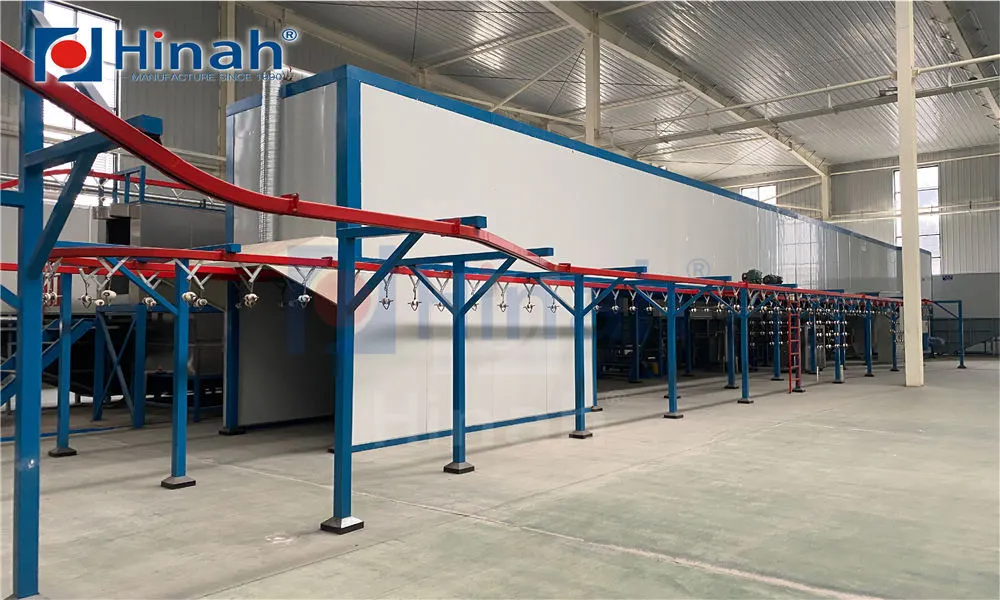
High-volume continuous lines use a single tunnel: the first 3–5 meters contain the spray booths (with overspray extraction), followed by an infrared (IR) or convection flash zone (40–60°C to gel the powder), then the main curing zone. This eliminates any open transfer. The integrated powder coating booth oven tunnel requires sophisticated zoning: each section has independent air handling to prevent powder migration into the hot zone. Capital cost is higher (typically 40% more than separate units) but provides the best finish consistency for automotive clearcoats or textured architectural powders.
Controlling airborne powder is the top priority. The spray booth must operate at a slight negative pressure relative to the surrounding room (typically -5 Pa) to contain powder. The oven, however, should be at a slight positive pressure (+2 to +5 Pa) relative to the room to prevent cold air infiltration that would create cold spots. When booth and oven are connected by a conveyor opening, these pressure regimes conflict.
Professional powder coating booth oven designers install a pressure equalization vestibule – a short tunnel (1.5–2m) with its own fan and filter. The vestibule operates at -2 Pa relative to the booth and +2 Pa relative to the oven, creating a smooth gradient. Additionally, flexible strip curtains at each end reduce air exchange by 80%. Data from HANNA installations show that such a vestibule reduces powder carryover into the oven by 92% compared to an open gap.
One of the most frequent quality problems in powder coating is outgassing – bubbles or pinholes that appear during curing. This happens when the part heats too quickly, causing trapped air or moisture in the substrate to expand and burst through the molten powder layer. A well-designed powder coating booth oven includes a gradual temperature ramp zone before the hold zone.
Flash-off zone: Immediately after the booth, the part passes through an ambient or slightly warm (30–40°C) section for 1–2 minutes. This allows solvents (if any) or moisture to evaporate before the powder melts.
IR pre-heat: Medium-wave infrared panels raise the part surface to 100–120°C over 30–60 seconds. The powder begins to gel but does not fully flow. This controlled outgassing prevents bubbles.
Convection hold zone: Finally, the part enters the main oven at 180–200°C for the required dwell time (typically 10–15 minutes for thermoset powders).
Retrofitting a ramp zone into an existing powder coating booth oven costs between $15,000 and $40,000 but reduces reject rates from 5–8% to under 1% for porous substrates (cast iron, aluminum castings). Many finishers recover this investment in less than six months.
A typical powder spray booth exhausts 10,000–20,000 m³/h of air (after filtering) to the outside. This air is at room temperature (20–25°C). Meanwhile, the curing oven’s burner consumes fresh ambient air for combustion, which must be heated to 200°C. By installing a simple air-to-air heat exchanger (plate or run-around coil), the booth exhaust can preheat the oven’s combustion air. Efficiency gains: for every 5°C rise in combustion air temperature, gas consumption drops by 1%.
For a continuous powder coating booth oven operating 4,000 hours/year, a heat recovery unit (cost $8,000–$15,000) typically saves $4,000–$7,000 annually in natural gas. Additional benefit: the booth exhaust is slightly cooled before discharge, reducing HVAC load on the factory. HANNA offers integrated energy recovery modules as an option on all complete powder coating plant designs.
Different part families impose unique requirements on the booth-oven interface.
Aluminum wheels require a flawless finish without any dust specks. The powder coating booth oven must have Class 1000 cleanliness (ISO 14644-8) in the transfer zone. Solution: a pressurized vestibule with HEPA filtration (99.97% at 0.3 µm) and positive pressure to repel particles. Additionally, the oven entrance includes a self-cleaning air knife that blows ionized air across each wheel to remove any loose powder before curing.
Long parts create a “piston effect” as they move through the booth and oven – pushing air ahead of them. This can disturb powder cloud and create uneven temperature profiles. Solution: a variable-speed conveyor that slows down at the booth exit and oven entrance, allowing air pressure to equalize. Also, side air curtains at the oven entrance reduce cold air infiltration. A properly designed powder coating booth oven for long extrusions includes pressure sensors at both ends, linked to the oven’s exhaust damper.
Massive parts (e.g., tractor frames) act as heat sinks. If they pass too quickly from booth to oven, the core temperature remains low while the surface cures – causing “shelling” (poor adhesion). Solution: a two-stage oven with a low-temperature “soak zone” (120°C for 20 minutes) followed by a high-temperature zone. The booth is extended with an infrared preheat station to raise the part’s surface temperature to 80°C before powder application, improving powder attraction. This configuration requires precise coordination of booth ventilation to prevent powder ignition from IR heaters (surface temperature kept below powder’s flash point, typically >250°C).
Unlike separate units, a combined powder coating booth oven has shared surfaces where powder can bake onto hot walls. Monthly inspection points:
Vestibule floor and walls: Use a non-contact infrared thermometer to check for hot spots >50°C (indicates oven heat leaking back). Install removable stainless steel panels for easy scraping.
Conveyor chain inside the oven: High-temperature lubricant (graphite-based) must be reapplied every 500 hours. Standard oil will carbonize and fall onto parts.
Pressure differential sensors: Calibrate quarterly to ensure the cascade remains within ±3 Pa. Clogged filters in the vestibule can reverse pressure, pulling powder into the oven.
HANNA provides a detailed maintenance logbook with every integrated system, including recommended spare parts (strip curtains, temperature probes, differential pressure switches).
Q1: What is the typical distance required between the spray booth and
the curing oven in an integrated line?
A1: For a basic open
transfer, a minimum of 1.5 meters is recommended to reduce air interaction. With
a vestibule (enclosed tunnel), the distance can be as short as 0.8 meters.
However, the best practice is to include a 2-meter vestibule with independent
extraction. The overall powder coating booth oven footprint
should allow for part length plus 1 meter on each side for maintenance
access.
Q2: Can I use the same exhaust fan for both the booth and the
oven?
A2: No. Spray booth exhaust contains powder particles (even
after cartridge filters, some fines pass through). Pulling this air into an oven
would deposit burnt powder on parts and heating elements. The two systems must
have separate exhaust ducts. However, a heat recovery unit can transfer thermal
energy from the booth exhaust to the oven’s intake without mixing air
streams.
Q3: How does part orientation affect the booth-oven
transition?
A3: Hanging parts with flat surfaces facing the
direction of travel minimizes air drag. Sharp edges or cavities facing forward
can scoop cold air into the oven, causing uneven heating. In a continuous
powder coating booth oven, parts should be rotated 90° after
coating (using a turntable in the vestibule) so that the broad side is
perpendicular to the oven’s airflow, allowing uniform heat circulation.
Q4: What is the additional cost for an integrated powder coating
booth oven compared to separate units?
A4: A separate booth and oven
from different suppliers might cost $180,000 combined (for medium volume). An
integrated system with vestibule, pressure control, and energy recovery
typically runs $230,000–$280,000. However, the integrated powder coating
booth oven reduces rework by 40–60% and saves $15,000–$25,000 annually
in energy and maintenance. Payback is usually 18–24 months. HANNA provides a detailed TCO comparison for each
project.
Q5: Can I retrofit a vestibule and pressure control to my existing
separate booth and oven?
A5: Yes, provided there is at least 1 meter
of space between them. A retrofit vestibule kit includes a modular steel frame,
transparent polycarbonate panels, a small extraction fan with filter, and two
strip curtains. Installation takes 2–3 days and costs $12,000–$25,000. Most
coaters report a 70% reduction in powder contamination inside the oven after
retrofit. Contact HANNA’s retrofit team for a
site assessment.
Q6: What safety certifications apply to a combined powder coating
booth oven?
A6: The booth section must comply with NFPA 33 (US) or
EN 12981 (Europe) for spray finishing – including fire suppression interlocks
and explosion venting. The oven section must meet NFPA 86 or EN 1539 for
industrial ovens. An integrated system requires a single control panel that
prioritizes booth safety (e.g., if the booth fire alarm triggers, the oven
burner shuts down and dampers close). HANNA builds all integrated powder coating
booth oven controls to meet these standards, with third-party
certification available.
Separate sourcing of spray booth and curing oven often leads to mismatched airflows, thermal inefficiencies, and quality defects. An engineered powder coating booth oven from a single supplier ensures proper pressure cascades, transition zones, and energy recovery. Whether you need a compact batch system or a high-speed continuous tunnel, HANNA provides custom designs based on your part dimensions, powder types, and production volume.
Send your inquiry today – include your maximum part size, desired output (parts per hour), and a layout sketch of your available floor space. Our engineers will prepare a conceptual drawing, performance guarantees, and a fixed price quotation within one week. For urgent projects, we can also arrange a virtual demonstration of our integrated test line.
Request a consultation for your powder coating booth oven from HANNA – references available from automotive Tier 1 suppliers and architectural coaters worldwide.