
Selecting industrial powder coating equipment requires a systematic evaluation of process integration, material utilization, and long-term operational costs. Unlike entry-level systems designed for intermittent use, industrial-grade finishing lines must sustain continuous shifts—often 16 to 24 hours per day—while maintaining first-pass yields above 95% and complying with stringent safety standards (NFPA 33, ATEX, ISO 1461). Over the past decade, I have commissioned over 80 high-volume coating lines across the automotive, architectural extrusion, and agricultural machinery sectors. This experience has shown that equipment selection based solely on capital expenditure frequently results in 20–30% higher operating costs within the first three years due to energy inefficiency, excessive powder consumption, and unplanned downtime.
This guide establishes quantifiable performance benchmarks for each subsystem: pre-treatment, conveyor architecture, spray booth technology, curing ovens, and process controls. We will examine how these components interact and why matching them to your specific part geometry, throughput targets, and color-change frequency is critical. Throughout, HANNA’s engineered solutions will serve as references for integrated design that reduces total cost of ownership (TCO) while meeting automotive-grade quality standards.
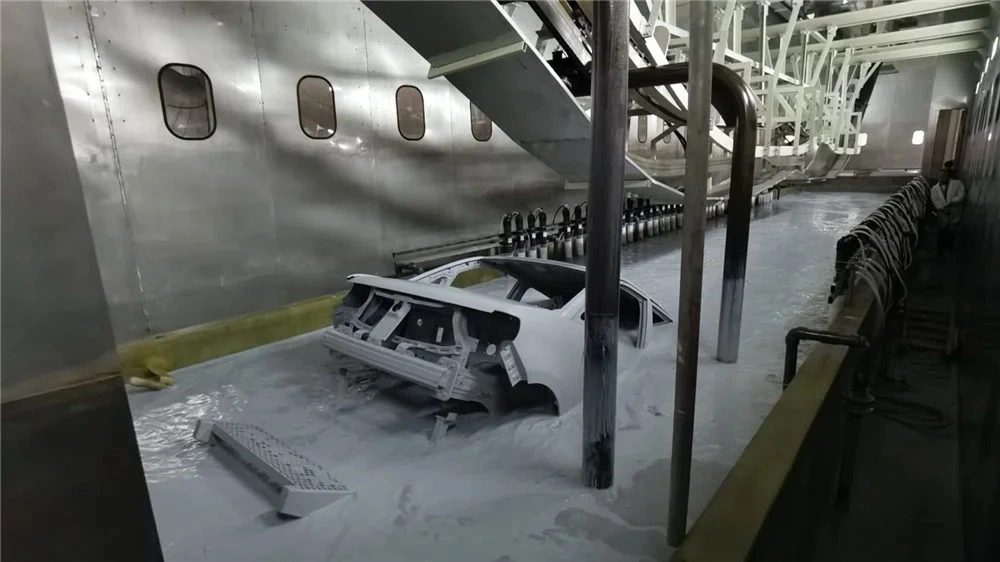
Industrial finishing lines fall into three primary configurations. The correct choice depends on part mix, volume, and changeover flexibility:
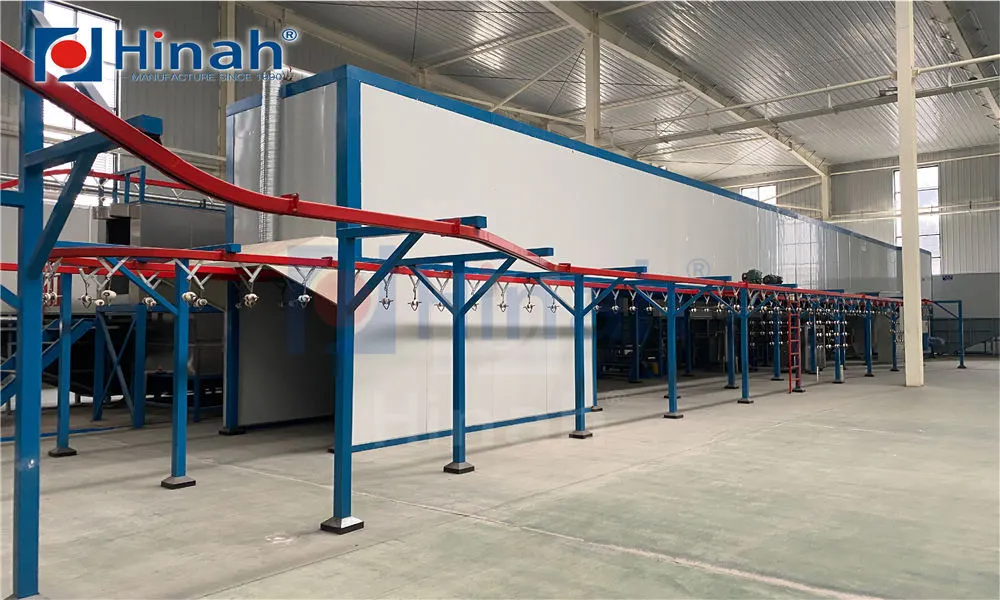
Continuous Monorail Systems: Ideal for high-volume, low-variety production (e.g., automotive wheels, appliance panels). Conveyor speeds typically range from 3 to 8 m/min, with fixed gun positions and automated reciprocators. These systems achieve the lowest cost per square meter coated but require longer color-change times (30–60 minutes).
Batch (Indexing) Lines: Suited for job shops and contract coaters processing diverse part sizes and frequent color changes. Parts are loaded onto carts or racks that move through each process stage in sequence. While labor-intensive, batch lines offer maximum flexibility and lower initial investment.
Hybrid Power-and-Free Conveyors: Combine the efficiency of continuous movement with accumulation zones that allow independent speed control for each process module. These systems are specified for complex assemblies (e.g., agricultural equipment frames) where different coating thicknesses or cure schedules are required on the same part.
When evaluating industrial powder coating equipment, request line speed simulations that demonstrate achievable throughput for your largest and smallest parts. Ensure that the conveyor drive system includes variable-frequency drives (VFDs) to adjust speed without mechanical modifications.
Substrate preparation accounts for 30–40% of coating failures when improperly specified. Industrial lines must integrate multi-stage washers with precise chemical control:
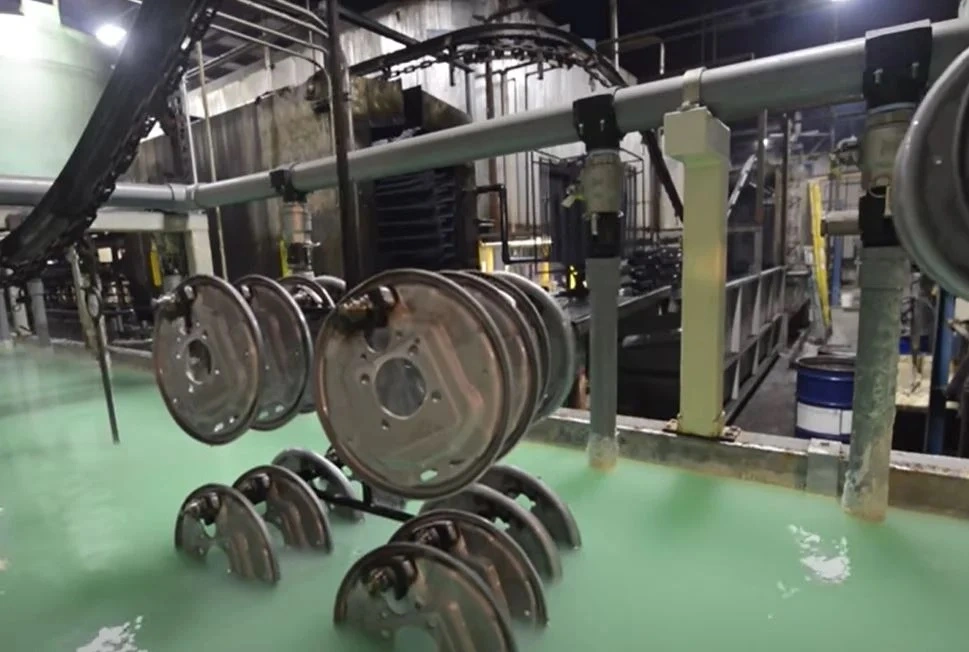
Iron phosphate (3-5 stage): Adequate for interior applications or mild environments. Requires dwell times of 60–90 seconds per stage and temperatures between 45–60°C.
Zinc phosphate (5-7 stage): Mandatory for automotive, agricultural, and coastal-exposed products. Includes deionized (DI) rinse stages to prevent salt deposition. Chemical bath parameters (free acid, total acid, accelerator) must be monitored continuously with automated dosing systems.
Nano-ceramic conversion coatings: Increasingly specified as an environmentally compliant alternative to zinc phosphate. These operate at ambient temperatures and produce less sludge, but require tighter pH control (4.5–5.5) and DI water quality below 20 µS/cm.
Integrated drying ovens must achieve part surface temperatures of 110–140°C for 8–12 minutes to eliminate moisture before coating. Infrared (IR) dryers are preferred for complex geometries, as they penetrate recessed areas more effectively than convection. Ensure that the dryer includes temperature profiling ports to validate that all part surfaces reach the required temperature.
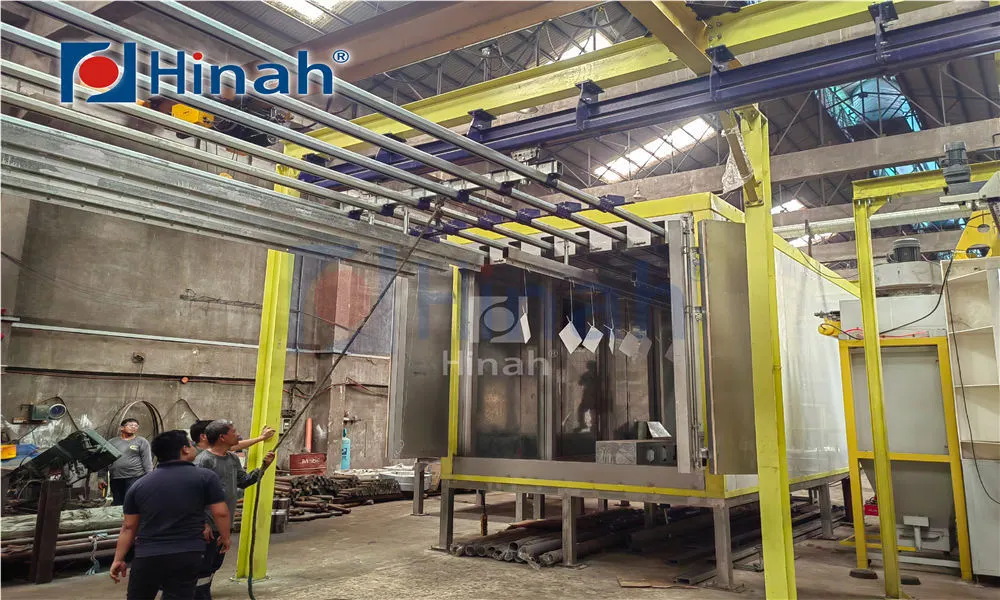
The spray booth is where material utilization and operator safety intersect. Key specifications for industrial environments:
Downdraft booths: Provide the highest containment efficiency (>98%) for large or complex parts. Air velocity of 80–100 ft/min is maintained across the booth opening, drawing overspray downward through floor grates. Required pit construction adds to installation cost but reduces housekeeping labor by 50% compared to crossdraft designs.
Side-draft booths: Ideal for long parts (extrusions up to 8 meters) where crossdraft would create velocity gradients. Adjustable airfoil vanes maintain uniform airflow across the part length.
Crossdraft booths: Suitable for parts under 1.5 meters in height. Lower initial cost but more susceptible to turbulence from operator movement.
Cartridge filter technology: Industrial booths utilize nanofiber-coated cartridges (MERV 15) with 99.9% efficiency on particles down to 0.5 µm. Automated pulse-jet cleaning maintains differential pressure below 1.5 inches water column.
Closed-loop recirculation: Returns conditioned air to the plant after filtration, reducing HVAC energy consumption by 30–40% compared to single-pass exhaust systems.
Reclaim management: Automated sieving (200–270 mesh) and rationing systems ensure consistent reclaim-to-fresh ratios (maximum 30% reclaim for most formulations).
For high-mix operations, quick-color-change (QCC) booths with modular cartridge banks and sweep-floor systems reduce changeover from 45 minutes to under 12 minutes. HANNA offers QCC platforms that include pre-programmed purge cycles and automated gun cleaning, further minimizing cross-contamination risk.
The oven is the largest energy consumer in any coating line. Industrial-grade ovens must deliver documented thermal uniformity and incorporate energy recovery:
Temperature uniformity: Request thermal profiles demonstrating ±5°F (±2.8°C) across all zones and across the oven cross-section. Non-uniformity causes under-cure (poor adhesion, low impact) or over-cure (color shift, embrittlement).
Insulation and construction: High-density mineral wool (6-inch minimum) with thermal break construction reduces heat loss by 35% compared to standard 4-inch panels. Stainless steel interior liners resist corrosion from outgassing volatiles.
Burner technology: Low-NOx, modulating burners with 10:1 turndown ratios maintain precise temperature control and reduce gas consumption by 15–20% relative to on/off burners.
Waste heat recovery: Exhaust-to-fresh-air heat exchangers or heat wheels reclaim up to 50% of waste energy. Payback periods typically range from 12 to 24 months in continuous operation.
For lines with varying part thicknesses, consider ovens with zone segmentation that allow independent temperature control for different sections. This prevents over-curing of thin sections while ensuring thick castings reach full cure.
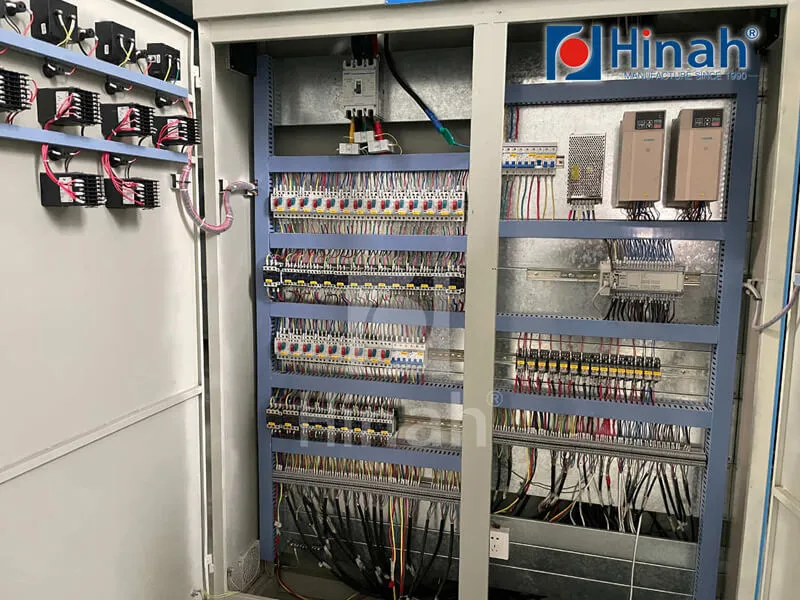
Modern industrial powder coating equipment incorporates PLC-based automation with real-time monitoring and predictive analytics. Essential capabilities include:
Recipe management: Centralized storage of gun parameters (kV, µA, flow rate), booth airflow, oven zone temperatures, and conveyor speed for each SKU. Reduces setup errors by over 90%.
Remote diagnostics: Ethernet/IP or Profinet connectivity enables vendor support to troubleshoot issues without on-site visits, reducing mean time to repair (MTTR) by 40–60%.
Predictive maintenance: Vibration sensors on fan and pump motors, pressure transducers on filter systems, and thermocouple arrays on oven zones feed into maintenance scheduling algorithms.
Energy monitoring: Sub-metering of electrical and gas consumption per shift enables precise cost accounting and identification of efficiency opportunities.
Control panels should be UL 508A certified and include safety interlocks per NFPA 79. Ensure that the system includes a historian database to store at least 12 months of process data for root cause analysis of defects.
When comparing industrial powder coating equipment, total cost of ownership (TCO) over 10 years typically breaks down as:
Initial capital: 25–35% of TCO
Energy consumption: 30–40%
Powder and chemical consumables: 20–25%
Maintenance and spare parts: 8–12%
Downtime and rejects: 5–10%
Key metrics to request from vendors:
kWh per square meter coated: Best-in-class lines achieve <1.2 kWh/m² for application and curing combined.
Transfer efficiency (TE) at standard conditions: Industrial booths should demonstrate >70% TE on flat panels and >65% on complex geometries with proper grounding.
Mean time between failures (MTBF): For critical components (conveyor drives, oven burners, booth fans), request documented MTBF data.
Facilities operating multiple shifts should prioritize equipment with redundant fans, dual filter banks, and modular components that allow hot-swap replacement without line stoppage. HANNA provides TCO modeling tools that factor in local utility rates, labor costs, and projected throughput to guide equipment selection.
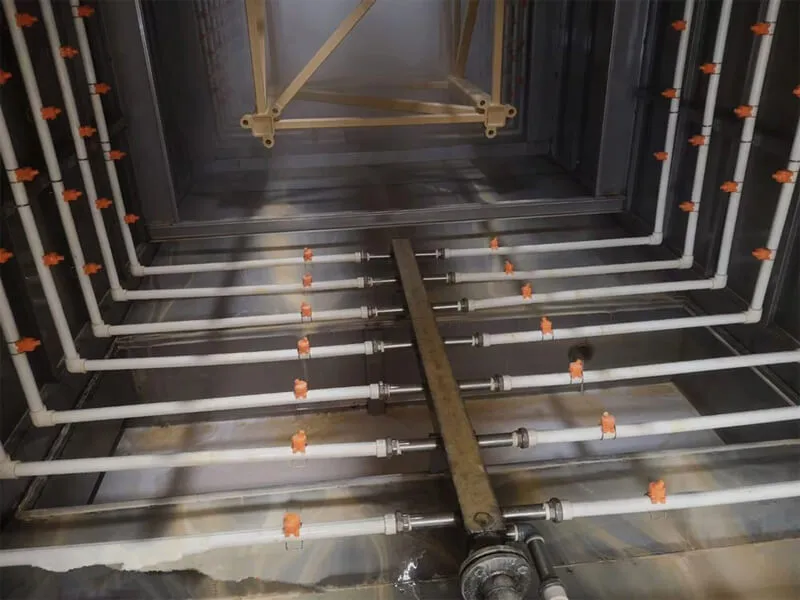
Equipment performance ultimately depends on proper installation, training, and after-sales support. Essential vendor capabilities:
Project management: Single-point responsibility for civil works, utilities integration, and equipment installation. Request detailed Gantt charts with milestones for foundation work, mechanical installation, electrical hookup, and commissioning.
Commissioning protocols: Formal Factory Acceptance Testing (FAT) and Site Acceptance Testing (SAT) with documented verification of all performance guarantees: transfer efficiency, temperature uniformity, throughput rates, and safety interlock functions.
Training programs: Comprehensive operator training on gun setup, booth cleaning, and preventive maintenance; technician-level training on PLC programming, oven calibration, and troubleshooting.
Spare parts logistics: Guaranteed availability of critical spares (cartridge filters, gun nozzles, burner igniters, conveyor chain links) with lead times under 48 hours. Consider consignment inventory agreements for high-wear items.
Request references from facilities with similar production profiles (part size, volume, substrate) and conduct site visits to observe equipment in operation. Pay particular attention to housekeeping practices—lines that are clean and well-maintained typically reflect strong vendor support and reliable equipment design.
Q1: What is the typical lead time for custom-engineered industrial
powder coating equipment?
A1: For standard modular systems, lead
times range from 8 to 16 weeks. Fully customized lines with specialized
automation, pits, or unique part handling require 20–24 weeks. Verify that
vendors provide a detailed project timeline with milestones for design approval,
FAT, shipping, and site commissioning. Expedited schedules often compromise FAT
thoroughness—ensure at least 2–3 weeks allocated for testing before
shipment.
Q2: How do I calculate required oven length and conveyor speed for my
production targets?
A2: Oven length (meters) = conveyor speed
(m/min) × required dwell time (min). Dwell time is determined by powder
manufacturer’s cure schedule—typically 10–15 minutes at metal temperature. Add
20% to calculated length to accommodate part spacing and thermal recovery zones.
Use thermal profiling during commissioning to validate that the heaviest parts
in your mix reach full cure temperature within the specified zone. Conveyor
speed should be adjustable via VFD to accommodate different part families.
Q3: What are the most critical safety certifications for industrial
coating lines?
A3: For North America, NFPA 33 (Spray Application
Using Flammable or Combustible Materials) and NFPA 70 (National Electrical Code)
are mandatory. OSHA 1910.107 covers spray booth requirements. For European
markets, ATEX 137 (Directive 1999/92/EC) and EN 12981 (Coating plants—Spray
booths for organic powder) apply. Ensure that control panels are UL 508A or CE
certified, and that explosion venting is calculated per NFPA 68 or EN 14491.
Request documentation of third-party certification for all safety-critical
components.
Q4: Can industrial powder coating equipment handle both high-volume
runs and small batch jobs?
A4: Yes, with appropriate design
features. Look for lines with modular booths that offer quick-color-change (QCC)
functionality (cartridge banks, sweep floors, automated purge cycles) and ovens
with wide turndown ratios to accommodate varying throughput. Power-and-free
conveyor systems allow batch processing within continuous lines by providing
accumulation zones. Vendors like HANNA offer hybrid platforms that switch between batch and continuous modes with
minimal changeover time.
Q5: What is the expected lifespan of industrial powder coating
equipment, and how can I maximize it?
A5: With proper maintenance,
well-engineered lines operate effectively for 15–20 years. Key longevity
factors: (1) use of stainless steel in pre-treatment sections to prevent
corrosion; (2) regular conveyor chain elongation monitoring and replacement
before exceeding 3% stretch; (3) annual oven calibration and insulation
inspection; (4) maintaining proper filtration to prevent powder migration into
mechanical components. Preventive maintenance costs typically run 2–4% of
initial equipment cost annually—a critical investment to avoid unplanned
outages.
Q6: How do I evaluate energy efficiency claims from equipment
vendors?
A6: Request detailed energy audits with sub-metered data
from reference installations comparable to your production volume. Key metrics:
kWh per square meter coated (total line), cubic meters of natural gas per square
meter (oven only), and compressed air consumption per shift (booth pulse
cleaning). Verify that energy recovery systems (heat exchangers, recirculation)
are included in the proposed configuration. Some utilities offer incentives for
energy-efficient equipment—check with your local provider for available rebates
that can offset capital costs.