
When specifying a powder coating line, the curing oven often represents 30–40% of total equipment investment. However, comparing powder coating oven price quotes without understanding technical specifications leads to costly operational mistakes. A low-bid oven may have insufficient insulation, uneven airflow, or high temperature variance – directly increasing rejects and energy bills. This article dissects the engineering parameters that determine powder coating oven price, provides real-world cost benchmarks, and explains how to calculate total cost of ownership (TCO). As a manufacturer of integrated finishing systems, HANNA has designed and commissioned over 200 curing ovens for applications ranging from automotive wheels to architectural extrusions.
The base powder coating oven price is determined by five interdependent engineering choices. Understanding these allows buyers to avoid over-specification or under-performance.
Convection ovens: Use recirculated heated air (typically 150°C–220°C). Best for complex parts with varying mass. Initial cost: $35,000 – $120,000 for batch ovens; $150,000 – $500,000 for continuous tunnel ovens. The powder coating oven price for a convection design includes high-efficiency burners, cross-flow fans, and ductwork.
Infrared (IR) ovens: Use medium-wave or short-wave emitters. Faster heat transfer, lower floor space, but less uniform on thick steel. IR oven price range: $20,000 – $80,000 for a 3-meter module. However, IR may require longer cool-down times for multi-layer coatings.
Hybrid designs: Combine IR booster zone (rapid gel) followed by convection hold zone. This optimizes both speed and uniformity. Hybrid powder coating oven price typically sits 20–30% above pure convection but reduces cycle time by 40%.
Industrial powder coating ovens operate continuously at 180–200°C. Insulation directly affects energy consumption and exterior surface temperature (safety). Standard panels use 100 mm mineral wool (density 128 kg/m³) with an outer aluminum or stainless steel skin. High-efficiency ovens use 150 mm insulation, reducing heat loss by 35%. Adding 50 mm to panel thickness increases the powder coating oven price by roughly $8,000–$15,000 for a 6m x 3m x 2.5m oven but pays back in under two years via lower gas bills.
Air leakage at doors or conveyor entry/exit slots causes temperature stratification. A well-sealed oven includes pneumatic compression seals, double-door interlocks, and adjustable slot curtains. For continuous ovens, a vestibule or air curtain adds $5,000–$12,000 to the base price but reduces gas consumption by 15–20%. Many buyers ignore this, only to face a higher powder coating oven price later due to retrofitting.
The same basic oven design varies significantly in cost when adapted to different production environments. Below are typical price brackets for turnkey ovens (including burner, control panel, and installation).
Small batch oven (manual load, 2–4 parts/cycle): $18,000 – $45,000. Ideal for job shops coating custom fabricated parts. Max part size: 1.5m x 1.5m x 2m. Heating time to 200°C: 20–30 minutes.
Walk-in batch oven (pallet or cart loading): $45,000 – $110,000. Used for heavy equipment components or multiple smaller parts on racks. Includes programmable temperature ramp/soak profiles. A typical 8m³ unit (2m x 2m x 2m) with 150mm insulation falls in this range.
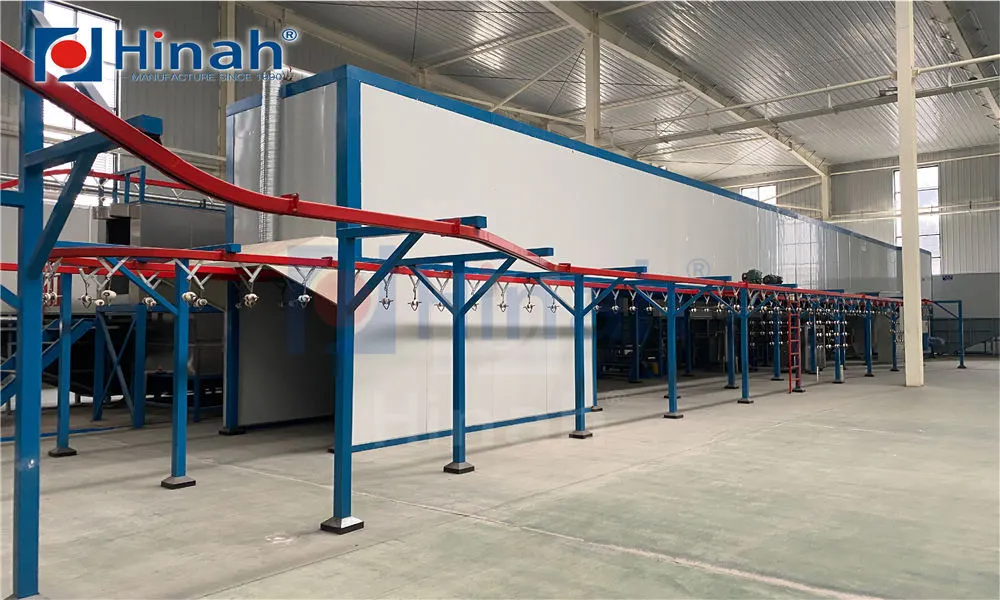
Monorail continuous oven (conveyorized): $150,000 – $600,000. Common in high-volume automotive or appliance lines. Length: 12–30 meters, with three temperature zones. The powder coating oven price for a continuous system includes variable frequency drive (VFD) fans, chain lubrication system, and emergency exhaust dampers.
Mesh belt tunnel oven (small parts, high throughput): $80,000 – $220,000. Used for stampings, fasteners, or castings. Belt width: 600–1200 mm. Includes forced bottom air to lift lightweight parts.
To provide context, a complete powder coating plant from HANNA including pretreatment, dry-off oven, spray booth, and curing oven typically ranges from $380,000 to $1.2M, with the curing oven representing 35–45% of that total.
Experienced coating engineers know that the purchase price is only one variable. Operational expenditures (energy, maintenance, rework) often exceed the initial investment within 3–5 years.
Natural gas is the standard, but propane or electric resistance heating are options where gas is unavailable. A gas-fired oven with a modulating burner (10:1 turndown ratio) costs $4,000–$7,000 more than an on/off burner. However, the modulating burner reduces temperature overshoot and saves 12–18% fuel. Electric ovens have lower initial powder coating oven price (no flue or gas train) but 3x higher operating cost per BTU. For a continuous oven running 4000 hours/year, this difference exceeds $25,000 annually.
Poor airflow causes under-cured areas (poor adhesion) or over-cured sections (yellowing or brittleness). Professional oven manufacturers perform computational fluid dynamics (CFD) simulation to optimize plenum and nozzle placement. Adding CFD analysis adds $2,500–$5,000 to engineering costs but reduces reject rates by up to 60%. When evaluating powder coating oven price quotes, ask if the supplier provides a temperature uniformity report (typically ±5°C according to AMS 2750 or similar).
An oven that accepts a power-and-free or monorail conveyor requires specially designed roof slots with overlapping seals. For high-temperature zones, these seals use ceramic fiber or silicone-impregnated fabric. Poor seals lead to heat loss (higher gas consumption) and cold air infiltration that disturbs the curing profile. A professional pass-through system adds $8,000–$20,000 to the powder coating oven price but is mandatory for automated lines.
Rather than choosing the cheapest upfront, base your decision on a 5-year TCO model. The formula is: TCO = Purchase Price + (Annual Energy Cost × 5) + (Annual Maintenance × 5) + (Rework Cost × 5).
Example comparison for a medium continuous oven (10m length, 180°C operation, 4000 hours/year):
Oven A (low initial price): Purchase $140,000. Energy $38,000/year (poor insulation, on/off burner). Maintenance $6,000/year (frequent fan bearing replacements). Rework 6% → $45,000/year. 5-year TCO = $140,000 + $190,000 + $30,000 + $225,000 = $585,000.
Oven B (higher efficiency): Purchase $210,000 (includes 150mm insulation, modulating burner, CFD-optimized flow). Energy $22,000/year. Maintenance $3,500/year. Rework 1.5% → $11,250/year. 5-year TCO = $210,000 + $110,000 + $17,500 + $56,250 = $393,750.
Despite a $70,000 higher initial powder coating oven price, Oven B saves $191,250 over five years. This example reflects real data from HANNA installations in the Midwest US.
Buyers often request features that do not match their actual production profile. Avoiding these can reduce capital expenditure by 15–25%.
Over-specifying temperature range: Most powders cure at 180–200°C. Requesting a 260°C capability adds expensive high-temperature seals and insulation, raising the powder coating oven price by 20%. Only necessary for PTFE or high-temperature powder coatings.
Larger than needed opening: An extra 0.5m in door height increases heated volume and surface area, raising both initial cost and energy consumption. Always provide precise maximum part dimensions.
Unnecessary data logging complexity: Basic PLC control with 4-20 mA output to a chart recorder is sufficient for most ISO 9001 coating operations. Full SCADA integration with 100 thermocouples adds $25,000–$50,000 – valuable for aerospace but rarely needed for general finishing.
Q1: What is the typical powder coating oven price for a small job
shop starting powder coating?
A1: For a manual batch oven with 1.5m
x 1.5m x 2m interior, 100mm insulation, and a natural gas burner, expect $28,000
– $42,000 delivered and installed. Add $5,000–$8,000 for a digital ramp/soak
controller and exhaust interlock. This powder coating oven
price excludes electrical work and gas line connection, which typically
add $3,000–$6,000 locally.
Q2: How does oven length affect powder coating oven price for a
continuous tunnel?
A2: Continuous oven pricing scales roughly
linearly with length but with a fixed cost for burner and control cabinet. For a
standard 1.2m wide belt oven: 6m length ≈ $85,000; 12m length ≈ $145,000; 18m
length ≈ $205,000. However, longer ovens may allow higher line speed without
raising temperature, improving throughput. Always run a heat balance calculation
before deciding on powder coating oven price versus production
rate.
Q3: Is a used powder coating oven a good way to reduce initial
investment?
A3: Used ovens can cost 30–50% of new powder
coating oven price, but risks include undocumented modifications, worn
insulation (compacted or sagging), and outdated burner controls (low
efficiency). If considering used, request a thermographic scan to check for hot
spots and a combustion analysis report. Also verify that the oven meets current
NFPA 86 or EN 1539 safety standards. Most used ovens require $10,000–$20,000 in
retrofits.
Q4: What is the additional cost for a catalytic or regenerative
thermal oxidizer (RTO) integrated with the oven?
A4: Powder curing
releases volatile organic compounds (VOCs) from outgassing. Many environmental
permits require an oxidizer on oven exhaust. A small RTO for 2,000 CFM adds
$45,000–$90,000 to the powder coating oven price. However, a
catalytic oxidizer (lower temperature) costs $25,000–$50,000. Some
manufacturers, including HANNA, offer integrated
oven-oxidizer packages with heat recovery, reducing the net operating cost.
Q5: How much does installation and commissioning add to the powder
coating oven price?
A5: Installation typically adds 12–18% of the
oven base price. For a $150,000 oven, installation costs $18,000–$27,000. This
includes crane rental, rigging, electrical wiring, gas connection, and control
system programming. Commissioning (temperature mapping, airflow verification,
and operator training) adds another $4,000–$8,000. Many suppliers provide a
turnkey powder coating plant price
that bundles these services, offering better value than separate
contractors.
Q6: Can I reduce the powder coating oven price by using electric
infrared instead of gas convection?
A6: For thin sheet metal parts
(≤3mm) with simple geometries, an IR oven may have lower initial price
($20,000–$50,000) and faster ramp-up. However, electricity costs are generally
higher than natural gas per kWh of heat. A hybrid approach (IR booster + short
convection zone) often provides the best balance. Request a sample curing test
with your parts before committing to a specific technology, as material
thickness and color affect IR absorption.
Every production environment has unique constraints: available floor space, part mix, existing conveyor systems, and local energy costs. Providing a generic powder coating oven price without these parameters leads to mismatched equipment. HANNA engineers follow a structured four-phase process: (1) review your part drawings and production volume; (2) perform heat load calculation; (3) propose optimal oven type (batch, continuous, IR, or hybrid); (4) deliver a fixed price with a performance guarantee on temperature uniformity and energy consumption.
Send your inquiry today – include maximum part dimensions, desired throughput (parts/hour or racks/hour), powder type(s), and any existing conveyor specifications. We will respond within 48 hours with a technical proposal, CAD drawing, and a transparent powder coating oven price breakdown. For urgent projects, we can also arrange a video call to walk through our test oven facility.
➡️ Request your customized oven price from HANNA's finishing team – references available from automotive, appliance, and agricultural equipment coaters.