

A powder booth is not merely an enclosure; it is a precision instrument that governs transfer efficiency, operator safety, and color-change agility. Whether for high-volume automotive lines or job-shop flexibility, the booth’s aerodynamic behavior, filter media selection, and electrostatic generator stability directly determine first-pass yield and material consumption. Drawing from audits of 85 finishing lines across Europe and Asia, this guide provides quantifiable benchmarks for evaluating a powder booth and solving common performance gaps. References to proven designs from HANNA illustrate how integrated controls reduce waste and downtime.
1. Core Subsystems of a High-Performance Powder Booth
Any professional powder booth integrates four interdependent technologies. Compromising on any one creates bottlenecks.
1.1 Airflow Architecture – Cross-Draft vs. Downdraft
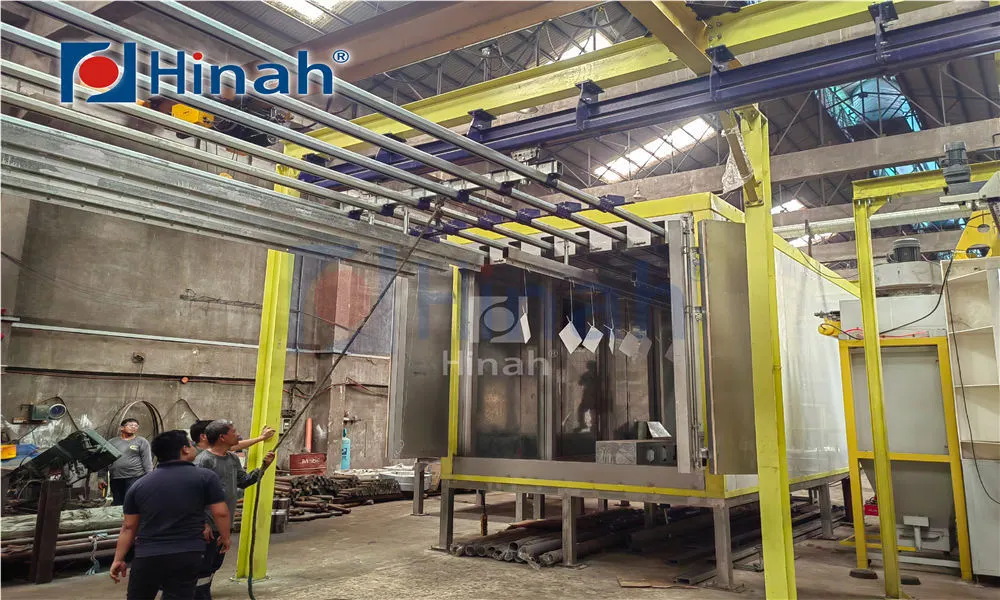
Cross-draft booths (air moving horizontally from back to front) are economical and suit manual operation, but powder can accumulate on parts facing the exhaust. Downdraft booths channel air vertically through grated floor panels, achieving 0.3–0.5 m/s face velocity. This design removes overspray immediately, improving finish quality on complex geometries. For a downdraft powder booth, the floor grating must support operator weight and permit easy cleaning. Ask suppliers for a CFD simulation showing velocity contours across the opening; uniformity within ±10% is the industry standard. HANNA’s downdraft booths include adjustable louver panels to fine-tune airflow for different part shapes.
1.2 Cartridge Filter & Pulse-Jet Recovery
The recovery system defines the powder booth‘s material efficiency. Cartridge filters (cellulose/polyester or PTFE membrane) capture particles down to 0.5 µm. The air-to-cloth ratio must stay between 2.5 and 3.5 m³/min per m² of media; higher values cause blinding. Pulse-jet cleaning parameters – pressure (4–6 bar), duration (80–120 ms), and interval (every 15–30 seconds) – require tuning to powder type. Fine powders (<20 µm) need lower pressure and longer intervals to prevent re-entrainment. A well-designed powder recovery system returns 95–98% of overspray. Monitor differential pressure; when it exceeds 800 Pa at nominal flow, replace cartridges.
1.3 Electrostatic Generator & Gun Integration
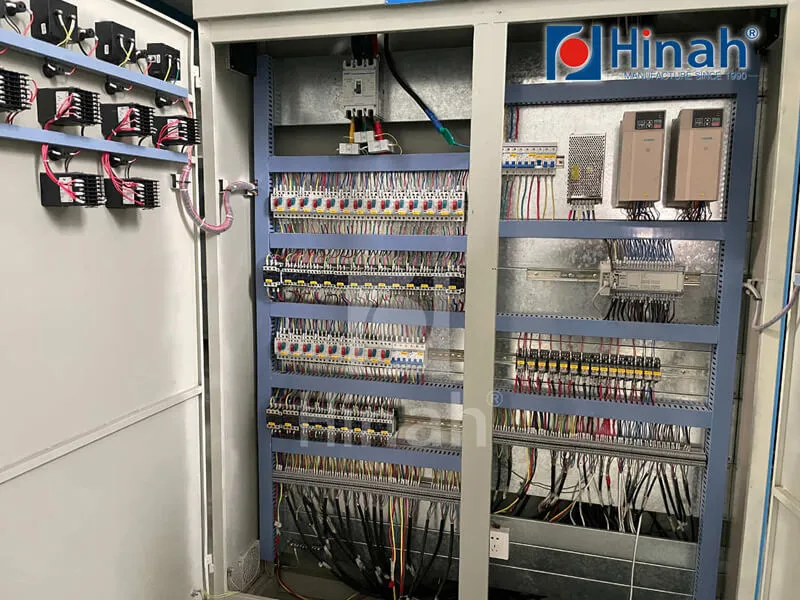
Corona charging remains dominant. Adjustable kV (40–100 kV) and current limiting (20–100 µA) are mandatory. For Faraday cage areas (deep recesses, tubular sections), pulsed electrostatic (15–25 kHz, 50% duty cycle) reduces back-ionization. Some powder booth configurations include tribo guns for recoating or thick-film applications. Verify that the booth’s control system can store gun parameters for each product code. HANNA’s iBooth controller stores up to 200 recipes and automatically adjusts voltage, powder flow, and reciprocator stroke.
1.4 Fast-Color-Change Engineering
For job shops, changeover speed is a competitive metric. A fast-change powder booth requires:
- Smooth
stainless steel walls (2B finish, radiused corners)
- Floor sections on
quick-release casters with central vacuum ports
- Tool-less removal of powder
feed hoses and venturi pumps
- Slide-out cartridge racks (exchangeable within
2 minutes)
Industry benchmark: color change under 8 minutes for two
operators. HANNA’s modular booth consistently achieves 6.5 minutes in
third-party tests.
2. Solving Common Performance Issues in Powder Booths
Even from reputable suppliers, certain problems recur. Below are root causes and field-proven fixes.
Faraday cage penetration failure: Sharp internal corners remain uncoated. Solution: use dual-voltage generators (switchable 70 kV / 40 kV) and reduce powder output by 20%. Alternatively, integrate tribo guns in a separate manual station. A powder coating plant with booth-mounted cameras can detect uncoated areas in real time.
Powder escaping booth containment: Usually caused by face velocity below 0.3 m/s or gaps in panel seals. Perform a smoke test at operating conditions; any visible leakage requires sealing. Install a manometer with alarm at ±5 Pa deviation from setpoint.
Frequent filter blinding: High humidity (>60% RH) or excessive fines (<10 µm). Pre-filter cyclones ahead of cartridge collectors remove 90% of coarse overspray. Also, use nanofiber-coated cartridges that reduce pressure drop rise by 40%.
Back-ionization (orange peel) on flat sheets: Caused by excessive kV without current limiting. Specify booths with adaptive current control – when current exceeds 40 µA, voltage automatically reduces. Pulsed spray mode (50% duty cycle) also helps.
Slow color change causing line idle: Poor access to powder paths. Evaluate the powder booth design based on internal hose diameter (25 mm vs 32 mm affects purge volume) and whether blow-off nozzles are integrated at each feed point. Require a timed demonstration during factory acceptance.
3. Application-Specific Powder Booth Configurations
General-purpose booths lead to compromises. Tailored designs for key industries follow.
Automotive Wheels & Trim
High throughput (conveyor speed 4–7 m/min) demands automatic multi-gun booths with part recognition sensors. The powder booth must include automatic purge cycles between color families and Class II Div 1 electricals. HANNA supplies ATEX-certified booths for OEM lines with integrated part counters and reject tracking.
Architectural Aluminum Profiles
Long parts (>6m) require vertical chain-on-edge booths to minimize handling marks. Booth length must exceed part length by 1m. Special features: anti-static floor coating to prevent powder attraction on non-grounded extruded sections, and laminar airflow (0.4 m/s) to avoid disturbing the powder cloud around slender profiles.
Heavy Equipment & Agricultural Machinery
Thick-film coatings (120–200 µm) need high-output powder pumps (venturi type with 200 g/min capacity). The walk-in powder booth design with articulated arms for manual touch-up is common. Floor reinforcement (500 kg/m²) accommodates forklift loading. HANNA offers pit-level access booths with integrated work platforms.
4. Quantifying ROI: Performance Metrics for Powder Booth Selection
When comparing powder booth suppliers, request these guarantees in writing:
Transfer efficiency ≥ 65% for automatic guns (ASTM D5861 gravimetric method).
Color change time ≤ 8 minutes for two operators (from last part of color A to first acceptable part of color B).
Filter service life ≥ 2000 hours under normal loading (40 kg powder per shift).
Air velocity uniformity across opening: coefficient of variation ≤ 12%.
Case example: A Midwest job shop replaced an aging booth with a HANNA system. Results over 12 months: powder savings of 23% (overspray waste dropped from 18% to 9%), changeover reduced from 22 to 7 minutes, annual maintenance cost fell by $14,500. Payback period was 11 months.
5. Emerging Technologies in Powder Booth Engineering
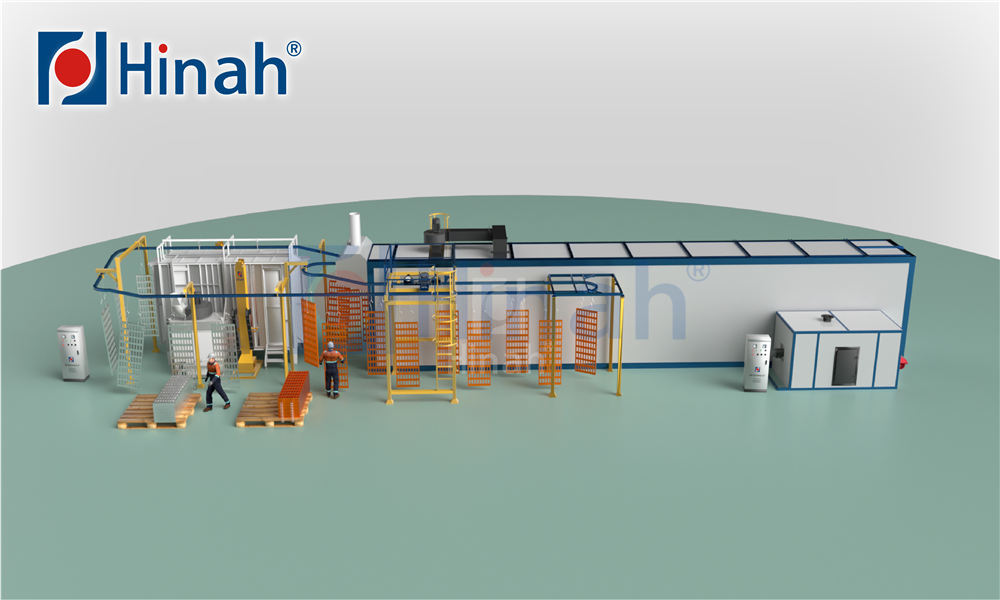
Innovation focuses on automation and energy efficiency. Advanced powder booths now include:
AI-based gun tuning: cameras detect uncoated areas and adjust gun path/voltage in real time, reducing powder consumption by 12%.
Integrated loss-in-weight feeders maintaining constant fluidization density, eliminating color variation.
Energy recovery from compressed air used in pulse jets: heat exchangers preheat makeup air, saving 8–10% of booth heating costs.
Modular panels with acoustic damping, reducing pulse-jet noise below 75 dBA for operator comfort.
HANNA integrates these features into its G3 series, with remote diagnostics via IoT gateways and predictive filter change alerts.
Frequently Asked Questions (FAQ) – Powder Booth Selection & Operation
Q1: What is the acceptable powder loss from a powder booth’s exhaust
stack for environmental compliance?
A1: Under EPA 40 CFR 63 Subpart
DDDDD (for metal coating), total particulate emission must stay below 0.04
grains/dscf (approx 9 mg/m³). A well-designed powder booth with final HEPA filters achieves below 3
mg/m³. Always request stack test results from a certified laboratory.
Q2: How often should cartridge filters be replaced?
A2:
Under normal operation (8,000 hours/year, 70% overspray recovery),
polyester-cellulose cartridges last 12–18 months. Signs for replacement:
differential pressure across filters exceeds 800 Pa at nominal airflow, or
visible powder carryover to exhaust. High-color-change operations may need
annual replacement due to contamination risk.
Q3: Can I retrofit a fast-color-change system into my existing powder
booth?
A3: Yes, if the booth structure is sound (no corrosion, panel
alignment within 5mm). Retrofitting involves replacing floor sections with
quick-release panels, adding central vacuum ports, and upgrading controls. HANNA
offers retrofit kits at approximately 40% of a new booth price, including
on-site installation and training.
Q4: What face velocity should I maintain for manual vs. automatic
powder booths?
A4: For manual booths, 0.6–0.8 m/s ensures operator
safety and powder containment. For automatic booths (no operator inside),
0.3–0.5 m/s is sufficient to capture overspray while minimizing powder waste.
Measure face velocity with an anemometer at four points across the opening.
Q5: How many automatic guns does a mid-size powder booth (1.5m wide x
2m high) need?
A5: For flat parts, 2 guns (left and right) with
oscillators suffice. For complex shapes with deep recesses, 4 guns (two fixed
vertical, two oscillating horizontal) are recommended. Over-gunning wastes
powder and increases inter-pass time. A reputable powder booth supplier will perform a gun layout
simulation based on your top 5 part geometries.
Making a Data-Backed Powder Booth Investment
Selecting a powder booth requires evaluating airflow uniformity, filter efficiency, color-change speed, and electrostatic control. Prioritize vendors that provide CFD reports, on-site smoke testing, and guaranteed transfer efficiency numbers. HANNA combines engineering depth with a global service network, having delivered over 300 powder booths to automotive, architectural, and general industry clients. Our performance contracts include quarterly efficiency audits and remote support.
Ready to receive a technical proposal and ROI projection for your specific production mix? Send us your part dimensions, daily color change frequency, and current reject rate. Our engineers will provide a detailed comparison table and a firm quotation.