
In any powder coating or liquid paint line, the paint baking oven is the critical stage where coated parts achieve their final mechanical and aesthetic properties. Whether you are curing a thermoset powder or baking a liquid topcoat, the oven must deliver precise, uniform heat to ensure crosslinking, flow, and adhesion. This article provides a deep technical overview of modern paint baking ovens, addressing heat transfer principles, common process challenges, and how leading manufacturers like HANNA engineer systems that maximise throughput while minimising energy consumption.
Three primary heat transfer modes are at work inside a paint baking oven: convection, radiation, and (to a lesser extent) conduction. In convection ovens, hot air is circulated at high velocity to scrub the part surface, raising the substrate temperature evenly. For powder coatings, convection remains the most common method because it handles complex geometries well. Infrared (IR) ovens use electromagnetic waves to directly heat the coating and substrate, offering rapid ramp‑up and precise zone control – ideal for flat panels or pre‑heated parts. Many high‑performance lines now combine both technologies in a single oven to balance speed and uniformity.
Modern convection paint baking oven designs rely on high‑volume, high‑velocity air impingement. Air is heated by natural gas burners, thermal oil, or electric elements, then directed through nozzles or slots positioned close to the part. Typical air velocities range from 15 to 30 m/s, ensuring the boundary layer is disrupted for efficient heat transfer. Temperature uniformity (ΔT) across the oven cross‑section should be within ±3°C to prevent under‑cure or over‑cure – a specification that HANNA achieves through computational fluid dynamics (CFD)‑optimised ductwork and modulating burners.
IR ovens are often used as boosters at the entrance of a convection oven. Medium‑wave IR emitters match the absorption spectrum of many powder coatings, rapidly gelling the powder to prevent contamination from air movement. In a hybrid arrangement, the first zone uses IR to set the coating, while downstream convection zones complete the crosslinking. This synergy reduces overall oven length and floor space – a key advantage when retrofitting into existing factories.
Selecting the right oven architecture depends on part geometry, production volume, and coating chemistry. Below are the main configurations used in today’s finishing lines.
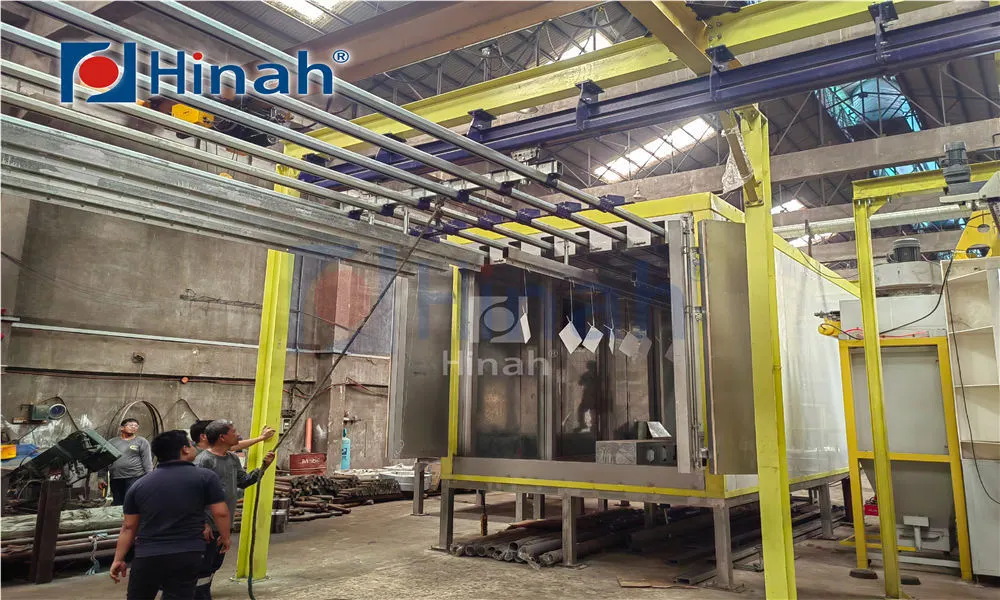
Batch ovens – Ideal for job shops and large, heavy parts. Parts are loaded onto racks, the door is sealed, and the oven cycles through a preset temperature profile. Batch paint baking oven systems offer flexibility but have lower throughput compared to continuous lines.
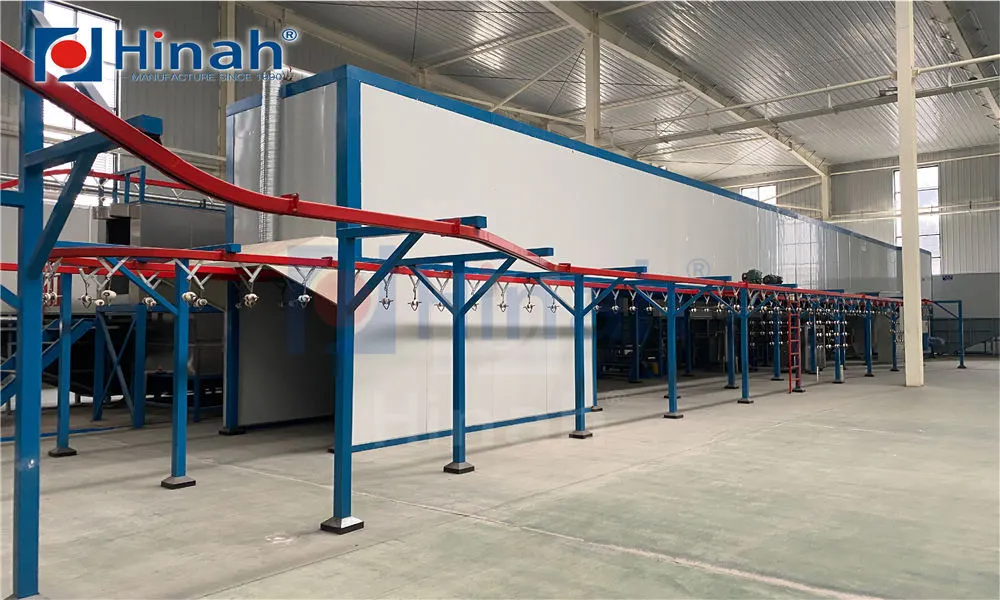
Continuous conveyor ovens – Parts move through the oven on an overhead or floor‑mounted conveyor. Zones maintain steady‑state temperatures, enabling high‑volume production for automotive, appliance, and architectural extrusion.
Walking beam / indexing ovens – Used for heavy parts like wheels or engine blocks. Parts are indexed through stations, each with controlled heating and cooling. Precise dwell time is critical for metallurgical and coating properties.
Multi‑zone combination ovens – These integrate IR, convection, and sometimes cooling sections in one continuous line. HANNA specialises in custom‑designed multi‑zone systems that optimise energy use while maintaining tight cure windows.
Even a well‑designed paint baking oven can suffer from quality issues if operating parameters drift. Below are frequent industry pain points and the engineering measures that resolve them.
Complex parts with deep recesses often exhibit lower surface temperatures, leading to incomplete crosslinking. To counter this, modern ovens use adjustable air nozzles and programmable logic controllers (PLC) that modulate burner output based on real‑time feedback from multiple thermocouples. Paint baking oven designs from HANNA incorporate “air rotation” systems that periodically reverse airflow direction, ensuring all surfaces receive equivalent heat input.
Paint baking ovens are among the most energy‑intensive equipment in a finishing plant. Heat losses occur through exhaust stacks, conveyor openings, and wall conduction. Solutions include:
High‑density mineral wool insulation (150–200 mm thickness) to reduce shell losses.
Variable frequency drives (VFDs) on recirculation fans to match air volume to actual load.
Heat recovery wheels or recuperators that capture exhaust heat to pre‑heat combustion air or incoming parts.
Catalytic oxidisers integrated with the oven exhaust to destroy VOCs while recovering thermal energy.
Data from HANNA installations show that such measures can lower gas consumption by 25–35% compared to non‑optimised ovens.
Automotive and aerospace specifications demand documented proof that every part has reached the required metal temperature for the correct duration. Continuous ovens now include multi‑point data loggers travelling with parts, or stationary IR sensors that scan part surfaces. Statistical process control (SPC) software alerts operators to drift before non‑conforming parts are produced.
When specifying a new oven or upgrading an existing line, engineers must evaluate several interdependent factors.
Most powder coatings cure between 160°C and 200°C, while some low‑bake liquid paints require only 80–120°C. Ensure the oven can maintain setpoint ±2°C across the entire working zone. Paint baking oven suppliers like HANNA provide temperature distribution reports (TDR) per ISO 13924 to validate performance.
Natural gas direct‑fired ovens are cost‑effective but introduce combustion by‑products that may affect sensitive coatings. Indirect‑fired or electric ovens eliminate this risk. For plants with waste heat from other processes, thermal oil or steam heat exchangers can be integrated.
Class 100,000 or better filtration is recommended to prevent particle contamination on wet paint before curing. In powder lines, a small amount of air extraction maintains a slight negative pressure, preventing dust escape while minimising heat loss.
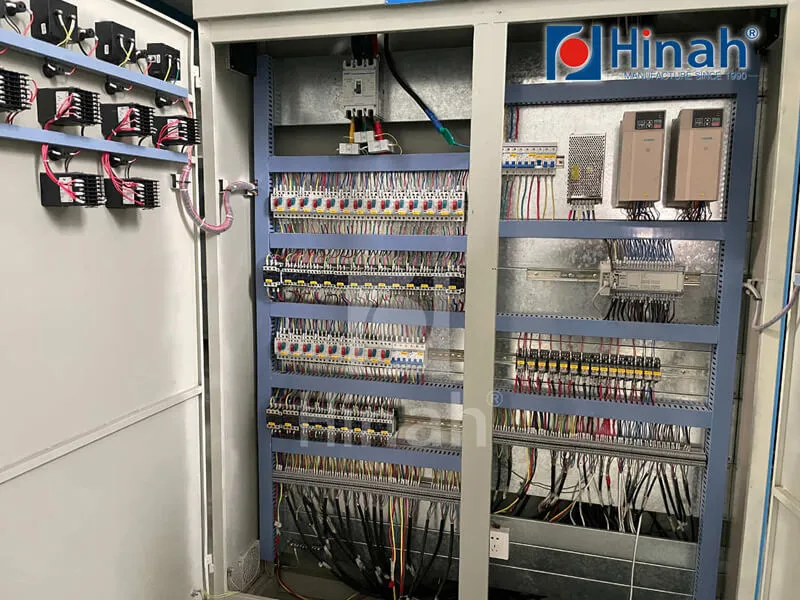
Modern ovens should feature PLC with remote monitoring, recipe storage for different part families, and open communication protocols (OPC UA, MQTT) to feed data into plant MES or ERP systems. This enables predictive maintenance and real‑OEE tracking.
With over two decades of experience in turnkey coating lines, HANNA has developed a modular platform for paint baking ovens that combines energy efficiency with process reliability. Every oven is designed using 3D CFD modelling to eliminate dead zones and ensure uniform airflow. HANNA offers both direct‑gas and indirect‑electric configurations, as well as hybrid IR/convection tunnels for specialised applications. The company’s in‑house fabrication of insulated panels and ductwork guarantees short lead times and strict quality control. Recent projects include a 6‑zone combination oven for agricultural machinery parts that reduced cycle time by 18% while cutting natural gas use by 30% compared to the client’s previous line.
Q1: What is the difference between a paint baking oven and a drying oven?
A1: A drying oven removes solvents or water from a coating at relatively low temperatures (typically below 100°C) and does not cause chemical crosslinking. A paint baking oven operates at higher temperatures (150–230°C) to initiate polymerisation or crosslinking in powder coatings and two‑component liquid paints, permanently transforming the film.
Q2: How do I determine the correct curing time for my parts?
A2: Cure time is dictated by the coating manufacturer’s technical data sheet (TDS), which specifies the substrate metal temperature required. Because heavy parts heat more slowly, you must measure the actual part temperature, not just air temperature. Use data loggers or witness coupons to verify that every part mass reaches the specified temperature for the full duration.
Q3: Can a paint baking oven designed for powder coating also cure liquid paints?
A3: Yes, provided the oven can achieve the lower temperatures needed for some liquid paints (e.g., 80°C for certain automotive clearcoats) and has adequate solvent vapour extraction to stay below 25% of the lower explosive limit (LEL). However, mixing powder and liquid in the same oven carries a risk of cross‑contamination, so dedicated ovens are often preferred.
Q4: What is the typical energy consumption of a continuous paint baking oven?
A4: Energy consumption varies widely with part weight, line speed, and insulation. As a benchmark, a well‑insulated convection oven curing 1 m² of 1.5 mm steel sheet may consume 250–350 kWh per ton of product. Retrofitting heat recovery and variable‑speed drives can lower this figure by 20–30%. HANNA offers energy audits to identify savings opportunities.
Q5: How often should a paint baking oven be maintained?
A5: Preventive maintenance should be performed quarterly, including lubrication of fan bearings, calibration of thermocouples and controllers, inspection of seals and door gaskets, and cleaning of air filters. Burners and safety devices require annual certification. Modern ovens with predictive sensors can alert maintenance teams when vibration or temperature deviations exceed thresholds.
Q6: What causes yellowing or discolouration in a powder‑coated part after baking?
A6: Over‑baking (excessive time or temperature) is the most common cause of yellowing, especially with white or light colours. Contaminants in the oven atmosphere – such as volatiles from previous batches or incomplete combustion – can also stain the surface. Ensuring proper oven exhaust, clean air makeup, and accurate temperature control (±2°C) prevents this defect.
Q7: Is it possible to convert an existing batch oven to a continuous system?
A7: In some cases, batch ovens can be modified by adding a conveyor pass‑through and zoning the interior, but the cost often approaches that of a new, purpose‑built continuous oven. HANNA evaluates each facility’s layout and production goals to recommend the most economical solution, whether a retrofit or a new modular oven line.