
In high-volume coating environments, the selection and configuration of Commercial powder coating equipment directly determines first-pass yield, energy consumption, and per-part cost. Unlike decorative or batch-process units, industrial-grade systems must sustain 18+ hours of continuous operation while maintaining film thickness tolerances below ±5µm. This guide provides a technical breakdown of modern equipment architectures, addresses production bottlenecks (Faraday cage penetration, color change downtime, reclaim inconsistencies), and presents data-driven selection criteria. HANNA integrates these principles into turnkey finishing plants, but the following insights apply to any rigorous B2B coating operation.
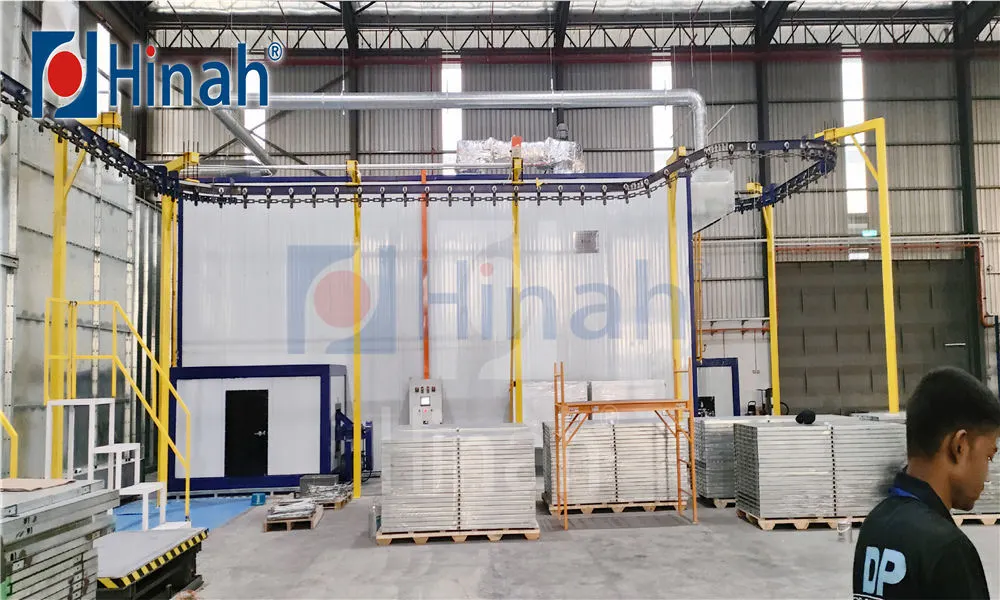
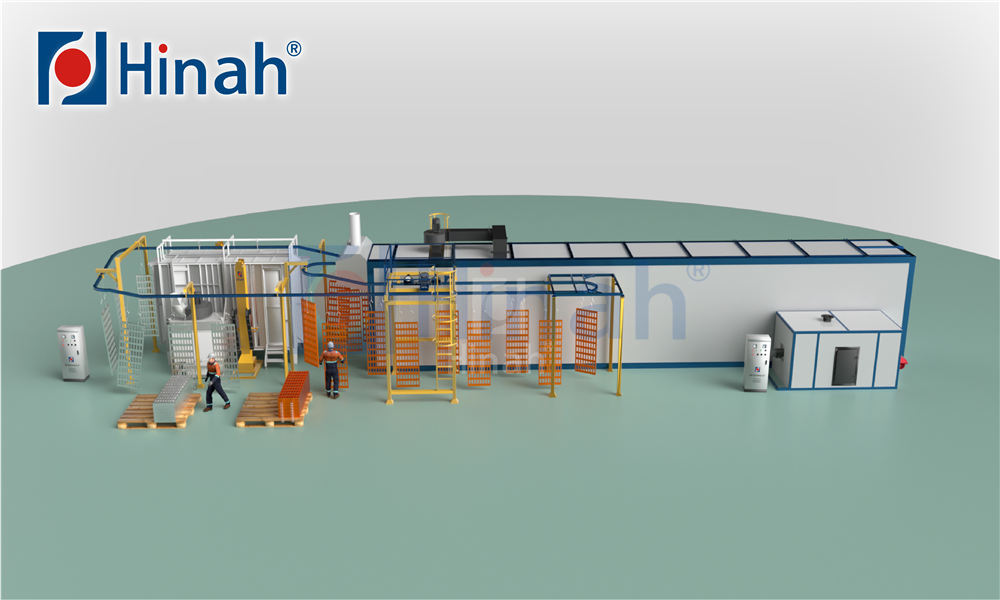
Every productive Commercial powder coating equipment line relies on four interdependent modules. Suboptimal performance in any single component compromises the entire system.
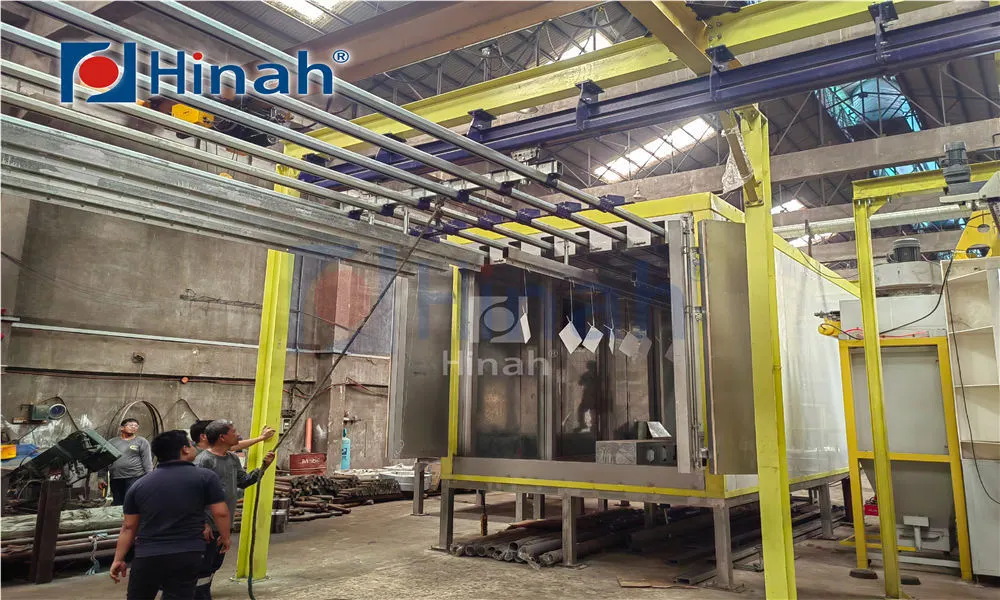
Powder coating spray booth – Aerodynamic design with controlled airflows (0.4–0.7 m/s downdraft or crossdraft) to minimize turbulence and overspray. Stainless steel construction with quick-release floor panels for color change access.
Electrostatic powder spray guns – High-voltage cascade (80–100 kV) or triboelectric charging; current-limiting circuitry to prevent back ionization on complex geometries. Key parameter: kV/µA curves matched to powder resistivity (10¹⁰–10¹⁴ Ω·cm).
Powder recovery systems – Cyclone + cartridge filter stages achieving 98.5% reclaim efficiency. Critical: filter pulse-jet timing (200–400 ms bursts at 5.5–6.5 bar) to maintain differential pressure below 1.2 kPa.
Curing oven and conveyor integration – Zoned infrared (medium-wave) combined with convection for thick substrates; temperature uniformity ±3°C measured via traversing thermocouples.
Field data from over 120 finishing lines reveals three recurring challenges that Commercial powder coating equipment must solve. Below are the root causes and engineered countermeasures.
Electrostatic fields naturally deflect from cavities, leading to thin coating inside corners. Solutions include:
Implementation of tribo-electric spraying (friction charging) which does not rely on external high voltage and provides better penetration into recesses.
Multi-gun positioning with programmable reciprocators that adjust gun-to-part distance (150–300 mm) and tilt angles (±15°).
Pulse-width-modulated (PWM) gun control – 20–50 ms intermittent bursts reduce charge accumulation while maintaining deposition.
Manual cleaning of booths and recovery loops can consume 45–90 minutes per change. Modern systems reduce this to under 10 minutes via:
Fast-color-change (FCC) booth design with smooth welded seams, removable floor plates, and internal blow-off rings.
Centralized powder management units that purge feed hoses with compressed air and reclaim virgin-to-reclaim ratio programmable per batch.
Quick-disconnect cyclone modules – complete cartridge filter exchange in under 5 minutes using clamp mechanisms.
Reclaimed powder (especially fines <10 µm) tends to agglomerate, causing orange peel. Mitigation strategies:
Sieving stations with 140–200 mesh screens (100–105 µm openings) integrated into the reclaim hopper.
Automated virgin-to-reclaim blending with closed-loop feedback from a triboelectric sensor monitoring powder flow rate (±2% accuracy).
Using acoustic fluidization instead of mechanical vibration – reduces bridging and maintains consistent bulk density (0.55–0.65 g/cm³).
Optimal Commercial powder coating equipment varies significantly by substrate geometry, required film thickness, and throughput rate. The following matrix summarizes proven setups.
Requirement: 60–80 µm single coat; 100% gloss retention after 1,000h salt spray (ASTM B117).
Equipment: 12-gun oscillating vertical reciprocators; booth length 6–8 m with independent gun control for inner/outer rim.
Recovery: Two-stage cyclone (primary for overspray >20 µm) plus secondary HEPA after-filter for air return to plant.
Challenge: Lengths up to 7 m; complex profiles with multiple channels.
Solution: Horizontal chain-on-edge (COE) conveyor; multilance reciprocating guns with programmable tilt; booth air velocity reduced to 0.35 m/s to avoid powder blow-off from deep grooves.
Quality control: Online non-contact film thickness gauge (β-backscatter) with closed-loop adjustment of powder output.
Requirement: 120–200 µm anti-corrosion coating; edge coverage mandatory.
Equipment: Powder coating spray booth with dense-phase dense-flow pump technology (150 g/min output at 6 bar).
Gun technology: Resistive cascade (60 kV max) combined with larger nozzle orifices (2.5–3.5 mm) to reduce charge-to-mass ratio and minimize Faraday cage issues on thick steel sections.
Replacing outdated equipment with current-generation Commercial powder coating equipment yields measurable improvements. Data from a 2023 retrofit project (mid-sized contract coater, 2-shift operation) show:
Transfer efficiency increase: from 52% (old corona guns) to 72% using closed-loop feedback and optimized booth airflow → powder consumption reduction of 28% (≈ $47,000 annual savings at $4.20/kg powder).
Color change time reduction: 55 minutes → 9 minutes, adding 3.2 hours of productive coating time per week (≈ 9,800 more parts/year).
Reclaim utilization rate: 42% → 71% due to improved sieving and fluidization, lowering virgin powder purchases by 19%.
Reject rate decrease from 4.7% to 1.2% (film thickness variation reduced from ±12 µm to ±4 µm).
Based on these figures, payback period for a new integrated plant (booth, guns, reclaim, oven control) typically falls between 14 and 22 months for operations coating >800 m² per shift.
To stay competitive, B2B buyers must evaluate emerging technologies that augment conventional Commercial powder coating equipment performance. The following are already deployed in early-adopter facilities.
Software models of electrostatic fields (using COMSOL or custom CFD) predict deposition patterns based on gun trajectory, part geometry, and powder particle size distribution. Operators can pre-program reciprocator paths and gun voltages offline, reducing physical trial runs by 65%.
Coriolis mass flow meters integrated into each gun feed line measure output with ±0.5% accuracy. Combined with a thickness gauge array after the booth, the system automatically adjusts powder delivery to maintain target film thickness without operator intervention.
New resin formulations cure at 130–150°C instead of 180–200°C, reducing oven energy costs by up to 30%. Curing process optimization using medium-wave IR panels in the first oven zone accelerates gelation, preventing powder sag on vertical surfaces.
Selecting a supplier solely based on component price often leads to hidden costs in integration, commissioning, and line balancing. HANNA provides process guarantees for each Commercial powder coating equipment line, including written commitment to transfer efficiency, color change time, and maximum particle emission (<5 mg/m³). Their engineering team performs on-site airflow visualization (smoke tests) and electrostatic field mapping before final acceptance. For operations with multiple shifts, HANNA offers predictive maintenance modules that track filter pressure drop, bearing vibration (ISO 10816-3), and nozzle wear, alerting technicians 200 operating hours before failure. This level of specificity reduces unplanned downtime by an average of 41% across 74 installed lines.
Furthermore, all HANNA equipment adheres to ATEX / NFPA 33 standards for Class II combustible dust, with integrated spark detection and suppression systems (infrared sensors coupled to CO₂ nozzles). Compliance documentation and full traceability logs are provided as part of the handover package.
A1: Well-maintained equipment lasts 12–15 years. The shortest-lived components are high-voltage cascade modules in spray guns (approx. 8,000–10,000 operating hours), cartridge filter elements (replaced every 12–18 months depending on reclaim load), and pump venturi blocks (wear every 2,000–3,000 kg of powder throughput). Powder recovery systems require periodic diaphragm replacement in pulse-jet valves.
A2: Retrofitting is viable if the oven provides uniform temperature (±5°C) and adequate dwell time. However, modern high-transfer-efficiency booths often reduce overspray, which may require adjusting oven airflow balance. A thermal profiling study (using 6–8 data loggers) is recommended before committing. Many suppliers, including HANNA, offer standalone booth + gun upgrades that integrate with existing ovens via conveyor sync modules.
A3: Booth length (L) in meters = (conveyor speed in m/min) × (required exposure time in minutes). Exposure time depends on number of guns and part complexity. A rule of thumb for medium-complexity parts: 8–12 seconds of exposure per coat. For 4 m/min conveyor speed, exposure of 10 seconds → 0.667 m needed. Multiply by safety factor of 1.5 → 1.0 m booth length per gun pair. Final length also includes entry/exit vestibules to contain powder.
A4: Powder with >0.5% moisture (by weight) drastically reduces charge acceptance. Resistivity drops below 10¹⁰ Ω·cm, leading to excessive current flow (back ionization) and pinholes. Use a dew point meter in compressed air lines – moisture should be below -40°C dew point. Many Commercial powder coating equipment lines now include in-line dryers and humidity sensors at the powder feed hopper.
A5: A practical method: weigh a set of 10–20 parts before coating (W1). Run a fixed amount of powder (e.g., 5 kg) through the system. After curing, weigh coated parts (W2). Total deposited powder = W2 – W1. Transfer efficiency = (deposited powder / powder fed from hopper) × 100. Average over three runs. Compare against supplier’s claimed TE – a discrepancy >7% suggests airflow imbalance or worn gun electrodes.
Every coating operation has unique constraints – part mix, available floor space, cure schedule, and environmental permits. Generic equipment recommendations often lead to suboptimal layouts and hidden operational friction. HANNA provides a four-step engineering consultation: (1) data collection of your current line OEE, (2) simulation of proposed Commercial powder coating equipment configuration, (3) firm ROI projection, and (4) on-site commissioning with operator training.
Send your production parameters (part size range, weekly output, colors used, current reject rate) to receive a customized equipment layout and quotation. All inquiries receive a detailed technical comparison report within 48 hours.
Contact the HANNA engineering team now: https://www.autocoatinglines.com/contact.html – include “Powder line inquiry” in the subject line for priority handling.