

Selecting the right powder coating oven for sale directly impacts your line's first-pass yield and operating costs. Many buyers focus only on price and dimensions. That approach leads to rejects and energy waste. This guide lists seven measurable criteria that experienced engineers use. Each point comes from field audits of industrial powder coating plants.

1. Temperature Uniformity Across the Curing Zone
A curing oven must maintain ±3°C or better throughout the load area. Poor uniformity causes under-cured spots (poor adhesion) or over-cured sections (yellowing, brittleness).
Request a nine-point thermal profile report per ASTM D3451.
Check if the oven uses multiple independent zones (warm-up, gelation, crosslinking).
Verify that thermocouples are placed on actual part surfaces, not just air.
When you inspect a powder coating oven for sale, ask for data logs from the last 12 months. Look for temperature dips during conveyor stops – a sign of poor thermal mass or undersized burners.
2. Convection vs. Infrared (IR) Heating Technology
Two main heating methods dominate industrial ovens. Each suits different production needs.
Convection Ovens
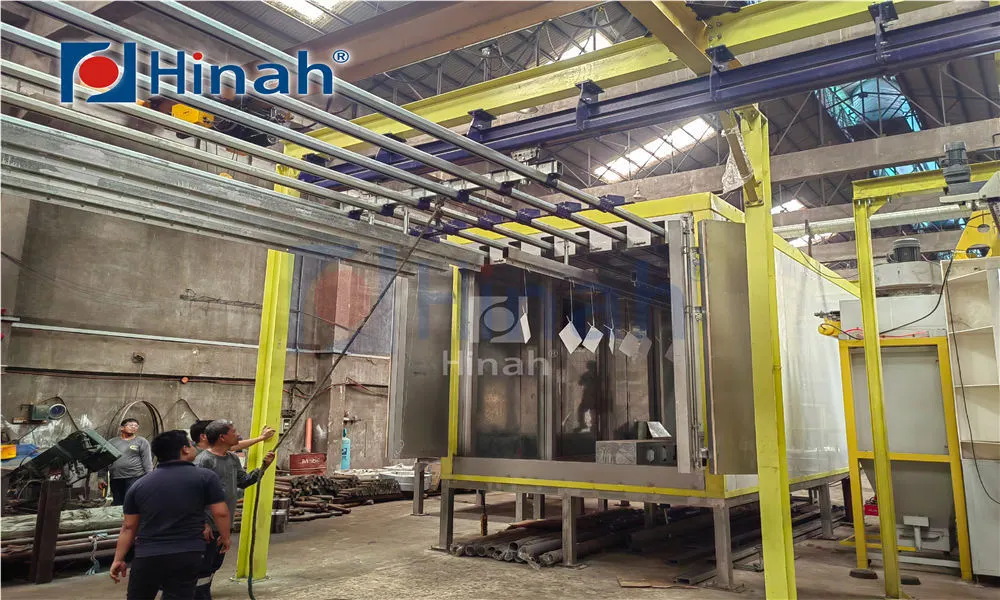
Gas or electric convection ovens use recirculated hot air. They work well for dense loads and complex shapes. Dwell times range from 10 to 25 minutes at 180–200°C.
Air velocity must exceed 1.5 m/s to break the boundary layer.
Look for VFD-controlled fans – they save 20–30% energy during idle periods.
Infrared (IR) Ovens
Medium-wave IR ovens cure powder in 30–90 seconds. They are ideal for high-speed lines or heat-sensitive substrates (e.g., MDF, aluminum).
Check emitter spacing: 150–300 mm to avoid shadow effects.
Hybrid IR + convection designs reduce total energy use by 15–22%.
HANNA engineers can help you match the oven type to your part mix and throughput targets.
3. Energy Efficiency and Heat Recovery Features
An oven consumes 60–75% of a powder line’s total energy. When evaluating a powder coating oven for sale, examine these efficiency components:
Exhaust heat recovery – cross-flow plate exchangers capture 50–60% of waste heat.
Modulating burners – maintain λ = 1.05–1.1 excess air; avoid on/off cycling.
High-density ceramic fiber insulation – keeps external skin temperature ≤ +5°C above ambient.
Ask the seller for utility records. A well-designed oven should use between 150 and 300 kWh per ton of coated parts. Higher numbers indicate poor insulation or outdated controls.
4. Conveyor Synchronization and Oven Length Calculation
The oven’s heated length must match your conveyor speed and required dwell time. Use this formula:
Oven length (m) = Conveyor speed (m/min) × Dwell time (min)
For example, a 10‑minute cure at 4 m/min needs a 40‑meter oven. Add entrance and exit vestibules (2–3 m each) to prevent heat loss.
Check if the oven has a powered roller or monorail conveyor – both must be in sync.
Verify that the conveyor chain elongation is below 3% (measure over 10‑meter span).
Look for interlocked PLC controls: oven burner shuts down if the conveyor stops unexpectedly.
HANNA provides thermal simulation reports that predict part temperature curves at different line speeds. This avoids guesswork.
5. Explosion Venting and Safety Compliance
Powder coating ovens must comply with NFPA 33 or EN 12981. Combustible dust can accumulate inside ductwork and oven chambers.
Required vent area: Av = C × (V)^(2/3) (C = 0.05 for typical powder with Kst ≤ 200 bar·m/s).
Vent panels must burst at 0.1–0.2 bar and be directed away from operators.
UV/IR flame detectors should trigger powder feed shutoff within 50 ms.
When you inspect a used powder coating oven for sale, request the original NFPA compliance certificate. Many older ovens lack proper explosion relief – retrofitting costs $15,000–$40,000.
6. Condition of Burners, Heat Exchangers, and Air Seals
Physical wear reduces efficiency and creates safety hazards. Perform a visual and thermal inspection.
Burners – look for cracked refractory or yellow flame (incomplete combustion).
Heat exchangers – use a borescope to check for soot or cracks; CO leakage is a serious risk.
Door air seals – should be flexible (hardness < 70 Shore A). Replace if cracked or brittle.
Recirculation fan bearings – listen for grinding; measure vibration – replace if > 7.1 mm/s RMS.
Ask for maintenance logs. A well-maintained oven has documented bearing lubrication, belt changes, and thermocouple calibrations every six months.
7. Automation, PLC, and Data Logging Capability
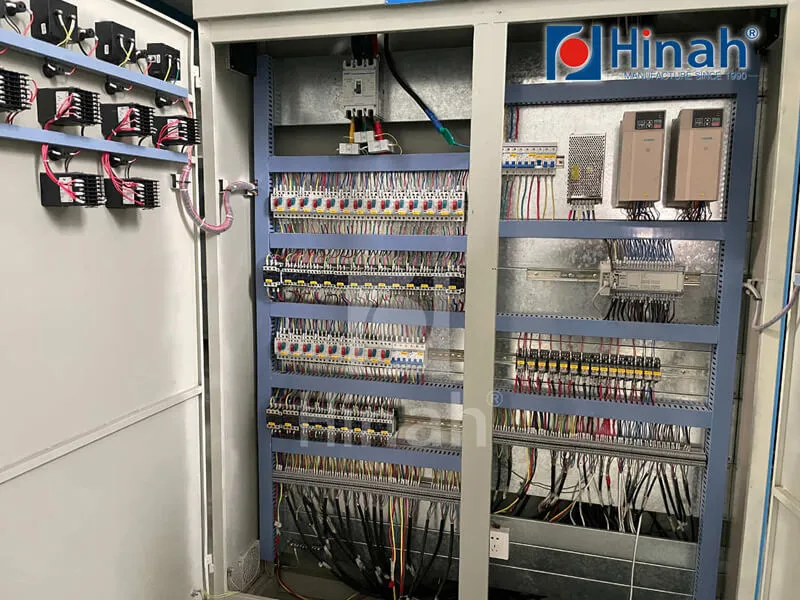
Modern ovens include programmable logic controllers (PLC) that store cure recipes and alarm history. This is critical for traceability and troubleshooting.
Verify that the PLC can store at least 50 powder cure profiles (time, temperature, ramp rate).
Check for remote access (OPC UA or Modbus TCP) to integrate with plant SCADA.
Ensure the data logger records part temperature for every batch – required for ISO 9001 audits.
Avoid obsolete PLC models (e.g., Siemens S5, Allen‑Bradley PLC‑5). Replacement parts are expensive and hard to find. Modern controllers from HANNA include intuitive touchscreen HMI and remote diagnostics.
Case Example: Avoiding a Costly Miscalculation
A metal fabricator found a used powder coating oven for sale at 50% below new price. Our HANNA inspection revealed a temperature variation of ±11°C, missing explosion vents, and a worn conveyor chain. Retrofit costs exceeded $180,000. The buyer instead purchased a refurbished oven with certified uniformity and full NFPA compliance. First-pass yield reached 97% within three months.
Frequently Asked Questions (FAQ)
Q1: How do I calculate the required dwell time for a new powder
coating oven?
A1: Use a data logger with thermocouples attached to
the heaviest part. Run the part through the oven at different conveyor speeds.
The correct dwell time is when the part reaches the powder manufacturer's
specified metal temperature (e.g., 190°C for 10 minutes). Always add a 10%
safety margin for load variations.
Q2: Can I use a second-hand powder coating oven for sale with a
different powder type?
A2: Yes, but verify that the oven can achieve
the required temperature range. Epoxy-polyester hybrids cure at 180–190°C, while
pure epoxies may need 200°C. Also check that the oven’s airflow pattern does not
blow off lightweight powders (adjustable dampers help).
Q3: What are the signs that an oven’s recirculation fan is
failing?
A3: Watch for three indicators: (a) increased temperature
difference between top and bottom of the oven (>8°C), (b) audible bearing
noise or vibration, (c) motor current spikes above nameplate rating. Replace
bearings immediately to avoid fan shaft seizure.
Q4: How often should I recalibrate oven
thermocouples?
A4: Every six months for Type K thermocouples used in
continuous operation. Use a certified dry-block calibrator at two points (150°C
and 200°C). Replace any thermocouple showing deviation > ±2°C. Drift
accelerates after 12 months due to oxidation.
Q5: Is a gas-fired or electric powder coating oven more
cost-effective?
A5: Gas is usually cheaper per kWh in most regions
(30–50% lower operating cost). However, electric ovens have lower upfront cost,
simpler controls, and no exhaust flue requirements. For high-volume lines (2+
shifts), gas with heat recovery offers the best ROI. For small batch work,
electric may be simpler.
Request a Technical Assessment for Your Next Oven Purchase
Buying a powder coating oven for sale without proper engineering data leads to rework, energy waste, and compliance risks. HANNA provides remote and on‑site oven audits, thermal profiling, and ROI calculations. Send your part drawings, required output (parts/hour), and powder type. We will deliver a customized recommendation including oven sizing, burner selection, and payback analysis.
Submit an inquiry to our engineering team → Get a fast response within 24 hours