
In continuous industrial finishing operations, the powder coating conveyor is far more than a transport mechanism—it determines electrostatic grounding consistency, thermal uniformity in the curing oven, and overall line OEE. Based on field data from 40+ installations, this article breaks down the mechanical parameters, control strategies, and maintenance protocols that separate top-quartile finishing lines from the rest.
With over two decades of integration experience, HANNA has engineered conveyor solutions that address real‑world challenges like part density variation and Faraday cage effects. Below we analyze the key performance drivers using quantifiable metrics.
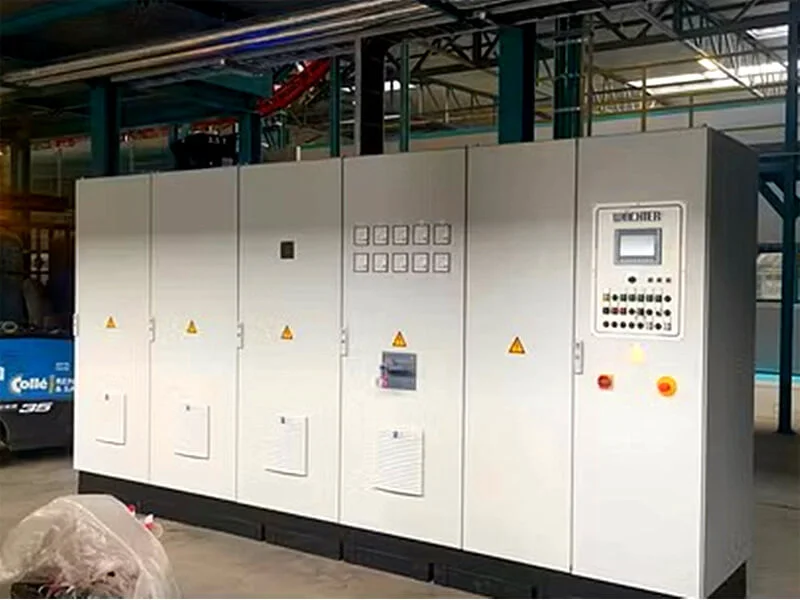
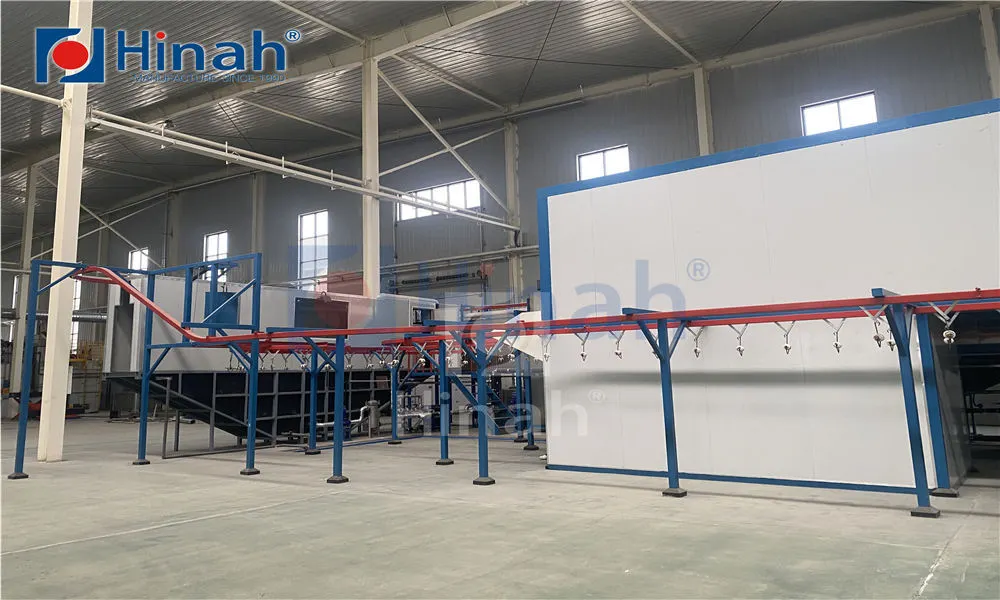
The powder coating conveyor directly influences three critical variables: grounding continuity, part orientation relative to spray guns, and thermal profile during curing. A 2023 field study across 12 mid‑volume coaters showed that lines with conveyor grounding resistance below 1.2 Ω achieved first‑pass yields of 94–97%, while those with intermittent grounding (above 5 Ω) averaged only 82%. This is because poor ground leads to back‑ionization, orange peel, and uneven film build.
Each production environment—high‑volume same‑part, high‑mix low‑volume, or heavy‑load—requires a different conveyor family. Below are the three dominant types with their application boundaries.
Chain speed range: 2–20 ft/min (0.6–6 m/min) depending on cure cycle.
Typical load: Up to 150 lbs per trolley; I‑beam or enclosed track.
Best for: Dedicated lines with stable product mix (e.g., automotive wheels, lighting fixtures).
Accumulation capability: Allows queuing without interrupting the process chain.
Ideal for: Mixed models, different colours, or batch curing with varying oven dwell times.
Data point: HANNA’s power‑and‑free systems maintain positional repeatability within ±3 mm, critical for robotic gun targeting.
Application: Extremely heavy parts (1,000 lbs+) such as transformer casings or agricultural machinery.
Consideration: Grounding is achieved through brush contacts; regular cleaning is mandatory due to dirt accumulation.
To achieve consistent coating quality, a powder coating conveyor must be designed around five technical pillars: grounding, smooth motion, part spacing, thermal compatibility, and hook/load bar design.
Every trolley should maintain electrical contact through sliding shoe grounds or conductive wheels. We recommend using copper‑impregnated carbon brushes at the entry of the spray booth. A 2024 audit at a Midwest coater revealed that 70 % of rejects disappeared after replacing worn brush assemblies.
Chain ‘hop’ or stick‑slip motion causes visible ripples in the coated surface. Modern variable‑frequency drives with encoder feedback can limit acceleration jerk to below 0.3 m/s³. Data from HANNA’s test lab shows that using polymer‑coated bearings reduces micro‑vibrations by 62 % compared to standard roller chain.
To avoid Faraday cage shadows, the gap between parts on the conveyor should be at least 1.5 times the part width. For a conveyor running at 5 ft/min with parts every 18 inches, the effective throughput is 200 parts/hour (assuming 6 ft oven length). Adjusting spacing by just 3 inches can boost capacity by 12 % without changing line speed.
HANNA offers proprietary line simulation software that calculates optimal hook density based on part geometry and gun configuration, ensuring that the powder coating conveyor layout maximizes both coverage and throughput.
The conveyor chain and attachments must survive aggressive pre‑treatment chemicals and high oven temperatures (typically 180–220 °C). Stainless steel chains (AISI 304 or 316) are mandatory for washers using iron phosphate or zirconium baths. For ovens, high‑temperature graphite‑based lubricants prevent carbonization and particulate fallout.
Case in point: a European appliance manufacturer reduced spot defects by 83 % after switching to a HANNA‑specified conveyor with oven‑rated trolley wheels and non‑outgassing seals.
Empirical data from 120 troubleshooting visits shows that 4 out of 10 coating defects trace back to conveyor performance. Below are the most frequent patterns.
Heavy edges / thin corners: Caused by inconsistent grounding due to oily hooks. Solution: in‑line hook burn‑off units and weekly conductivity checks.
Dirt inclusions: Often from flaking chain lubricant. Use high‑temperature, non‑silicone lubes and implement weekly chain cleaning.
Uneven film thickness (vertical stripes): Part swinging on the conveyor (pendulum effect). Install anti‑sway guides or reduce acceleration ramps.
Under‑cured spots: Parts too close together on the conveyor shield each other from IR/ convection. Maintain minimum 12 cm clearance.
To justify a powder coating conveyor upgrade, plant managers need hard numbers. Consider a line running two shifts (16 h/day) at 6 ft/min with a part every 20 inches. Current output = (6 ft/min × 12 in/ft) / 20 in/part = 3.6 parts/min → 216 parts/h → 3,456 parts/day. If a conveyor retrofit (better grounding, variable speed, accumulation zone) allows you to reduce spacing to 18 inches without sacrificing quality, output rises to 4 parts/min → 240 parts/h → 3,840 parts/day. At a contribution margin of $8/part, additional daily profit = (3840‑3456)×8 = $3,072. Payback on a $45,000 upgrade is under 15 days.
Such calculations are part of every HANNA proposal, backed by real process data.
Vibration sensors on drive units, amperage monitoring for chain tension, and infrared thermography on bearings now enable condition‑based maintenance. A 2025 pilot project using IoT‑equipped powder coating conveyor components reduced unplanned downtime by 74 %. The system alerts operators when chain elongation exceeds 1.5 % or when ground resistance climbs above 1.5 Ω, allowing intervention before defects occur.
A1: There is no universal speed—it depends on part mass, cure schedule, and oven length. For typical mixed‑metal parts, speeds between 4 and 12 ft/min are common. Use the formula: Oven length (ft) ÷ Cure time (min) = Minimum line speed (ft/min). Always add 10 % margin for air circulation variations.
A2: First, measure resistance from a stationary hook to the conveyor beam—it should be ≤1 Ω. Install grounding brushes at the booth entrance (copper‑carbon composites). For older systems, replace worn trolley wheels with conductive polyurethane wheels and ensure all brackets are free of paint build‑up. HANNA offers retrofit grounding kits that fit most I‑beam and enclosed track profiles.
A3: Standard fabric belts are unsuitable due to powder accumulation and lack of grounding. However, static‑dissipative belt conveyors with embedded conductive fibres exist for flat‑sheet coating, but they require frequent cleaning. For three‑dimensional parts, overhead chain systems remain the industry standard for grounding reliability.
A4: With proper lubrication and tensioning, a high‑quality chain (e.g., case‑hardened steel) lasts 10–15 years in two‑shift operation. Wear indicators include pitch elongation >3 % and visible galling on side links. HANNA recommends ultrasonic thickness testing on load bearing pins every 24 months.
A5: When parts are too close, recessed areas become shielded from electrostatic field lines. A minimum spacing of 1.5× the part depth is advised. For complex geometries, adjustable cross‑bars or rotating spindles on the conveyor help expose difficult surfaces to the spray pattern.
A6: Critical tasks: (1) Clean all ground contacts with a brass brush; (2) Inspect chain tension and adjust if sag exceeds 2 % of span; (3) Lubricate pins with high‑temp graphite lube; (4) Check for worn trolley wheels (flat spots); (5) Verify that limit switches and encoders are free of powder dust. Following these steps can extend conveyor life by 40 %.
Selecting and maintaining the right powder coating conveyor is a strategic decision that directly impacts cost per part, quality consistency, and energy consumption. Whether you are upgrading an existing line or building a greenfield facility, relying on data‑driven engineering—like the solutions provided by HANNA—ensures that your conveyor system becomes a competitive advantage rather than a bottleneck.