Industrial surface finishing relies heavily on electrostatic thermosetting powder application to create resilient, uniform, and environmentally compliant coatings. Achieving precise film builds on complex metal substrates requires an integrated system approach. Modern high-volume finishing lines combine automated pretreatment, electrostatic spray mechanics, powder recovery, and thermal curing into a single continuous process. Deploying advanced Industrial powder coating equipment allows manufacturing facilities to attain high transfer efficiency, minimize material waste, and satisfy strict quality specifications across diverse industrial applications.
Surface finishing engineering demands direct control over pneumatic transport, high-voltage field distribution, and aerodynamic containment within the spray zone. Equipment engineered by market leaders such as HANNA addresses these operational requirements by combining precise digital gun controls with optimized booth airflow dynamics. Understanding the underlying physical and mechanical mechanics of these systems is vital for process engineers and line operators seeking to eliminate finish defects and maintain consistent throughput.
The core function of electrostatic spray equipment is to impart an electrical charge onto atomized powder particles and propel them toward a grounded metal part. The electrostatic field created between the gun tip and the substrate guides the powder, causing it to adhere via electrostatic attraction until thermal fusion takes place in the curing oven.
Powder application systems primarily utilize two distinct charging methods: Corona charging and Triboelectric charging.
When applying powder into deep channels, interior angles, or recessed areas, lines of force from the electrostatic field concentrate on the outer grounded edges. This phenomenon, known as the Faraday cage effect, prevents charged powder particles from entering deep cavities. Modern automated spray systems mitigate this effect using advanced field-limiting technology.
Digital micro-ampere control automatically scales down the current (µA) while maintaining high voltage (kV) as the gun approaches recessed substrate geometries. Reducing free-ion generation softens the electrostatic field lines, allowing the pneumatic velocity of the carrier air to push the charged powder deep into the recess. Selecting correct nozzle configurations, such as flat-jet nozzles with localized deflection shields or angled cross-slot nozzles, further alters the air pattern to overcome field deflection.
A fully integrated finishing line operates as a synchronized production loop. Every subsystem—from chemical surface preparation to final cross-linking—impacts overall coating adhesion, film thickness, and structural durability.
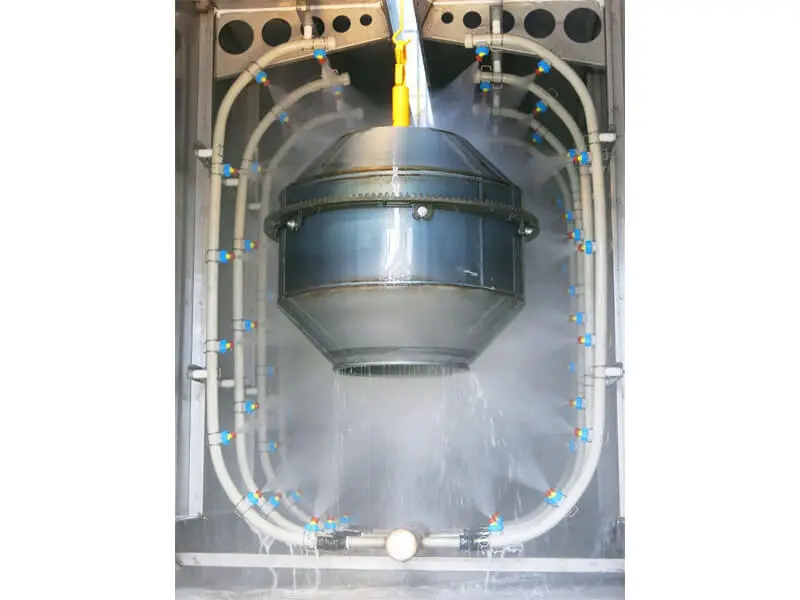
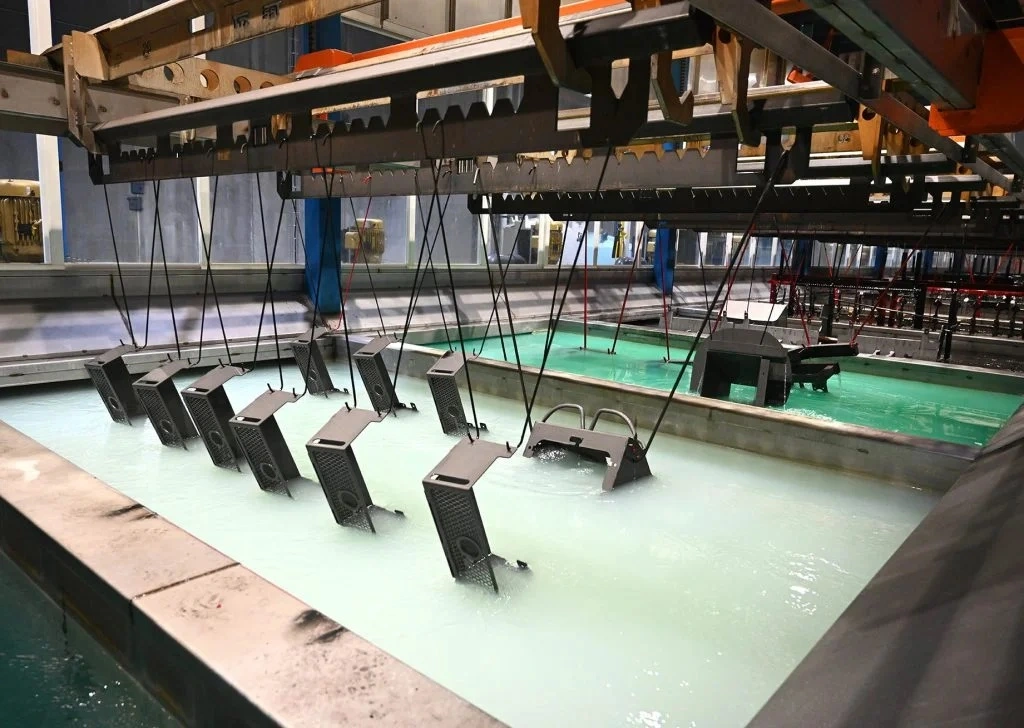
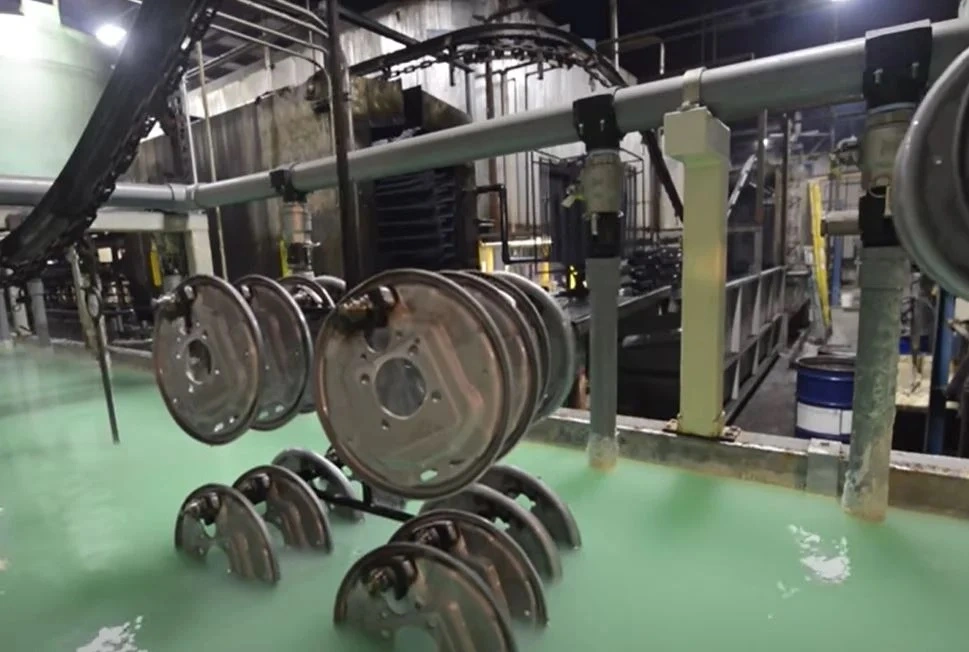
Coatings cannot bond effectively to contaminated metal substrates. Multi-stage chemical pretreatment systems clean, etch, and passivate metal surfaces prior to powder application. Modern eco-friendly lines utilize multi-zone tunnel washers that cycle parts through specific chemical phases:
Maintaining balanced containment airflow inside the spray booth prevents powder from escaping into the plant floor while ensuring that internal cross-drafts do not disrupt spray patterns. High-performance Industrial powder coating equipment incorporates non-conductive plastic or composite booth structures (such as polypropylene or sandwich-wall designs) that resist powder attraction, directing nearly all overspray toward the recovery ducting.
Powder recovery is handled via two main equipment configurations:
Consistent powder delivery requires steady fluidization inside the feed hopper. Compressed air passes through a porous membrane plate at the bottom of the hopper, lifting and separating the powder particles so they behave like a low-density liquid. High-volume production systems engineered by HANNA integrate dense-phase peristaltic pumps that move heavy powder volume using low air volumes. Unlike standard venturi pumps that suffer from throat insert wear and fluctuating feed rates, dense-phase transport delivers stable powder volume over long distances, yielding ultra-consistent film thickness tolerances.
Once powder is deposited onto the substrate, the part enters a curing oven where thermal energy initiates a multi-phase physical reaction: melting, leveling, gelling, and thermosetting cross-linking. The process demands tight temperature distribution across the entire working volume of the oven chamber.
| Heating Technology | Heat Transfer Mechanism | Primary Application Strengths | Operational Considerations |
|---|---|---|---|
| Direct Convection Ovens | Circulating hot air via high-volume fans | Handles complex, varied three-dimensional shapes; uniform heating across massive structural mass. | Requires longer ramp-up times to achieve Peak Metal Temperature (PMT). |
| Catalytic Infrared (IR) Ovens | Direct radiant wave energy absorption | Rapid surface gelation; fast line speeds; compact footprint zone prior to main oven. | Requires line-of-sight exposure; shadow areas on complex parts require convection back-up. |
| Hybrid Pre-gel Systems | Combined Radiant IR gel phase followed by convection soak | Locks powder in place rapidly to prevent cross-contamination and air-shear disturbance. | Demands multi-zone temperature sensing and PLC control synchronization. |
Thermosetting resins, including epoxies, polyesters, and fluoropolymers, require precise peak metal temperatures—typically between 160°C and 200°C—sustained over a specific dwell time (usually 10 to 20 minutes). If the substrate fails to reach the required PMT, the polymer matrix remains under-cured, leading to poor impact resistance, reduced chemical resistance, and premature coating failure. Thermographic data-logging devices pass directly through the oven, tracking real-time surface thermocouples to ensure proper thermal cure profiles.
Consistently high finish quality depends on identifying root causes of visual or structural coating defects. Equipment calibration and process control directly resolve surface anomalies.
Orange peel refers to a wavy surface texture resembling the skin of a citrus fruit. This condition occurs when the powder film fails to flow out smoothly during the initial melt phase before cross-linking occurs.
Back-ionization occurs when an excessive accumulation of charged powder on the substrate surface traps incoming ions, generating micro-discharges through the uncured powder layer. This results in tiny craters, star-burst patterns, and severe surface roughness.
To eliminate back-ionization, the facility must ensure continuous electrical grounding of the workpieces through conveyor hangers. Grounding resistance must measure under 1 Megohm from the rack to the earth ground point. Regularly stripping cured powder buildup from hooks, lowering corona gun output current (below 30 µA), or increasing the distance between spray tip and substrate stops charge buildup on the part surface.
Cast iron, aluminum die-castings, and hot-dip galvanized components retain microscopic air pockets, moisture, and organic volatile residues within their porous matrices. When subjected to cure oven heat, trapped gases expand rapidly, blowing through the melting powder layer and creating micro-pinholes or blisters.
Incorporating tailored process techniques on reliable Industrial powder coating equipment prevents outgassing defects:
Configuring state-of-the-art Industrial powder coating equipment requires balancing line speed, part geometry, and production volume.
Extrusion finishing lines handle long, linear architectural profiles requiring strict color uniformity and high weatherability (meeting AAMA 2604/2605 standards). These lines feature vertical dipping or dense horizontal spray zones equipped with multi-axis automated reciprocators. Electrostatic guns are mounted on precise servo-driven positioning pillars that adjust distances in real time based on optical profile scanners, guaranteeing uniform coating on complex extrusion walls without overspray waste.
Heavy steel fabrications present high mass differentials, combining thin sheet metal enclosures with thick structural steel beams on a single frame. Standard convection settings may under-cure the heavy beams while overheating the sheet metal paneling. Custom finishing lines designed by HANNA utilize multi-zone smart airflow control combined with targeted radiant heating arrays to balance heat absorption across varying steel thicknesses.
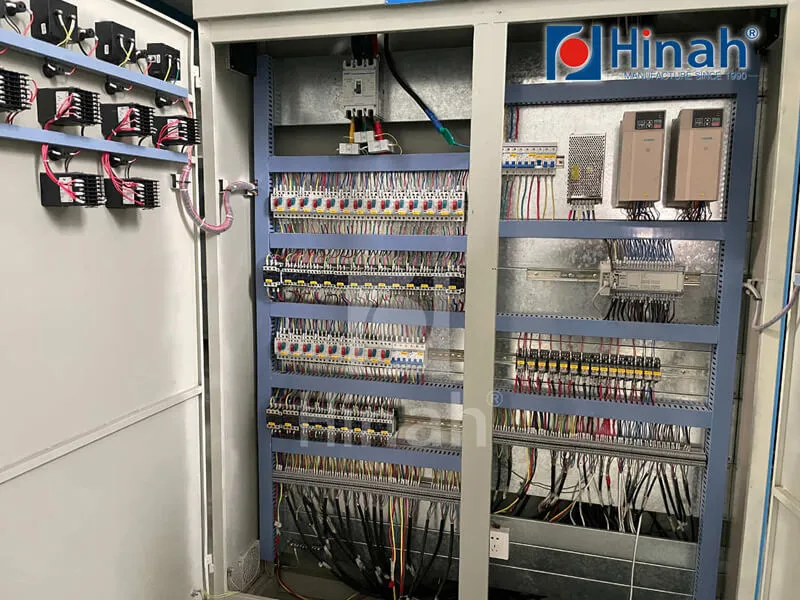
Modern powder finishing operations rely heavily on digital automation, real-time diagnostic monitoring, and programmable logic controllers (PLC) to manage line parameters. Modern centralized SCADA (Supervisory Control and Data Acquisition) systems track crucial metrics including conveyer line speeds, booth static pressure levels, compressed air dew point quality, multi-stage tank chemical concentrations, and oven temperature profiles.
Integrated part recognition technology reads incoming conveyor hooks using light curtains or 3D vision cameras. The PLC uses this geometry data to trigger specific spray gun groups, adjust reciprocator strokes, modulate powder output volumes, and pause spray functions when hook gaps occur. Automated control minimizes material consumption, reduces operator error, and ensures consistent quality standards batch after batch.
Q1: What structural factors cause back-ionization during high-voltage electrostatic spraying?
A1: Back-ionization occurs when electrical charge accumulates within the applied powder layer faster than it can bleed off to earth ground. This buildup creates an opposing localized field, causing micro-discharges that puncture the uncured powder layer. Primary causes include inadequate grounding (resistance exceeding 1 Megohm due to coated hooks), excessive gun current (µA), or holding corona guns too close to the workpiece surface.
Q2: How does dense-phase powder pumping technology differ from traditional venturi delivery systems?
A2: Dense-phase systems use peristaltic action with high powder volume and low airflow velocity, whereas traditional venturi pumps rely on high-velocity air suction. Dense-phase technology maintains uniform, pulse-free powder delivery over extended distances, suffers significantly less mechanical tube wear, and allows precise digital control over powder-to-air ratios, achieving tight film thickness tolerances.
Q3: What chemical pretreatment stages are required for aluminum substrates exposed to corrosive outdoor environments?
A3: Aluminum intended for harsh environments requires multi-stage pretreatment including an alkaline degreaser, acid etch or deoxidizer, deionized water rinses, and a zirconium conversion layer or chrome-free passivation layer. This sequence removes native oxide layers, increases micro-surface area for mechanical interlock, and provides passivation against sub-film galvanic corrosion.
Q4: Why is airflow management inside powder application booths critical to transfer efficiency and containment?
A4: Booth airflow must maintain a gentle, continuous face velocity (typically 0.4 to 0.5 m/s) through open operator portals to trap oversprayed powder within the booth shell. If cross-draft velocities are too high, powder plumes are deflected away from the grounded part, drastically lowering first-pass transfer efficiency. Conversely, insufficient face velocity risks letting fine powder drift out of the booth into the plant environment.
Q5: How do process engineers verify complete cross-linking in thermosetting powder coatings?
A5: Cure verification relies on mechanical and chemical testing methods. Common field tests include solvent rub resistance testing (MEK double rubs according to ASTM D5402), cross-hatch adhesion testing (ASTM D3359), and differential scanning calorimetry (DSC) analysis. DSC measures residual exothermic energy in a laboratory setting to confirm that the resin matrix achieved full thermal reaction during cure time.
Selecting, configuring, and commissioning tailored Industrial powder coating equipment requires rigorous process engineering matched to specific throughput targets, space constraints, and quality standards. Experienced finishing engineers are available to review complete line layout design, perform powder application testing, evaluate transfer efficiency metrics, and provide functional specifications for custom automated finishing systems. Request an engineering consultation and line assessment to discuss system configurations tailored to your production demands.